
Lecture
Meanings assigned to subjective (stance, evaluative) modality indicate the speaker's attitude toward the situation being reported, i.e. his psychological or mental stance (propositional attitude, attitude of the mind) – desirability, hypotheticality, an assessment of probability, and the like.
Meanings of subjective modality can be expressed by mood (subjunctive: If only he would come at last!), see section 4.2; by constructions (Of all things, that had to happen!), see section 4.3; by parenthetical words (He has probably already arrived), see section 4.4. A special variety of subjective modality is represented by the meanings of possibility and necessity (at least in some of their varieties), expressed predominantly by a special class of predicates (can, need, be obliged, etc., cf. He could have gone somewhere, The book must be on the shelf), see section 4.1.
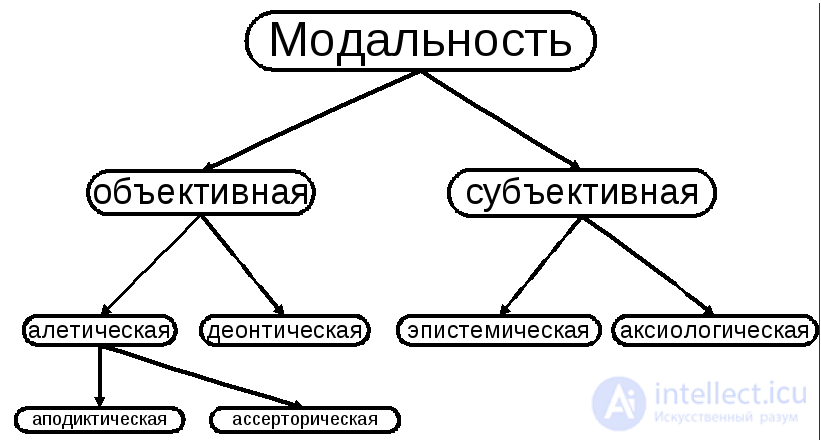
The sphere of subjective modality includes various kinds of psychological or mental stances of the speaker toward what is being reported, among them the meanings possibility and necessity.
The meanings possibility and necessity are expressed by predicates and parenthetical words such as: can, may, possibly, maybe, probably (possibility); need, must, necessary, must not, should, obliged, ought, is required, must have (necessity) and others. The meanings ‘possibility’ and ‘necessity’ also enter into the semantics of syntactic constructions (for example, of the independent infinitive: There is no mending a day by exertions of a candle-end (B. Pasternak) = ‘it is impossible to mend’) and of illocutionary forces. For example, the semantics of an order includes the component ‘necessity’: an order must be carried out.
Possibility and necessity are the main concepts of modal logic (see, for example, [Feys 1974]). Logic offers an apparatus that can be used in describing the polysemy of modal words in natural language; in describing contextual synonymic relations between possibility and necessity; in explaining the interaction of modality with negation. For more on possibility and necessity in modal logic see section 4.1.3.
For example, logic predicts the synonymy of cannot and must not: He cannot accept this gift » He must not accept this gift; How could I have forgotten! » I must not have forgotten; the synonymy of must be P and cannot not be P: He must acknowledge this » He cannot fail to acknowledge this, see further below section 4.1.1.3.
In logic three types of modality are distinguished – ontological (otherwise – alethic, from the Greek aletheia ‘truth’), deontic, and epistemic. In section 4.1.1.1 these three types of modality are examined using the example of possibility, in section 4.1.1.2 – using the example of necessity.
4.1.1.1. Three types of possibility
I. Ontological possibility
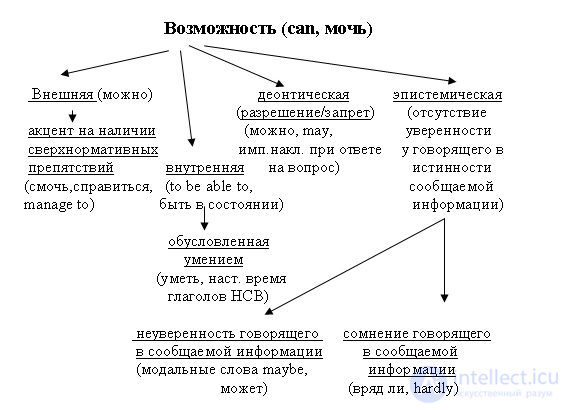
The statement that P(X) is ontologically possible means that X is capable of performing P by virtue of his physical or intellectual capacities; that there are no obstacles in the world to P(X) being the case: ontological possibility follows from the objective structure of the world. The main markers of ontological possibility are can / will be able to, may. Examples.
(158) <...> a hare can run more than four hundred kilometers in a day [«Murzilka» (2002)]
(159) <...> he was certain that she had ordinary cataracts, which could be removed, and her lost eyesight at least partly restored. [L. Ulitskaya. Journey to the Seventh Side of the World (2000)]
(160) <...> Irina could not kiss the director. She felt sick. [V. Tokareva. Her Own Truth (2002)]
The verb can [mochʹ] has present and past tense forms (can, could), while its perfective correlate manage to [smochʹ] has past and future tense forms (managed to, will manage to), so that these verbs are not morphologically defective in the sense that the English modal verb can is. (NB: the perfective forms managed to and will manage to of the verb smochʹ are admissible only in the context of ontological possibility and are not used in the context of the deontic and epistemic meaning of can).
Synonyms for the ontological can, may are is capable of, is able to, has the possibility to. Each synonym naturally has its own shades of meaning. For example, in (160) could not cannot be replaced by did not have the possibility to, since there is a possibility to is usually used with reference to something desirable.
Ontological possibility (especially – impossibility) can also be expressed non-lexically – by a construction with the independent infinitive, see section 4.1.2:
(161) You shall not see such battles (M. Yu. Lermontov. Borodino) = ‘you will not be able to see such battles (more precisely – to take part in them)’
(162) How could you possibly know me! = ‘you cannot know me’
The semantics of the ontological can is disclosed by A. Wierzbicka's interpretation [Wierzbicka 1987]:
(163) X can do V = ‘X will do V, if he wants to’
For example: Ivan can swim across the Volga = ‘he will swim across it, if he wants to’.
It should be noted that this interpretation is suitable only for that variety of ontological possibility which in [Auwera, Plungian 1998] is called internal possibility (participant internal possibility). Internal possibility is ability; external ontological possibility concerns the state of affairs external to the subject. External possibility (participant external possibility) is illustrated by example (159).
A construction with a marker of external possibility can express existential quantification:
(164) Strategic mistakes can have large-scale consequences » Some strategic mistakes have large-scale consequences.
Internal ontological possibility does not presuppose the speaker as the subject of this modality (Ivan can / is able to swim across the river = a property of Ivan, independent of the speaker's assessments), and, in accordance with our definitions, is not subjective, and accordingly not a grammatical modality either, see section 1.1 (a similar reservation is made in [Palmer 1986: 16] regarding the English can). The above-mentioned logical equivalences do not work on ontological possibility: Ivan cannot swim across the Volga ≠ must not swim across it.
II. Deontic possibility
Deontic possibility – is the possibility of some action by an Agent, asserted by a morally or socially responsible subject or institution. Deontic possibility is connected with duty, with the requirements on behavior imposed by a system of rules. In the prototypical case, deontic possibility is a permission granted by an authority, for example the speaker.
(165) Well, if you don’t wish to be charming, which would be quite pleasant, you may not be. [M. A. Bulgakov. The Master and Margarita (1929-1940)]
(166) You may leave your things here, we have a large staff of cloakroom attendants. [«Screen and Stage» (2004)]
Deontic possibility can be expressed not only by the verb can/may (You may go!), but also by a performative sentence (I permit you to go), the imperative mood (Go!), and the combination to have the right.
In [Bulygina, Shmelev 1997] it is noted that ontological and deontic possibility differ in their relation to the logical law ab esse ad posse: this law applies to ontological possibility, but not to deontic possibility – what really exists may be that which is not permitted. Deontic possibility in essence presupposes ontological possibility: what is forbidden is usually that which is ontologically possible.
Deontic possibility is under the control of an authority and is therefore freely used in directive speech acts: Allow me through! Let me say! May I pass? (» ’let me pass’). Whereas from verbs expressing ontological possibility, imperatives are either unnatural (?have the ability) or not formed at all (*be able!).
The opposition between ontological and deontic possibility manifests itself in the interaction of these modalities with the grammatical aspect of the subordinate infinitive in the context of negation. Negation of deontic can/may and one may requires replacing the perfective aspect of the subordinate infinitive with the imperfective. Thus, the negation of (167a) should be is (167b), with the imperfective aspect; in sentence (167c), with the perfective aspect of the verb, the modality is understood as ontological (see on this [Rassudova 1968/1982: 124]):
(167) a. Here one may cross the street – in the deontic meaning: ‘it is permitted’;
b. Here one must not be crossing the street;
c. Here one cannot cross the street.
The opposition between ontological and deontic modality is shown by examples (168)–(170); in examples (a), with a perfective verb, the modality is ontological, = ‘impossible’; in examples (b), with an imperfective verb, – it is deontic, = ‘wrong’:
(168) a. They say one cannot get used to pain. Not true. [I. Grekova. Fracture (1987)] = ‘it is impossible to get used to it’
b. If only it would all end soon. Why does he need this merciless pleasure? One must not get used to her, one must not allow oneself to fear loss. [Yu. Nagibin. Another Life (1990-1995)] = ‘it is wrong to get used to it’
(169) a. He cannot be helped = ‘impossible’; b. He must not be helped = ‘wrong’
(170) a. He cannot be interrupted = ‘impossible’; b. He must not be interrupted = ‘wrong’
The imperfective aspect in the context of negated deontic possibility (i.e., in the context of a prohibition) is to some extent semantically motivated: to forbid an action as a whole, it is enough to forbid the activity that leads to that result (whereas ontological impossibility concerns precisely the attainment of the result, hence the perfective). For the negated deontic I permit, the imperfectivity of the subordinate infinitive is not obligatory – both forms are possible (although the imperfective is preferred):
(171) I do not permit you to place / to have placed the armchair here.
III. Epistemic possibility
Epistemic possibility expresses the incompleteness of the speaker’s knowledge. It is used to formulate probabilistic judgments. Examples.
(172) True, considerations of common sense were also not on their side, but common sense itself could turn out to be flawed. [V. Bykov. The Stone (2002)]
(173) The newspaper could have been crumpled, blown into a pile by the wind, soaked by rain, or crushed by a dog or livestock with its snout... [V. Astafyev. The Flying Goose (2000)] – it is unknown exactly what happened
(174) Irina suddenly realized that Sasha could have been burned along with the tent or shot in the entryway. [V. Tokareva. Her Own Truth]
In sentence (174) the modality is unambiguously epistemic: it is a possibility that occurs to the subject of the attitude – Irina (who in this case does not coincide with the speaker).
We speak of epistemic possibility when different possible states of the world are being considered and the speaker does not know which of the possibilities is the case. However, in example (175) the verb can/may is in a context where the possibility, from the speaker’s point of view, is the only one:
(175) Marfusha walked around utterly dejected, but did not raise the alarm, and this could mean only one thing: she knew where Sonka was. [V. Belousova. The Second Shot (2000)]
Deontic possibility only makes sense in relation to situations that are controlled by a subject; therefore, in the context of uncontrollable situations, the modality is unambiguously epistemic, not deontic:
(176) A real danger is posed by the fact that the state may be late in reacting to the situation in the area of interpersonal relations between men and women [«Family Doctor» (2002)]
Epistemic possibility can be expressed not only by the verb can/may, but also by the words one may, one may not, and the parenthetical words possibly and maybe:
(177) He might have gone to Paris.
(178) Maybe, he went to Paris.
(179) Possibly, he went to Paris.
In all three sentences there is one and the same proposition – ‘he went to Paris’ and one and the same modality – epistemic possibility.
Epistemic possibility has the speaker as its subject. Thus, the speaker is the subject of the supposition in sentence (180):
(180) Petka might have forgotten about our agreement.
Epistemic possibility interacts non-trivially with the question:
(181) Maybe I should apologize? » Should I apologize?
4.1.1.2. Three types of necessity
I. Ontological necessity
Ontological necessity can be understood as logical necessity. The main indicator is must:
(182) It is curious that Semashko hates the intelligentsia, and inevitably must hate it, because as a Bolshevik he is no longer an intellectual, he is already an instrument within the elemental force: the elemental force against the intellectual. [M. M. Prishvin. Diaries (1918)]
An example of ontological necessity from [Kobozeva, Laufer 1991]:
(183) What kind of mug is that? A mug must have a handle.
Close to ontological necessity is «practical» necessity, expressed by the words need to, have to. Practical necessity is connected with the concept of a goal (see [Levontina 2006]). Therefore the word need has three valencies – Subject of the goal, Requirement, and Goal:
(184) To light a fire
The goal may not be expressed explicitly:
(185) – Naturally, – answered Azazello, – how could he not be shot? He absolutely had to be shot. [M. A. Bulgakov. The Master and Margarita (1929-1940)]
The words need to, have to do not necessarily presuppose the speaker as the Subject of the goal, so practical necessity is not necessarily a grammatical modality (the same was said above regarding ontological possibility, see section 4.1.1.1).
II. Deontic necessity
Deontic necessity – is an obligation. The agent must perform some action if there is a person or institution whose authority he recognizes; or if there are moral principles or social norms that compel him to act this way. Deontic necessity is connected with the notions of moral duty, obligation, and law-abiding behavior.
Markers of deontic necessity: must, is obliged, it is necessary, obligatorily, inevitably, certainly, it is required, should; with negation – wrong, unconstitutional, illegal, immoral. Examples.
(186) <…> waved his hand at the arrested man, showing that he must follow him. [M. A. Bulgakov. The Master and Margarita]
(187) And meanwhile, for two months now, both these newspapers and our entire office have been trying to instill in me that I must hate the Germans [L. N. Andreev. The Yoke of War (1916)]
(188) Fear of breaking the rules must be organically inherent in a local government official. [Discussion on local self-government bodies (2001-2004)]
Usually necessity stems from some Source or Cause: X needs Y (i.e., Y is the Source of what is necessary for X). By specifying the Cause, one can distinguish different kinds of deontic obligations.
III. Epistemic necessity
Epistemic necessity – is the speaker's belief in the high probability of a situation:
(189) We were captivated by the project of a rock band that was supposed to make us famous. [LiveJournal post (2004)]
(190) If I, an ordinary man going forward with my belly, not sharing the views of the communists, hate the present-day «swinishness», then how much must an honest communist hate it, for whom this swinishness stands in the way of his life path? [M. M. Prishvin. Diaries (1920)] – must hate = ‘must be hating’, epistemic necessity
The opposition between epistemic and deontic modality is partly expressed by the case of the subject. Thus, the word must in sentence (191), with a nominative subject, can be understood in both the epistemic and the deontic sense, while in (192) it is more likely epistemic, which follows from the fundamental non-agentivity of the verb with a genitive subject (see Negation / section 6.1.1); however, a deontic reading is also possible – for example, if this is an order for the eviction of an unreliable person:
(191) He must notbe in Moscow at this time.
(192) Him there must not be in Moscow at this time.
The modality of necessity can also be expressed by a construction with an independent infinitive:
(193) We are no strangers to living under such a scenario. [«Izvestia» (2002)] – absence of necessity – ontological
(194) On Monday there is a school assembly. Everyone is to come dressed up. [V. Soldatenko. Other pieces… (2010)] – deontic necessity, i.e. obligation
4.1.1.3. Necessity and negation
The word must in all its meanings interacts with negation non-compositionally: must not most often means the same as must not [in the sense of "must (do the) not"]:
(195) He must not stop at the first step – awareness of his own evil – but must take the second step – acknowledge the existing Good above him. [V. S. Solovyov. Three Speeches in Memory of Dostoevsky (1881-1883)]
In fact, here must not means ‘cannot’. Indeed, must not stop = must not-stop, and must not, by one of the laws of modal logic, means ‘cannot’: necessarily not P = it is false that P is possible.
In example (196) must not guess = ‘it must be arranged so that she does not guess’ (an epistemic reading ‘most likely, she will not guess’ is also possible, but the context shows that this is not what is meant):
(196) He must not guess that she started this intrigue on purpose... [T. Tronina. A Mermaid for Intimate Encounters (2004)]
So, must not, as a rule, does not mean ‘it is not true that he must’. More precisely, the compositional reading in the sense of negating obligation requires special prosodic effort: You don't have to( answer this letter = ‘you may not answer’. Meanwhile, the words is obliged, obligatorily interact with negation compositionally, i.e. not obligatorily P = possibly not P:
(197) ...it
Negation of a marker of ontological and deontic necessity usually requires replacing the perfective infinitive with the imperfective [Rassudova 1968/1982]; [Paducheva 2008]. Example.
(198) Olya believed that women like her should not get married <…>, because otherwise they would not be able to work. [A. Berseneva. Flight Over the Separation (2003-2005)]
In (198) the subject is plural; but even with a singular subject, as in (199), the aspect is likewise imperfective:
(199) She believed that she should not get married.
In example (200) the perfective is used, but the imperfective is also possible and preferable:
(200) Before the start of the operation he was instructed that under no circumstances should he reveal himself even to the crews of other vessels. [«Soldier of Fortune» (2004)]
The same in example (201) – the perfective infinitive predisposes the reader toward an epistemic reading of must – toward an understanding in the sense of a probabilistic assessment; for expressing the deontic meaning the imperfective would be preferable:
(201) The historian's instinct told Eidelman that letters of this kind are above all documents, and they should not linger in his personal archive... [«Nash Sovremennik» (2004)]
For надо, нужно ["one must", "one needs"] the replacement of perfective with imperfective under negation is obligatory, cf. надо сказать ["one must say"] and не надо говорить ["one need not say/talk"].
So, with deontic meaning the imperfective infinitive is preferable. Negation of epistemic necessity, on the contrary, does not require replacing the perfective infinitive with the imperfective:
(202) I believe that this situation should not end simply in discussion. [«Novyi Region» (2008)]
(203) I think Spartak should not meet much resistance [Football-4 (forum) (2005)]
In (204) must expresses the speaker's opinion, his assessment of the probability of the situation:
(204) The Seal is stubborn and hates cops to the limit. He must not crack. – You don't understand much! – the one they called Vaga cut him off. – Between us, the Seal is tough, but at the police station everything is different, understand? [N. Leonov, A. Makeev. The Cop Roof (2004)]
In example (205) the type of necessity is itself unclear (which is common for situations referring to the future); but judging by the absolute appropriateness of the perfective aspect, the modality here is epistemic: should not arouse = ‘it is unlikely to arouse’, the speaker's confidence (in a narrative context – the character's).
(205) Everything had been thought through down to the smallest detail: in the morning Katya and the children would leave for Sheremetyevo, which should not arouse any suspicion, since Katya always went to the dacha in advance to prepare the house for Mur's arrival. [L. Ulitskaya. The Queen of Spades (1995-2000)]
The correlation of epistemic modality with the perfective aspect of the verb is not accidental. This is a consequence of the fact that epistemic modality naturally arises in the context of uncontrolled events, when the semantics of the verb lacks the component of «activity» that would be sufficient to forbid in order to prevent the situation as a whole from arising. Cf. the well-known correlation of the negative perfective with uncontrollability for the imperative: не вари каши ["don't cook porridge"] – intentional; не свари каши ["don't (accidentally) burn the porridge"] – accidental ([Bulygina 1980: 341]; [Zaliznyak 1992: 81], see also Imperative / section 2.4).
Example (206) is interesting in that the modal word occurs in a hypotactic context and the «moral authority», i.e., the subject of the judgment of obligation, is syntactically expressed – it is the accusers:
(206) He publicly asked his accusers from the pulpit why he должен ненавидеть the West, and why, hating its development, would he read its history? [A. I. Herzen. My Past and Thoughts] = ‘why do you demand that I hate?’
Possibility and necessity can be expressed in a construction with the infinitive.
In the meaning of possibility (more often – impossibility), the perfective future tense form can be used:
(207) Where he is now, I will not скажу; What his name was, I will not вспомню. You will not пойдешь anywhere!
(208) Now you can only пройдешь there on skis.
The meaning of epistemic possibility is discernible in some contexts in the future tense of the verb быть used in its copular meaning:
(209) Why, she будет even older than her highness. [E. P. Karnovich. Court Lace (1884)]
For more detail, see Non-future meanings of future tense forms.
Among the non-lexical markers of possibility, one should also mention the passive-potential meaning of reflexive verbs [Paducheva 2001], see also Reflexivity / Section 2.9. The Modal Passive:
(210) These stains отстирываются with difficulty = ‘they can be washed out only with difficulty’
(211) The cabinet does not открывается = ‘it cannot be opened’
Within modal logic, possibility and necessity are defined through quantification over the set of possible worlds. The notion of a set of worlds accessible from the actual one is introduced: for different types of modality (for example, epistemic and deontic), the sets of accessible worlds differ. Let us consider sentence (212):
(212) John must be earning a lot.
Here we are dealing with epistemic modality, and the set of accessible worlds is determined by the information the speaker has about John. For epistemic modality, a definition through quantification over the set of possible worlds fits intuition quite well, cf. [Lyons 1977: 790]. If in all accessible worlds (i.e., in all worlds compatible with my knowledge) p is true, then p is necessary. If it holds in some, then p is possible. If in none, then possibility is negated. For (212) the meaning is that, on the basis of what the speaker observes, they must necessarily conclude that John earns a lot.
As for deontic modality, here the definition of the set of accessible worlds runs into difficulties, so that quantification over possible worlds does not allow the semantics of modal markers to be represented with the same clarity. Some prospects for solving this problem are outlined in [Kratzer 1991].
The indicative and the subjunctive mood in a subordinate position express objective modality (see Section 2); the imperative expresses illocutionary modality (see Section 3). The subjunctive mood in an independent position, as well as a large number of constructions with бы (such as constructions with хоть бы, если бы, and others), express subjective modality, see The Subjunctive Mood / Section 3.4.5 and Section 2.4.2.
Thus, the optative sentences in (213) express the attitude – desirability:
(213) If only our team бы выиграли! If only it было бы summer now!
Sentence (214) has the grammatical illocutionary type – assertion; the particular illocutionary type – reproach: ‘What would it have cost you to wait
(214) If only you бы подождать!
Another rhetorical question in which the subjunctive mood expresses expressiveness:
(215) Who бы мог have thought!
Subjective (i.e., speaker-oriented) meaning can be conveyed by constructions with conjunctions, particles, lexical repetition, interjections (Ох уж эти деньги!), and pronouns (Вот голос так голос!). As a rule, this meaning is expressive and belongs to the class of main clause phenomena; i.e., it is impossible in a subordinate context.
Several examples are considered below.
Example 1. By means of the construction «надо же было + infinitive», the speaker expresses disapproval or displeasure about what has happened; its meaning is – ‘one should not have’:
(216) And надо же было precisely today to послать the car in for inspection. [V. Grossman. Everything Flows]
This construction is a particular case of negation arising as a consequence of interpreting the utterance in an ironic sense, cf. the uses of the subjunctive mood discussed above, Section 4.2:
(217) – Congratulations, Sofya Konstantinovna. – Было бы something to be glad about! – Sonya muttered. [T. Solomatina. Nine Months, or «A Comedy of Women's Situations» (2010)]
Example 2. The phrase надо же, как / какой / сколько / куда / что / до чего and the like has a completely different, phraseologically bound meaning – it expresses the speaker's surprise (NB the construction with an indirect exclamation typical of the context of surprise, [Paducheva 1996: 302]):
(218) Надо же, как time flies! [A. Gelasimov. Someone Else's Grandmother (2001)]
(219) Marina. Надо же, до чего he has become impudent… [A. Vampilov. Provincial Anecdotes (1968)]
Connective words (как, какой etc.) link the marker of surprise with the object of surprise. But an asyndetic connection is also possible:
(220) – Well, would you believe it – he ran away! – Yegor exclaimed in astonishment. [V. Shukshin. Snowball Berry Red (1973)]
The meaning of surprise arises only in the context of a main clause; in a hypotactic context надо же does not acquire an idiomatic meaning, and the meaning of the whole is compositionally derived from the meanings of the parts:
(221) Feeling that надо же to say something, <…> I told him that I had just read «Pnin» and that I had liked it very much. [G. Barabtarlo. The Permitted Dissonance (2003)]
Example 3. By means of the construction «мало ли что + predication» (in place of что there can be кто, где, когда, and almost any other interrogative pronoun or pronominal adverb), the speaker can express the opinion that what happened is unimportant (see [Paducheva 2011]):
(222) He did say – in two days. – Мало ли что he said. Want to bet? [A. Gelasimov. You Can (2001)] = ‘he could have said many things, but that should not be taken into account’
This construction can also have other meanings – ironic, i.e., the opposite, ‘a great deal’, or ‘a great deal, including bad things’:
(223) Мало ли что can be found on someone else's computer! [«Izvestia» (2001)]
(224) I decided to wash this fang: мало ли где it had been lying and кто had touched it! [«Oktyabr» (2001)]
Many subjective-modal constructions express negation in various ways, cf.:
(225) (a) А мне-то( что? = ‘that's none of my business’
(226) (b) Ему-то что( = ‘nothing
Example 4. By means of the construction «нет чтобы + infinitive», the speaker expresses disapproval that a person did not do or is not doing something:
(227) Нет, чтобы listen, adjust, wait for one's solo, not push oneself forward. [L. Gurchenko. Applause]
It is significant that in all these cases the subject of the propositional attitude (displeasure, disapproval, etc.) can only be the speaker; and all these constructions are non-subordinable and non-quotable, see on the non-subordinability of sentences with an unambiguously expressed illocutionary intent in section 3.2.
Example 5. The construction «chto za + noun phrase» can have several meanings [Podlesskaya 2007]. Its basic meaning is the expressive expression of negative evaluation:
(228) What kind of jokes are these! = ‘bad jokes’
The same construction with an anaphoric or cataphoric addition can be used for the expressive expression of positive evaluation:
(229) What a delight these young ladies from the county are! (A. S. Pushkin. The Squire's Daughter)
[show note]
The construction «chto za + noun phrase» can also be used as an ordinary non-expressive identification question (and in this function, accordingly, it does not express subjective modal meaning):
(232) What stop is this?
In a hypotactic position, i.e. in the context of an indirect question, only the identification meaning remains:
(233) I couldn't understand what kind of person he was; I didn't know what song this was; tell me properly what he looks like and what kind of person he is; we will have a clear idea <…> what kind of fans we have.
However, the positive evaluation can still be retained in a hypotactic context with certain types of matrix predicates:
(234) Imagine what bliss it was to talk with her (A. A. Bestuzhev-Marlinsky)
[show note]
The domain of subjective modality includes parenthetical words and phrases that express one propositional attitude or another of the speaker. It is essential that the predicate expressing this propositional attitude not have a predicative form and that the speaker not be the explicitly expressed subject of this predicate. Thus, undoubtedly in Ivan will undoubtedly return expresses confidence and is an indicator of subjective modality, whereas in the sentence I am sure that Ivan will return (just as in Masha is sure that Ivan will return) there is no subjective modality.
The point is that a propositional attitude expressed in a predicative form does not produce the syntactic reflexes that are characteristic of grammatical modality (see section 1.3) – an egocentric subject and syntactic non-subordinability.
Indeed, the first generally accepted condition in the definition of grammatical modality is that the modal subject must be the speaker. Meanwhile, an attitude expressed by a finite verb or a syntactically equivalent predicative can have an arbitrary subject. (NB. Unlike illocutionary modality, subjective modality does not presuppose an addressee – although it does not exclude one either.)
Another constitutive property of grammatical modality is that it tends toward the position of the modus, i.e. the apex of the semantic structure of the sentence – allowing above itself only predicates equal to itself, i.e. also modal predicates (see section 1.1). But if a propositional attitude is expressed by an ordinary predication, then there are no obstacles to its «embedding» – its immersion into any context, i.e. into the scope of other operators. Thus, Why is Masha sure that Ivan will return? – is a normal interrogative sentence, whereas the phrase Why will Ivan undoubtedly return? is admissible only as an echo question.
In principle, parenthetical words, like all other words, should be described in the dictionary. However, the general properties of parentheticality as a specific semantic-syntactic phenomenon fall within the competence of grammar. Parenthetical words and phrases, for the most part, express the speaker's attitude toward what is being reported (i.e. they have, in the speech discourse, the speaker as their implied subject) and thereby fall within the domain of subjective modality.
In [Grammar 1980(2): 229–231] seven classes of parenthetical words and phrases are distinguished on a semantic basis. We will examine one of them – words expressing the speaker's emotional-intellectual attitude or evaluation.
Within the class of attitudes and evaluations, one can further distinguish:
a) words expressing a propositional attitude – approval, disapproval, apprehension, surprise (for example: fortunately, unfortunately, strange as it may seem, heaven forbid, it turns out);
b) correspondence to expectation (of course, naturally, certainly, indeed, in fact);
c) evaluation of the reliability of information (undoubtedly, indisputably, probably, unquestionably, it seems to me, without doubt, probably, in all likelihood, obviously, must be, one must suppose, possibly, most likely, maybe, it seems), see [Vinogradov 1947: 739].
Let us note one important distinction within the markers of reliability. Mental predicates are divided into predicates of opinion (of the type to believe) and predicates of knowledge (of the type to know, to see, to feel). A corresponding distinction exists within the class of parenthetical words. Parenthetical words expressing the modus of opinion are possibly, probably. And words expressing the modus of knowledge are it seems, clearly, definitely, as if, apparently (this distinction was introduced in [Yakovleva 1988], but is presented here using more generally accepted terminology).
In the group with the modus of knowledge, the most frequent word is it seems. The parenthetical it seems is used in the following situations [Bulygina, Shmelev 1997]:
1) in a situation of an uncertain perceptual impression: It seems there's a smell of gas;
2) in a situation of recollection or when conveying something not precisely remembered:
(243) At one of the stations, it seems, between Belgorod and Kharkov, I got off the train to walk along the platform. [A. P. Chekhov. Beauties (1888)]
3) when conveying not fully reliable information obtained from other people or through inference: It seems he's not in town;
4) in a situation where there are no reliable data to render a final judgment: It seems we did the wrong thing.
Confirmation of the connection between it seems and the modus of knowledge is its incompatibility with non-referential pronouns: *It seems someone has already solved this problem
In the sentence It seems we did the wrong thing, the word it seems at first glance expresses an opinion. However, as shown in [Zaliznyak 1991], in a modal and evaluative context a substitution can occur, whereby an opinion-evaluation is passed off as knowledge (correspondingly, a non-verifiable proposition is passed off as a verifiable one): the sentence states that the speaker is in a «state of knowledge» – albeit an uncertain one.
Thus, the implied speaker is, with the word it seems, the subject of uncertain knowledge. It is significant that an explicitly expressed first-person subject changes the semantics of the parenthetical word [Bulygina, Shmelev 1997]: It seems the film is good can be uttered in a situation of conveying information obtained from other people, or when the film has not been watched to the end; whereas It seems to me that the film is good expresses only the subject's uncertainty in their own evaluation.
Sentences with the word it seems are sometimes syntactically non-subordinable:
(244) a. Ivan, it seems, is on vacation. – b. *Zina thinks that Ivan, it seems, is on vacation.
The syntactic non-subordinability of a sentence may be evidence of the presence in it of an unambiguous marker of illocutionary modality, or simply a consequence of the expressivity of a subjective-modal marker, see section 3.1. However, non-subordinability may also be due to a purely semantic incompatibility of the parenthetical modal marker with the modality of its associated proposition (see section 2.3). To set out the general rules on this matter, some preliminary explanations are needed.
Three groups of parenthetical words are distinguished from the point of view of the modality of the associated proposition [Paducheva 1996: 313].
I. Parenthetical words compatible only with the real modality of the associated proposition; thus, in (245)–(247) the speaker asserts that the situation (described in the proposition) obtains:
(245) Ivan, unfortunately, is on vacation.
(246) Honestly speaking, Bobby got carried away with lying.
(247) He, nevertheless, is thriving.
If the associated proposition of the parenthetical word is not asserted, a parenthetical phrase from group I cannot be used:
(248) *Ivan, unfortunately, is on vacation?
(249) *If Ivan, unfortunately, is on vacation, we will have to wait until autumn.
II. Parenthetical words presupposing a neutral modality in the associated proposition; thus, in (250), unlike in (245), the speaker asserts nothing, but reports only their supposition:
(250) Ivan, probably, is on vacation.
Group II parenthetical words can be used in the context of a question, and some even in a conditional sentence:
(251) You, apparently (probably, likely, it seems, sort of), are busy?
(252) If you, maybe, are busy, say so directly.
Group II includes all parenthetical markers of certainty (i.e. certainly, … it seems).
III. Parenthetical words indifferent to the modality of the associated proposition. This group includes words expressing conformity to expectation:
(253) He, of course, is busy again.
(254) You, of course, will come?
If a sentence with a (modal) parenthetical phrase is syntactically subordinated to a predicate of propositional attitude, then the associated proposition of the parenthetical phrase falls within the scope of two operators: the subordinating operator of propositional attitude, and its own, modal one. It is clear that if these operators are not compatible, a semantic anomaly will arise. There are two natural rules of agreement.
Rule 1. A parenthetical phrase presupposing a neutral modality of the associated proposition is not compatible with a subordinating predicate that requires an affirmative modality (or presumptive status) for the same proposition:
(255) *I am glad that he, probably, has returned.
(256) *I am upset that she definitely left.
(257) *It turned out that he indisputably is a swindler.
For maybe in example (258) it is hard to propose any interpretation whatsoever – if doesn't know that, then it means is stored, not maybe, is stored:
(258) And no one knows that, maybe, under his quilted jacket she keeps her white kerchief... (V. Artemov. Nude)
Rule 2. Parenthetical phrases expressing the mode of knowledge (i.e. it seems, clearly, definitely, as though, sort of), are possible only in the context of subordinating predicates of knowledge – such as to know, to see, to feel, see (259); similarly, a phrase expressing the mode of opinion combines with a subordinating predicate of opinion, see (260) (this rule is formulated, in other terms, in [Yakovleva 1988]):
(259) a. I feel that I am definitely being followed; I feel that I will, it seems, have to give in.
b. *I feel that he, possibly, is somewhere nearby; *I feel that I, undoubtedly, am tired.
(260) a. I believe that you, undoubtedly, will manage; I think that he, probably, will refuse.
b. *I think that Ivan, it seems, is on vacation; *I think that Ivan clearly is pleased.
Returning now to example (244), we see that the non-subordinability of it seems here is explained not by the subjective modality of this word as such, but by a semantic mismatch between the propositional attitude and the modal predicate. Thus, the verbs to recall, to sense, to sense (perceive), to understand, to conclude, and even to be glad are able to subordinate it seems:
(261) Through its noise she heard some sound in the room, and with alarm recalled that, it seemed, she had not locked the door; carefully opening the bathroom door a crack, she looked out. [A. Kabakov. The Writer (1990-1991)]
(262) – I'm not worried, – answered Maksim. And felt that, it seemed, he had lied again. – No, I am worried, but not afraid, – he corrected himself. [V. Krapivin. The Bolt (1976)]
(263) The rascals Goshka and Sashka, sensing that their father was in an excellent mood, that, it seemed, he had come into some money, immediately started begging for presents. [E. Volodarsky. Diary of a Suicide (1997)]
(264) Having taken up his post, Orlov spent the first day getting his bearings, the second making sense of what he had seen, and on the third realized that, it seemed, it was already time to do something. [«Stolitsa» (1997)]
(265) By how delighted Huáscar was, the Inca concluded that, it seemed, having covered a couple dozen kilometers around the city looking for a gift, they had finally found it. [Ulya Nova. Inca (2004)]
(266) The neighbor, delighted that, it seemed, a topic for conversation had finally been found, turned to face me. [M. Golovanivskaya. A Contradiction in Essence (2000)]
Subordinate it seems is also admitted by verbs of speech – which in this context behave like verbs of knowledge:
(267) Father had just told her two days before that, it seemed, he had met the one woman he had needed his whole life [A. Berseneva. Flight over the Separation (2003-2005)]
(268) And, imagine, Valka, he dropped to his knees in front of me and declared that, it seemed, he loved me. [T. Tronina. A Mermaid for Intimate Encounters (2004)]
(269) About ten or fifteen minutes later Nikolai Ivanovich reported that, it seemed, Baran and his passenger had arrived: they had parked the car in the lot, Baran stayed in the car, and the passenger walked to the apartment building on Seleznyovka. [L. Korneshov. The Newspaper (2000)]
(270) ...he wanted to inform his friend that, it seemed, he knew this «dead man». [S. Osipov. The Passion According to Thomas. Book Two. Primus Inter Pares (1998)]
(271) ...and only afterward finally managed to force out that, it seemed, he had fallen out of love with his wife [E. Shklovsky. State of Weightlessness (1990-1996)]
(272) Mother told me afterward that, it seemed, Uncle Buma had not been careful enough in treating him, not preventing him from getting out of bed. [N. M. Gershenzon-Chegodaeva. A Daughter's Memoirs (1952-1971)]
So, in a hypotactic context the implied subject of a parenthetical phrase may not be the speaker, but the subject of the subordinating clause (section 4.4.2):
(273) Kolya thinks that Ivan, maybe, will come.
This means that modal markers (at least some of them) are susceptible to hypotactic projection, i.e. are secondary (otherwise – soft) egocentrics, see [Paducheva 2013].
Speaking of the implied subjects of parenthetical words, one should note the use of it seems in the subjunctive mood – it would seem:
(274) Volodya arrived indignant: he had asked representatives of the «Yamaha» firm to give Zhenya a grand piano. It would seem, that's what it cost them! But they settled for some sort of electronic keyboard. [S. Spivakova. Not Everything (2002)]
If in an ordinary context the implied subject of кажется is the speaker, then the subjunctive mood adds the perspective of a second participant in the speech situation: the speaker invites the listener to share his point of view, so that казалось бы expresses an expectation that the speaker assumes is shared by him and the listener. In example (274) it is not accidental that но appears in the following sentence – it expresses the fact that the expectation does not correspond to reality. In the meaning ‘казалось бы’, plain кажется can also be used, cf. Онегин, я тогда моложе, я лучше, кажется, была.
And example (275) (due to E. E. Razlogova) shows that on the basis of the implied subjunctive mood of the parenthetical кажется, an indirect speech act arises:
(275) Я, кажется, русским языком говорю!
Here the speaker has no uncertainty about the language in which he is speaking. His illocutionary goal is to find out why the listener behaves as if the language were incomprehensible to him. That is, the implied subject of the modality is the listener.
The implied subjects of the parenthetical оказывается are of interest (attention was drawn to this word in the article [Khrakovsky 2007b]). Its meaning includes the following two components:
оказывается (X, P) =
I. X learned
II. X was surprised that P (or: X did not expect that P).
Unlike the parenthetical кажется, which from the point of view of its actional class is a stative, the parenthetical оказывается denotes a change of state and presupposes not one subject but, possibly, two. This creates grounds for a complex interference of «voices». In example (276) the person X is the speaker; he is both the subject of new knowledge and the subject of surprise:
(276) Я так рада! Нашлись, нашлись! Они, оказывается, болели и не подавали весточек! (Л. Петрушевская. Три девушки в голубом)
Besides the person X, the situation may include the person Y – the Source of the knowledge, since one usually learns something from someone. In (276) the Source is offstage; but the person Y may also be absent altogether; thus, in (277) the speaker obtains knowledge not from a Source participant, but from direct perception:
(277) Вернулся домой, на крылечко взошел, хотел было дверь открыть, а она, оказывается, изнутри на засов заперта. (В. Писарев. Волшебные сказки)
Alongside these two ordinary uses, оказывается has a specific use in narrative context. Namely, it may be that the participant Y, the source of information, is present in the context of the situation, but the information received from him did not become knowledge for the subject X. In example (278) the person Y (mother) holds an opinion (which for Y is knowledge) that is obviously not shared by the speaker. Thus, the speaker, having received the information, did not become a subject of knowledge:
(278) Мама все время пытается воспитывать его <брата> на моем положительном примере. Оказывается, я стал человеком благодаря трудолюбию и настойчивости, которые проявлялись у меня в раннем детстве [В. Аксенов. Звездный билет]
The shift in the meaning of the word оказывается can be represented (B. Partee, personal communication) as an ironic interpretation (see on this in sections 3.2 and 4.2): the utterance is understood in the opposite sense, namely, as a denial of what is literally expressed in it. This concerns so-called external negation [Horn 1989: 362–370]: what is denied is not only the surprise expressed by the word оказывается in its literal meaning, but also the presumption of fact inherent in that meaning, which ordinary negation does not deny.
Like other secondary egocentrics, оказывается, allows hypotactic projection. Thus, in (279) the implied subject of оказывается is the semantic subject of the gerund узнав, i.e., the subject of the matrix clause он, ultimately Борис Грибанов:
(279) Работник Гослитиздата Борис Грибанов, встретив Владимира Корнилова, стал сетовать, что он всегда уважал Войновича как писателя и порядочного человека, а теперь он <был> очень огорчён и разочарован, узнав, что Войнович, оказывается, пишет доносы. [В. Войнович. Иванькиада (1976)]
Meanwhile, in example (280) (from [Khrakovsky 2007b]) the implied subject of surprise for the hypotactic оказывается is the speaker:
(280) И тут он <спутник, татарин> высказал мне свою тайную просьбу: купить ему дом в Крыму, но на мое имя, потому что татарам, оказывается, домов не продают. (Л. Улицкая)
The parenthetical оказывается does not allow interrogative projection – it is not used in the context of a question: оказывается can express rejection, but not doubt. The word неужели, also carrying the semantics of surprise, has exactly the opposite properties – it requires that its associated proposition express doubt and is used only in questions:
(281) Неужели он недоволен?
The semantic shift represented by example (278) makes it possible to discover a semantic connection between surprise and bewilderment: surprise is caused by an
продолжение следует...
Часть 1 4. “Subjective” Modality
Часть 2 - 4. “Subjective” Modality

Comments