
Lecture
1. Manipulation
2. Implicature
Manipulation of human consciousness can be carried out by means of various tools, including language.
Speech manipulation is a form of speech influence aimed at:
«For manipulation to succeed as fully as possible, it must remain unnoticed. Manipulation is guaranteed to succeed when the person being manipulated believes
that everything happening is natural and inevitable. In short, manipulation requires a false reality in which its presence is not felt».
- H. Schiller
THE PURPOSE OF MANIPULATION is to induce the manipulated person (the addressee) to accept certain statements as true without weighing all the arguments.
According to S.A. Megentesov, any speech utterance «is inherently linked to an aspect of influence or suggestion».
THE USE OF MANIPULATION IN SPEECH
In modern society, speech manipulation is used in practically every domain where language is applied:
On the whole, speech manipulation is aimed at shaping certain preferences, tastes, needs, prejudices and stereotypes in a broad audience that are advantageous to the manipulator.
MANIPULATION TECHNIQUES IN MCDONALD'S ADVERTISING

Persuasiveness (persuasion) (from Latin persuadere – to persuade) denotes the influence exerted by the author of an oral or written message, by linguistic means, on
the consciousness of its addressee with the goal of convincing them of something, or calling on them to perform or not perform certain actions.
Suggestiveness (from Latin suggerere – to suggest) – the inclusion of suggestion within the conveyed information in a hidden, disguised form.
Persuasiveness – is influence in general, i.e. a generic concept, while suggestiveness – is a specific concept, and also a synonym of manipulation.
Persuasiveness, as the broader concept, encompasses suggestiveness.
TECHNIQUES OF SPEECH MANIPULATION
Classification by different levels of language:
1) Lexical level
the emotional component of a word, the use of euphemisms, the creation (sometimes borrowing) of new words, metaphor, the stylistic figures of antithesis and contrast
2) Grammatical level
the use of the passive voice instead of the active, nominalization, means of dialogization and creating intimacy in the presentation, imperatives, rhetorical questions
3) Phonetic level
phonosemantic and alliterative linguistic devices, rhyme
4) Graphic level
metagraphemics, in particular supragraphemics, means of graphic emphasis – font variations, collages
The success and effectiveness of speech influence is determined by how precisely the choice of linguistic means, from among their great variety, is made in order to achieve the intended influence.
An implicature is a semantic-pragmatic component of an utterance that refers to what is implied in the utterance but is not expressed and does not strictly
follow from it.
Implicature (from Latin implicatio «connection; interweaving, entanglement» ) — the non-literal part of the meaning of a text , when information is present in the text in a hidden form but is not explicitly expressed (the addressee draws the inference themselves), that which «was meant» (as opposed to what was said , or the «explicature»). The concept of implicature was introduced by H. P. Grice in the 1980s.
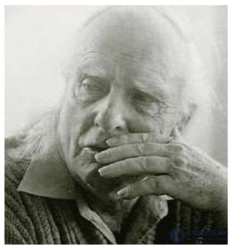
Because the meaning is left unstated, implicature leaves the speaker the possibility of disavowing that meaning.
Grice distinguished two kinds of implicature :
Examples
Vasya got his driver's license and passed his driving tests.
Let us split the sentence into two parts:
(1) Vasya got his driver's license… - A
(2) …and passed his driving tests. - B
A+B = Vasya first got his driver's license and then passed his driving tests
B+A= Vasya first passed his driving tests and then got his driver's license
swapping the places of the sentences – the «addends» – does not change the truth value. If A has the value ‘true’ and B also has the value ‘true’, then both
A+B and B+A will be true.
THE COOPERATIVE PRINCIPLE
«Make your contribution such as it is required, at the stage at which it occurs, by the accepted purpose or direction of the talk exchange in which you are engaged».
Make your contribution to the conversation such as is required at the moment at which the conversation takes place, and by that purpose or direction of the exchange of turns (i.e.
of the dialogue) in which you are engaged.
(Paul Grice)
The participants in a conversation are aware of each other's interests and assume that their interests coincide.
Cooperative dialogues: a contract, teacher – student, doctor – patient
Non-cooperative dialogues: criminal – investigator, seller – buyer…
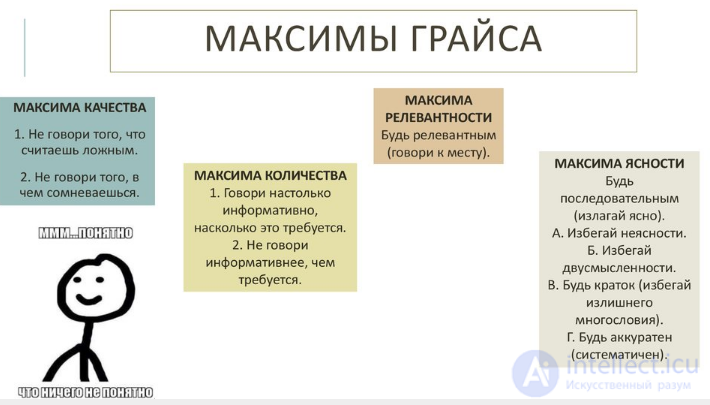
GRICE'S MAXIMS
MAXIM OF RELEVANCE
Be relevant (say what is to the point).
MAXIM OF QUALITY
1. Do not say what you believe to be false.
2. Do not say that for which you lack adequate evidence.
MAXIM OF QUANTITY
1. Make your contribution as informative as is required.
2. Do not make your contribution more informative than is required.
MAXIM OF MANNER
Be perspicuous (be clear).
A. Avoid obscurity of expression.
B. Avoid ambiguity.
C. Be brief (avoid unnecessary prolixity).
D. Be orderly (systematic).
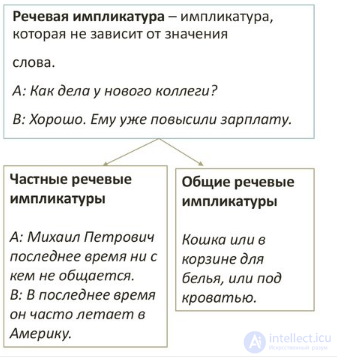
Conversational implicature – an implicature that does not depend on the meaning of the word.
A: How is the new colleague doing?
B: Well. He's already gotten a raise.
Particularized conversational implicatures
A: Mikhail Petrovich hasn't been talking to anyone lately.
B: Lately he's been flying to America a lot.
Generalized conversational implicatures
The cat is either in the laundry basket or under the bed.
Conventional implicature – an implicature derived from the meaning of the word.
John is English. Therefore, he is a gentleman.
The teacher was chatting with Karina, a bore, today.
FEATURES OF CONVERSATIONAL IMPLICATURES
FEATURES OF CONVENTIONAL IMPLICATURES
John is English. Therefore, he is a gentleman
«Non-cancellability»- John is English. Therefore, he is a gentleman. But Englishmen are not gentlemen
Non-calculability - it cannot be justified by means of any of the maxims (the maxim of quality, the maxim of quantity, the maxim of relevance, the maxim of manner)
«Conventionality» - the Speaker builds the component of gentlemanliness into the concept of Englishman.
CONVENTIONAL IMPLICATURES VS. PRESUPPOSITIONS comparison and difference
A presupposition is a component of the meaning of a text that is not expressed verbally; it is prior knowledge.
One can say that meaning is the basis of the information conveyed in discourse by means of linguistic (verbal) units and their combinations. The study of the informational component of discourse fragments of various lengths necessarily involves the study of the semantic basis of an extended utterance, which correlates with the categories of discourse [Oleshkov 2006: 61-62]. The most important categories of discourse include the concepts of explicature, implicature, and presupposition, which are used to describe the hidden meanings of an utterance.
Presupposition stands in opposition to the communicatively relevant content of an utterance. It enters into the semantics of a sentence as the interlocutors' «fund of common knowledge». Communicative presuppositions are the speaker's notion of the addressee's degree of awareness [Arutyunova 1988: 85-89].
Explicature is considered to be a judgment expressed explicitly in an utterance, i.e. one that results from the speaker's (addresser's) semantic representation being adequate to the addressee's expectation [Oleshkov 2006: 96].
Explicature - a semantic-pragmatic component of an utterance that explicitly expresses its meaning and sense
SCALAR IMPLICATURES
Scalar implicatures belong to generalized conversational implicatures and are associated with a certain scale.
The orchestra played many of Beethoven's symphonies.
MANY does not mean ALL
Consequence of the maxim of QUALITY: the Speaker is not sure that the orchestra played all of Beethoven's symphonies.
Consequence of the maxim of QUANTITY: the Speaker is sure that the orchestra did not play all of Beethoven's symphonies.
You will be taught how to properly use cosmetics that will make you even more attractive.
Hidden information that you extract: you are beautiful, it only remains to become even more beautiful with MARY KAY cosmetics.
Give style to the healthy shine of your hair!
Hidden information: you already have a healthy shine, it only remains to give it style with PANTENE PRO-V hair spray.
A car that will help restore your trust in cars.
Hidden information: you have lost trust in cars, and now only VOLVO can fix the situation.
COBRA tights - in them you are even more dangerous!
Hidden information: you are already dangerous
As a technique of linguistic manipulation, implicatures are especially popular in advertising, since not only is the information perceived uncritically due to bypassing the analytical processing procedures in the addressee's brain, but it is also difficult to hold the advertiser accountable for the inaccuracy of information that is not explicitly spelled out.
Implicature can be used to belittle competitors' products:
Implicatures are also used to hint at the unconditional truthfulness of information:
The meaning of the concept «implicature» is close to the meaning of the everyday word «hint» (cf. also circumlocution, rigmarole, insinuation, prompting, and roundabout speech) . The concept of a hint is broader than a purely speech-based discourse implicature (one can hint by silence or by action; the meaning also allows for coercion: «to hint with a pitchfork»). However, I. B. Shatunovsky classifies a hint as a special phenomenon also on a purely linguistic level : in the case of a hint, the speaker fundamentally wants to preserve the ambiguity of the utterance to the end (usually because a direct statement of the indirect, «flickering», meaning poses a danger to the speaker or the addressee).
CONCLUSIONS
Communication is a goal-directed activity; it is strategic in nature.
To accomplish their overarching task, the speaker strives to choose the linguistic form most appropriate to a given communicative situation, to construct the utterance so that it corresponds to their intention, the emotional state of the communicants, and other extralinguistic
conditions of communication.
Implicature can be regarded as one of the categories of discourse that serves to increase the semantic volume of a message. Implicature is part of a communicative strategy, since it contains the information that the speaker realizes in the utterance by means of certain tactics.
1.Dotsenko E.L. The Psychology of Manipulation: Phenomena, Mechanisms and Defense. M.: Moscow State University Press, 1997.
2.Chernyavskaya V.E. The Discourse of Power and the Power of Discourse. M.: Flinta, 2006.

Comments