
Lecture
Modality is a conceptual category that characterizes: a) the speaker’s attitude toward the content of the utterance; or b) the status of the situation denoted in it with respect to the real world; or c) illocutionary force, i.e. the speaker’s communicative goal. In grammar, modality is expressed above all by mood. For example, in the sentence Не уверен, что Маша пришла бы (“I’m not sure Masha would have come”) the subjunctive mood expresses the fact that the situation of Masha’s coming is hypothetical rather than real. In the sentence Вот бы пришла Маша! (“If only Masha would come!”) the subjunctive mood expresses the desirability of the same situation for the speaker. In the sentence Уходи, Маша! (“Leave, Masha!”) the imperative mood expresses a prompt to action. Modal meanings are also expressed by many other means – constructions (Быть бычку на веревочке), parenthetical words (наверно, “probably”), modal verbs and predicatives (such as мочь, можно, нужно), particles (все-таки), and so on.
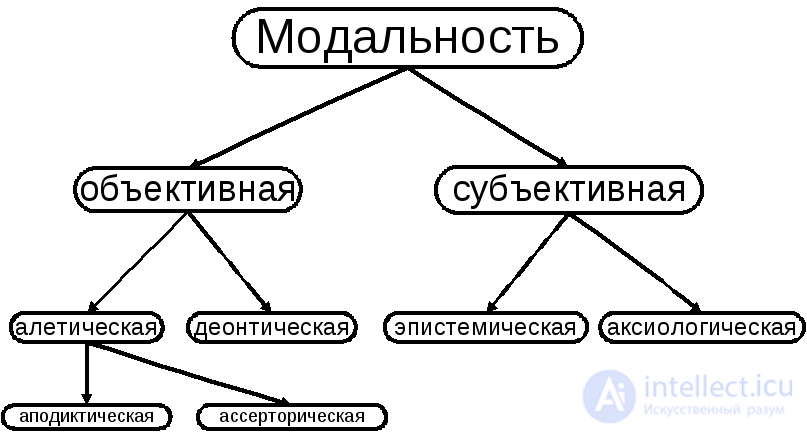
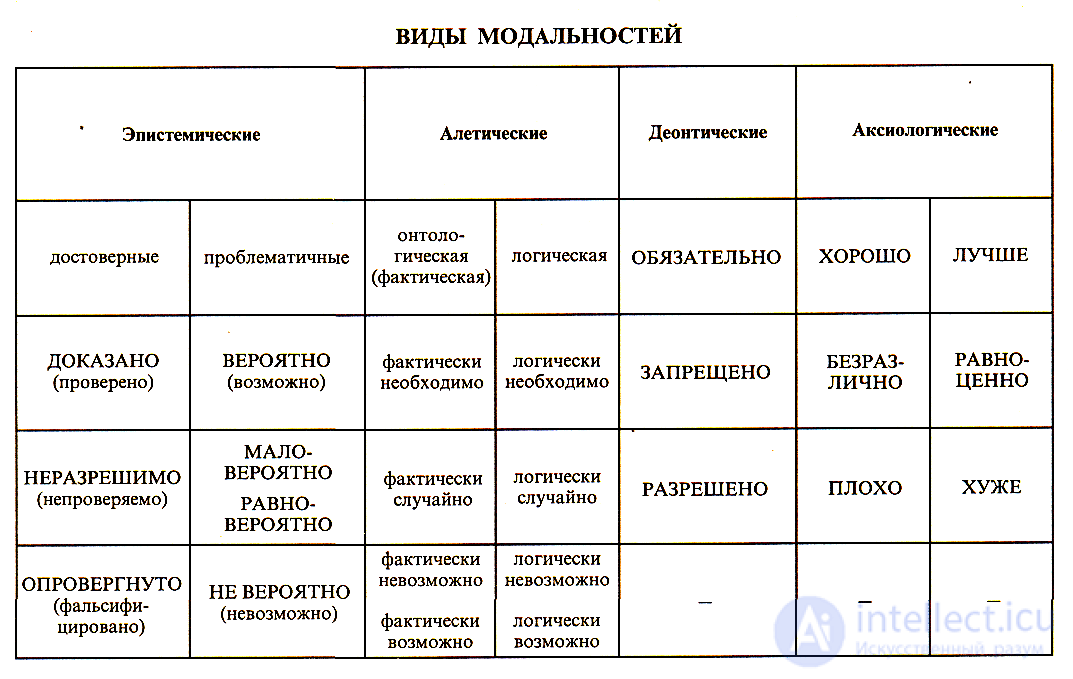
The term modality is used to denote a broad range of heterogeneous phenomena. The sphere of modality includes the following groups of meanings.
a) The opposition based on the feature reality – irreality, cf. Он стал чемпионом (“He became champion” – real modality) and <Ему надо было выиграть последнюю партию – тогда> он стал бы чемпионом (“He needed to win the last game – then he would have become champion” – irreal modality). This is the so-called «objective» modality, which is expressed by the grammatical category of mood – namely, by the opposition of indicative vs. subjunctive mood, see section 2. Modality and Mood, as well as the article Subjunctive Mood.
b) The opposition of utterances by illocutionary force (in traditional terminology, «sentence type by communicative purpose»): utterances and sentences may be declarative, imperative, or interrogative: Дети ушли; Дети, уйдите!; Ушли ли дети? Accordingly, one speaks of assertive (declarative), imperative, and interrogative «illocutionary modality». There are also more particular illocutionary types. Illocutionary force is expressed by mood (in particular, the imperative), interrogative words and particles, intonation, and a range of «minor syntax» constructions (Что бы тебе с ней познакомиться! – a prompt), see section 3. Illocutionary Modality.
c) The sphere of modality also includes meanings that express the speaker’s attitude toward what is being reported – that is, the speaker’s psychological or mental stance, propositional attitude, or attitude of the mind, for example desirability, hypotheticality, doubt, and the like. This is the so-called «subjective modality», see [Vinogradov 1975]; [Grammar 1980(2): 214–236]. Subjective-modal meanings are expressed by the subjunctive mood in its optative (desiderative) meaning (see Subjunctive Mood / section 2.3), as well as by parenthetical words and phrases, special constructions, particles and interjections, word order, and intonation. All these grammemes, words, and constructions presuppose the speaker in their semantics – yet the speaker is not their explicitly expressed subject: Ну и дождь! Вот дождь так дождь! Уж и дождь! Дождь и дождь! Тот еще был дождь! Наверно, дождь! Надо же, дождь! These meanings are often expressively colored. As a synonym one may use the term attitudinal modality. (In [Plungian 2011: 424] this modality appears as «evaluative».) See section 4. Subjective Modality.
d) Beginning with Aristotle, the meanings of possibility (До вокзала можно доехать на трамвае, “One can get to the station by tram”) and necessity (Ты должен ей помочь, “You must help her”) are traditionally called modal. In Russian, possibility and necessity are expressed lexically (by verbs, predicatives, parenthetical words, particles) as well as by constructions – above all infinitival ones: Тебя не убедить (= ‘one cannot convince you’, negation of possibility), Мне завтра дежурить (= ‘I have to be on duty’, necessity). There are even languages (for example, Hungarian, Japanese) where such meanings are expressed morphologically. The meanings of possibility and necessity, especially in their epistemic (knowledge-related) and deontic (duty-related) varieties, naturally adjoin the zone of subjective modality. See section 4.1. The Modalities of Possibility and Necessity.
Deontic modality — is a request, advice, order, or prescription expressed in a judgment that prompts someone toward specific actions.
Example
"It is forbidden to cross the intersection on a red traffic light"
Thus, three spheres of modality can be distinguished in Russian – objective, subjective, and illocutionary. It is precisely these three spheres of modality that are distinguished, in general, across the languages of the world, see, for example, [Foley, Van Valin 1984: 214]; in [Le Querler 1996] they are called, respectively, objective, subjective, and intersubjective.
Unlike tense, aspect, or person, modality in Russian is not expressed by any single unified grammatical category. However, modality is one of the important grammatical meanings for the Russian language (grammatical in the typological sense, i.e. potentially capable of being served by grammar – not in the sense of grammatical meaning according to Jakobson [Jakobson 1959]; a similar place in Russian grammar is occupied, for example, by definiteness): modality is an element of the «universal grammatical set» [Plungian 2011: 94–95]. What follows concerns Russian grammatical modality, i.e. modality that is expressed in Russian grammatically – morphologically or syntactically.
As for the meanings ‘possibility’ and ‘necessity’, in a number of European languages the verbs expressing possibility and necessity are called modal and belong to the sphere of grammar by virtue of their morphological features, so that the meanings they express are automatically classified as grammatical modality. In Russian, the markers of possibility and necessity are not morphologically distinguished in any way (see, however, section 2.4.2). Nevertheless, in Russian too these words belong to the sphere of grammatical modality, since they have special syntactic reflexes. In particular, the markers of possibility and necessity imply, in certain uses, an egocentric modal subject distinct from the grammatical subject (in [Plungian 2011: 435] it is noted that the appearance of the speaker as the subject of a modal marker indicates the grammaticalization of the marker). Another possible syntactic reflex of a lexical modal marker is syntactic non-subordinability, see sections 3.2, 4.2; this is also grounds for regarding a lexical unit with modal meaning as an object of grammar.
Illocutionary oppositions in the Russian grammatical tradition are not assigned to the sphere of modality: they constitute a separate parameter. Thus, in [Grammar 1960: 353–367] declarative, interrogative and imperative sentences are treated as «classes of sentences according to the purpose of the utterance». However, in [Grammar 1980(2): 215] the possibility of including illocutionary meanings among the modal ones is not, in principle, rejected. (These meanings are included among the modal ones, for example, in [Bondarko et al. 1990].) Indeed, if objective and subjective modality are counted as belonging to the sphere of modality, then illocutionary modality must be included there as well: the imperative, like the indicative, is a mood, and the meaning of a mood is a modal meaning, see below section 2.1. See [Palmer 1986: 14–23] on the connection between mood and modality, and [Lyons 1977: 828] on the semantic closeness of the imperative and deontic modality.
In the content of an utterance one can usually distinguish a modal marker and a proposition (on the proposition see [Lyons 1977: 452] and the survey in [Paducheva 1985: 34–40]) – which roughly corresponds to the «modus» and «dictum» in the terminology of Charles Bally, see [Bally 1955]. It should be borne in mind, however, that a proposition may contain a modal operator (such as possibly or must) or a predicate of propositional attitude (of the type desirable, a pity), i.e. it may be modalized. Thus, in the phrase Did you, perhaps, forget about our agreement? the scope, i.e. the dictum, of one modal marker, the question, is formed by a proposition containing another modal marker, perhaps. Bally's terms are therefore not always convenient: Bally assumes that the modus is hierarchically higher than the dictum, whereas in fact the dictum (with respect to some modus) may itself contain a modus.
Markers of illocutionary modality occupy a special position: they indeed express a modus that cannot be embedded in a dictum, i.e. one that is non-subordinable, see section 3.2. Thus, a sentence with must, which expresses deontic modality, a subjective one, is subordinable (Mother thinks that you must help her), whereas a sentence with the imperative, which expresses a modality close in meaning but illocutionary, is not: *Mother thinks that help her. An illocutionary marker cannot even fall within the scope of negation – negation with the imperative does not express negation in the ordinary sense of the word, but a new speech act (thus, Open the door! is an incitement, while Don't open the door! is a prohibitive). There are, however, exceptions here too; on the possible subordinability of illocutionary markers see section 3.6.
Thus, there are not two conceptual centers in the sphere of modality, as is sometimes thought (cf. [Plungian 2011: 423]), but three: modality expresses a) the relation of the utterance to reality; b) the speaker's relation to the content of the utterance; and c) the communicative purpose of the utterance.
The boundary between illocutionary and subjective modality is not always sharp. Thus, irony is a speech act, i.e. illocutionary modality; but irony can be an expressive means of expressing negation, and expressivity belongs to the sphere of subjective modality. In [Grammar 1980(2): 216] the sphere of subjective modality is taken to include meanings such as agreement/disagreement, acceptance/non-acceptance <of the interlocutor's utterance>, approval, censure, condemnation, appeal, incitement, warning, threat, incomprehension, emphasis, and the like, many of which should properly be assigned to the illocutionary sphere. Say, approval, and especially disapproval, in contexts such as What do you want with that motorcycle! or Whatever possessed you to get married! (examples from [Shmelev 1958]), are illocutionary meanings. The distinction should be sought in the fact that in the context of illocutionary modality the speaker acts, above all, as the subject of speech directed at the addressee, whereas in the context of subjective modality he is only the subject of a propositional attitude, cf. in this respect a wish and a desire. However, this distinction is not always easy to identify.
Modal meanings of different types can be combined, i.e. have as their scope one and the same proposition. Thus, assertive illocutionarity is compatible with various variants of subjective modality expressed by parenthetical words: Ivan must be in Kiev; He is unlikely to return, and so on. Interrogative illocutionarity is compatible with the subjunctive mood: Would you go with him on a reconnaissance mission? This rules out treating interrogativity as a mood in Russian. There are, however, certain restrictions on the compatibility of modal meanings from different spheres, see section 2.5 on this.
The boundaries of the semantic sphere of modality are drawn differently by different scholars. Let us dwell on some meanings that do not belong to the modal ones – at least, in the grammar of the Russian language.
Negation does not belong among the modal meanings (unless one counts expressive negation, which belongs to the sphere of subjective modality, as in the sentence As if I wanted to go there! = ‘I have no wish to’). Negation is an operator that combines with the most varied grammatical meanings (including modal ones), forming natural semantic combinations. For example, the negation of possibility is impossibility, the negation of permission is prohibition. The category formed by the opposition of assertion and negation is called polarity (see, for example, [Horn 1989: 157]; [Melchuk 1998: 149]).
Words with the meaning of evaluation are close to the sphere of modality. The difference is that modal meanings characterize the proposition as a whole, whereas evaluation (usually along the good/bad parameter) more often enters into the semantics of individual words (such as to manage to, to be driven to, to get worked up, to show off). This is a separate sphere in the semantics of natural language (predominantly in lexical semantics), although one closely adjoining subjective modality. See on evaluation [Arutyunova 1998: 130–274].
The grammatical category of evidentiality also adjoins the sphere of modality; it expresses the source of the speaker's information about a situation, or, more precisely, the path of access to the reported information, see the works of N. A. Kozintseva in [Khrakovsky 2007b], as well as [Aikhenvald 2004]; [Plungian 2011: 450]. In languages with grammaticalized evidentiality, an utterance about a fact, i.e. about an event that the speaker himself saw or in which he took part (direct evidentiality), is grammatically opposed to utterances with indirect evidentiality, where the speaker relies on data that was reported to him (quotative); reports the result of his own inferences (inferential); or something that seemed to him to be the case (imperceptive), and so on. In Russian, evidentiality is not a grammatical category, although lexical markers of evidentiality (mainly particles and parenthetical words) are numerous, for example: allegedly, as if, as though, it seems, apparently, it looks like, see [Bulygina, Shmelev 1997]; [Khrakovsky 2007a]; [Letuchiy 2008]. A special role is played by the particles mol, de and deskat', «xeno-markers» according to N. D. Arutyunova, associated with the reporting of someone else's speech, but expressing a complex of meanings not reducible to simple quotativity (see, in particular, [Plungian 2008]; [Paducheva 2011b]).
There is a close connection between evidentiality and epistemic modality: epistemic modality usually denotes the incomplete degree of certainty expressed by the speaker regarding the information he reports (see section 4.1.1), while evidentiality marks the sources information on which the speaker bases their statement – thereby partially relieving themselves of responsibility for the reliability of the information. Both meanings can be expressed jointly by a single marker, but indirect evidentiality by itself does not imply unreliability [Khrakovsky 2007a]. In [Palmer 1986] evidentiality is included within the sphere of modality. On some points evidentiality and modality indeed coincide, see [Plungian 2011: 366] on the fact that the evidential meaning of conclusivity (otherwise – presumptivity) is nothing other than epistemic necessity. However, the generally accepted view can be considered to be that evidentiality and modality are different categories, between which there is a close connection. See in detail on the connection between modality and evidentiality, for example, [Makartsev 2014: 40–49].
In [Grammar 1980(2): 214] the term «objective» modality is used with respect to the meanings expressed by mood. In fact, the semantics of mood is always subjective – in the sense that it presupposes a speaking subject. For the optative meaning of the subjunctive mood this is obvious: If only it were summer now! = ‘I want it to be summer now’. But the speaker is also present in the semantics of the indicative mood. This is demonstrated by the well-known Moore's paradox, see [Wittgenstein 1953: 190]. The phrase She is beautiful, but I don't think so is anomalous, since it contains a contradiction: the first clause ‘she is beautiful’ has the implication ‘I think she is beautiful’, which contradicts the assertion of the second clause – ‘I do not think so’. The component ‘I think…’ in the semantics of an affirmative sentence is even more than an implication: it is the speaker's epistemic commitment. The explicit identification of subjectivity in language with the figure of the speaking subject belongs to É. Benveniste, see [Benveniste 1974: 292].
True, in a subordinate syntactic position the subject of modality may not be the speaker. Thus, in the sentence Petka could well have lied the subject of the modality expressed by the modal verb is the speaker (see on this section 4), while in Ivan thinks that Petka could well have lied the subject of the modality is not the speaker but Ivan – the subject of the main clause. Indeed, there are different modes of interpretation ([Paducheva 1986]; [Paducheva 1996]), that is, different contexts of language use: besides the ordinary speech (i.e., dialogic) discourse, there is narrative and, accordingly, the narrative context; there is the hypotactic context (i.e., the context of a subordinate clause). And there are general rules of projection, according to which the speaker can be replaced, in different communicative contexts, by different subjects (see on projections in [Lyons 1977: 579] and, in detail, in [Paducheva 2011a]). The rules of projection concern not only the modal subject but subjectivity as a whole.
The implied subject of modality depends, among other things, on the type of speech act. For example, in a question and in the answer the subject may be different:
(1) – May <I>? – You may.
The presence of an implied modal subject may determine the boundary between grammatical and lexical modality, see on this in section 4.1.1.
With these reservations, it can be said that what is common to all phenomena in the sphere of grammatical modality is the participation of the speaker: modality is an egocentric category, see egocentric units of language. It is precisely on this basis that negation is excluded from the sphere of modality (see section 1.2 above), since it is not an egocentric category – at least not in Russian.
According to Palmer, subjectivity is the criterion of modality («subjectivity is an essential criterion of modality», [Palmer 1986: 16]). However, modality is far from being the only egocentric category. Another sphere of the egocentric is deixis. (These two spheres are combined in the classic work of R. O. Jakobson – [Jakobson 1957/1972], which introduced the more general notion of the shifter.) The third and fourth are the already-mentioned evaluation and evidentiality. Finally, there is communicative structure (theme-rheme division), which deals with the opposition known / unknown, thereby appealing to the speaker and the listener.
Below in section 2 there is a brief overview of the modal meanings expressed by mood (for details on the modal meanings expressed by mood, see Mood) – which concludes the topic of Modality and Mood; here the boundaries of objective modality are also clarified. At the end of section 2 a table of the compatibility of the three types of modality with one another is given. Section 3 deals with illocutionary modality, section 4 – with subjective modality, in particular – with possibility and necessity expressed by modal verbs and predicatives (on the expression of these meanings by the infinitive see Infinitive).

Comments