
Lecture
Boustrophedon — is a style of writing in which alternating lines are reversed, with letters also written in reverse order, mirror-fashion. This differs from modern European languages, where lines always begin from the same side, usually the left.
The original term comes from Ancient Greek: βουστροφηδόν boustrophēdón, a compound of βοῦς boûs, «ox»; στροφή strophḗ, «to turn»; and the adverbial suffix -δόν -dón, «in the manner of» — that is, «in the manner of an ox turning [while plowing]». It is most often found in ancient manuscripts and other inscriptions. It was a common way of writing on stone in Ancient Greece, becoming less popular over the course of the Hellenistic period. Many ancient scripts, such as Etruscan, Safaitic, and Sabaean, were often or even typically written in boustrophedon.
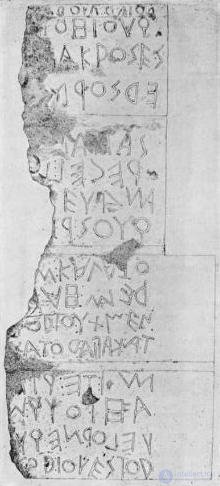
The Forum inscription (one of the oldest known Latin inscriptions) is written in boustrophedon, although irregularly: reading from top to bottom, lines 1, 3, 5, 7, 9, 11, 12, 14, 16 run right to left; lines 2, 4, 6, 8, 10, 13, and 15 — left to right; lines 8, 9, and 16 are inverted. (From the impression by Domenico Comparetti.)

A diagram of text in the form of reverse boustrophedon, done in the style of rongorongo, but using the Latin alphabet.
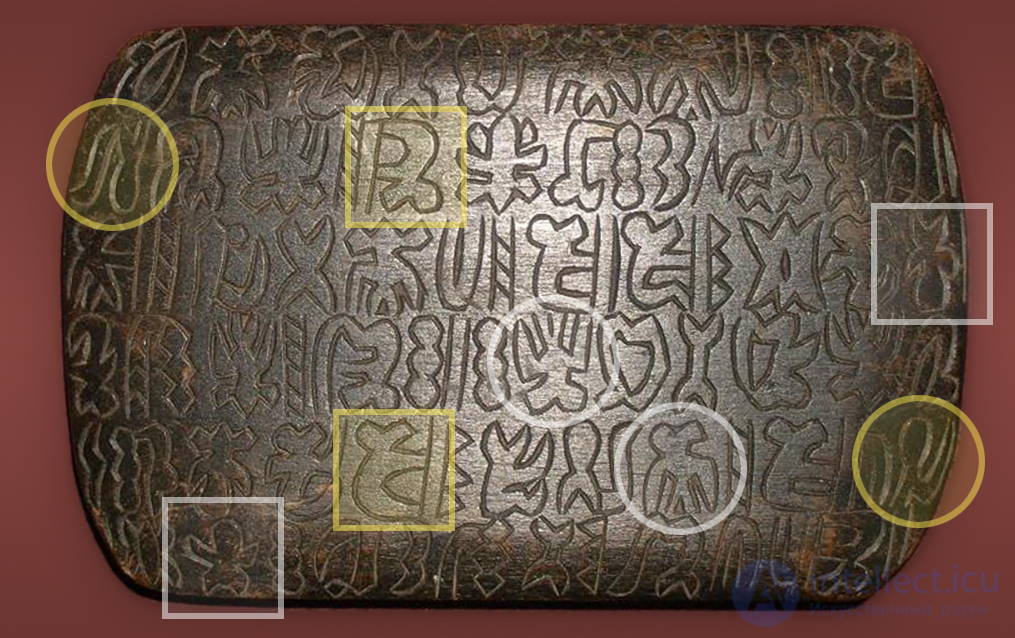
A rongorongo tablet, on which several glyphs are highlighted, symmetrically arranged relative to one another when rotated by 180° (reverse boustrophedon).
Wooden boards and other carved artifacts of Rapa Nui bear a boustrophedon-like script called rongorongo, which remains undeciphered to this day. In rongorongo the text in alternating lines was rotated 180 degrees rather than mirrored; this is called reverse boustrophedon.
The reader begins reading from the bottom left corner of the tablet, reads the line left to right, then rotates the tablet 180 degrees to continue reading the next line, also left to right. When reading one line, the lines above and below it appear inverted. The text continues on the second side of the tablet at the point where it ended on the first, so if the first side has an odd number of lines, the second will begin at the top left corner, and the direction of writing will change to top-to-bottom. Larger tablets and staves could be read without turning if readers were able to read upside down.
Hungarian folklorist Gyula Sebestyén writes that the ancient boustrophedon script resembles the Hungarian notched sticks for inscriptions of Old Hungarian script, made by shepherds. The carver held the wooden stick in his left hand, cutting the letters with his right hand from right to left. When the first side was finished, he turned the stick vertically and began carving the opposite side in the same way. When unfolded horizontally (as with inscriptions cut in stone in boustrophedon), the result was writing that began right to left and continued left to right in the next row, with the letters inverted. Sebestyén suggests that the ancient boustrophedon script was copied from such wooden sticks with carved letters that were used for epigraphic inscriptions (without recognizing the true meaning of the original wooden script).
The Luwian language had its own version, Hieroglyphic Luwian, which is read in boustrophedon style [6] (most of the language was written in cuneiform).
Luwian hieroglyphs are read boustrophedonically, with the direction of each individual line indicated by the front of the animal figures or body parts that make up particular hieroglyphs. Whereas the numerous ideograms and logograms of Egyptian hieroglyphs indicate direction, the direction of a line of text in Luwian hieroglyphs is harder to determine.
Ease of reading at an early stage of writing
At a time when the direction of writing had not yet become fixed, boustrophedon helped:
avoid returning to the start of the line,
maintain continuity of reading.
Savings of space and material
This method allowed text to be placed more densely on stone, clay, or metal.
A transitional form of writing
Boustrophedon was used as an intermediate stage between:
right-to-left writing (under Phoenician influence),
and the eventual left-to-right writing (classical Greek alphabet).
Ritual and official inscriptions
It was often used:
in laws,
decrees,
dedicatory inscriptions,
to emphasize the antiquity and sanctity of the text.
A modern example of boustrophedonics is the system for numbering plots within surveyed settlements in the United States and Canada. In both countries, surveyed settlements are divided into a 6-by-6 grid of 36 plots. In the U.S. Public Land Survey System, plot 1 of a settlement is located in the northeast corner, and numbering continues boustrophedonically up to plot 36 in the southeast corner. The Canadian Dominion Land Survey system also uses boustrophedon numbering, but it begins from the southeast corner. Following a similar pattern, street numbering in the United Kingdom sometimes runs sequentially in one direction and then returns in the other (the same numbering method is used in some cities in continental Europe). This differs from the more common method, where odd and even numbers on opposite sides of a street increase in the same direction.
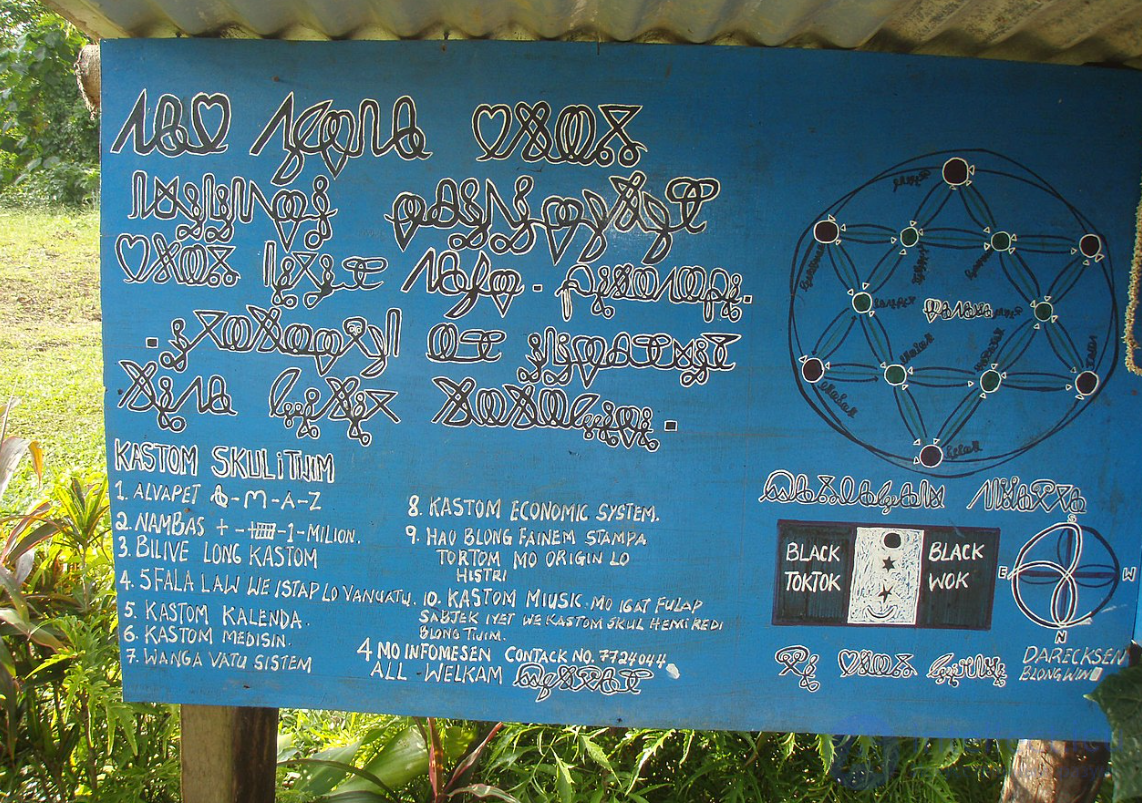
Note: the Avoiuli script uses boustrophedon.
The Avoiuli writing system, used on Pentecost Island in Vanuatu, is boustrophedonic by nature.
The Indus script, although still undeciphered, may be written using boustrophedon.
Another example — is the boustrophedon transform, known in mathematics.
Sources also indicate that Linear A could be written left to right, right to left, and in boustrophedon form.
Permanent human teeth are numbered in boustrophedon sequence according to the American Universal Numbering System (UNS).
Marilyn Aronberg Lavin used this term to describe a type of narrative direction that a cycle of wall paintings can take: «Boustrophedon occurs on the surfaces of individual walls [linear], as well as across one or more opposite walls [aerial view] of a given sanctuary. The narrative is read on several levels, first left to right, then in reverse right to left, or vice versa».
In the GRIB2 digital spatial data compression algorithm, values are packed «boustrophedonically, to make «consecutive» values more redundant».
Moon type, an early form of notation for the visually impaired, was sometimes written in boustrophedon so that the reader would not need to lift a finger from the surface to read after reaching the end of a line. Although the direction of reading changed, the orientation of the glyphs remained constant relative to the page. [14]
In 1884, British printer and publisher Andrew White Tuer published a book titled «Should We Read Backwards?», written by James Millington for the Leadenhall Press, in which this principle was tested on a page of English text. In 2025, graphic and type designer Karl J. Kurtz developed the ideas set out in «Should We Read Backwards?», designing a Latin typeface for boustrophedon use and typesetting an English-language book in boustrophedon to test its applicability to modern texts.
The constructed language Ithkuil uses boustrophedon writing.
The Atlantean language, created by Marc Okrand for Disney's 2001 film «Atlantis: The Lost Empire», is written in boustrophedon to recreate the feeling of flowing water.
The code language used in «The Montmaray Journals» — Kernetin, is written using boustrophedon. It is a combination of Cornish and Latin and is used for secret communication.
J. R. R. Tolkien wrote that many Elves were ambidextrous and wrote left to right or right to left as needed.
In Lin Carter's «Green Star» novels, the writing system of the Laonese people is written in boustrophedon style.
To make it easier to read from one musical staff to another and to avoid a «jump of the eye», Jean-Jacques Rousseau proposed a «boustrophedon» notation. This requires the writer to write the second staff right to left, then the next left to right, and so on. Words are reversed across the line break.

Comments