
Lecture
Allusion (Lat. allusio «a hint, a joke») — a stylistic figure containing an indication, an analogy, or a hint at some literary, historical, mythological, or political fact that has become established in textual culture or in colloquial speech. The material used in formulating the analogy or hint that forms an allusion is often a well-known historical saying, some catchphrase, or a quotation from classical poetry.
The French writer Charles Nodier proposed the following definition: «A hint, or allusion, is the ability to quote appropriately, giving the quotation a meaning it did not originally have» . Reinterpreted quotations can be used for the titles of books (for example, Valentin Kataev's «My Diamond Crown»). Reinterpreted quotations often acquire a parodic tinge.
An allusion is a literary figure that expresses an analogy, an indication, a hint at a frequently used and well-known fact, person, idea, or episode (historical, literary, political, mythological, or of any other kind) that is established and widespread in speech. It is used to introduce a necessary subtext into a text or oratorical speech. Such literary elements are the representatives of an allusion and are called markers. The word allusion derives from alludere (Latin), translated as «to play, or to joke». The device of allusion has long been used to compose and enrich written and oratorical texts. As a term, allusion appeared in the 16th century, and it was only four centuries later that it began to be studied as a phenomenon. This stylistic device is necessary for simplifying complex ideas, either by referring to already-described multifaceted facts or by creating a necessary background, for example a fairy-tale or mythical one.
Biblical subjects often provide material for allusions. For example, the title of the film «V. Davydov and Goliath» refers to the widely known biblical story of David and Goliath.
In other cases, the titles of earlier works may be used. For example, Dr. James Tiptree Jr. made her debut in science-fiction literature with the story «The Birth of a Traveling Salesman» (1968), in whose title one can see an allusion referring the reader to the title of the play «Death of a Salesman» (1949) by the American playwright Arthur Miller, and in the title of the Russian series «Always Say „Always“» — an allusion to the James Bond film «Never Say Never Again».
Unlike reminiscence, it is more often used as a rhetorical figure requiring an unambiguous understanding and reading.
Difficulties often arise with the use of the term «allusion», namely with the choice of government. On the one hand, the definition of allusion as a hint suggests to the writer government with the preposition to (allusion to something). On the other hand, allusion as a reference presupposes the use of the preposition to (allusion to something).
A biblical allusion to the fall of Adam and Eve, who were tempted by Satan in the guise of a serpent.
THE BURDEN OF THE EARTHLING, THE GREAT MISSION OF MANKIND – terms used in justifying the expansion of humanity; the first is an allusion to a formulation by R.
I ENTERED INTO INTIMATE RELATIONS – an allusion to a joke: an interpreter is leading a delegation through a factory and is asked – what is the foreman talking to the apprentice about? A very significant, concrete allusion is contained in the address to Queen Anne, when the poetess says that her early years were illumined by the favor of the great Elizabeth. Evidently, Smirnova was unaware of John Florio's allusion to Rutland's literary work in the dedication to him of the Italian-English dictionary, or of Jonson's words in his epistle to Elizabeth Rutland that her husband had come to love the art of poetry, not to mention many other facts. Also of interest is the allusion to the fact that the Sidney family had income from publications.
A mournful allusion to John Salusbury, who died in the summer of 1612, allowed me to determine the true date of the book's appearance, and through it to identify the prototypes of the Dove and the Phoenix – the extraordinary Rutland couple, who departed this world at the same time as Salusbury. However, in doing so they dropped a very important comma from the text, as a result of which the allusion that determines the meaning of the poem disappears. The description of the machinations of Lyapis-Trubetskoy in the editorial offices of departmental journals and the quotation cited by Persitsky – an allusion to a story by V.
The Oxfordians have to assume that the plays that appeared after this time were created before 1604 but published later, although the allusions to events of 1605-1610 contained in them speak definitely against such an assumption. Numerous allusions show that the author of this additional epilogue-poem is describing the Rutlands' castle, Belvoir, and grieving over the absence of its mistress, Elizabeth Sidney-Rutland, to whose pen belong the previously placed addresses to the queen and to the most noble ladies, her friends, as well as the poem itself about the Passion of Christ, which gave the book its title.
Political allusions were to a considerable extent eliminated even during the preparation of the magazine version, and some parodies were also removed. These parodies, and likewise some political allusions, are examined in detail in the commentary.
The principles of the commentary are traditional: what is explained first of all is realia, quotations and reminiscences, literary and political allusions, parodies, specific events one way or another connected with episodes of the novel, and textually significant variant readings. Many countrymen and friends of the authors of the novel were published in this magazine, Kataev among them, whose stories are alluded to further on.
It is far easier to say «As strong as Hercules» than to use a large set of words to describe what strength is like. Hercules is a mythical hero who possessed the greatest strength, capable of moving and lifting any objects, however heavy they might be. No one could compare with him in strength, since an ordinary person was not given such natural gifts. Hercules, on the other hand, was considered a demigod who was worthy of possessing supernatural abilities.
If the reader or listener knows what is contained in the image of this or that hero or event that the author uses, then a certain mood is created. The author does not have to use many words to convey his thought, while at the same time creating a certain mood. It is easier to write about the anger that was characteristic of Hitler than to describe in many words what feelings the author's hero experienced.
The allusion in Alexander Solzhenitsyn's novel is found in the title of the work. In his «Divine Comedy», Dante Alighieri formed a strict structure of the afterlife, dividing it into nine circles. The sinful soul, according to the plot of the Italian author's poem, finds itself in one of them. But each of the circles corresponds to the gravity of the transgressions committed during life. In the first are the most harmless sinners, whose guilt is highly doubtful: unbaptized infants, virtuous but unbaptized people. In Solzhenitsyn's novel, Dante's first circle is taken as an allusion. What kind of allegorical device this is and what function it performs can be understood by recalling the author's words: «The most precious thing in the world is to know that you are not taking part in injustice». The heroes of the Russian writer are punished, suffer, like the inhabitants of the first circle of the Italian philosopher, innocently, and are victims of a huge, terrible system.
The English writer draws a parallel between the characters of his novel «The Collector» and Shakespearean characters from the tragedy «The Tempest». In both the first and the second case, the symbols occupy a medial position.
As for works of Russian classical literature, a vivid example of an allusion to images from the work of the English playwright is Leskov’s novella «Lady Macbeth of the Mtsensk District».
The choice of the source of allusions depends on the time in which the author lives, and on his ideas. In the novel «The Master and Margarita», allegories and subtle hints at biblical images and plots are present everywhere. Bulgakov’s work gives rise to many questions and mysteries. But the author of this cult work of the 20th century clearly refers to Goethe’s «Faust». The name of the main heroine is the principal allusion. Bulgakov devoted the main storyline to love and the theme of fleeting happiness, which is also an interesting subject of study for critics due to the abundance of images of the German poet in it.
With the help of such stylistic devices, an author can refer not only to a well-known literary work, but also to some historical fact. Various elements from biblical or mythical plots can play the role of an allusion. What this artistic phenomenon is cannot be answered within the scope of a single article. Many literary scholars have devoted works to this topic, each proposing their own interpretation and classification. To get a general idea of allusion, several examples from literature should be given and classified according to the main criterion – namely, the source from which it may be borrowed. So, such artistic images can be:
Allusions are used to form the plot, to reveal the character of the hero, or to convey the author’s idea. They can be found in the title of a work or at its ending. They can also occupy a medial position.
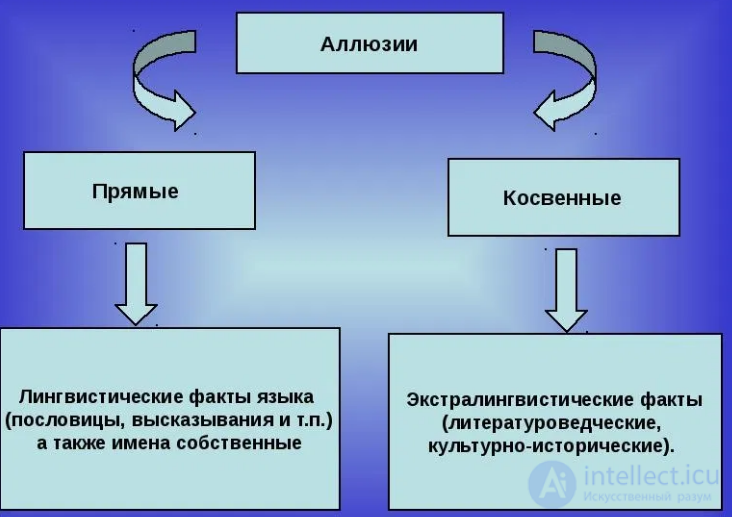
Biblical and mythological devices are those that refer to religious texts. Examples of allusion using the Bible are «the good Samaritan», «she turned the other cheek», etc. They are the most emotionally charged and are used to give characters a certain characteristic.
Historical allusions are aimed at pointing to specific historical facts and figures. They are the most precise and concrete, easy to understand, but the least emotionally rich, and they convey factual information.
Proper names (frequently encountered names of animals, birds, geographical names, works of art, names of gods).
There are several other ways to classify this phenomenon, for example, as something that can be used in a direct context or be veiled, constructed as a riddle. Allusions also differ in terms of contextuality and general awareness. The former are accessible and understood by people living in a particular era or moving in a particular circle; the latter are universally accessible. In terms of structure, it can be expressed by a word, several words, or even an entire verbal construct.
For a stylistic device to be correctly interpreted, and indeed noticed and understood at all, the author and the reader must share common themes and knowledge. Devices referencing another ethnic group often significantly complicate the understanding of the text and the work of the translator. In the person perceiving the text, interacting with allusions can give rise to diverse associative chains. In order for the variant that the author intended to convey to be chosen from among all the possibilities, precedent knowledge and ideas are needed (folklore, national and world classical literature, texts of the major religions), which will be shared by the community to which the given text is addressed.
It is difficult to overstate the influence of stylistic devices in creating subtext in a text; they also perform a number of functions:
Characterizing or evaluative (used to detail an image by comparing the character with other well-known objects or characters, in order to convey these qualities to them);
Text-structuring (introducing additional information and binding together the overall text of the work).
Allusion can also include catchphrases, which are also known to many people and which can be referenced. Examples include:
Allusion is used in psychocorrection, when it is necessary to remove defensive barriers and mechanisms, which is possible if the person does not have a negative attitude toward the reference being used. Thus, allusion can be used to reorient a person, reduce defense mechanisms, and evoke certain emotions.
People often write diaries using allusion as a way of channeling negative emotions or conveying their thoughts. Of course, for an allusion to be understood, the listener or reader must have encountered the image or event to which the author refers in other works that reveal these concepts. If the reader/listener is not familiar with the allusion, then they may skip it, not notice it, or simply not understand it.
Requirements for allusion
An allusion must have the following characteristics in order to be understandable to the reader or listener:

Comments