
Lecture
Syntax (Ancient Greek σύν-ταξις «composition», «coordination», «order») — is a branch of linguistics that studies nominative and communicative language units: the sentence and the phrase. Syntax, in its literal translation, means not only composition but also the arranging, coordinating, and joining of words into coherent text. This branch of the science of language studies the lexical and grammatical meaning of phrases, as well as the types of syntactic connection.
In linguistics, syntax is a set of rules, theoretical systems, and language processes that order and study the structure of sentences in a given language. The goal of many syntaxes is to establish syntactic rules common to all languages, as well as to study the ways of combining words into phrases and sentences in various languages.
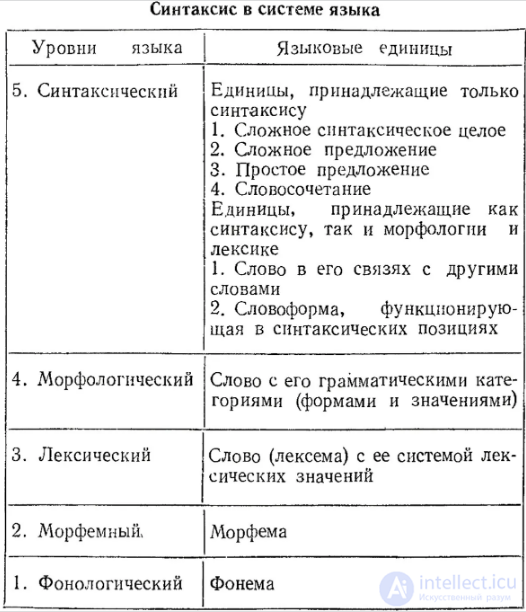
Syntax in linguistics refers to the study of the structure of sentences and phrases in a language, as well as to the rules that determine how these elements can be combined to create meaningful utterances. It studies how words, phrases, and sentences are organized within a language system.
The main concepts and terms associated with syntax include the following:
Sentence: It is the basic unit of syntax and consists of one or more words that are combined together to express a complete thought.
Words and morphology: Words are the basic elements of language and can be independent or compound. Morphology studies the internal structure of words and their grammatical forms.
Phrases: They consist of one or more words and can be noun phrases, verb phrases, adjective phrases, and so on. Phrases can perform various functions within a sentence.
Grammatical relations: Syntactic relations describe how various words and phrases are connected to one another within a sentence. Some typical relations include subject and predicate, object and modifier.
Grammatical categories: These include categories such as number, gender, tense, case, and others, which can influence the syntactic organization of sentences.
Syntactic rules: They determine the permissible combinations of words and phrases in a sentence. The rules may vary depending on the language.
Parse trees: This is a graphical representation of the syntactic structure of a sentence, in which words and phrases are represented as nodes of a tree connected by relations.
Syntax studies the ways of combining words into phrases and sentences. In constructing a sentence, any native speaker links all the language units into a sentence, which is why syntax is considered one of the foundations of communication. In every language, words and phrases form coherent speech, written or spoken, on the basis of syntactic connections that use patterns characteristic of that language. The patterns of speech construction in each language have multiple features and characteristics specific to the phonetic, grammatical, and morphological structure of that language.
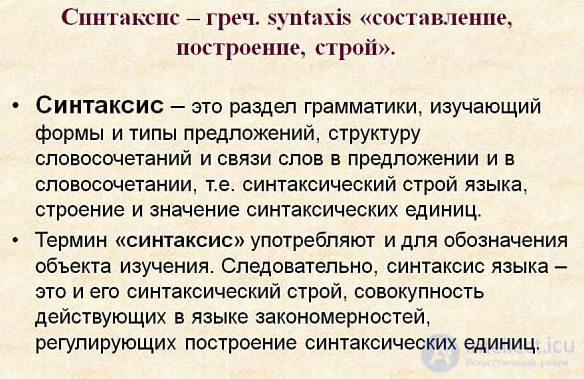
The subject of study in syntax is «syntactic units», or language constructions in which elements of speech are joined by syntactic connections and relations . Syntax is inseparable from the norms of communication, the structure of thought, and the reality being denoted, which makes it the most universal part of language structure. At the same time, each language has its own specific rules of syntactic relations and ways of applying them. In many languages, the purpose of syntax is to create a set of rules and systems for the processes occurring in the language environment, which study and order the ways of combining words and the varied structure of text. The word «syntax» has, mainly, two meanings:
The grammatical structure of a language
The branch of the science of language that studies
The syntactic relations between components within a phrase show significant typological differences across languages . The syntax of a language, both written and spoken, is reflected in the process of a person's mutual, orderly arrangement of parts of speech that form a single whole in accordance with the designation of the surrounding reality, which is why it is closely connected with the mindset of the speakers of the language and is part of linguistics — a complex and branching system of disciplines of both a theoretical and an applied nature .
In the Russian language, syntax together with morphology forms the foundations of grammar . In the mid-19th century, the logical school of grammar, as reflected in the works of Buslaev, showed its main interest in the sentence, viewing and defining it as a judgment expressed in words. The end of the 19th and beginning of the 20th centuries are represented in the works of the formalists (Fortunatov, Peshkovsky, Peterson), who singled out the phrase and defined it as the main subject of the study of syntax. Shakhmatov, in his works, put forward the thesis that there are two syntactic units — the phrase and the sentence.
The grammatical features of sentences and their syntactic construction were unified in Russian linguistics by V. V. Vinogradov, who introduced the terms «predicativity» and «communicativity», which combined the concept of the sentence as a part of speech with the features of grammatical and syntactic construction (a sentence is constructed by an individual at a specific time, carries information, has content, an addressee, and a grammatical form).
Predicativity, according to V. V. Vinogradov , is the minimal syntactic category that determines the functional specificity of a sentence; the key feature of a sentence that relates its content to reality and thereby makes it a unit of communication (an utterance) . Modern linguistic science relies on the concept of predicativity, considering it a key concept in syntax .
The basis of syntax in the languages of the world is invariably a construction denoting an object and an action, which may have different meanings and be expressed by different parts of speech. The basis of vocabulary is the word, which forms concepts of objects and phenomena; the basis of syntax is the reflection of relations between objects and concepts. In the sentence Snow is falling, a natural phenomenon and the action associated with it are reflected. Syntax establishes connections between these concepts, which are regulated by the system of language relations in different cultures. Language systems have different grammatical rules and categories, which is why they differ significantly from one another. In some languages, there is no concept of tense. Into such a language it is impossible to translate the phrase We went to the movies yesterday, since these languages lack the concept of «yesterday and today», and the means of syntax and grammar cannot express relations of time .
The encounter of native speakers of one language with other syntactic models causes difficulties in translation. The Present Perfect in English is used as a present tense, whereas in the Russian model it seems like a past tense .
A special area of syntax is phraseological units, which function within sentences, have grammatical and syntactic connections with phrases and sentence members, but differ both from the word and from the phrase .
Syntactic models in colloquial speech and fiction rely on the established language norm, but at the same time loosen it, establishing new connections, departing from and violating the literary norm by using repetitions, inversion, tautology, and other devices. Some of these devices belong to lexis and syntax simultaneously, which is why they are called «lexico-syntactic», while others belong mainly to the sphere of syntax, which is why they are called «syntactic figures» .
In mathematics, syntax is defined by a set of rules applicable in mathematical systems, such as formal languages. Simplified versions of the original mathematical model of syntax and the method of modeling it on a computer are applicable to any written language.
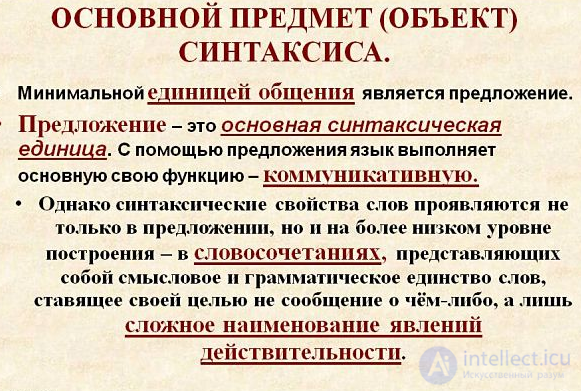
Syntax can be classified according to various criteria. Here are some of the main types of syntax classification:
By type of language:
By analytical approach:
By sentence structure:
By level of analysis:
The typology of languages is based on establishing similarities and differences in the linguistic structure and syntax of a given language. W. von Humboldt divided languages into isolating, agglutinative, and inflectional, reflecting an effort to distinguish types of languages on the basis of general principles underlying the structure of grammatical forms. Among agglutinative languages he distinguished languages with a specific sentence syntax — incorporating languages, and he introduced into the concept of language such a unit as the sentence .
The structure of sentences used within a given syntax is often the basis of the typological classification of languages:
and other structures in various languages .
Communicative syntax
The main function of language is communication between people. The object of study of communicative syntax is the process that turns words into sentences, utterances, and coherent text. These are questions such as the actual (functional) and syntagmatic division of the sentence, the functioning of word combinations within a sentence, the communicative paradigm of sentences, the typology of utterances, and so on.
Semantic syntax
The objects of study of semantic syntax are the text and the structural schemes by means of which its coherent construction takes place: word combinations, simple and complex sentences, complex syntactic wholes, various kinds of utterances connected with the situation of speech, as well as the structure of a text extending beyond the limits of a complex syntactic whole . The study of linguistic regularities is of great importance for linguo-stylistic and psycholinguistic analysis of a text .
Static syntax
Static syntax studies structures not connected with context: the sentence, the word combination, and other units of language. This is a logically consistent classification of the elements of a language (spoken, written, or machine) existing in the minds of native speakers irrespective of the functioning of these elements within a sentence. For example, the grammatical paradigms of declension and conjugation.
In modern linguistics and applied sciences, actual (functional) syntax, structural-semantic, functional, cognitive, and generative linguistics are also studied, as well as many other directions .
From deep antiquity to the modern era, linguistics, and syntax among its branches, remains an extremely uncertain field in terms of scientific knowledge and definitions. Within the framework of the theory of knowledge and the philosophy of language, the view of syntax or sign systems changes depending on the era and the views of researchers; various schools and directions arise in semiotics, philosophy, and linguistics that focus on different aspects and problems of language systems.
All researchers agree that there is an inseparable connection between language, thought, and consciousness. When it comes to questions about the nature and quality of this connection, some scholars believe that the mechanism of thought is not connected with a verbal code, since it is carried out independently of language on a universal objective quality embedded in the meaning of an expression or sentence. Others believe that the mechanism of thought is closely connected with language, and that without it there can be no thought. Still others hold that thought can be both verbal and non-verbal (sensory-figurative)[20].
The structure of speech or text as a science was first examined by the ancient Greek Stoic philosophers, who also introduced the term «syntax» as a means of conveying the logical content of utterances. At the center of the attention of the ancient Greek philosophers was the study of thought processes, which is why logic, morphology, and syntax became a reflection of a single linguistic phenomenon.
In the 13th—16th centuries, in universal (philosophical) grammars and in the «Port-Royal Grammar» (17th century), the categories of syntax were called universal (A. Arnauld and C. Lancelot), since syntax was defined as the substantive domain of grammar. Phonetics and morphology were assigned to the domain of expression rather than content. Syntax was regarded as the doctrine of the means of expressing thought and dealt with sentences and their parts (parts of the sentence)[21].
This direction was also reflected in Russian grammatical scholarship, whose origin V. V. Vinogradov traces back to the grammars of Lavrentiy Zizaniy (1596) and Meletius Smotritsky (1619), and which then developed further in the works of M. V. Lomonosov, then I. I. Davydov, K. S. Aksakov, and F. I. Buslaev .
In the history of philosophical thought, the following linguistic conceptions are distinguished :
Throughout the 19th—20th centuries, there existed three main directions in the study of syntax, which were largely opposed to one another:
These directions are centered on the sentence. The logico-syntactic direction was developed mainly by N. I. Grech and F. I. Buslaev, the formal-syntactic direction underlay the research of F. F. Fortunatov, and the psychological-syntactic direction was developed by A. M. Peshkovsky and A. A. Shakhmatov .
Scholars such as L. S. Vygotsky, J. Marouzeau, C. F. Brunot (France), J. Kuryłowicz (Poland), the American scholars E. Sapir and B. Whorf, the linguists of the Geneva School (C. Bally, A. Sechehaye, A. Frei), and many other scholars had a great influence on world linguistics .
The modern period in the development of domestic linguistics is characterized by the rapid development of linguistic theories in general and syntactic theories in particular. The current state of syntactic doctrine is characterized by the existence of a great many aspects in the interpretation of linguistic phenomena . Some of them are concerned with the study of the semantics of syntactic units, others study structure, others reflect a striving to reveal the structural-semantic features of languages, and still others are related to applied sciences . The large number of syntactic problems and the possibility of approaching them from different points of view, combined with the abundance of aspects of consideration, has led to the appearance of an unprecedented number of directions in syntax research and syntactic concepts, including such directions as syntactic stylistics and cognitive syntax .
Research in the field of syntax includes various directions and approaches. Here are some of them:
Generative syntax: Research in this direction focuses on developing grammatical theories and formal models that make it possible to generate correct sentences in a language. An example is the in-depth study of Chomskyan grammar and the application of formal grammars, such as type 0, 1, 2, or 3 grammars.
Cognitive syntax: This direction of research is concerned with understanding how people perceive, process, and produce linguistic expressions. Researchers study the cognitive mechanisms and processes associated with syntactic processing, including various aspects of perception, memory, attention, and decision-making.
Functional syntax: In this direction, the emphasis is on studying how syntactic structures and rules serve the communicative purposes and functions of language. Researchers are interested in how syntactic constructions help express meanings, relations, and goals in language.
Comparative syntax: Research in this direction compares the syntactic structures and rules of different languages in order to identify universal features and differences between them. This helps to understand the universal principles of language organization and the influence of linguistic features on syntactic structure.
Historical syntax: Research in this direction studies the evolution and changes of syntactic structures and rules in a language over time. Historical syntax helps to reveal the processes that lead to changes in the grammar of a language and to identify the causes of these changes.
Corpus syntax: This is a direction of research that uses large collections of texts (corpora) to analyze syntactic structures and patterns in language. By analyzing large volumes of data, researchers can identify statistical tendencies, preferences, and the use of specific syntactic constructions in various contexts.
Syntactic means are grammatical and lexical elements in a language that are used to construct syntactic structures and express relations between words and phrases. They help determine word order, their functions, and syntactic connections in a sentence. Here are some examples of syntactic means:
Parts of speech: Words in a language can be classified into various parts of speech, such as nouns, verbs, adjectives, pronouns, prepositions, etc. Parts of speech determine the syntactic role of a word in a sentence and its possible grammatical forms.
Grammatical categories: These are properties of words that determine their grammatical characteristics. Examples of grammatical categories include number, gender, tense, case, person, and others. Grammatical categories can influence agreement and syntactic constructions in a sentence.
Case and agreement: Case is the form of a word that indicates its syntactic role in a sentence. Agreement is the matching of the form of one word with another according to grammatical categories such as number, gender, and case.
Syntactic constructions: These are patterns and rules that determine how words and phrases can be combined into sentences. Examples of syntactic constructions include subject and predicate, object and modifier, subordinate clauses, and so on.
Punctuation marks: Punctuation marks, such as the period, comma, question mark, and exclamation mark, serve as syntactic means for indicating pauses, separating and highlighting elements of a sentence, and organizing text.
Secondary elements: These are elements that add additional information to a sentence or phrase, such as subordinate clauses, parenthetical words or phrases, appositions, and so on. They help indicate additional relations and expand the expression of a thought.
Syntax as the study of connected speech is closely intertwined with stylistics, since all the main functional-stylistic and emotionally expressive properties of linguistic units at various levels manifest themselves within the conditions of a particular syntactic context. The presence of communicative and logical syntactic means makes syntax the most universal part of the language structure.
Syntactic analysis makes it possible to understand how sentences are constructed in a language and what structural and semantic relations exist between words and phrases. This is an important aspect of language study and helps linguists analyze and describe the grammatical rules of various languages.
this is 1) the means and rules, specific to particular languages, for creating units of speech;
2) the branch of grammar that studies the process of speech generation.
This is a universal, highest level of grammar for all languages. The syntactic system of a language is connected, on the one hand, with the process of human thought, and on the other, with the process of communication, the verbal interaction of people.
BRANCHES OF SYNTAX
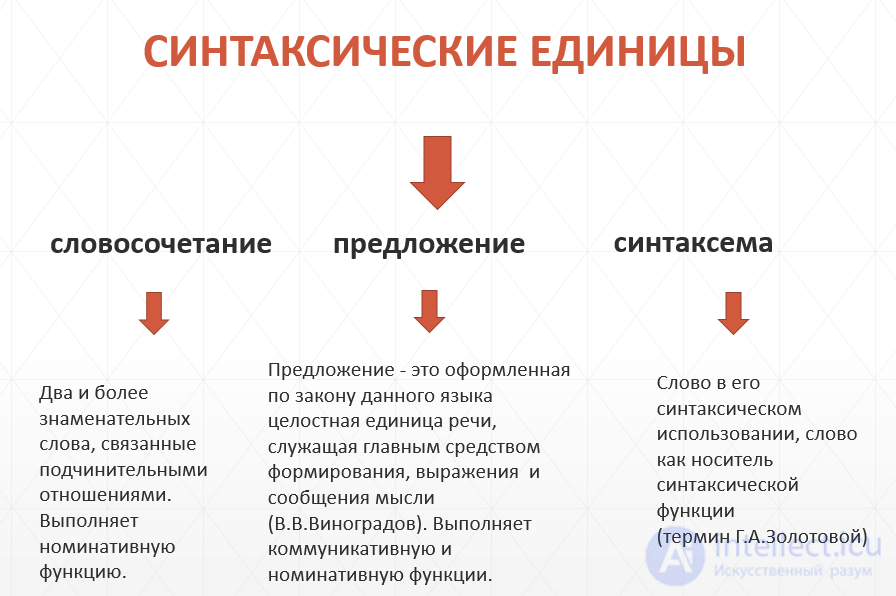
SYNTACTIC UNITS
Types of word connection in a phrase
Government
— a way of forming a subordinate connection in which the dominant component of a phrase requires the dependent component to be placed in a specific grammatical form; in this case, a change in the form of the main word does not cause a change in the form of the governed word.
in Indo-European languages it is typical for attaching to the main word a prepositional or non-prepositional word form of a noun or pronoun: English He loves his country.
strong government for expressing objective (to read a book, to cut bread) and complement (to become an enemy, to be known as an eccentric) relations
weak government for expressing object-attributive relations (a gift to the father).
Izafet
Turkish Çay bardağı - tea glass, where Çay is the modifier, and bardağı ‘glass’ is the modified word.
Tajik kitob-i khub ‘a good book’, where kitob means ‘book’, and -i is the (invariable) marker indicating that the following word is a modifier of the preceding one.
Main features of a sentence
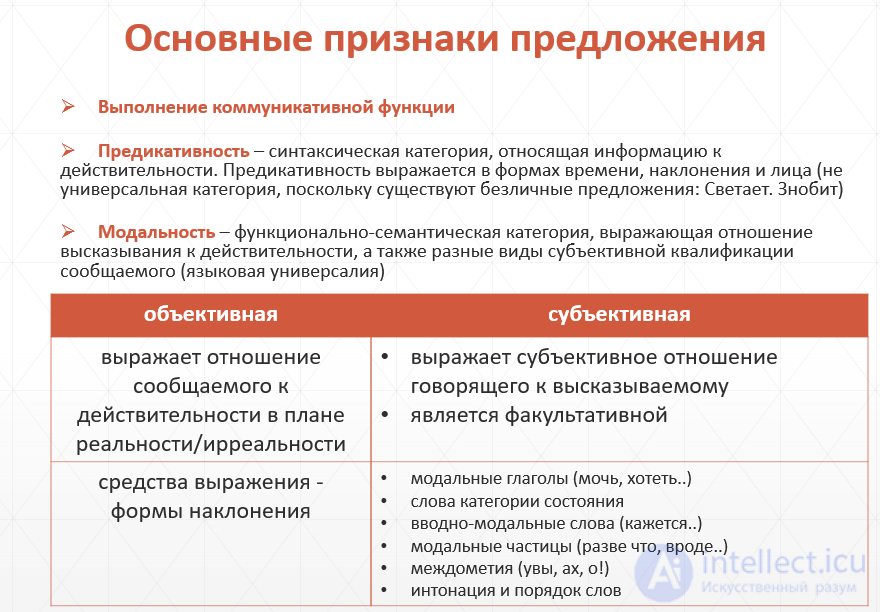
Aspects of studying the sentence
I. Structural (formal) organization of the sentence
II. Semantic organization of the sentence (nominative theory of sentence study)
III. Communicative organization of the sentence
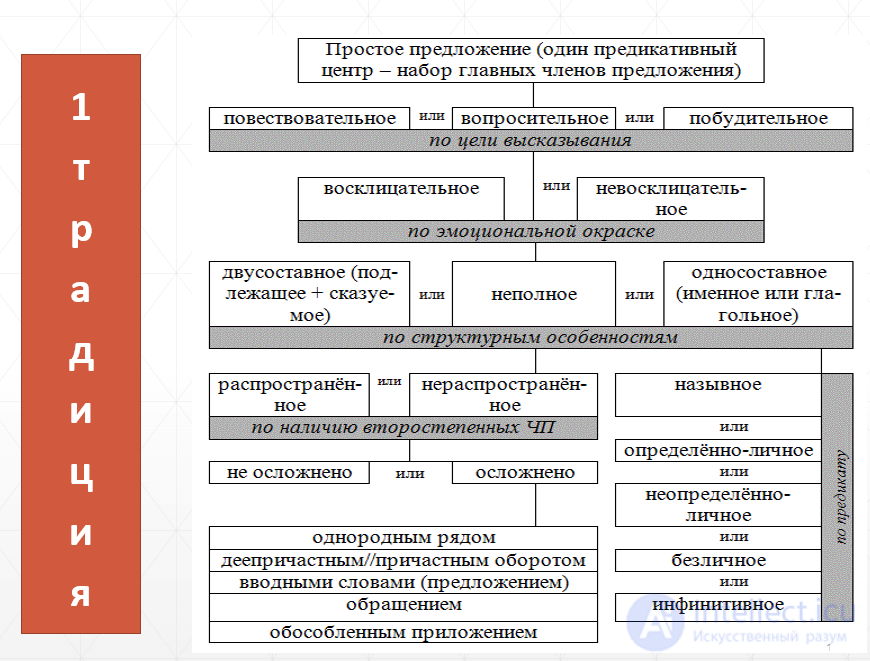
2. The verb-centric theory
Lucien Tesnière (1893-1954) - a French linguist, specialist in Slavic languages and general syntax, one of the outstanding linguists of the 20th century.
1959 «Elements of Structural Syntax» Published in Russia in 1988.
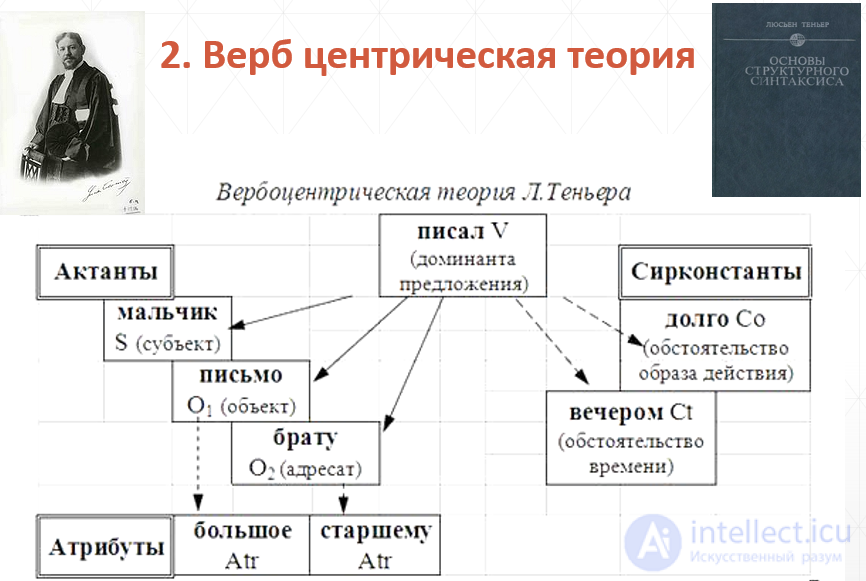
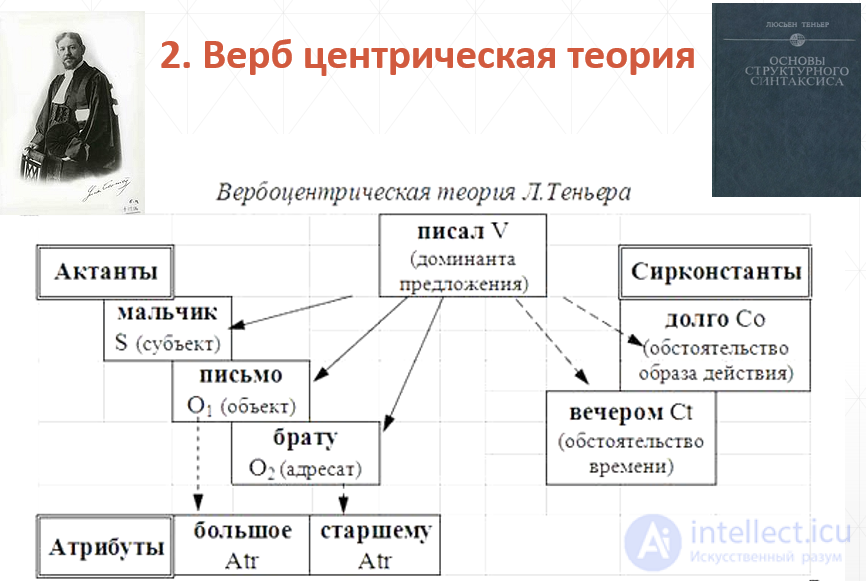
Actants have different roles: the first actant – the subject; the second actant – the direct object (i.e., the direct complement), the third – the indirect complement.
L. Tesnière's theory of actants was refined and expanded.
In the 60s-70s of the 20th century, more detailed descriptions of the semantic roles named within a sentence appeared: agent/actor, patient, beneficiary, etc.
The valency of a word is determined by:
The following types of valency are distinguished:
In Russian scholarship, valency came to be regarded as a property of all meaningful units, not only verbs.
II. The semantic organization of the sentence
Traditional linguistics (Fortunatov, Baudouin de Courtenay, Ferdinand de Saussure) held that the form of a sentence dictates its meaning, and that identical forms yield identical meaning.
The second half of the 20th century - the Nominative theory of the sentence
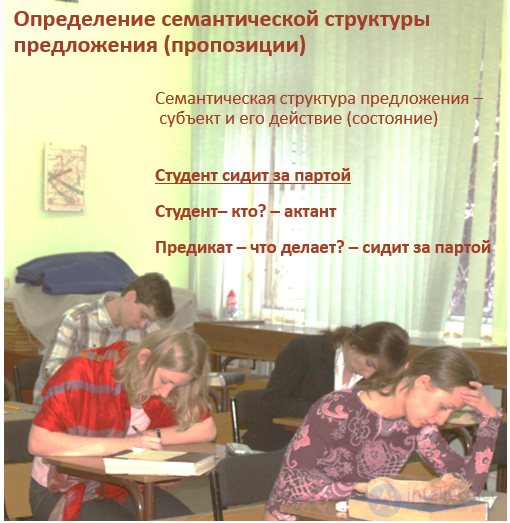
The sentence reflects a specific fragment of reality, a certain state of affairs, event, or situation
The lectern stands in the classroom. Applicants crowded near the entrance.
If the sentence is a unit of the plane of expression, then the plane of content is some event, situation.
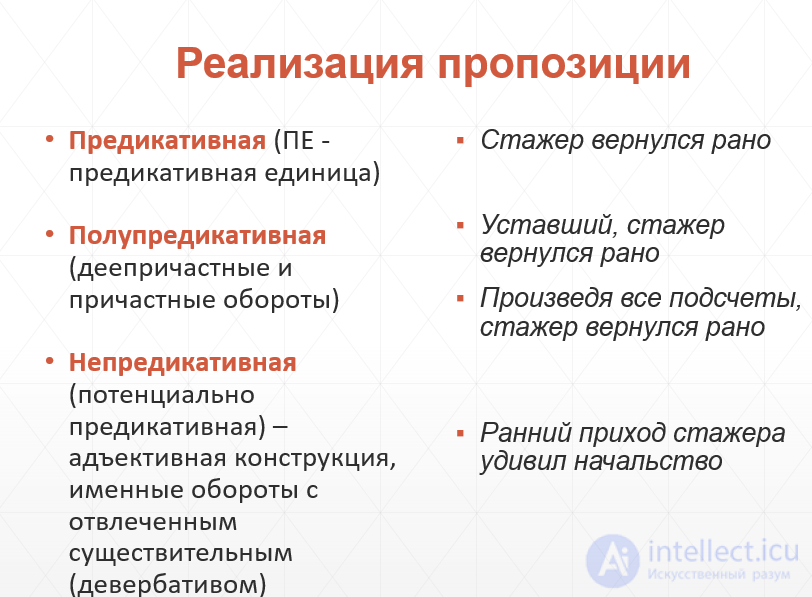
Correlation of PUs and propositions
How many PUs and propositions are there in the following sentences?
Objective and subjective content in a sentence
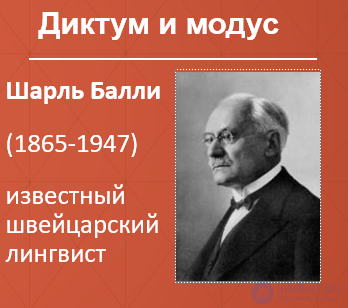
Objective and subjective content in a sentence
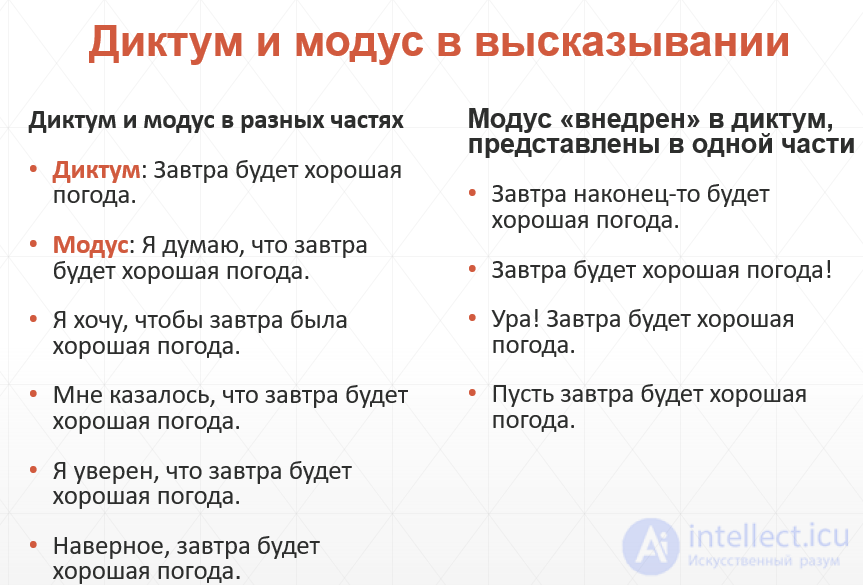
Dictum – the objective part of a sentence's content, models a situation of extralinguistic reality. Represented explicitly.
Modus – the subjective part of an utterance's content, models the speaker's attitude toward what is being communicated. May be represented explicitly or implicitly (covertly). This is an optional part of the utterance. The modus may be embedded within the dictum (The sky is gray. – The sky appears gray).
This division of the content of an utterance was first developed and formulated in the book
«General Linguistics and Questions of the French Language» (M., 1955).
Dictum and modus in an utterance
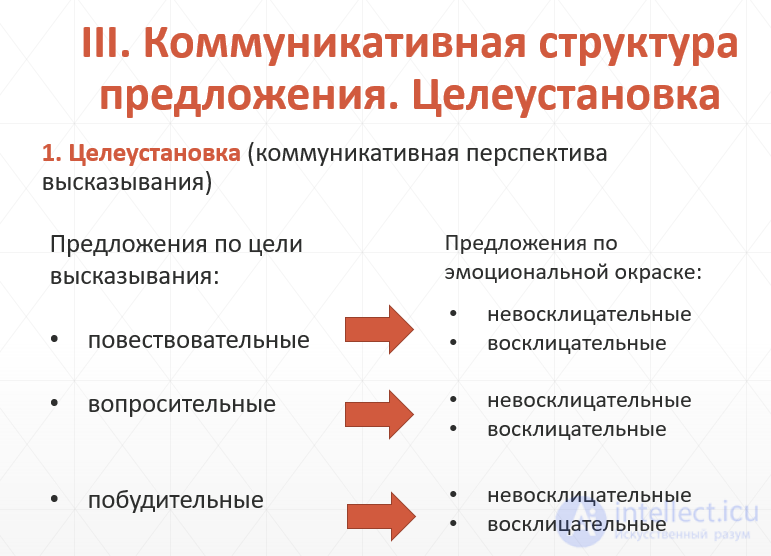
III. Communicative structure of the sentence. Purpose-setting
1. Purpose-setting (communicative perspective of the utterance)
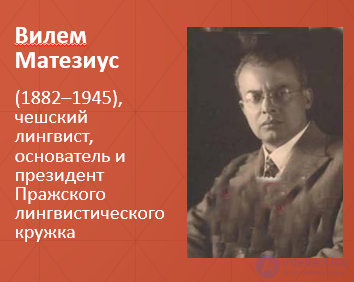
2. Actual (functional) division of the sentence
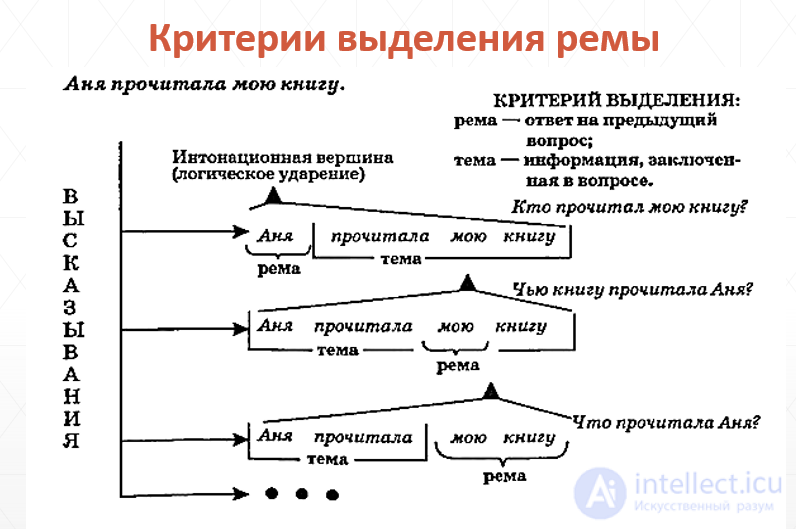
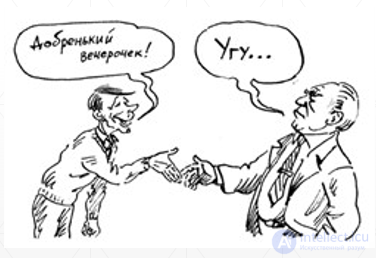
3. Pragmatic aspect of the sentence

Comments