
Lecture 5 min.
Isolating languages (also known as amorphous, monosyllabic, or root languages) are languages with a low ratio of morphemes to words. In a maximally isolating language, words would consist of a single morpheme, the root, forming neither compound words nor combinations with suffixes, prefixes, and so on. In this respect, isolating languages are the opposite of synthetic languages, in which words may consist of several morphemes.
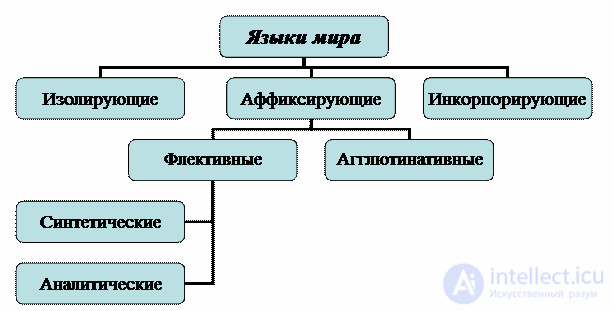
Historically, all languages were divided into three classes (isolating, inflectional, and agglutinative). The division was based on two factors:
In isolating languages, each morpheme corresponds to a separate word. Examples from Russian:
хаки (khaki)
This word (хаки, khaki) consists of only one morpheme (хаки itself); the ratio of words to morphemes is 1:1.
Another example:
проездной (proyezdnoy, 'travel pass'; lit. 'for travelling') (билет, bilet, 'ticket')
This word (проездной, proyezdnoy) consists of four morphemes (про-, -езд-, -н-, -ой; pro-, -ezd-, -n-, -oy); the ratio of words to morphemes is 1:4.
Languages considered isolating have a ratio of words to morphemes of 1:1 (or close to 1:1). In their pure form, isolating languages "have no morphology": they use independent function words for those grammatical purposes that in synthetic languages are usually expressed by affixes or by changes in the root.
The ratio of morphemes to words is treated as a continuous variable. The higher this ratio, the less likely it is that a given language is isolating. Languages with a ratio above 1.0, in which several morphemes are used in a word, are called synthetic. Inflectional and agglutinative languages can be defined as subclasses of synthetic languages. A particular language is assigned to one of the two subclasses on the basis of a single factor (the degree of "fusion" between morphemes).
Isolating languages are widespread in Southeast Asia, for example Vietnamese and Classical Chinese (which differs from Modern Chinese). Practically all the languages of the region are isolating (the exception is Malay). The Austronesian languages of this region also show more isolating features than other languages of that group. Some other isolating languages of the region are Burmese, Thai, Khmer in Cambodia, Lao, and others.
Isolating languages not only lack dependent morphemes indicating the role of words in a sentence, but also tend to avoid function words that would serve the same purpose, so word order in a sentence is usually of exceptional importance. Thus, in Chinese, word order conveys the relations between the subject and the direct object. For example:
| traditional | 明天 | 我 | 的 | 朋友 | 會 | 爲 | 我 | 做 | 一 | 個 | 生日 | 蛋糕 |
| simplified | 明天 | 我 | 的 | 朋友 | 会 | 为 | 我 | 做 | 一 | 个 | 生日 | 蛋糕 |
| pinyin | míngtīan | wǒ | de | péngyou | huì | wèi | wǒ | zuò | yí | ge | shēngri | dàn’gāo |
| literal English | tomorrow | I | (possessive particle) | friend | will1 | for | I | make | one | (measure word) | birthday2 | cake |
| literal Russian | завтра (zavtra) | я (ya) | (possessive particle) | друг (drug) | будет (budet)1 | для (dlya) | я (ya) | делать (delat') | один (odin) | экземпляр (ekzemplyar) | день рождения (den' rozhdeniya)2 | пирог (pirog) |
| "Завтра мой друг/мои друзья сделают пирог на мой день рождения." (Zavtra moy drug/moi druz'ya sdelayut pirog na moy den' rozhdeniya; "Tomorrow my friend/friends will make a cake for my birthday.") |
1 会 (huì) is an intensified form of 将 (jiāng), marking the future tense of the verb (will…). In Russian it can be rendered with intensifying words expressing certainty plus a perfective verb ("обязательно испекут", objazatel'no ispekut, 'will definitely bake').
2 生日 (shēngri) means "birthday"; here this word is not a temporal adverb but an adjective that denotes the relation to the cake, like "birthday cake" in English.
As the table shows, English, too, is quite isolating, except for the plural morpheme -s, which is a suffix. It should be noted that the word form my is not polymorphemic, as one might think when comparing it with the Chinese text. It is a single morpheme conveying the meaning of two Chinese words.
zuò ('to do, to make') does not change in the present tense:
| traditional | 他們 | 在 | 做 | 作業 |
| simplified | 他们 | 在 | 做 | 作业 |
| pinyin | tāmen | zài | zuò | zuòyè |
| literal English | they | are | doing | homework |
| literal Russian | они (oni) | есть (est')1 | делающие (delayushchie) | уроки (uroki) |
| "Они делают уроки." (Oni delayut uroki; "They are doing homework.") |
1 A copular verb, a marker of the present tense.
A sentence in Burmese (subject-object-verb word order) is constructed in a similar way:
| မနက်ဖြန် | ကျွန်တော်1 | ရဲ့ | သူငယ်ချင်း | မွေးနေ့ | ကိတ်မုန့် | တစ် | ဗန်း | ဖုတ် | ပေး | မည်။² |
| məneʔpʰyà̃ ma ne' hpyan |
ʧənɔ̀ kya no |
yḛ ye. |
θəŋèʤí̃ tha nge chin: |
mwéinḛi mwei: nei. |
keiʔ mo̰ʊ̃ kei' moun. |
tə ta |
bá̃ ban: |
pʰoʊʔ hpou' |
péi pei: |
myì myi |
| завтра (zavtra) | я (ya) | (possessive particle) | друг (drug) | день рождения (den' rozhdeniya) | пирог (pirog) | один (odin) | (measure word) | печь (pech') | давать (davat') | (future tense particle) |
| "Завтра друзья испекут пирог на мой день рождения." (Zavtra druz'ya ispekut pirog na moy den' rozhdeniya; "Tomorrow my friends will bake a cake for my birthday.") |
1 This pronoun is normally used by male speakers.
² Citation (literary) form. The colloquial form is မယ်.
In most cases, the term analytic means the same as isolating. However, analyticity implies that syntactic information is conveyed by separate grammaticalized words (see bound morphemes) rather than by morphology. Clearly, the use of separate words is an isolating factor, whereas the use of inflection to express syntactic relations promotes syntheticity.
In this sense, all isolating languages are analytic. However, there may be languages that, although they do not use inflection, have a large number of derivational affixes (see also derivation (linguistics)). For example, Indonesian has only 2 inflectional morphemes and approximately 25 derivational morphemes. Indonesian is regarded as a weakly synthetic language (hence not isolating), but analytic for the most part in the expression of syntactic relations.

Comments