
Lecture 6 min.
An attributive complex is a multi-component complex of the type noun + noun.
This is a situation in which English allows nouns to be used in the function of an adjective in relation to the head noun.
Signal frequency – "частота сигнала" (chastota signala).
Auto repair plant construction project – "проект строительства авто ремонтного завода" (proekt stroitel'stva avto remontnogo zavoda).
The appearance of attributive complexes was due to the following reasons:
The most difficult problems, as a rule, arise in translating attributive word combinations. The translation of such word combinations depends on the following factors: the semantic relations between the elements of the word combination, the composition of the word combination, and its stylistic status. Each of these conditions separately, and any combination of them, may determine the direction of transformation and the application of translation techniques and therefore require a preliminary semantic analysis.
English syntax allows the construction of attributive word combinations in which the defining component may be expressed not by a single word but by an entire word combination or even a sentence (sometimes such attributes are essentially a stylistic device, a special kind of epithet). The translation of such "two-storey" word combinations, as a rule, falls within the scope of such techniques as compression or expansion, but sometimes also requires additional functional transformations or descriptive translation:
out-of-town visitors — "приезжие посетители" (priezzhie posetiteli)
out-of-the-way places — "места, где редко бывают" (mesta, gde redko byvayut)
the better-than-anticipated — "показатели выше запланированных" (pokazateli vyshe zaplanirovannykh)
results
an-hour-early visitor — "гость, явившийся начас раньше срока" (gost', yavivshiisya nachas ran'she sroka) '',
Features of translation:
- translate on the basis of the logical-semantic (meaning-based) connections of the words
- the head word is the last one
Into Russian, nouns in the function of a modifier are translated, as a rule, by the following constructions:
Adjective
Noun in the genitive case
Noun with a preposition
As you may have noticed, the attributive noun specifies the meaning of the word that follows it in some respect, and the nature of the specification may vary within wide limits:
Certain pairs of words formed in this way become so firmly established in everyday use that they turn into a single, so-called compound noun (compound noun): bookshelf ("книжная полка" (knizhnaya polka, 'bookshelf')), classroom ("классная комната" (klassnaya komnata, 'classroom')), handshake ("рукопожатие" (rukopozhatie, 'handshake')), wheelchair ("кресло-каталка" (kreslo-katalka, 'wheelchair')), wallpaper ("обои" (oboi, 'wallpaper')) and many, many other compound words.
Chains of attributive nouns are of particular interest, because when there are two or more modifiers it becomes not entirely obvious how to group them, and although in most cases the semantics of the expression leaves no doubt, quite curious ambiguities sometimes occur. Here is a simple example to begin with, in which the modifier is an expression that itself contains an attributive noun:
night vision — "ночное зрение" (nochnoe zrenie)
night vision goggles — "прибор ночного видения" (pribor nochnogo videniya)
The reverse can also occur: an expression with an attributive noun becomes the head whose meaning is specified by a modifier standing in front of it:
water bottle — "бутылка для воды" (butylka dlya vody)
glass water bottle — "стеклянная бутылка для воды" (steklyannaya butylka dlya vody)
And speaking of curiosities, consider the following expression:
dance teacher listing — "вакансия учителя танцев" (vakansiya uchitelya tantsev)
Now let us add the specifying modifier private ("частный" (chastnyi)):
private dance teacher listing
And now how are we to understand who exactly is wanted? A private dance teacher, or an instructor for a class in private, erotic dance? A mystery...
The general rule here is simple: a noun used as an attributive is almost always in the singular, even when the head noun is clearly plural in nature, and to us this may sound rather absurd. How about these, for example:
The color of which eye do you mean, the right or the left? I demand clarification! And is it all right if I put both gloves into the glove box at once? And do you really sell only one toy in your store?
In some cases, however, the semantic load of the attributive does require it to take the form of a plural noun:
Attributive nouns pose one more difficulty, which arises in translating from Russian into English. Since the relation of belonging can be expressed in English in different forms, the question arises which of them to choose in each particular case: with a preposition, with an apostrophe, or simply with nothing (the attributive)? For example, how should one say "угол отражения" (ugol otrazheniya, 'angle of reflection') in English: angle of reflection, reflection's angle or reflection angle?
It must be said at once that there is no general answer here, and for practically any such relation of belonging one can think up contexts in which one or another of these forms would be appropriate. However, one should bear in mind that many common word combinations have a quite definite fixed form, for example:
Therefore, if you face the task of translating from Russian into English, for fixed word combinations and expressions try, where possible, to find the exact (or most common) translation variant; it is quite likely to turn out to be not at all what you imagined. For example, it will be much better to translate "род деятельности" (rod deyatel'nosti, 'type of occupation') as occupation than as activity gender or gender of activity
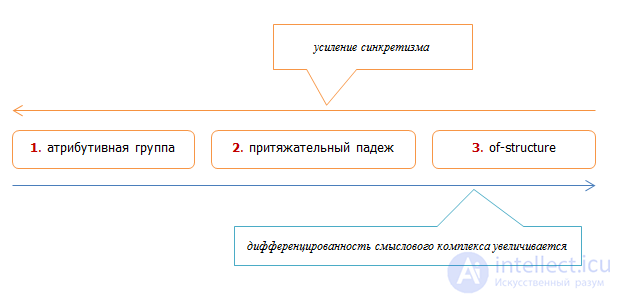
Syncretism is expressed most strongly in attributive combinations, less so in semantic complexes with the possessive case, and in the of-structure syncretism is weakest:

Comments