
Lecture 11 min.
A phraseological unit, or idiom, is a word combination that is stable in composition and structure, lexically indivisible, and holistic in meaning, and that functions as a single lexical unit. An idiom is used as a whole, ready-made combination of words that cannot be broken down further and usually does not allow its parts to be rearranged internally.
Classifications of phraseological units:
1. Phraseological fusions – absolutely indivisible word combinations, "whose meaning is completely independent of their lexical composition and of the meaning of their components…" For example, to rain cats and dogs – лить как из ведра (lit' kak iz vedra, lit. 'to pour as from a bucket'; of rain); be all thumbs – быть неловким, неуклюжим (byt' nelovkim, neukluzhim, 'to be clumsy, awkward').
2. Phraseological unities - word combinations in which "the meaning of the whole is linked to an understanding of the figurative core of the phrase, of the potential meaning of the words".[1, 94]. For example, to spill the beans – выдать секрет (vydat' sekret, 'to give away a secret'); to burn bridges – сжигать мосты (szhigat' mosty).
3. Phraseological collocations – word combinations "formed by the realization of bound meanings of words". These lexical meanings can manifest themselves only in connection with a strictly defined range of concepts and their verbal designations. For example, one can say ''страх берет'' (strakh beret, lit. 'fear takes [one]', i.e. 'one is seized by fear'), ''тоска берет'' (toska beret, 'one is seized by anguish'), but one cannot say ''радость берет'' (radost' beret, 'joy takes [one]'), ''наслаждение берет'' (naslazhdenie beret, 'delight takes [one]'), and so on. For example: a bosom friend – закадычный друг (zakadychnyy drug), a pitched battle – ожесточенная схватка (ozhestochennaya skhvatka),
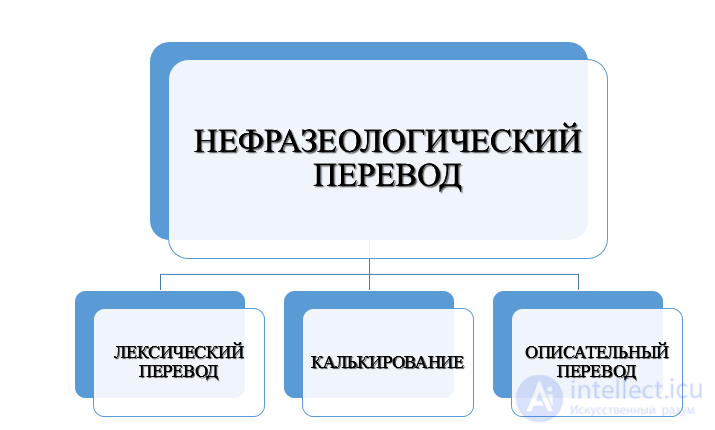
Non-phraseological translation, as the name itself indicates, renders a given phraseological expression by lexical rather than phraseological means of the target language. It is usually resorted to only after making sure that none of the phraseological equivalents or analogues can be used. Even taking into account the compensatory potential of the context, such a translation can hardly be called adequate: there are always some losses (imagery, expressiveness, connotations, aphoristic quality, shades of meaning), which is what makes translators turn to it only in cases of extreme necessity.
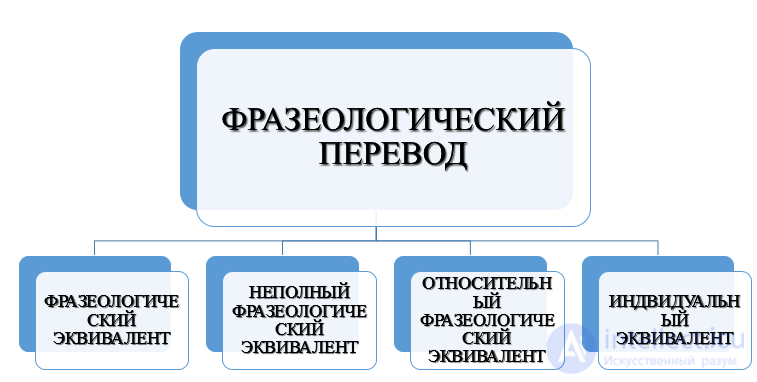
Phraseological equivalents
Full equivalents are Russian equivalents, for the most part single equivalents of English idioms, that coincide with them in meaning, lexical composition, imagery, stylistic orientation, and grammatical structure. The number of such correspondences is small: for example: burn one's boats - сжечь свои корабли (szhech' svoi korabli); in the seventh heaven - на седьмом небе (na sed'mom nebe), etc.
A partial equivalent does not imply any incompleteness in the rendering of meaning, but merely contains lexical (kill the goose that lays the golden eggs - убить курицу, несущую золотые яйца (ubit' kuritsu, nesushchuyu zolotye yaytsa, lit. 'to kill the hen that lays golden eggs')) or grammatical differences (for example, in number: play into somebody's hands - играть на руку кому-л. (igrat' na ruku komu-l.); there is no rose without a thorn - нет розы без шипов (net rozy bez shipov), and differences in word order: all is not gold that glitters - не все то золото, что блестит (ne vse to zoloto, chto blestit); he laughs best who laughs last - хорошо смеется тот, кто смеется последним (khorosho smeyotsya tot, kto smeyotsya poslednim). In the last case there is also a minor lexical difference (best - хорошо (khorosho, 'well')), or lexico-grammatical differences
"Overtone" translations, or "contextual substitutions"
Calquing, or literal translation.
The problem of translating English idioms
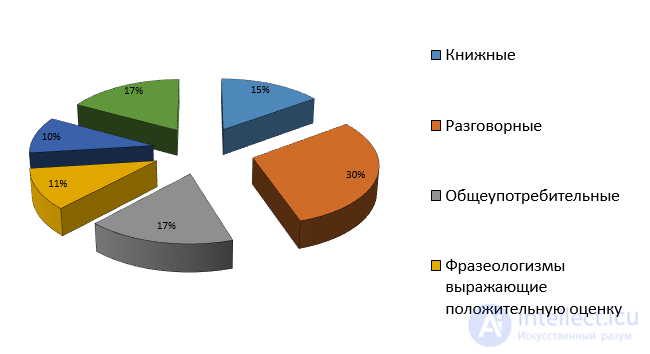
Classification of idioms in Maugham's works
It is worth noting that phraseological equivalents and analogues are found most often in the following groups of set expressions:
This category includes phraseological units , which have entered the languages of many peoples from historical (chiefly ancient), mythological, and literary sources, that were borrowed from language to language, or that arose among different peoples independently of one another owing to the commonality of human thinking and the similarity of certain aspects of social life, work activity, production, and the development of science and the arts.
Many such units are winged words. Among them are quite a few connected with historical or mythological figures. Thus, in different languages there are phraseological equivalents of the English Achilles' heel: French talon d'Achilles, German Achilles Ferse, Czech Achilova pata, Russian ахиллесова пята (akhillesova pyata), Bulgarian ахилесова пета (ahilesova peta); Bulgarian пирова победа (pirova pobeda) and Russian Пиррова победа (Pirrova pobeda) are equivalent, as are English Pyrrhic victory and French victoire a la Pyrrhus.
It is easy to see that many of the listed phraseological units are calques, that is, precisely the formations that are needed for full equivalence. This is very good and makes the work of a translator who knows how to use dictionaries much easier. There is, of course, a "but". Membership in the international category is not enough by itself to ensure the correct translation of an idiom. First, far from all "international units" that have entered one language exist in the others. Second, despite the identical route of translation (calquing), minor formal differences are still noted between equivalents (a phrase versus a compound word, a prepositional versus a non-prepositional construction, different suffixation, etc.), and this sometimes makes things considerably harder for the translator: "Achilles" in Bulgarian transcription is "Ахил" (Ahil), so one would have expected "Ахилова пета" (Ahilova peta); the Russian equivalent козла отпущения (kozla otpushcheniya, 'of the scapegoat', genitive) is English scapegoat, a translation by a compound word (which is far more common in German). Third, although comparatively rarely, there may be more than one equivalent, and then the translator cannot mechanically replace his unit with an equivalent one.
All these "buts" place a strict demand on the translator: to check every doubtful case in dictionaries.
Quite often, phraseological equivalents are found among set comparisons. Many peoples say: sings like a nightingale, brave as a lion, stubborn as a donkey, drunk as a pig, and so on. But for the same qualities, alongside these images there are others that are unfamiliar to the target language. A comparison with a "nightingale" clearly will not do for countries where the bird is unknown, and the translator must weigh it twenty times before introducing an unfamiliar image once. The other comparisons require the same weighing: whether to translate with one's own, familiar image or to preserve the "exotic" one. For example, the English and the French see stubbornness in the mule, while the donkey is also a symbol of stupidity; as for drunkenness, alongside the pig, various peoples use quite a few other images: French (drunk as) a thrush, a monk (Franciscan, Templar), or a slice of bread in broth.
Compound terms (including compound names) are a special group of phrasal units that in any case require equivalents in the target language. However, since the terminological element prevails over the phraseological in them, we list them here with the proviso that they are always translated by equivalents, though not necessarily phraseological ones: many compound terms in one language have single-word equivalents in another (cf. Bulgarian зъбно колело — Russian шестерня (zabno kolelo, 'toothed wheel' — shesternya, 'gear'), English thorax or chest — Russian грудная клетка (grudnaya kletka), Bulgarian гръден кош (graden kosh)).
Grammatical phraseology is a conventional name for multi-word (separately written) function parts of speech, chiefly compound prepositions and conjunctions. Prepositions such as в течение (v techenie, 'during') (чего, chego, + genitive) and в связи (v svyazi, 'in connection') (с чем, s chem, 'with what'), and conjunctions such as так как, благодаря тому что, в то время как (tak kak, 'since'; blagodarya tomu chto, 'thanks to the fact that'; v to vremya kak, 'while'), etc., like terms, require an equivalent in the target language, though not necessarily a phraseological one. Among them there are also units of international currency, such as English in accordance with, with the exception of, German im Einklang mit, mit Ausnahme von, Russian в соответствии с, за исключением (v sootvetstvii s, za isklyucheniem), and so on.
Verb-noun combinations (verbal descriptive expressions) make up a substantial group of non-figurative phraseological units, a category that is still not clearly delineated in theory but is already represented in practice by several Russian reference dictionaries. They are also called set, or bound, word combinations, a designation that in essence applies to any phraseological unit; they are considered to unite phraseological collocations and expressions; in our view, these are most likely units taking shape on the basis of stable lexico-syntactic combinability.
Regardless of whether these units are considered idioms or not, their translation tends toward the phraseological, although one often has to resort to their single-word synonyms. The point is that "descriptive verb-noun expressions" often differ stylistically from their single-word synonyms (cf. предавать забвению (predavat' zabveniyu, 'to consign to oblivion') and забывать, стоять на страже (zabyvat', 'to forget'; stoyat' na strazhe, 'to stand guard') and сторожить, питать доверие (storozhit', 'to guard'; pitat' doverie, 'to have trust') and доверять, принять решение (doveryat', 'to trust'; prinyat' reshenie, 'to make a decision') and решить), (reshit', 'to decide'), which for the most part is what forces the translator to look for phraseological equivalents for them in the target language.
Much of what has been said about the translation of non-figurative phraseology also applies to phraseological schemes, or syntactic phraseology, whose units M. Leonidova assigns to an "intermediate, syntactic-phraseological level"; unlike grammatical phraseology, they too tend toward phraseological translation, mainly because of their expressive coloring. From the standpoint of translation this category is extremely interesting, but it is still almost entirely undeveloped.
No reference was made to the scene. But from then on things went from bad to worse .
Об этом инциденте они старались не упоминать. Но с тех пор дела пошли из рук вон плохо (Ob etom intsidente oni staralis' ne upominat'. No s tekh por dela poshli iz ruk von plokho)
The idiom go from bad to worse is used in the sense of "to get worse and worse; out of the frying pan into the fire" (из огня, да в полымя, iz ognya, da v polymya, lit. 'out of the fire and into the flame').
He was a fine, upstanding fellow and he was not at all badly off.
Это был превосходный подающий надежды молодой человек, к тому же далеко не бедняк. (Eto byl prevoskhodnyy podayushchiy nadezhdy molodoy chelovek, k tomu zhe daleko ne bednyak.)
The idiom badly off is used by Maugham in the sense of "in need, in poverty".
The idiom black as night has the meaning "joyless, hopeless; in a dark light". In this particular sentence, however, the technique of calquing was used.
‘It’s wonderful’, he said to them one day at supper. ‘It’s a true rebirth. Her soul, which was black as night, is now pure and white like the new-fallen snow’ [1.33, p. 33].
"– Это просто чудо", – сказал он (Дэвидсон) как-то за ужином. – Это истинное возрождение. Его душа, которая была чернее ночи, нынче чиста и бела, как первый снег. (Eto prosto chudo, skazal on (Devidson) kak-to za uzhinom. Eto istinnoe vozrozhdenie. Ego dusha, kotoraya byla chernee nochi, nynche chista i bela, kak pervyy sneg.)
[[b5168]]

Comments