
Lecture 20 min.
Borrowing, in linguistics and translation studies, is the process by which one language adopts a word, expression, or meaning of another language as is (that is, without translation), as well as the result of this process, the borrowed word itself.
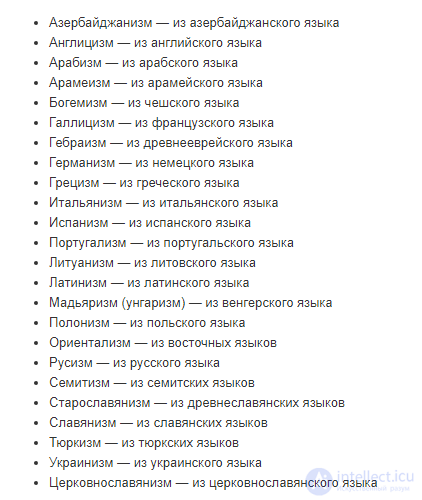
Depending on the donor language, borrowings in Russian are called anglicisms, arabisms, germanisms, and so on. In some cases the name of a borrowing may not coincide with the modern name of the language used by its speakers, but may derive from an alternative or older name of the state, country, people, or source language, or of their ancestors or territorial predecessors: for example, borrowings from Czech are called bohemisms (from the historical name of the region of Bohemia), and those from French are called gallicisms (cf. Gaul, the Gauls). The name of a borrowing may cover a group of related languages (Slavicism, Turkism), and so on.
In theory, it is customary to distinguish, by a number of parameters, borrowing from closely related, distantly related, and unrelated languages.
Borrowings may be direct (between the languages of neighboring peoples and cultures) or mediated, involving an intermediary language. Borrowings from one language into several, with minimal change in form and meaning, are called internationalisms. The route of borrowing may be oral, through live conversational contact between speakers of different languages, or written, through contact with foreign-language vocabulary in book sources. By the latter means it is possible to borrow elements belonging to an older stage of the same language (the revival of archaisms, for example in poetic language: Richard Wagner in his music dramas, Count Aleksey Tolstoy, and others).
By the way a foreign word is adapted, the following are distinguished:
Semantic calques is also a common name for semantic borrowings. Calquing is a soft way of assimilating a foreign meaning and is widely used in the languages of countries where public opinion disapproves of direct forms of borrowing, considering them destructive to the language (Czech, Finnish, Icelandic).
As early as the early Middle Ages, English took in a large number of borrowings from the Scandinavian languages (including such basic words as skin, ill, and even she). The largest wave of borrowings was medieval, after the Norman Conquest, from Old French; as a result, almost half of the English vocabulary has Romance roots. In the modern period, a large number of learned Latinisms and new borrowings from the continental languages entered the language.
Borrowings from the Celtic languages in English are few and in most cases belong to dialectal vocabulary or to the vocabulary of the lower strata of the population. Of interest is the counting system of British sheep farmers, which derives from the numerals of the extinct Cumbric language. A syntactic calque from the Celtic languages is, by origin, the Continuous tense system, which is absent from the other Germanic languages.
Words that entered English during trade contacts back on the continent, for example: wine, pear, pepper. The ancient tribes, the ancestors of the Anglo-Saxons, who inhabited the northern part of Central Europe, traded with the Roman Empire, fought against it, encountered Roman merchants, and borrowed from the Romans a number of words connected with trade, goods, and objects new to these tribes. Words borrowed during Christianization: mass, school, priest, devil, and others. The second layer of Latin borrowings is connected with Christianity, which was brought by Roman preachers who converted the pagan Anglo-Saxons to the new faith. The language of church services was Latin, so many Latin words of religious content penetrated Old English. Most of these words were not originally Latin but came into Latin from Greek, since Christianity took shape in the eastern part of the Roman Empire. Christian books were translated into Latin.
From Danish, as a result of the Scandinavian conquest (from approximately 870). This group of borrowings is not very numerous, but it includes very frequent words. Here are some examples:
they, them instead of hie, hem (hem has survived in colloquial expressions such as I met 'em yesterday);
take, cut, get, in place of which native English words would have given in the modern language *nim, *snide, *werth;
are, fellow, gear, ill, happen, happy, husband, kick, law, leg, low, odd, rove, rug, scale (in the sense "fish scale"), scalp, skill, skin, skip, skull, tight, ugly, wrong, etc.
nay, fro, skirt, dike, sky, screech, for which English cognates have survived: nay, from, shirt, ditch, welkin, shriek;
suffixes in toponymy: -by, -beck, -thorp(e), -fell, -toft, -thwaite, from the Scandinavian words byr "settlement", bekkr "stream", thorp "village", fjall "mountain", topt "homestead", thveit "enclosed plot" and others; examples of place names: Rugby, Welbeck, Scunthorpe, Micklefell, Lovestoft, Applethwaite;
flock, mug and some others entered through the mediation of Anglo-Norman;
nag, ombudsman, ski, skive, slalom, slam are words denoting realities new to the English; they came in from the modern Scandinavian languages in the 19th and 20th centuries.
Scandinavian borrowings are difficult to distinguish from native English words, since Danish and Old English were closely related languages. A characteristic difference is that Danish words retained /k/, /g/ and /sk/, whereas in English these turned into sibilants (palatalized): /k/ and /g/ under certain conditions, /sk/ always.
In 1066 the Normans conquered England. Normandy was a French duchy; it acquired its name after the French king Charles the Simple, unable to cope with the Vikings, ceded this territory to them by treaty in 912. By 1066 the Vikings had long since adopted the French language and had assimilated with the local population. They came to England as speakers of French (the Norman dialect) and bearers of French culture and the French feudal system. After the Norman Conquest power lay entirely in Norman hands; Duke William the Conqueror also removed English clergy and replaced them with Norman ones. The native population continued to speak English, while the Norman dialect developed into Anglo-Norman, which became the language of the state and lasted until the end of the 14th century. During this time English absorbed an enormous number of French words. Of the 80,000 most frequently used words of English, approximately 22,500 are French borrowings (of all periods of history).
Borrowings reflect Norman influence particularly clearly in the spheres of government, military affairs, church organization and urban life:
Craftsmen who lived in the countryside kept their English names, whereas urban ones came to be called by French words: butcher, mason, tailor. Animals are named with English words, but their meat with French ones: beef, mutton, pork, veal.
Terminology, 16th century. The Middle Ages were succeeded by the Renaissance, which is characterized by the rapid development of science and technology, an unprecedented flowering of literature and art, the invention of printing, the great geographical discoveries, and the successes of materialist philosophy in its struggle against church dogma and the dominance of the church. In this period English borrowed many words from the classical languages. They differed sharply from earlier borrowings in character: as a rule, they are scientific words. They entered the language in written form, through literature and scholarly works, which contributed to the maximum preservation of the Latin form of the word.
In the first half of the 20th century a large number of German words, including individual morphemes such as eigen-, entered British scientific vocabulary. The penetration of German vocabulary continued during the Second World War in the domain of military terms and practically ceased after the war.
Borrowing of foreign words is the process by which some foreign-language element appears and becomes established in a language; the term also denotes such a foreign-language element itself. Borrowings result from contacts and relations between peoples, professional communities and states.
When Russian lacks some concept it needs (this may be either a new "object" or a new "idea"), there are four possibilities:
The first method is not a borrowing but word creation. This method is the most natural and preferred one for Russian. Words and meanings created by the second and third models are called borrowings in the broad sense. In scientific terminology, which strives for unambiguity, the second and fourth mechanisms are used more often. The second and third mechanisms, after word creation, are the most important sources of enrichment of the standard literary language.
The nature and volume of borrowings in Russian make it possible to trace the paths of the language's historical development, that is, the paths of international travel, contacts and scientific development, and, as a consequence, the crossing of Russian vocabulary and phraseology with other languages. Observing the transfer of words and phrases from a foreign language into Russian helps to understand the history of Russian, both the literary language and its dialects.
Table 1. Features of borrowed words
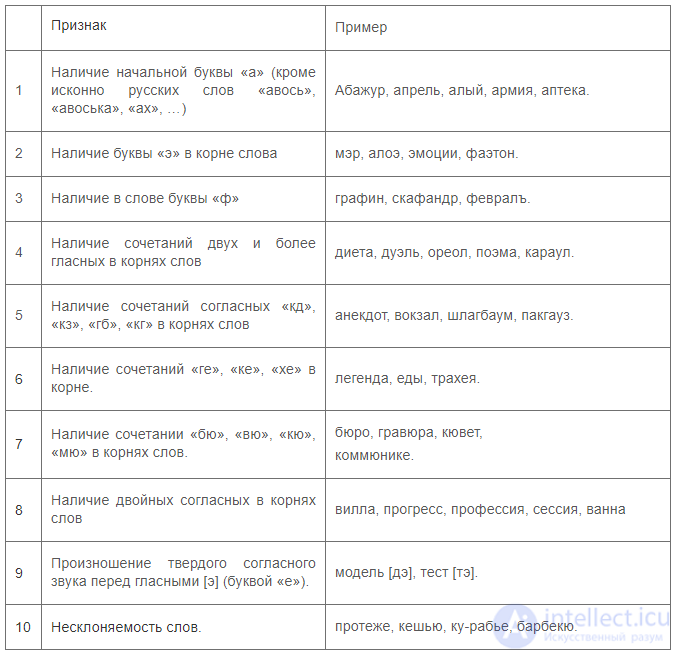
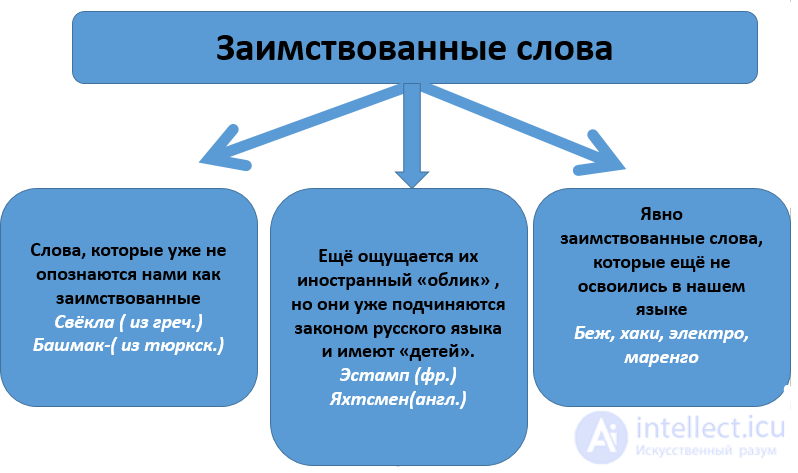
Borrowed words have two main spheres of application:
Powerful layers of borrowed vocabulary in many languages consist of words that are internationalisms, often of a terminological nature. Thus, in the European tradition, scientific and technical vocabulary formed from Latin and Greek roots has long been international. In contrast to the change (most often narrowing) of meaning found in other types of borrowing, internationalisms in a number of languages coincide almost completely in both their sound-letter form and their meaning, which serves to ensure the unity of terminology across different fields of human activity. Such words are understood by educated speakers of many languages. Examples of internationalisms include words such as радиус (radius, from Lat. radius "ray") or its derivative радио (radio); also юриспруденция (yurisprudentsiya, 'jurisprudence', Lat. jurisprudence), телевидение (televidenie, 'television'; television from Gk. tele- "far" and Lat. vision "sight, seeing"). In recent decades the main source of internationalisms has been English, whose influence is noticeable in such areas of human activity as information technology (examples of internationalisms: компьютер (komp'yuter), принтер (printer), роутер (router), сканер (skaner), Интернет (Internet), сайт (sayt, 'website'), Википедия (Vikipediya, 'Wikipedia') and many others), modern music (джаз (dzhaz, 'jazz'), рок (rok, 'rock'), панк (punk), свинг (sving, 'swing'), блюз (blyuz, 'blues'), рэп (rep, 'rap')) and economic theory and practice (бизнес (biznes, 'business'), маркетинг (marketing), менеджмент (menedzhment, 'management'), мерчандайзер (merchandayzer, 'merchandiser'), аутсорсинг (autsorsing, 'outsourcing')).
If a word was polysemous in the source language, usually only one of its meanings is taken over in borrowing; that is, the word's meaning is narrowed, for example:
The same applies to calques:
Borrowing increases the lexical volume of a language, serves as a source of new roots, other word-formation elements and terms, expands and nuances the range of concepts used in different areas of social life, or replaces existing ones. It is a spontaneous or managed form of language contact and a source of language change. Where inter-language contacts are massive and intensify, borrowing, along with other forms of language interaction, can lead to the formation of hybrid forms of speech (trade languages) and mixed languages (pidgins, creoles), and so on.
Purist views are widespread that borrowings clog the language and do it irreparable harm, since they destroy the links between native words and introduce alien meanings into its system; however, this may be contradicted by such obvious facts as that many of the richest languages (English, German, Russian, Japanese) contain entire layers of borrowed words. Moreover, in most cases the borrowing of foreign words accompanies the adoption of technological, cultural, social and other innovations. Hence the enormous importance of borrowed words for cultural history.
Slavic Christian terminology, taken from the Greeks together with Christianity; Russian nautical terminology, of Dutch-German origin, like seafaring generally; the common European musical terminology, coming from Italy; fashion terminology, taken from France; and so on. Some borrowed words, such as the names of metals, animals and plants, are very ancient and are almost round-the-world travellers, passing from one people to another together with the objects themselves. Thus Russian тмин (tmin, 'caraway'; dialectally also кмин, kmin), Polish kmin, Old Church Slavonic, German Kümmel (Old High German chumin) trace their origin to Greek κύμινον and Latin cuminum borrowed from the latter, which in turn go back to Ancient Hebrew כַּמּוֹן ("kammon"), which then meant cumin . See also тмин (tmin, 'caraway').
There is no doubt that borrowing occurred on a wide scale in prehistoric times as well. It may well be that some words taken to be Common Indo-European were borrowed into Proto-Indo-European from other languages. However weak the cultural development of the undivided Indo-Europeans may have been, they must still have had trade and other dealings with other peoples, and borrowing could undoubtedly have taken place. Science is so far unable to identify such most ancient borrowings, although something will probably be uncovered through further joint work by archaeologists and linguists.
The most reliable criterion for establishing that a word is borrowed is its phonetic makeup. The contradiction of a word's sounds to known phonetic laws characteristic of the given language usually testifies to the word's foreign origin. Thus, for example, the Russian word "брада" (brada, 'beard'), formerly used in elevated style alongside the basic word "борода" (boroda, 'beard'), is borrowed from Old Church Slavonic (through Church Slavonic), because ра (ra) (instead of the expected оро (oro) found in the native Russian word борода) contradicts the sound law of the so-called pleophony, or full vocalization (likewise with град (grad, 'city') — город (gorod, 'city'), страж (strazh, 'guard') — сторож (storozh, 'watchman'), etc.).
The other criteria, semasiological (a difference in meaning) and morphological (a difference in form), are less reliable and can be applied only when it is impossible to determine a word's origin from its phonetic makeup. Thus the secondary, non-everyday meanings of the words муж (muzh, 'husband'; secondary 'man') "man" and жена (zhena, 'wife'; secondary 'woman') "woman" were possibly borrowed from Latin homo and mulier through the mediation of Church Slavonic.
A distinction is usually drawn between "assimilated" words (Ger. Lehnwörter) and "foreign" words (Ger. Fremdwörter). The former are customarily taken to be words that were mostly assimilated very long ago and do not give the impression of anything alien, that is, that have become "native" in the given language, for example, князь (knyaz', 'prince'), витязь (vityaz', 'knight, warrior'), известь (izvest', 'lime'), комната (komnata, 'room'), корабль (korabl', 'ship'), лошадь (loshad', 'horse'), таможня (tamozhnya, 'customs house'), хлеб (khleb, 'bread'), царь (tsar', 'tsar'), церковь (tserkov', 'church'), etc. The latter include words assimilated mostly recently that still retain their foreign appearance: аберрация (aberratsiya, 'aberration'), офицер (ofitser, 'officer'), дифференциация (differentsiatsiya, 'differentiation'), параллакс (parallaks, 'parallax'), адъютант (adyutant, 'adjutant'), etc. This division, however, cannot be called strictly scientific; it is based on a subjective impression, which is highly changeable, and serves only as a basis for some kind of classification. A critique of it can be found in S. Bulich's work "Church Slavonic Elements in the Modern Literary and Popular Russian Language" (Part I, St Petersburg, 1893, Introduction); the most important literature on the question is also listed there, and the process itself is characterized. See also his "Borrowed Words and Their Significance for the Development of Language" ("Russkii filologicheskii vestnik" [Russian Philological Herald], Warsaw, 1886, no. 2).

Comments