
Lecture 6 min.
Simultaneous interpreting is one of the most demanding types of oral translation, in which the interpreter renders the speech into the target language synchronously, while listening to the source-language speech, as opposed to consecutive interpreting, in which the interpreter speaks during pauses in the source-language speech . A simultaneous interpreter is an interpreter who specializes in simultaneous interpreting.
Simultaneous interpreting is normally performed with special simultaneous interpreting equipment; sometimes the whispered interpreting technique (chuchotage) is used for an individual listener. Simultaneous interpreting is possible because in modern languages about 50% of words carry no new information, and it is also significant that a certain part of the information is not perceived by listeners anyway.
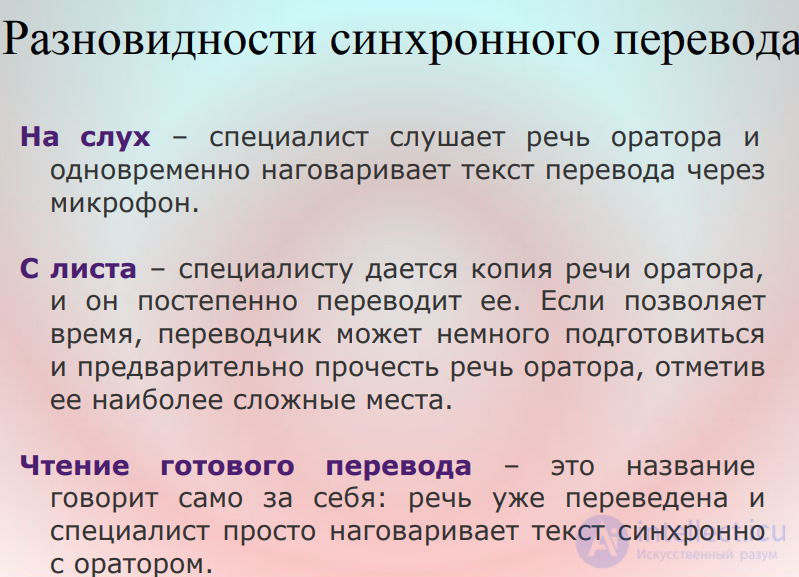
Fig. Types of simultaneous interpreting
Simultaneous interpreting appeared in the late 1940s. It was initiated by the UN. There are 2 varieties:
Simultaneous interpreting appeared in the late 1940s. It was initiated by the UN.
Simultaneous interpreting is a form of translation in which the interpreter translates at the same time as the speaker is talking, lagging behind the speaker by, as a rule, 1 to 1.5 sentences. Simultaneous interpreting appeared with the founding of the UN.
Simultaneous interpreting is translation performed at the same time as the speaker's speech. Working in the simultaneous mode requires constant concentration of attention and uninterrupted speaking. The working schedule of a simultaneous interpreter presupposes a 40-minute rest after 20 minutes of work.
The simultaneous interpreter has to react every second to the words perceived by ear. An indispensable condition for the success of a simultaneous interpreter is a stock of equivalent pairs of lexical units linked with each other by a sign relation, which make it possible to translate not through thinking but through conditioned reflexes. Hence the conclusion: simultaneous interpreting really is performed at the same time as the speaker's speech, which yields a considerable gain in time, thereby banishing from conference halls the minutes and hours of endless boredom that overcomes those present.
In simultaneous interpreting, the sign-based method may be used, which involves a transition from a sign (a word or phrase) of one language to a sign of another. It can play the role of a lifesaver in simultaneous interpreting.
Most simultaneous interpreters work in the phrase-by-phrase translation mode.
If something unexpected occurs in the speaker's speech that breaks the routine attributes of speech, the interpreter has to switch from the autonomous, skill-level mode of work to the mode of conscious processing, with all the attendant phenomena: lagging behind the speaker, omission of minor details, and speech slips.
From the above we can conclude that a person becomes a simultaneous interpreter only if the two languages coexist in his or her mind not as separate systems but in a single semantic field of working situations, anticipated contexts and a given subject area
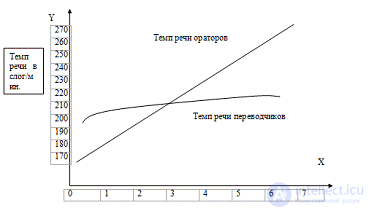
Fig. 2. Graph of the dependence of interpreters' average speech rate on speakers' speech rate
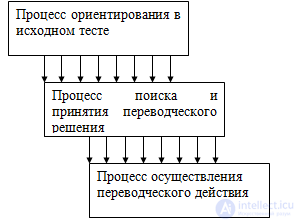
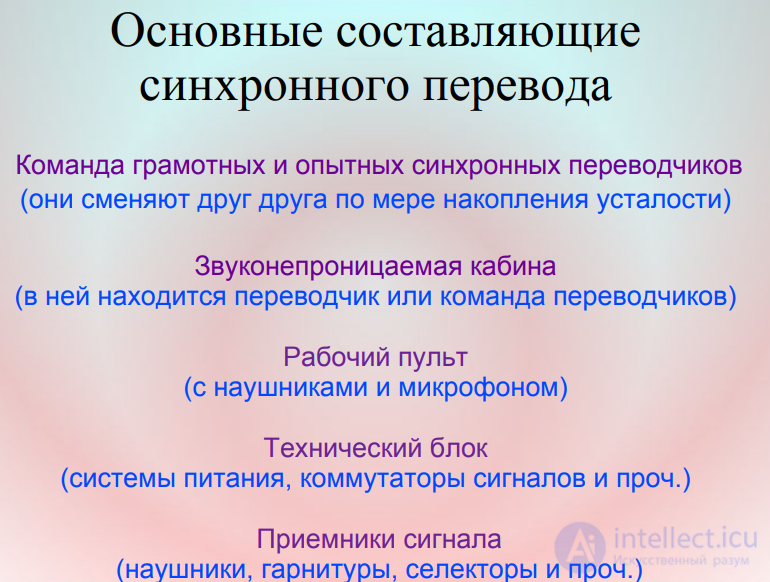
Fig. Technical equipment for simultaneous interpreting
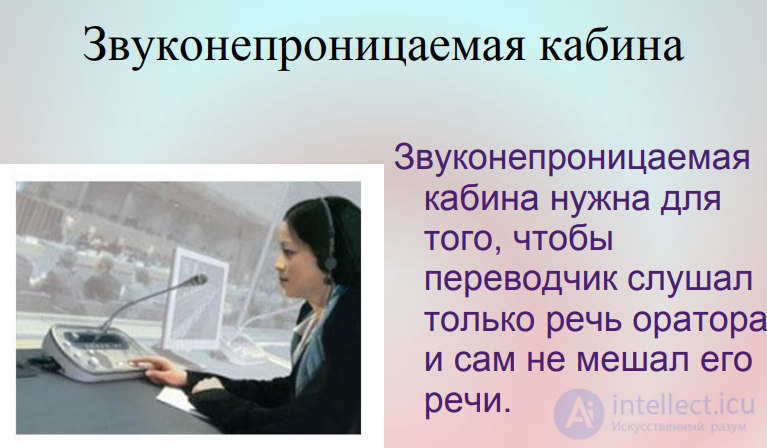
Fig. Soundproof booth
Besides the requirements of fluent command of the foreign and native languages and of grammatically correct, phonetically well-articulated speech in the target language, a simultaneous interpreter needs certain specific skills. First of all, this means knowledge of a stock of set constructions and clichés and the ability to find them quickly, that is, automatization of linguistic and speech means of expression, which ensures speed of reaction. Since simultaneous interpreting requires a high degree of concentration, prolonged work at an event with simultaneous interpreting demands a high level of mental and physical endurance. At large events interpreters work in shifts, with one interpreter's turn lasting 15 to 30 minutes of continuous work.
Because of its complexity, mastering simultaneous interpreting requires thorough and lengthy training. Simultaneous interpreting is taught in philology programmes at universities and at linguistic institutions of higher education; there are also specialized educational institutions focused on training interpreters. The International Association of Conference Interpreters maintains a register of educational institutions that meet the association's requirements and train simultaneous interpreters for events; for example, the institutions listed as training interpreters from English into Russian include Astrakhan State University, the University of Geneva, the University of Bath, Shanghai International Studies University, the Institute of Intercultural Management and Communication of the French Grandes Écoles, the University of Paris III, the University of Mainz, Heidelberg University, the Munich Institute of Foreign Languages and Translators, Israel's Bar-Ilan University, City University London, the Middlebury Institute of International Studies, and the advanced translation courses at the University of Maryland. The content of training in simultaneous interpreting has a structure isomorphic to the structure of the final goal of training, i.e. each component of the training content specifies the scope and nature of the knowledge, abilities and skills corresponding to the realization of a specific training goal. The structure of training includes preparatory exercises (checking and switching on the equipment, listening to and repeating the source text, etc.), practice exercises (simultaneous reading of a previously translated text, simultaneous sight translation, simultaneous interpreting by ear), followed by the final cycle of training, the practice of simultaneous interpreting, for which conditions as close as possible to real ones are created. Thus, the specific features of simultaneous interpreting described in this term paper show that, despite the tangible advantages this type of translation offers, namely savings of time and of the cost of providing interpreting for speakers at international forums and conferences where the number of working languages is more than two, it poses certain problems for the simultaneous interpreter. The importance of simultaneous interpreting in international communication can hardly be overestimated. It is the highest link in the evolution of translation activity and determines the future of the development of translation studies. Its use in the everyday work of interpreters worldwide makes it possible to solve the problem of accurate translation at various international forums and conferences, and also provides practical material for research and for the development of translation theory, and helps to work out general principles and features of the construction of particular and special translation theories for various language combinations. It reveals the influence of pragmatic and sociolinguistic factors on the translation process.

Comments