
Lecture 12 min.
The features of particular sounds can be recorded by means of special transcription symbols.
Transcription reproduces the sound form of a foreign word, whereas transliteration reproduces its graphic form (its letter composition). Formerly transliteration was used (Newton – "Невтон" (Nevton)). Today the leading method in modern translation practice is transcription with the retention of some elements of transliteration.
For each pair of languages, rules are developed for rendering the sound composition of a source-language word; they specify the cases in which elements of transliteration are retained and the traditional exceptions to the currently accepted rules. Traditional exceptions concern mainly the customary, time-honoured renderings of the names of historical figures and of some geographical names (Charles I - "Карл I" (Karl I), William III - "Вильгельм III" (Vil'gel'm III), Edinborough - "Эдинбург" (Edinburg)).
Units translated by means of translational transcription:
proper names, names of peoples and tribes, geographical names, names of business institutions, companies and firms, periodicals, names of hockey and other sports teams, established rock bands, cultural objects, etc.
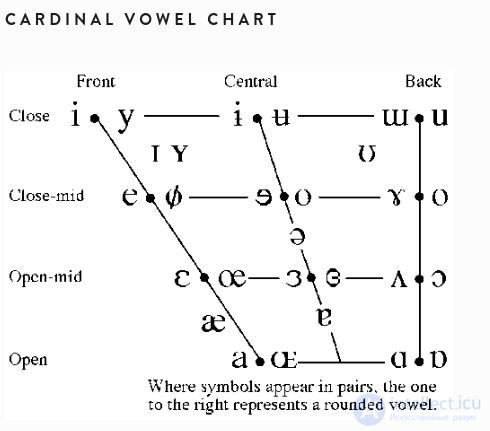
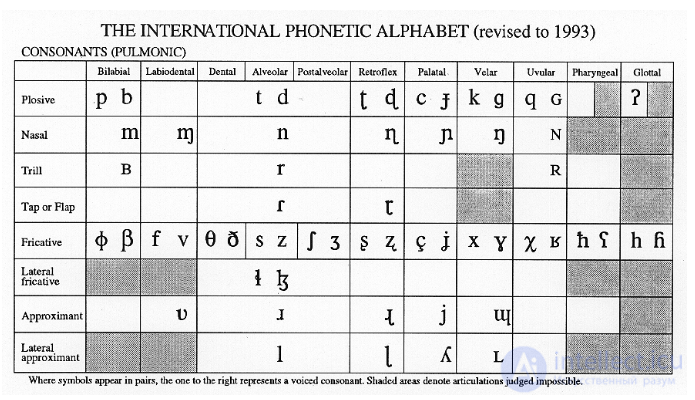
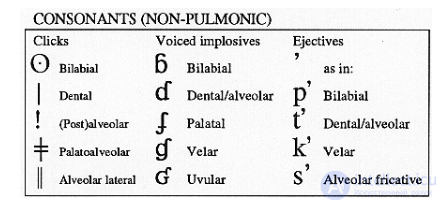
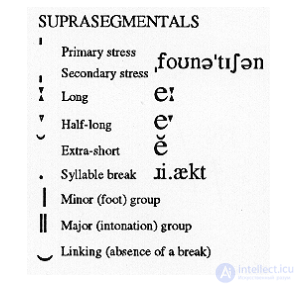
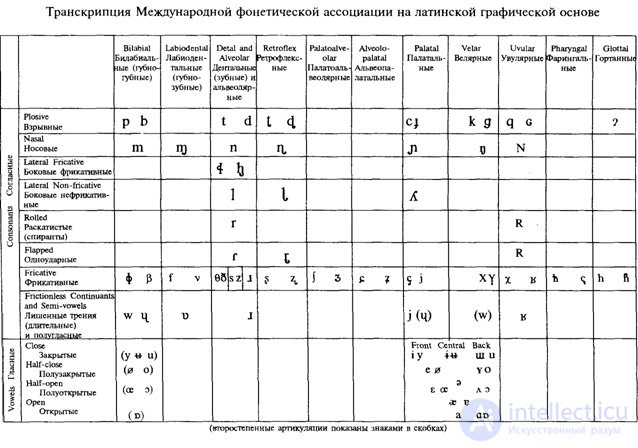
Some of the IPA tables are given below.
Vowels
Pulmonic consonants
Non-pulmonic consonants
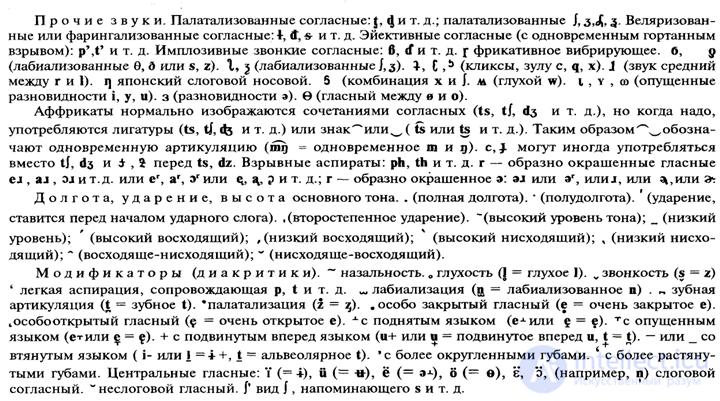
Symbols for some suprasegmental phenomena
Transcription may be oriented toward recording only those sound elements and features that are significant for the phonological system of the given language. In this case we are dealing with phonemic, or phonematic, or phonological, transcription.
Transcription can record not only phonemes as invariant entities but also their variants (above all allophones, as well as free variants). In that case we are dealing with allophonic (allophonic), or phonetic, transcription. Its symbols are usually enclosed in square brackets: грусть (grust', 'sadness') [gorous’t’], там (tam, 'there') [tãm], German Tat 'deed' [tha:th], German Rad 'wheel' [ra:th] and [Ra:th]. Cf. the phonemic notation of these words: /grus’t’/, /tam/, /ta:t/, /ra:t/. Phonetic transcription can sometimes be very, very detailed.
Transcription must not be confused with transliteration, which serves to render the spelling of a word (most often a proper name) of one language by means of a different graphic system. The rendering is done letter by letter: Алексей, Шолохов, Журавлёв, Чернов, Щур → Aleksey, Sholokhov, Zhuravlyov, Chernov, Shchur (when oriented toward English orthography); Aleksej, Scholochow, Zhuravljov, Tschernow, Schtschur (when oriented toward German orthography),
When foreign names are transliterated by means of Russian script, spellings often appear that do not correspond to the actual pronunciation of these names in the donor language: French Hugo /ygo/ → "Гюго" (Gyugo) /g’ugo/. Elements of approximate practical transcription may be included in Russian transliteration: New York → "Нью Йорк" (N'yu York).
In its pure form, transliteration is found relatively rarely and, as a rule, is associated with long-established forms of names:
Illinois — "Иллинойс" (Illinois) (not "Илиной" (Ilinoi))
Michigan — "Мичиган" (Michigan) (not "Мишиган" (Mishigan)).
For a number of objects, traditional forms of translation have become established, which either partly coincide with the original name
or may not coincide at all with the name of the object in the source language:
In the transcription of geographical names, a shift of stress often occurs, caused by the phonetic preferences of the target language:
"Вашингтон" (Vashington) (stress on the last syllable). There is a rule according to which, if the name contains a meaningful word, mixed translation is often used, that is, a combination of transcription and semantic translation:
Transcription is used in translating the names of firms, companies, publishing houses, car makes and periodicals, for example:
However, the names of educational institutions, as a rule, undergo partial or complete semantic translation:
- realia, names of national and cultural objects characteristic of the source culture and relatively little known or entirely unknown to the target culture. The most common way of rendering them in another language is translational transcription or standard transliteration.
Some of these names, especially those containing semantic components that reflect certain real properties of the object, are translated either by the mixed method or by calquing:
- terms. The source of transcriptions is, as a rule, Greek, Latin or English units, depending on which roots underlie the source term:
Transcription is the most artificial kind of writing, since it is used for special purposes and serves special needs, whereas orthography is the writing of the whole nation, which develops historically and lives by tradition.
According to its aims, transcription may be: 1) phonetic, 2) phonemic and 3) practical.
1) Phonetic transcription pursues the aim of an exact graphic record of pronunciation. It is used in dictionaries of foreign languages (where the orthography is very far from the pronunciation and lacks proper regularity; English, for example), in language textbooks, in textbooks of diction and declamation, and in records of live speech (dialectological records, phonetics textbooks, etc.).
The basic principle of phonetic transcription is that every sound pronounced must be recorded separately. Phonetic transcription may use any existing alphabet, but with the addition of special signs that are absent from the practical alphabet. There are various devices for this (diacritics, inverted letters, ligatures, the use of letters from other alphabets, etc.).
2) Phonemic transcription renders each word by its phoneme composition, without reflecting the variants and variations that arise in weak positions. It is used in recording grammatical examples and paradigms, where the structural rather than the pronunciation side matters. Its principle: each phoneme, regardless of position, is always represented by the same sign. Phonemic transcription needs considerably fewer signs than phonetic transcription, since the number of phonemes is always smaller than the number of variants and variations. It is close to those orthographic systems that consistently apply the phonemic principle (for example, Russian), and far from the orthographic record where orthography is based on the etymological and traditional principles (for example, in French and English orthography).
Of the transcriptions used in the practice of the Soviet Union, the most frequently encountered is either the system of the International Phonetic Association on a Latin graphic basis (IPA; in French AIP "Association Internationale Phonetique", in English IPA "International Phonetic Association", see the table on pp. 378–379), or the Russian Phonetic Alphabet (RPA) on a Russian graphic basis (existing in various versions).
It is recommended to enclose the text of phonetic transcription in square brackets ; the text of phonemic transcription in angle brackets < >.
In phonetic transcription the text is divided into speech measures (rhythmic groups) by a vertical bar placed at the end of each measure; the place of stress must also be indicated (' before the stressed syllable).
In phonemic transcription stress is not marked, and the transcribed morphemes are joined by hyphens within words that are separated by spaces.
Example of phonetic and phonemic transcription
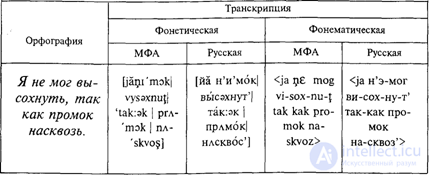
This transcription may be either synthetic (a phoneme as a whole is represented by a letter) or analytic (each feature of a phoneme is represented by a separate letter, digit or diacritic).
3) Translitera2 tion and practi2 cal transcription.
Transcription and transliteration must be distinguished.
Transliteration1, as its name shows, is the transposition of the letter spelling of one language or one graphic system into the graphic signs of another system. Such is the rendering of Greek inscriptions in Latin letters, for example: iППoc, – hippos ("horse"), Аυηvη – Athene ("Athens"), or of Serbian writing in Croatian, for example: Лоублана – Ljubljana, Крагуевац– Kraguevac. The same is true of the rendering of Russian personal names, geographical names, etc. in the letters of the Latin alphabet. However, transliteration also concerns common nouns, for example in the titles of books, journals, papers, etc.
1 Transliteration – from Latin trans – "across" and lit(t)era – "letter"
One should not think that transliteration ignores the peculiarities of the alphabet of the language being transliterated and is meant to "translate" letter for letter, paying no attention to letter combinations and to their place in the alphabet and in the writing system; that is, one should not think that transliteration consists in rendering English Schakespear as Схакеспеар, (Skhakespear), Byron – as Бирон (Biron) instead of Шекспир, Байрон, (Shekspir, Bairon), French Meillet as Меиллет, (Meillet), Henri as Хенри (Khenri) instead of Мейе, Анри, (Meye, Anri), Spanish Juan as Йуан (Юан) (Iuan (Yuan)) instead of Хуан (Khuan), or Swedish Nordenskjold'K.QiK. Норденскйолд (Норденскъельд) (Nordenskyold (Nordenskel'd)) instead of Норденшельд. (Nordenshel'd)
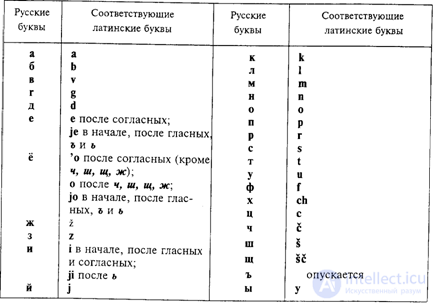
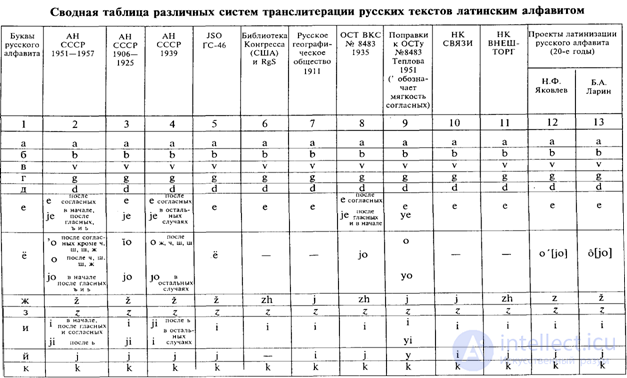
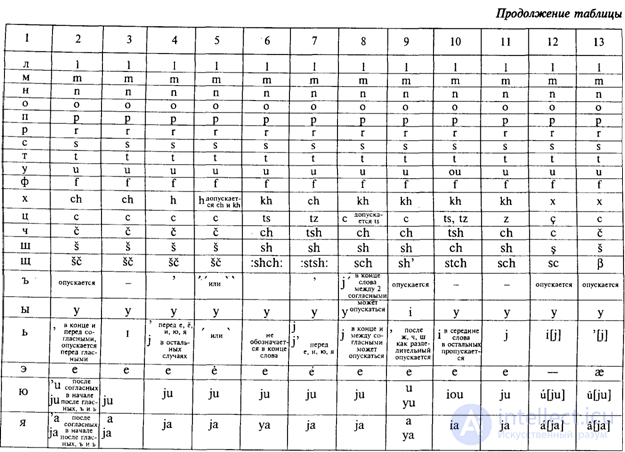
The accompanying table shows the system of transliterating Russian writing into Latin letters (for a summary table of various systems of transliterating Russian texts into the Latin alphabet see pp. 382–383).
Rules for transliterating Russian proper names into Latin letters
(Institute of Linguistics of the USSR Academy of Sciences, 1951–1956)
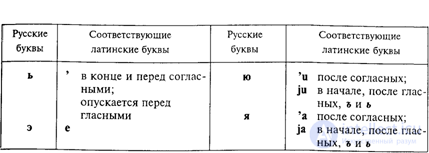
Transliteration should be distinguished from practical transcription.
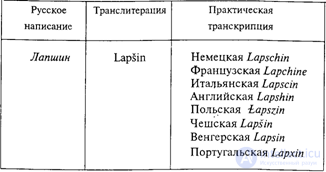
Transliteration can and should be international, since it is not oriented toward any particular national alphabet, whereas practical transcription proceeds precisely from a given alphabet and from the rules for reading its letters and letter combinations adopted for the given orthography.
If we compare transliteration and practical transcription using the rendering of the Russian surname Лапшин (Lapshin) in Latin script, we get the following:
In the case of practical transcription from a Latin-script language into Cyrillic, the same divergence results:
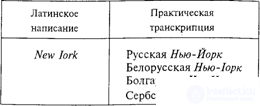
Practical transcription is meant to introduce foreign words and their combinations into a Russian text without going beyond the accepted alphabet, i.e. without introducing new letters or special diacritics.
As for orthography, however, some deviations are possible here; for example, the spelling of ы (y) after к, й, ш, ж (k, y, sh, zh) and at the beginning of a word (Кызыл-Ырмак, Жайык, Йыытс, Шыклар, Джыланды; Kyzyl-Yrmak, Zhayyk, Yyyts, Shyklar, Dzhylandy); the spelling of я, е, ю (ya, e, yu) after ц, ш, ж, ч, щ, к, г, х, й (ts, sh, zh, ch, shch, k, g, kh, y) (Свенцяны, Цюрих, Шяуляй, Шюмег, Йерди, Кяхта, Гюнтер, Хюж; Sventsyany, Tsyurikh, Shyaulyai, Shyumeg, Yerdi, Kyakhta, Gyunter, Khyuzh), the spelling of ь (soft sign) after ц (ts) (Пакосць; Pakosts'), the spelling of э (e) after л (l) (Малэцки; Malettski, as distinct from Малецки; Maletski), the spelling of й (y) before о, и (o, i) (Йорген, Йопъян, Йиржи, Шантийи; Yorgen, Yop"yan, Yirzhi, Shantiyi) and so on.
Special rules in practical transcription govern the spelling of non-alphabetic signs (hyphen, apostrophe, quotation marks) and also of capital letters.
Special lists specify the spelling of traditional names (Париж, Рим, Вена, Неаполь, Швейцария, Швеция, Германия, Дания; Parizh, Rim, Vena, Neapol', Shveytsariya, Shvetsiya, Germaniya, Daniya), and also cases of translation (мыс Доброй Надежды, острова Зеленого Мыса, остров Пасхи, Ричард Львиное Сердце, Генрих Птицелов; i.e. Cape of Good Hope, Cape Verde Islands, Easter Island, Richard the Lionheart, Henry the Fowler).
Thus, practical transcription is the rendering of words and word combinations of one language into words of another language; the words are taken in the full range of their linguistic characteristics (lexical, grammatical, phonetic and graphic) in order to introduce the facts of one language into the composition and system of another.

Comments