
Lecture 25 min.
Language is a multifunctional tool that is widely used in the life of society, and it cannot exist without mutual linguistic rapprochement between people. For this reason, one common language must be adopted for purposes of communication, but the functions and status of the state and national languages of individual states must not be affected. Language policy helps to organize languages in society and, ideally, to resolve any conflicts on linguistic grounds. There are many definitions of language policy.
V. M. Alpatov's book "150 Languages and Politics: 1917-2000" is devoted to an analysis of the language situation and language policy in the Russian Federation. According to the author, the language situation and language policy in every multilingual state are the result of the interaction of two opposing needs: the need for identification and the need for communication.
According to Schweitzer's definition, language policy is a system of measures of conscious influence on the functional side of language and, within certain limits, on its structure, carried out by the state, a class, a party or any social movements, measures that are part of their general policy and correspond to their aims. (Schweitzer A. D. Modern Sociolinguistics: Theory, Problems, Methods. Moscow: Nauka, 1976.)
Since there were differences in terminology, V. P. Grigoriev proposed his own definition of language policy, in which it is treated as "the theory and practice of society's conscious influence on the course of language development, i.e. purposeful and scientifically grounded management of the functioning of existing languages and of the creation and improvement of new linguistic means of communication".
The New Dictionary of Methodological Terms and Concepts gives the following definition of language policy.
Language policy (from Greek politikē, "the art of governing").
A set of ideological principles and practical measures for resolving language problems in a state or a union of states. Purposeful and coordinated activity of state education authorities at the national and regional levels, local self-government bodies and national public organizations in the field of studying, teaching, spreading and popularizing a particular language.
Language education as a value implies consideration of three axiological blocks:
Language education as a state value;
Language education as a social value;
Language education as a personal value.
Only in harmony among state, social and personal interests is it possible to achieve high-quality results in solving the socio-cultural problems facing society, the state and education.
Language education is a factor that turns a person into a developed individual and expands his or her social and economic freedom, which is why an important role is assigned to this factor.
Among the most important circumstances attesting to the demand for foreign languages in modern Russia are globalization, interstate integration in the sphere of education, and access to experience and knowledge in the world. At the same time, it is known that the public need for high-quality language education may not find support at the state level. This is expressed in the failure of the heads of educational agencies to understand the importance of introducing the younger generation to new means of communication, and also in insufficient state funding of the education sector, which leads to an outflow of teaching staff from education and makes it impossible to equip the educational process with adequate material and technical resources.
Today, however, the orientation toward intercultural communication ties the social demand to the problem of developing linguistic diversity in society and the multilingualism of its citizens. Linguistic and cultural diversity are now regarded as one of the most valuable elements of the world, European and all-Russian cultural heritage. Connected with this is the development of a set of measures intended to help strengthen the status of modern non-native languages and to create conditions guaranteeing every person the opportunity to study a modern non-native language as a tool that allows one to find one's bearings in a modern multicultural society and to engage successfully in intercultural interaction. In this, the learner is elevated to the rank of subject of learning activity and subject of intercultural communication, that is, becomes the central element of language education as a system. This means that it is the learner, and the prospects of his or her personal and linguistic development, that are regarded as an integral object of language policy.
The Council of Europe, with the support of the governments of the Western European countries and a number of Eastern European countries, ranks the development of common principles and content of language policy among the priority areas of its activity.
In Europe, alongside English, which is compulsory as the first foreign language in all European schools, the most widely studied languages are those of economically developed countries, primarily German, followed by French and Italian.
The spread of Russian in Europe is envisaged in connection with the well-known changes of recent decades.
Moreover, it is assumed that in Eastern Europe German (which most Europeans speak fluently) will gradually displace English as the language of international communication. French will retain its position as a language of communication outside Europe. Spanish, while remaining mainly the language of the Latin American continent, is unlikely to become more widespread in Europe in the near future, since that continent is not increasing its weight in the field of vision of European politicians.
These languages are what currently determine language policy in the EU countries:
It is therefore possible to define the hierarchy of the foreign languages most studied in Europe, which determines the language policy of European countries for the new millennium, as follows: English - German - French - Russian - Spanish (Italian - Portuguese). In determining language policy, all three aspects are taken into account: history, the present and the future. Singling out only one of them, in the opinion of specialists, violates the very essence of language, which preserves history within itself, allows one to live in the present and opens paths to the future. Therefore the literature and culture of the country of the language being studied are integral parts of the content of foreign language teaching in Europe at all levels.
A study conducted in the Federal Republic of Germany showed that working in 80% of European firms requires knowledge of at least two foreign languages, primarily English and French (in a ratio of 25:1), and in 45% of firms a minimum of three languages (Spanish, Italian, Russian). Moreover, those most in need of foreign language knowledge are not so much exporting as importing firms. As the studies also emphasize, knowledge of a foreign language will be necessary not only at the export-import level but (when joint ventures are formed) at all levels of production, from the doorman to the chief executive officer.
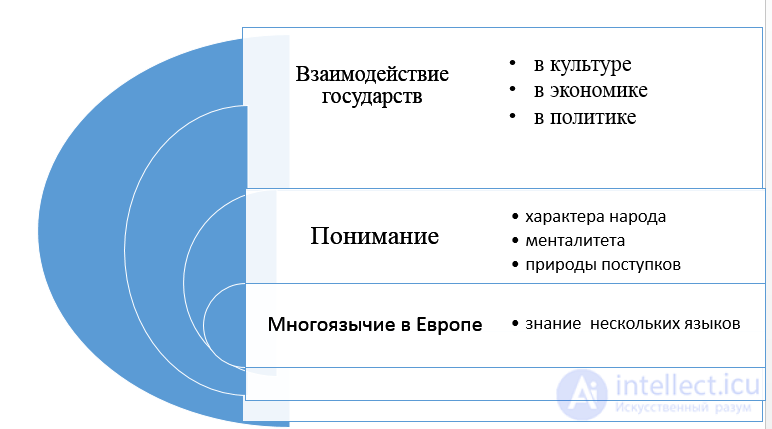
Thus multilingualism is an integral part of present and future Europe, and command of several foreign languages is currently conditioned not only by economic but to a large degree by general educational considerations, as a factor in the general, political and cultural development of the individual.
Therefore, at the present stage of social development, the culture-forming function of education increases sharply: education must change from a means of enlightenment into a mechanism for developing culture and shaping the image of the world and of the human being within it.
In contemporary Europe, education is understood as an understanding of one's own civilization, that is, mastery of the foundations of philosophy and science and of the most important works of art and literature. The main task of education is therefore the formation and development of the individual, not through the accumulation of particular facts but through the assimilation of particular content, above all through reading. Since genuinely informative reading is possible only with a fairly advanced command of language, the main road to education runs through language, both one's native language and foreign ones. But the most important point in the European concept of education is that an educated person is a product of his or her culture (as the Russian psychologist B.G. Ananyev also wrote: "The personality is a product of culture"), which enables such a person to take other people's views into account and to change his or her own accordingly, that is, to be tolerant towards others. The tolerance of an educated person is understood here not merely as forced forbearance but also as recognition of another worldview as equal to one's own, awareness of one's own cultural and mental boundaries, and recognition of another personality and another culture as a necessary path to enriching one's own existence in the modern world, in which the various peoples of Europe are gradually drawing closer and borders are opening.
The "Concept of the Long-Term Socio-Economic Development of the Russian Federation for the Period up to 2020" provides for:
Today the language policy of the Russian Federation finds itself in a field of tension between international, federal and regional language policy. In some regions of the Russian Federation, language issues are being resolved quite acutely, owing to existing problems in implementing agreements and the legal relations between the federal and regional levels. In addition, besides problems of domestic policy, questions of language policy at the international level have become increasingly significant in recent years. Attention to external language policy is driven by the needs of soft-power politics. The principles, forms, aims and instruments of each state's language policy take shape under the influence of the language situation, which is unique to each region. In this context Russia occupies a special place, since it is a multinational, multilingual and multicultural country. The country's development strategy in recent years has been linguistic unity within linguistic diversity. The language situation in Russia depends to a considerable extent on the complex structure of the state. The Russian Federation comprises 85 equal constituent entities. More than 100 indigenous peoples live on its territory, along with a number of ethnic groups, and more than 150 languages of different language families are represented: Slavic, Turkic, Finno-Ugric, Mongolic, North Caucasian and others. In terms of the age of their written tradition, there are languages with an ancient written tradition, an old written tradition, a recent written tradition and a new written tradition, as well as unwritten languages; there are about 80 literary languages. The means of linguistic unification of the state is Russian, the state language of the Russian Federation. The level of linguistic unity in the Russian Federation is high: 98.2% of the population speak Russian. 23% of the population speak another 38 languages, and the remaining 114 languages are spoken by only 1% of the population.
One aspect of language policy is its interaction with the state educational policy of the Russian Federation, through whose educational systems (general education, higher education, science) state language policy is implemented.
An important task is to introduce students to universal and global values and to develop in them the ability to communicate and interact with representatives of other cultures.
By including foreign languages in the school education system, the register of languages studied at school grows and, consequently, so does the range of possible and actual communicative contacts between representatives of different foreign-language societies.
Teaching foreign languages changes the relative weight of different languages and influences the processes of learners' linguistic and personal (including cultural and speech) development, as well as their awareness of their interdependence with one another and with all the people of the planet in the search for solutions to global problems.
In addition, teaching foreign languages stimulates the understanding of the sociocultural portraits of the country of the target language and of representatives of another linguistic community.
The choice of a particular language to be taught/studied at school and, more generally, the inclusion of foreign languages in the content of school education are determined to a considerable extent by the political positions and orientations of a given society and state.
Language policy in the sphere of foreign language education is aimed at establishing interstate and intersocietal contacts and at preventing, regulating and overcoming conflicts that may result from the suppression, or unjustified exaggeration, of the role of particular languages in society.
Teaching intercultural communication is, first of all, foreign-language education, which is carried out in different types of educational institutions. The first stage in forming the linguistic personality is the study of foreign languages at school, where the main communicative partner is the teacher, who acts as a relayer of the culture of the country of the target language.
School language policy is an integral part of the language policy of the country as a whole. It therefore shares the features of general language policy. School language policy can be defined as purposeful, scientifically grounded management by the state and society of the functioning and development of the school education system in the field of native and non-native languages.
The emergence and existence of natural language is inseparably linked with the emergence and existence of the human being, homo sapiens. The Linguistic Encyclopedic Dictionary gives the following definition of the concept "language": "Language in general is a semiotic (sign) system that arose naturally (at a certain stage in the development of human society) and develops in accordance with laws < … >, possessing the property of social purpose; it is a system that exists primarily not for a particular individual but for a particular society" [Linguistic Encyclopedic Dictionary. Moscow: Soviet Encyclopedia, 1990. P. 604].
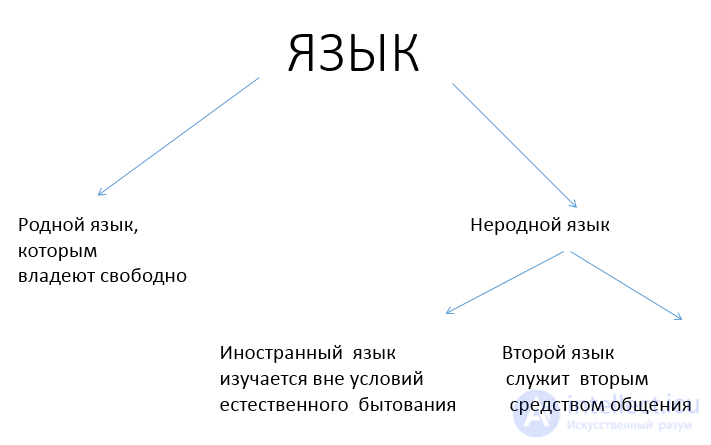
A foreign language stands as a kind of alternative to the native language. There are various, sometimes contradictory, criteria for defining the native language. The criterion of origin seems optimal: according to it, the native language is the language in which the mother begins to communicate with the child from the moment of birth and which the child to some extent assimilates even in the womb (N.D. Galskova).
When choosing the language of instruction in an educational institution, "native language" is understood as the language that a 5-6-year-old child speaks fluently. In a multinational society such as Russia, a child may speak several languages to practically the same degree, which makes it difficult to divide languages into native and non-native.
A non-native language can take two forms: a foreign language and a second language. The German linguist W. Klein gives the following definitions of "foreign language" and "second language". A foreign language is a language that is studied outside the conditions of its natural use, that is, in the educational process, and that is not used alongside the native language in everyday communication. A second language, by contrast, serves alongside the native language as a second means of communication and is usually acquired in a social environment where it is a real means of communication.
Thus, unlike a second language, a foreign language is acquired outside the social environment in which that language is a natural means of communication. However, this distinction is conditional, and it is quite difficult to establish clear boundaries between them. A foreign language and a "second" language can easily "pass" into each other under appropriate circumstances. For example, German is a foreign language for someone studying it in Russia, but for immigrants mastering it as a means of everyday communication in Germany it becomes a second language. If an immigrant leaves Germany and returns to his or her own country, German moves from the category of a second language to that of a foreign language.
The controlled process of acquiring a language is connected with such concepts as language teaching and language learning, that is, with language instruction. Foreign language instruction is a specially (institutionally) organized process in which, through the interaction of learner and teacher, particular experience is reproduced and assimilated in accordance with a set goal (N.D. Galskova). This refers to foreign-language speech experience, which the teacher possesses to one degree or another and which the learner lacks wholly or in part.
According to I.V. Rakhmanov's definition, foreign language instruction is "... the process of the teacher's systematic and consistent communication of knowledge and inculcation of skills and habits in the field of foreign languages, the process of their active and conscious assimilation by students, the process of creating and consolidating in children the qualities that we seek to cultivate in them". It is evident from this definition that instruction is a two-sided process, uniting the teaching activity of the foreign language teacher/instructor and the learner's activity, directed at learning/mastering the language.
There are essential differences between the concepts of "language acquisition" and "language learning" . Language acquisition is characterized by unconscious, intuitive, unintentional assimilation of linguistic content that is not under direct control. Language learning is a conscious process that presupposes, above all, the explicit use and assimilation of rules and linguistic elements. Consequently, the concept of "language learning" is broader than the concept of "language acquisition".
Unfortunately, however, learning a language and being taught it do not always lead to the learner's mastery of the subject. The latter becomes possible when, as a result of the learner's study activity (language learning), guided by the teacher's activity (teaching), the learner develops the ability for intercultural communication using a new language code. Mastery of the ability for intercultural communication is therefore primarily the result of the learner's own activity; in other words, the effectiveness of instruction is determined by the personality of the learner, who must assume a certain share of responsibility for the results of instruction.
As noted above, a person's introduction to a new language can take place under different conditions: in the country of the target language and outside it. The study of foreign languages away from the country of the target language has two sub-variants:
The latter sub-variant is the most typical of domestic conditions of foreign language teaching.
The introduction of new foreign methods is to be welcomed, but only with the proviso that many of them were developed on the assumption of direct contact with native speakers. The geopolitical (and, unfortunately, economic) situation of our country gives grounds for asserting that for most learners the conditions for studying a foreign language here are "artificial", and in this case one can speak only of controlled study of a foreign language in isolation from the language environment. If learners have an opportunity to come into direct contact with a native speaker in their own country, a unique situation of a natural language environment arises. Such a situation has an indisputable advantage, because neither a teacher with an excellent command of the foreign language nor authentic teaching materials that objectively represent the culture of the target-language country can fully compensate for the absence of direct interaction with a native speaker of that language. That is why it is so important to organize school exchanges, to look in one's own country (region, city, village) for real opportunities to "reach" native speakers of the target language, and to foster in learners a need to use the language as a means of communication.
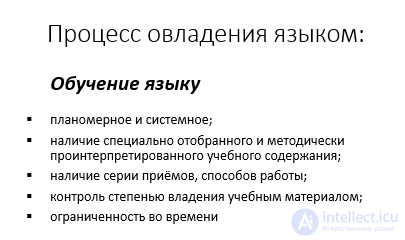
Thus, with regard to domestic conditions, we can speak of language instruction. Instruction is characterized by planning and systematicity, by specially selected and methodologically interpreted learning content, by a series of techniques and ways of working aimed at learners' memorizing this content and at the learner's monitoring of the level and degree of command of the learning material, and also by a certain limitation in time. Learners' speech and non-speech actions are quite rigidly regulated by the aims of instruction set by the teacher at each particular stage of school education, and by the content of instruction, which as a rule represents the literary-colloquial norm of the modern language.
The development of speech habits and skills can be controlled through special tasks and exercises. For this reason foreign language teaching is often associated only with developing learners' reproductive skills, that is, the ability to retell a given text or speak on the basis of prepared material. This cannot be accepted categorically. Learners' success in mastering a foreign language is determined by their ability to use the language material they have learned or are learning in new communicative situations. It is therefore necessary to develop both reproductive and productive activity of the learner in the educational process.
N.D. Galskova conventionally divides the whole set of factors determining the specific character of the foreign language teaching system, at all its levels and in all aspects of consideration, into five groups:
Socio-economic and political factors are primary in relation to the others. It is well known that the socio-economic and political situation in a society shapes the social demand regarding the foreign-language training of its citizens. The higher the public need for knowledge of a language and for specialists who speak one or more foreign languages, the more significant the pragmatic aspects of teaching the subject become. The greater a society's need for new professional, personal, cultural and scientific contacts with speakers of a foreign language and with the achievements of the cultures of different countries, and the more realistic the possibility of establishing such contacts, the higher, naturally, the status of the foreign language as a means of communication and mutual understanding.
At present this status is becoming even more significant, as a consequence of certain factors characteristic of modern society:
The demand for a foreign language in society in turn raises the status of the foreign language as a school subject in the general education of schoolchildren. In our country, for example, the foreign language has been among the compulsory subjects in recent decades, yet until recently the governing bodies and school administrations, and above all secondary school staff, treated it as a compulsory subject but not one of prime importance. This was also reflected in the reduction of the class hours allotted to foreign language study. For example, in the late 1970s and early 1980s the number of class hours in secondary school fell from 18 to 14. Beginning in 1985, when the state began to pursue an actively open policy towards the world community, heightened interest in foreign languages became one of the characteristic features of public life. The role and place of the subject in the overall system of school education changed radically: the foreign language was moved into the category of subjects of federal significance, taking its place in the general subject register alongside the native language and literature. Schools responded quickly to the public need for knowledge of foreign languages and included a second foreign language in their curricula and, where conditions permitted, a third.
Policy and Language Educational Policy on Foreign Languages Have in Common is that all of them are strategically aimed at establishing peace and interaction between peoples and, in a multinational country, also at avoiding and eliminating interethnic conflicts.
The distinctive feature of contemporary educational policy on foreign languages is its orientation towards creating favourable conditions in the country for various categories of learners to study a broad range of foreign languages, in order to satisfy public and personal needs for learning these languages. In other words, when speaking of school language policy in the educational sphere of foreign languages, one should have in mind a set of scientifically grounded ideas and adequate, systematic, purposeful and managed measures which: — support the positive traditions that have developed within the education system in the field of foreign languages and stimulate innovative processes within it, thereby ensuring, on the one hand, stability in its functioning and, on the other, its progressive development and improvement; — improve the quality and effectiveness of language education in the country by ensuring the long-term development of the educational system in the field of foreign languages, taking into account the change in its methodological and technological paradigms and the development of appropriate means of introducing and implementing new conceptual approaches.
Policy on introducing pupils in general education institutions to foreign languages should be aimed at ensuring harmony between society, the state and the individual.
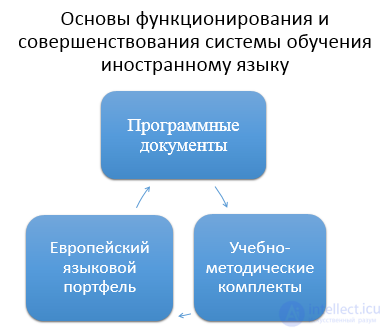
Fig. Foundations of the functioning and improvement of the foreign language teaching system
New approaches to solving language problems in the state:

Comments