
Lecture 6 min.
Non-equivalent vocabulary consists of lexical units of a language that have no corresponding lexical equivalent in the target language.
The existence of non-equivalent vocabulary (NEV) is due to the socio-cultural component, which differs among peoples. All words conditioned by the culture of a particular people are called culture-bound words, or realia.
NEV: words and realia that have no counterpart in the target language at the given stage of its development
Reasons for the existence of NEV.
When comparing two languages (Russian has a developed system of suffixes: "Дочь-дочка-доченька-дочурка" (doch', dochka, dochenka, dochurka, 'daughter' and its diminutives), whereas English has nothing of the kind, it has fewer suffixes. The captain's daughter.)
There are realia: words and phrases that name objects characteristic of the life, everyday existence, culture and historical development of one people and alien to another. Being bearers of national and historical colouring, they generally have no counterparts in other languages.
Realia are words and phrases that name objects characteristic of the life, everyday existence, culture, and social and historical development of one people and alien to another; being bearers of national and/or historical colouring, they generally have no exact counterparts (equivalents) in other languages and therefore cannot be translated in the usual way, requiring a special approach
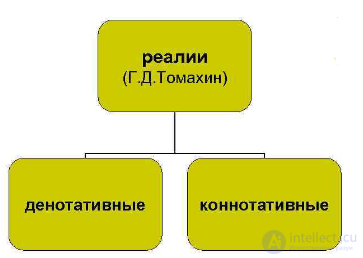
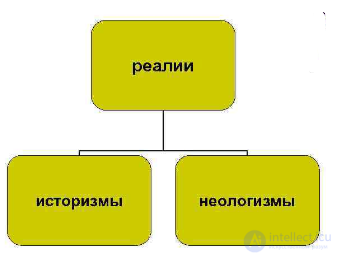
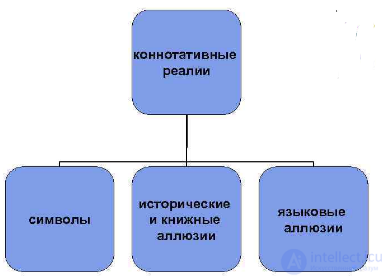
There are as many realia as there are spheres of human activity.
The concept of "realia" is broader, since it is used irrespective of translation ("пельмени" (pel'meni, 'pelmeni, meat dumplings')), whereas the concept of NEV is narrower, since NEV are involved in the translation process.
I. Ethnographic realia:
1) dwellings: cottage, town house, ranch, condo, studio
2) clothing: moccasins, parka
3) food: hamburger, frank and roll, French fries, maple syrop
4) service establishments: drug store, laundromat, soda fountain
5) transport: elevatedI.
4) service establishments: drug store, laundromat, soda fountain
5) transport: elevated railroad, subway, express train, local train
6) communication (post, telephone, etc.): Western Union, collect call
7) leisure and pastimes: barbecue, bread-and-butter letter, baseball
8) customs, traditions, holidaysI.
7) leisure and pastimes: barbecue, bread-and-butter letter, baseball
8) customs, traditions, holidays: trick or treat, jack-o'-lantern, Thanksgiving Day, Washington's cherry tree
9) measures, money: pound; inch, foot; dime, quarter
10) routine behaviour: hissing, whistling, etc.
11) speech etiquetteI. Ethnographic realia:
10) routine behaviour: hissing, whistling, etc.
11) speech etiquette: forms of address, greetings, invitations, requests, apologies, etc.
II. Geographical realia:
1) features of relief and climate: prairie, Dust Bowl, Sun Belt
3) features of administrative and territorial division: state, county; downtown, uptown
4) features of flora: sequoia (redwood), hickory
4) features of fauna: buffalo, grizzly bear, bald eagle
5) cultivated plants: corn,
6) fauna: buffalo, grizzly bear, bald eagle
7) cultivated plants: corn, pumpkin
8) natural resources and specific features of their development: homestead, cowboy, bushboy
III. Socio-political realia:
1) state symbols and symbols of the states: Stars and Stripes, Old Glory
2) realia connected with the US Constitution: checks and balances, Bill of Rights
3) realia of the legislative branch: Congress, Senate, senior senator, junior senator, House of Representatives
4) the president and the White House staff: the White House, the OvalIII. kitchen cabinet
5) executive departments: Under-Secretary, Assistant Secretary, Secretary of State, Attorney General
6) agencies: Independent agencies, NASA
7) civil servants: Civil service, Hatch Act
8) the judicial system: theIII.
7) civil servants: Civil service, Hatch Act
8) the judicial system: the Supreme Court, Chief Justice, domestic relations court
9) local self-government: territory, governor, lieutenant governor
10) elections: primary election, running mate
11) political parties and public organizations: Grand Old Party (G. O. P. ), Ku-Klux-Klan
IV. Realia of the education system, religion and culture
1) education system: elementary school, high school, civics, campus
2) religion: Baptism, Methodism, Young Men's Christian Association (YMCA)
3) literature: Babbitt, All the King’s Men
4) theatre and cinema: western, Broadway, drive-in theatre
5) mass media: Associated Press (AP), The New York Times
6) fine arts: the Metropolitan Museum of Art (the Met), the Hudson River School
7) musical culture: country music, banjo, spirituals
V. Onomastic realia:
: 1) toponyms: "We fought Lexington to free ourselves, we fought Gettysburg to free others" (Noms F. )
2) anthroponyms: Uncle Sam, Jim Crow, Jack and Jill, Rockefeller
Realia at the aphoristic level:
l"No taxation without representation"
"Give me liberty or give me death"
1) transliteration / transcription: Lincoln – "Линкольн" (Linkol'n) / drugstore – "драгстор" (dragstor)
2) calquing: skyscraper – "небоскреб" (neboskryob)
3) descriptive or explanatory translation: Madicaid – "программа предоставления медицинской помощи малоимущим" (programma predostavleniya meditsinskoi pomoshchi maloimushchim, 'a programme providing medical care to the poor')
4) approximate translation: drugstore - "аптека" (apteka, 'pharmacy')
5) transformational (contextual) translation: He died of exposure – "Он умер от простуды" (On umer ot prostudy, 'He died of a cold') / "Он замерз в снегах" (On zamerz v snegakh, 'He froze to death in the snow') / "Он погиб от солнечного удара" (On pogib ot solnechnogo udara, 'He died of sunstroke')

Comments