
Lecture
I think that those of you who have been to Greece would never agree that Greeks work better than Russians. Nevertheless, according to research by the Organisation for Economic Co-operation and Development (OECD), Russia, with its labor productivity level of $26.5 per hour, lags behind all OECD countries (essentially all developed countries), including Greece, except for Mexico, where it stands at $21.6. The OECD average is $54.8, while the leaders — Ireland and Luxembourg — stand at around $99 per hour.
These figures do not mean that Russians work little, but that they work inefficiently. This is about the low efficiency of labor organization and management. Among the main reasons usually cited are the low qualification of Russian managers, a rigid legislative system, and even the harsh climate. All these reasons matter, but there is one more that is almost never mentioned — the predominance of the "red" type of corporate culture in Russian business.
Unfortunately, without recognizing the problem of the low level of corporate culture, it is impossible to solve any systemic problem of business efficiency. This is exactly what the quote from Lewis Carroll's immortal work at the beginning of the article is about: if you don't know what your problem is, you won't be able to solve it. If you don't know where you're going, no matter which way you go, you won't get a result.
Very often, when describing types of corporate culture, consultants make the reservation that there is no such thing as a bad corporate culture, and that any culture can be effective depending on the context.
Although they are formally correct, this reservation, unfortunately, has a negative effect on managers who are encountering the concept of Spiral Dynamics for the first time. In my view, this reservation is akin to doctors' articles about the benefits of alcohol. An alcoholic doesn't hear the words "in moderate amounts" — all he hears is "Alcohol is good for you." Likewise, many managers, on hearing the reservation about the usefulness of any type of culture, only hear the words "Everything's fine with me. No need to change."
The problem is that "the culture of power," which is good on the battlefield or in a feudal society, is completely ineffective in an age of digitalization, faster decision-making, and the shift from competing on product quality to competing on team quality.
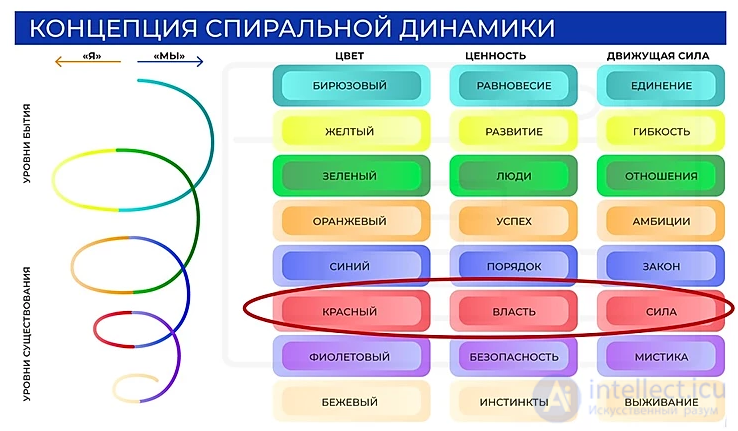
So what exactly is "red" culture? Here is a brief definition below:
"Red" culture — "Culture of power." Principles: "The strong are always right," "I'm the boss, you're a fool," and so on. The leader of the company becomes the most powerful, tough, authoritarian manager — to use the language of biology, the "alpha male." He takes the maximum amount of authority for himself and forces others to follow him, and his decisions sometimes take on the character of outright arbitrariness. The answer to the question of why a particular decision was made most often sounds like this: "Because I said so." Everyone else obeys the leader, and at their own level copies his behavior. The leading (if not the only) management system is a direct order, implying unquestioning obedience."
Within a "red" corporate culture, the classic directive hierarchical management model is always used to run the business:
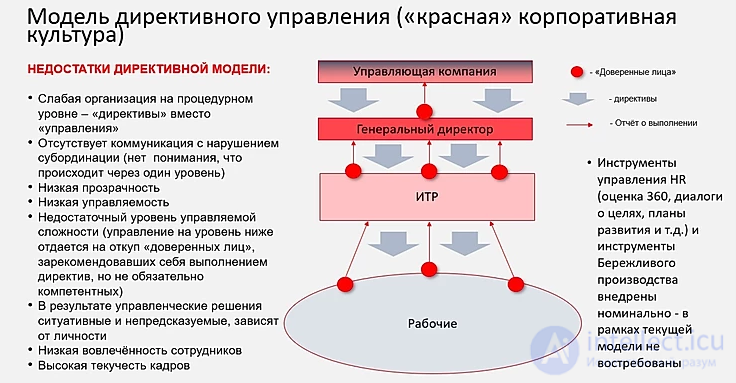
Some of the shortcomings of this type of corporate culture are listed in the figure above, but two are the most harmful to the company's effectiveness:
Let's take a closer look at these two factors.
First — "Power as the main value." You will never hear about this at meetings or in official corporate communications, but the issue of power in such an organization is always the main one. Business decisions are made not through the lens of their effectiveness, but through the lens of authorship — a boss's idea will always be recognized as more valuable than a subordinate's idea. No matter how valuable an idea is for the effectiveness and profitability of the business, it will first be examined through the lens of politics — whether it will infringe on the interests of someone powerful, whether it contradicts their position. And if it does contradict it, then this decision may well lose out to a decision that is outright disastrous from a business standpoint, but politically correct. This creates an atmosphere of "double standards," where at the official level one set of goals and values is proclaimed, but in reality the picture is quite different. For example, "People and Efficiency" are the formal principles, while "Personal power and Unquestioning obedience" are the informal principles by which the organization actually lives.
This atmosphere of double standards forms a certain approved model of employee behavior in the organization — do nothing except what your boss has directly ordered you to do, but don't do even that too well, so as not to cast a shadow on him.
Naturally, no improvement initiatives are welcomed in such a paradigm, and although slogans about continuous improvement are heard in all official communications, everyone understands that this is just a corporate game.
In everyday work this manifests itself as total lack of transparency, fictitious reporting, constant firefighting, and crisis-management policies. Corruption and theft can flourish. Given that employees are evaluated not by effectiveness but by loyalty, instead of productive work there is an "imitation of vigorous activity," while managers and employees spend the bulk of their energy on intrigue, "politics," and efforts aimed at strengthening their personal power and well-being. The company's goals fade into the background in this atmosphere.
As far as personnel are concerned, a red corporate culture squeezes out of the company any proactive professionals who rely on their own expertise and want to work toward business results rather than politics. Any initiatives to improve labor efficiency, systematize operational data, implement management tools, or any other attempts to improve the company's performance at a systemic level are sabotaged and fail. The reason is simple — all such systemic improvements, if implemented correctly, lead to greater transparency in business decision-making, which instantly exposes the low efficiency of management at all levels, and that is something nobody needs within a "red" corporate culture. Unquestioning obedience and loyalty as the highest value give rise to mutual cover-up, and mutual cover-up makes it impossible to openly acknowledge mistakes, leaving no chance for improvement.
Although all Russian researchers in the field of corporate culture agree that "red" corporate culture is predominant in Russia, you are unlikely to meet a manager, especially at a large company, who believes that "red" corporate culture is about them. On the one hand, corporate culture really is heterogeneous — say, the culture of an IT department at a manufacturing company may indeed be at a higher level than the culture in the production departments. However, here, as they say, "the exception only confirms the existence of the rule."
On the other hand, what prevents a manager from seeing the real state of affairs in the company is the "Aura of the red leader" — a phenomenon whereby, no matter what a manager asks their subordinates, no matter how honest a critique they demand, they will hear only praise and unconditional approval of their decisions. It's all quite simple — in a culture where an employee's career depends on the boss's favor rather than on that employee's effectiveness, the boss has no chance of hearing healthy criticism of their own actions. This leads to "red" leaders gradually sinking into a world of illusions over time, where all their management decisions are infallible, and any failures are explained by the low quality of the staff.
In this regard, I recall a case from my own practice, when at one manufacturing plant, as part of a Lean transformation project, management decided to launch a "Problem Solving Board" tool to get direct feedback straight from the workers about existing problems.
The director gave the order to hang up the boards, and consultants ran several training sessions for employees on how to work with the PSB.
The next day, burning with impatience, the director personally went to inspect the Problem Solving Boards, and on the very first one he saw a huge inscription: "The director is a ****ing [expletive]!"
Furious, he ordered all the boards taken down, and the person who wrote it to be found and fired.
This is a good example of how, under the influence of the "Aura of the red leader," the manager turned out to be unprepared even for the very thought that employees might feel such negative emotions toward him. Accordingly, the conclusion drawn was that "one black sheep" had turned up in "our excellent team," and the opportunity to see the systemic problem and start working on it was missed.
Just as often, when asked "isn't your organization 'red'?", managers start talking about what high-culture systems and tools they have implemented.
"We have Lean, Agile, we have KPIs, OKRs, we do 360-degree reviews, we run an annual employee survey and measure employee engagement, and the engagement index is growing! We are definitely not a 'red' organization!"
I'd like to share a case from my own practice. At one of the plants of an industrial company, new management announced with great fanfare the implementation of Lean Manufacturing. A lot was said about how this new approach would take the plant to a new level of efficiency. And the first Lean tool chosen for implementation was the 5S system at a pilot section of the production warehouse.
The warehouse manager greeted us with great enthusiasm, and together with his team we began the first stage — sorting — but under piles of old junk and unneeded parts we suddenly came across an interesting archaeological discovery — old faded 5S instruction plates and posters, and remnants of specific paint markings on the floor.
"Oh, we already implemented 5S once before, three years ago!" the section manager cheerfully explained, seeing the silent question in my eyes. "It's just that over time it was somehow all forgotten…"
I asked whether it was even necessary to implement this tool if he wasn't going to use it anyway.
"Well, how could we not implement it? It's a good thing, after all," he replied.
You won't find reliable official statistics on the effectiveness of culture-change project implementation in Russia. But if you dig through Western publications, you'll find various studies saying that anywhere from 60% to 75% of such projects turn out to be unsuccessful. To be honest, if someone were to cite a figure of 90% unsuccessful projects in Russia, I wouldn't be shocked, and I'd even consider that estimate overly optimistic, because out of several dozen Lean Manufacturing implementation projects at large and medium-sized companies, whose details I was familiar with either directly or through reliable sources of information, 100% of the projects turned out to be failures, and either naturally self-destructed, leaving behind fossilized scraps of plates and posters, or degenerated into an internal cargo cult, around which entire bureaucratic structures organized themselves for its continuous support, PR, and self-perpetuation.
Lengthy research into this problem has led me to the paradoxical conclusion that the management of companies embarking on large-scale cultural change is in fact not interested in its success.
More precisely, they would not mind changing the behavior of their subordinates, but they would in no way want to change their own behavior. Moreover, after numerous attempts in conversations to lead top managers of various organizations toward the idea that perhaps they, as managers, have room to improve, I encountered the deepest rejection of this idea. That is, of course, they are all for personal professional development — they attend many training sessions, read a lot of business literature — yet their management style remains monolithically red and undergoes absolutely no change whatsoever. Yes, of course, they realize that not everything works out for them, because, unfortunately, they are forced to work with staff who are, for the most part, very inert, incompetent, and disengaged, and that is exactly why (!) it is the culture of these subordinates that needs to change, but toward themselves they have, by and large, no complaints. Obviously, the "aura of the red manager" only reinforces them in this conviction. Naturally, the thought that all the problems of low efficiency among their subordinates and the whole business they manage are a direct consequence of their own personal "red" management style has no chance whatsoever of entering their heads.
Let me give one more example from practice.
To solve one of the classic problems of "red" organizations — the lack of bottom-up communication — a system of continuous production improvement using "cross-level communication," which I called "Two-level small teams," was developed and proposed to the director of one company. He was delighted and gave the order for immediate implementation, guaranteeing full carte blanche for the implementers' actions.
The very first joint sessions with workers and top managers gave excellent results — the workers were inspired by the fact that management turned out to be able to listen and hear, and the top managers honestly admitted that they hadn't had a real picture of the state of affairs on many issues, having received quite different accounts of it from line management.
Thunder struck at the next session, when the team moved from general questions to analyzing real production problems of a systemic nature. When the processes were visualized on diagrams and the "difficult" questions were voiced publicly, the inefficiency specifically of the company's management became so obvious at a certain point that the director jumped up in the middle of the discussion and announced the immediate shutdown of the project.
"It's all clear to me, we're just wasting time!" he said. "We need to work, not talk!"
The painful shock of realizing one's own imperfection turned out to be too strong. Some psychologists call such a breakdown of one's own psychological-safety superstructures the "Fall of the crown" and consider it, although painful, a necessary step toward recognizing one's own problems, and therefore toward correcting them.
In the end, the secret to implementing Lean Manufacturing (and any similar approaches and tools such as Agile, 6 Sigma, etc.) in "red" organizations turned out to be simple and sad: systemic improvements in these organizations are not needed by anyone except the owner and a few enthusiasts, which means that all projects to implement them, without prior deep work on transforming the management culture, are doomed to fail, at least in terms of financial efficiency. Managers don't need efficiency because it leads to a limitation of their power; rank-and-file employees don't need it either, because in "red" organizations it only leads to higher quotas, staff cuts, and an increased level of absurdity and stress at work.
The reason I mentioned financial efficiency is that it's very common for the external trappings of a new culture, in the form of a kind of "Potemkin village," to be maintained by management solely for the purpose of reporting to the company's owners as a demonstration of their own effectiveness.
It is clear that the price of this demonstration becomes enormous costs for maintaining this fiction of implementation. And then the classic follows: we write beautiful reports, keep double and triple accounting, and blame any failures on specific individuals, usually from the lowest rank.
But probably the biggest loss from such projects is the loss of employees' trust and enthusiasm.
Having had their fill of such «improvements», employees start to wildly shy away at the mere mention of any «implementation projects», or they react like that shop foreman, ready to implement 5S all over again every single day, senselessly and mercilessly, giving a smiling salute.
As you understand yourselves, the syndrome of learned helplessness and the sense of the absurdity of everything going on around does not make an employee more engaged and inspired for labor feats.
Despite the fact that the communication system in red companies is built so that top management has almost no chance of encountering an honest description of all the absurdity happening at the lower levels (in such cases one can speak of a «collective aura of the red leader», where faith in one's own infallibility is fed and shared by other red-leader colleagues), the sheer totality of this phenomenon and the poor production results nevertheless often push them toward the thought that rank-and-file employees could be a bit more responsible about their work.
At such moments, clever (predominantly Western) consultants appear beside them, telling them about Employee Engagement. The basic, uncomplicated idea of this concept is that if an employee is engaged and motivated, they treat their work responsibly and wholeheartedly, and treat the company's resources thriftily, as if they were their own. At the same time, the employee is always happier and gets injured less often.
And despite the fact that the consultants are conceptually absolutely right – proper work with Employee Engagement can lead to magnificent results in all the areas mentioned – but, as you probably already understand, just as in the Kingdom of Crooked Mirrors, any good initiative in «red» corporate culture gets twisted and turns into a theater of the absurd.
At present, absolutely all (yes, yes, 100%) Russian companies apply one and the same scheme for working with Employee Engagement, which among Western
professionals bears the apt name «feeding the bear». The scheme is quite simple:
Moreover, there is nothing wrong in itself with improving everyday conditions or with financial and non-financial bonuses. The only bad thing is that these measures alone can never ensure employee engagement.
The key to employee engagement is simple: power and trust. If you want your employees to become Engaged employees, you need to do only two things: start trusting them and start sharing power with them.
These principles are not only simple, but, moreover, they are built into a person by Nature itself.
A bit of the inevitable popular science, for a correct understanding of what drives us at work.
A person's physiological motivation is part of the mechanism of «continuous improvement» and the drive toward constant development. A kind of physio-psychological kaizen of the human being.
In creating an efficient organism, nature faced the task of making sure that every individual of the population would continuously strive not only to reproduce and strengthen its own safety, but also toward the continuous development and improvement of all aspects of the population's existence.
As with other basic instincts, Nature solved this task with the combination of the human «reptilian brain» plus the hormonal system.
In case of «socially incorrect» human behavior, the reptilian brain gives the hormonal system the command to apply the «stick» in the form of releasing the hormone of depression and self-destruction – cortisol, and the «carrot» — in the form of releasing the hormone of motivation and anticipation of happiness – dopamine, for «socially correct» behavior.
The solution to how to understand which social behavior of a person is correct (aimed at the development of the population) and which is incorrect (aimed at anything except the development of the population) was likewise simple, reliable, and elegant, like everything Nature does.
Our rather dim-witted «reptilian» brain simply reads what the people around us think about our behavior, using our more advanced, newly formed brain — the neocortex, with its ability to critically assess what is happening, or, put more simply, it reads our own thoughts on the matter. If we read society's reaction to our actions as approving, that is, the people around us consider our actions useful, then the ancient brain opens the dopamine taps that fill us with joy, anticipation of reward, as well as energy and an untiring will to overcome obstacles on the way to the goal.
Recall the moment when you took on an important project whose results, as you knew for certain, could greatly advance you and strengthen your career position, and with every successful step your brain flooded you with joyful anticipation. You wanted to think only about the project and its goals, you could work tirelessly 20 hours a day, and you woke up filled with seething positive energy, despite lack of sleep and an unhealthy diet.
But you will surely also have no trouble recalling those moments when the success of the project was under threat – stress, anxiety, and fear, if the risks of failure were not fatal. And in the event of a complete failure, when you realized that the project's success was practically unattainable, you felt depression, apathy, an inability to make yourself do anything at all, and a persistent urge to «drop everything and go to Gagra».
Your brain will likewise understand that you are engaged in an aimless, useless task if you yourself understand that success is in principle impossible, and you do the work purely formally, just to get paid. This, essentially, is what happens within projects in «red» organizations.
Cortisol and dopamine — are Nature's tools, which is ready to subject us to any suffering if we bring no benefit to the population, but will not withhold reward either, if we are useful.
This is precisely why a person who finds themselves in idleness inevitably gravitates toward artificially generating dopamine through such quick pleasures as drugs, alcohol, overeating, and so on. Our reptilian brain, with the help of the neocortex, understands that our actions are useless for the population of the species and shuts off the taps of pleasure. Depression rolls over the person, and they are forced to hack the hormonal system using artificial picklocks.
What principles of dopamine motivation, then, do you need to know in order to make your employees' engagement as high as possible, low-cost for the company, constant, and self-renewing.
These principles are simple:
«Ambitious but achievable goals» — the «reptilian brain» will give the employee a great deal of dopamine energy-motivation only if they themselves consider the goal important. But the goal must also be achievable, because fear of the «cortisol» stick will not let them act if there is a high probability of failure.
«Self-organization» — the «reptilian brain» will open the dopamine taps only if the task set emphasizes the person's high value in the eyes of the population — compare how a manager frames the task: «Eduard, the company has decided to launch a project important to the company, and we believe only you can bring it to success, think it over and propose the best way to implement it» versus «Eduard, the project is very important, so I have written up a detailed plan right here, laying out everything down to the smallest detail, follow it strictly and report on progress every day, morning and evening».
It is obvious that in the first case the reptilian brain registers the person's high importance to the population and will flood him with dopamine motivation, while in the second it will unerringly understand that it is precisely the manager who is important to the population, and Eduard is merely a dumb instrument capable only of carrying out someone else's instructions. In fact, instead of energy, in the second case Eduard will get a cortisol cudgel, from which any thought of carrying out such a task will evoke slumped shoulders, persistent yawning, and the desire to perform it as formally as possible, or better yet, to dodge it altogether.
Given that micromanagement and total control are the most widespread methods in red organizations, the result is inert, disengaged employees, low production results, and a perpetual atmosphere of stress.
It is only for orange that «success» is the highest value; for «red», the highest value is power, success is not important to it, and it certainly does not strive for a success story.
«Red» differs from «blue» even more, since power is an individual value, whereas rules and order are a collective one.
The leader of an ideal «red» state can boldly say — «I am the state», while in an ideal «blue» state there is no leader at all — life there flows as in Franz Kafka's well-known novel «The Trial».
It is precisely these laws of the system that become the obstacle in the path of implementing any projects to raise business efficiency and employee engagement.
However, not everything is hopeless in a «red» organization. Today we will talk about those managers who, while operating within a «red» system, nevertheless manage to achieve high results.
First of all, it must be noted that although efficiency or success are not the highest value in «red» organizations, they are still valued, simply because raising business efficiency means increasing the distributable resource base, access to which is what provides the main resource — power.
Therefore, some active-natured people, driven by a desire to get pleasure in the form of dopamine from creative, useful activity instead of «serotonin» happiness from the awareness of their own power and high status, begin a cultural transformation within their own sphere of influence – usually a section or department, and sometimes an entire business unit.
Such examples of striving for efficiency within a «red» organization are almost always conditioned by the personality of individual managers. Especially often these are leaders who rose from below and have a clear picture of what is happening at all levels of the company.
If you analyze the approach of managers who demonstrate high efficiency of the team subordinate to them within a «red» organization, the picture that emerges is almost always similar: formally they accepted all directives from above, but internally they began implementing the tools of the next culture level using the methods of the existing culture. They may not have thought in terms of cultural transformation, but they acted intuitively correctly, following the right pattern:
In each case it played out somewhat differently, as befits a homegrown or intuitive method, but all of these successful managers shared one common line of behavior: they were always an impeccable role model for their employees. They chose the stance that in the West is called «Practice what you preach».
If they set rules, they themselves were the first to follow them down to the smallest detail, in the strictest manner. If they demanded success, they supported displays of enthusiasm in every employee, advancing that person's ideas regardless of rank or title, and if indeed they asked for the advice and agreement of their peers, they never under any circumstances used their power to steer the team toward their own decision; moreover, they were prepared to accept a decision they had privately considered a failure in advance, if that was the decision the whole team had arrived at.
Emotional intelligence, ambition, and self-discipline. That is what set such leaders apart.
And yes, such a model of enlightened, separate principalities run by trusted individuals can fit within the main unwritten law of the red hierarchy — full autonomy in exchange for full loyalty. Such an enclave can, however, become the target of internal raiding attempts, especially from new ambitious managers, attracted by the internal success onto which they would like to put their own name. However, such successful leaders usually always have patrons among top figures, who wisely consider it short-sighted to slaughter the «goose that lays the golden eggs».
At first glance, the existence of such successful «principalities» inside «red» organizations might, in some sense, justify the existence of the classic «red» management model based on «trusted individuals». As if to say, «you can achieve excellent results with «red» tools too!». However, first, on closer examination it turns out that the success of these «red» leaders is explained by the fact that they independently «repainted» themselves into a different color. Second, far from all «trusted individuals» can become such leaders. Moreover, without consistent and continuous work on their own leadership position, the overwhelming majority of managers slide back into «red» management. Simply because managing in the style of «red» culture is the simplest and most psychologically comfortable management style for a leader.
A person is always inclined to take the path of least resistance. And that is precisely why managing in the spirit of red leadership is the simplest and most psychologically attractive. Your orders are carried out unquestioningly, your mistakes are never criticized, no effort, no self-restraint.
Very often, when assessing the level of corporate culture in an organization, experts lean toward a «multicolored» verdict, evaluating the company's culture based on the formal features of its existing management tools.
To understand this, let's look at how corporate culture forms in a company. People often think that corporate culture is something that is built and changes over the years.
The answer: it depends on which direction you're moving – up or down. Raising your culture even by one level almost always requires a great deal of effort and time. You can slide down to the level of red culture simply by stopping conscious work to avoid sliding down. Remember Lewis Carroll's line: «It takes all the running you can do, to keep in the same place. If you want to get somewhere else, you must run at least twice as fast as that»? That's exactly how it is with corporate culture. For example:
Does a manager reprimand employees for their mistakes, but stay silent in a situation where his own mistake became obvious to everyone or, even worse, blame it on another employee?
In response to an employee's question, «Why does it have to be done exactly this way?», does the manager answer «Because I said so» and the like?
In response to indignation at such behavior, does the manager harshly suppress the «rebellion», threatening dismissal and other forceful methods?
Congratulations. Exactly one second after this, all the employees who witnessed it are now living in a «red» organization. Very often, the manager may not even see a shadow of discontent or indignation on employees' faces, but rest assured – each of them has concluded in their head – that no rules exist, we live by the manager's whim.
People are very adaptive, so rest assured that exactly one second after such an act, you have triggered a new behavioral mechanism in the head of every employee. Someone will immediately decide there's no place for them here and go update their resume on hh.ru. Someone will rush to smile at you more often and pay you compliments, while someone else will simply start toxically talking about you in the smoking area. But, one way or another, motivation to achieve results will decrease. Why strive for results if your advancement and success in the organization depend not on your results, but on the boss's favor?
And it won't matter that you have a corporate code of conduct with rules spelled out for everyone.
And after that, you will only be able to helplessly watch, through the «aura of the red leader», as production and financial reports worsen amid universal approval of your actions and readiness to instantly embrace any of your strategic decisions — remember Peter Drucker's immortal phrase: «Culture eats strategy for breakfast»?
How can you shed the aura of the red leader and start developing as a manager?
An ideal self-assessment tool on the question «Am I a «Red» leader?» is an anonymous questionnaire about adherence to values. Rate yourself using this survey on your own, then run the same anonymous survey among your subordinates. Pay special attention to ensuring anonymity and communicating that anonymity to the employees taking part in the survey. Tell them that no conclusions will be drawn about them based on the survey results, and that you are conducting this survey solely for your own development as a manager.
Which values should a leader check in themselves if they want to avoid «red» stagnation and create an atmosphere of growth and success in the team?
To understand which values will protect you from the «aura of the red leader» and allow you to create an atmosphere for transforming a «work collective» into a high-performing team, let's briefly look at the pros and cons of each level of culture in the context of today's market and existing trends.
We've already talked a lot about the «red» culture of power. What is good and bad about the «blue» culture of rules?
«Blue» culture gives employees more power and limits the power of managers. Employees know that within their job description their rights are inviolable. Managers cannot make decisions «because they feel like it»; they must assess how well these decisions align with the accepted rules. The tools of this culture include ISO standards, process management, and others
Pros: employees are far more focused on achieving high results than in the «red» culture, since they understand that their prosperity in the organization depends on how well they follow the rules and achieve clearly specified results, rather than solely on the favor of their direct manager.
Cons: slow processes, high bureaucracy, high fragmentation – in their work employees do not think about value for the business, focusing exclusively on their own KPIs. The efficiency of such an organization can also be low.
«Orange» culture gives employees even more power, but now more selectively: greater power is given only to highly effective employees who achieve high results. Here people still play by the rules, but the focus is now not on scrupulous rule-following and bureaucratic isolation, but on achieving success for the company. The tools of this culture include Lean manufacturing, kaizen, 6 Sigma, and other tools whose main focus is efficiency.
Pros: organizations with an «orange» culture are incomparably more effective and deliver far better business results than «red» and «blue» ones. The culture itself helps promote talented and effective people into leadership positions (compare this with the promotion principle in «red» culture, where the main criterion for promotion is loyalty).
Cons: «Orange» employees and managers are focused on success, but it is personal success, and if a business decision would benefit the company but conflict with personal career interests, the choice will be made in favor of the personal. High internal competition also causes moral «burnout» among employees – the stress of rivalry, constant overtime – all of this reduces performance in the long run. Despite its very name, the «culture of success», «orange» culture is also far less successful than «green» culture because of its high internal competition, which hinders cooperation, worsens communication, and affects both the speed and quality of decision-making.
You've probably noticed that the higher the level of culture, the further power and authority descend down the hierarchical ladder. This is entirely consistent with the physiological-hormonal model of human motivation. The more an employee's success depends on the employee themselves, the higher their motivation to act, and to act effectively.
«Green» culture is a culture of Consent, where each person's power ends where another person's boundaries begin. The value of each employee is high. Decisions are made through brainstorming, discussions, and debate, and the motto could be called: «Two heads are better than one». The tools of this culture include Agile, Scrum, Management 3.0, Facilitative Leadership, and so on.
Pros: the highest transparency compared to the previous levels, and accordingly the highest effectiveness of communication and decision-making, ensuring their quality and speed. In this regard, you can very often hear that «green» culture is not effective, because every decision has to be agreed upon. I categorically disagree with this, and in this regard I want to recall the saying: «For every complex, tangled problem there is a simple, quick, wrong solution». So many times in my own practice I have seen how quick decisions made by a narrow circle turn into such an enormous waste of money and time for hundreds of people that, in the time it took, the issue could have been discussed and agreed upon with all participants many times over, a well-considered decision could have been reached, and excellent results could have been achieved, far exceeding every KPI and beating every deadline. So why do people keep calling «green» culture ineffective? The reason for this is its…
Cons: «green» culture is a culture in which not just high-performing teams grow. It is a culture that creates legendary companies, about which myths are told, which are described in books, and which are discussed at conferences as the best examples. The only drawback of such a culture is the difficulty of building it. Not because the culture itself is complex. The challenge is that to build it you need to successfully climb every step of the cultural spiral:
And, again, the difficulty of implementing «green» culture is relative and depends on one's personal level of development. For a hopelessly «red» manager, all these principles are not merely difficult – they are utterly ridiculous and absurd. For such people, implementing «green» culture means the complete collapse of every value and foundation they believe in. And until all these steps have been climbed and paradigms broken – introducing the tools of «green» culture is, naturally, pointless.
However, it must be acknowledged that the number of people for whom these principles are self-evident and the only acceptable ones is also large and continues to grow exponentially. Also, analyzing modern trends toward high demands for team effectiveness, one can confidently assert that cultural transformation toward higher levels of culture, both individual and team-based, is what will set market leaders apart from laggards.
We have talked so much about how difficult individual and team transformation is that the question arises: is it even worth it for me personally to strive for some illusory «company effectiveness», if, for example, I'm not its owner – or even if I am the owner?
Let's talk a little about what you get in return when you give up «red» power. What you get in return for giving up comfortable «red» leadership.
The answer is simple – happiness.
Yes indeed, besides the opportunity to develop and become a more successful professional, you gain real, genuine happiness. What is now called «Happiness at Work».
A bold claim, but let's try to break it down.
Do you know why the work of a rock musician or, say, an actor is so appealing? Do you know why they drink themselves into ruin without roles, yet are ready to spend their whole lives performing at a small provincial theater, as long as they can keep going out on stage?
It's because of the rush of endorphins from being recognized by other people. That very mechanism of physiological motivation we talked about in the second part of the article.
In the case of theater actors, musicians, and other performers, this mechanism works in the most direct and powerful way – there is no greater confirmation of your value to the population than hundreds or thousands of people applauding you and approving of your actions with shouts of «bravo»! There, this effect is so powerful that it is comparable to a drug.
You're not an actor or a singer at the level of Freddie Mercury? No problem. I have good news for you. Once you become a «green» leader, you will start receiving a stream of energy that may not be as devastatingly powerful, but is strong and stable, coming from a successful, fired-up, energized team that believes in you and in itself, and with which you achieve excellent results, developing both as a professional and as a person.
So what do you need to do in practice, how do you instantly assess and make the right «green decisions» that will let you steadily climb the ladder of spiral dynamics, dramatically reduce the level of stress and burnout, and boost your team's performance?
In the scientific community there is a biosocial hypothesis of the origin of culture – the biosocial theory of culturogenesis, which holds that a human being is above all a part of nature and lives according to certain biological laws, while culture is a purely human way of adapting to the environment. A human being creates a certain system of values, traditions, and symbols, in which the social arises out of the biological.
This theory explains the individual tension associated with moving up the ladder of spiral dynamics – the lower the level of culture, the «more natural» and closer to our animal origins human behavior is, and any movement «upward» in this sense is a complication that requires effort.
At the individual level, you can adopt higher levels of culture organically if your personal cultural level is already high – that is, if it formed on its own through upbringing, the influence of your environment, and the people around you.
If your personal level of culture is — «red», then, to become a «leader of the future», you will first of all need to work on yourself, and how exactly to do that is probably, on its own, a topic for a separate, lengthy article.
Moreover, even if a person is used to behaving according to the rules of «green» culture, at moments of fatigue, irritation, or in a critical situation they very quickly slide back into «redness», simply because it is the least energy-demanding mode.
On the spiral dynamics ladder, «blue» culture of rules follows «red» culture. And this is no accident – it is precisely clearly formulated rules, shared and supported by society, that serve as a way of keeping a person from sliding back into a natural, primitive state. Rules, values, and the tools that support them create the culture of behavior in an organization and, therefore, directly affect its effectiveness.
In this article we will talk about the evolution of rules, and also explain exactly which rules will allow your organization to reach a high «green» level of effectiveness, what principles they should be based on, what tools should be applied for this, and what methodology will let you not merely copy the approaches and tools mentioned in this article, but also, through the lens of values, understand their essence – and therefore be able to adapt them to your unique business context and create your own tools and business solutions.
The optimal way to understand «What exactly should be done?» — is to move from forming a goal and a vision of the future toward developing a strategy and breaking that strategy down into tools and tasks.
As a vision and goal, I propose the following formulation: «Building an effective, motivated, and engaged team that responds flexibly to change, self-organized around ideal processes based on the principles of continuous improvement».
This formulation seems to me optimal from the standpoint of the current state of Russian business, and it represents the minimally necessary foundation for the transition to «organizations of the future», where the goal of you and your employees (colleagues) will no longer be financial success, but exclusively self-realization and service to lofty ideals, or any other goals you may wish to achieve. Any attempts to jump straight from the «red» level into a bright future, without first achieving the stage of effectiveness and, accordingly, financial success, in my observation, end in the worst form of cultural schizophrenia.
At the individual level, this is a manager who acts using «red» methods but considers himself «green», or, God forbid, «teal».
At the organizational level, this is a «company that has declared itself «green», «teal», Agile-transformed, and so on, but continues to be managed by «red» methods.
We have already mentioned a psychological phenomenon called a psychological defense. It is often called the «halo» or «rose-colored glasses». This is a situation in which, having experienced discomfort upon colliding with reality, a person's psyche begins to form a «pseudo-reality» in which the problem does not exist, or has already been successfully solved, or is not significant enough to pay attention to it, let alone fight it. We already mentioned alcoholics who find justification for their addiction in articles about the benefits of alcohol, but I think you yourselves can cite plenty of examples of such self-deception «for the salvation» of one's own psyche. Both at the level of a single individual and at the level of an organization, the mechanism is simple – reality strikes at self-esteem, painfully wounds the Ego, but there isn't enough strength or resolve to change reality, and so illusions come to the rescue.
The tragedy here is that, because of belief in such illusions, this person or organization deprives itself of even the hypothetical possibility of solving its problems and improving its position in reality for the better. The second part of the problem is that reality, in any case, sooner or later, time after time, will break through such a psychological defense, delivering ever more painful and destructive blows. For, as boxers say, the most terrifying blow is the one you never saw coming.
At the organizational level, the effect of such a psychological defense is even more destructive. Unlike an ordinary «red» organization, where employees understand the rules of the game («whoever doesn't praise the boss will die a worker, and his native factory will become his grave» (c) a free quote from the classics), in a «red» organization that has convinced itself that it is «green», the rules of the game become maximally unclear, and the level of stress, absurdity, and chaos for employees becomes off the charts.
Want to find out whether your organization is suffering from «cultural» schizophrenia? First of all, pay attention to the rate of unwanted staff turnover. If it is high, then most likely your organization is like an alcoholic who assures himself that he knows his limit; a glutton who tells everyone about his «big bones»; and a loser lecturing from the couch about how he would have achieved everything, if only he wanted to.
Not a pleasant picture? Well then you have two options: either erect yet another psychological defense along the lines of «people just don't want to work, that's why they're running away», or admit that your organization is seriously ill and needs urgent treatment.
Let's take a look into the world business medicine cabinet and see what path the business community has traveled in terms of building a «healthy» effective organization.
The picture below shows the evolution of approaches and tools as scientific and technological progress advances and the complexity of relationships within organizations grows.
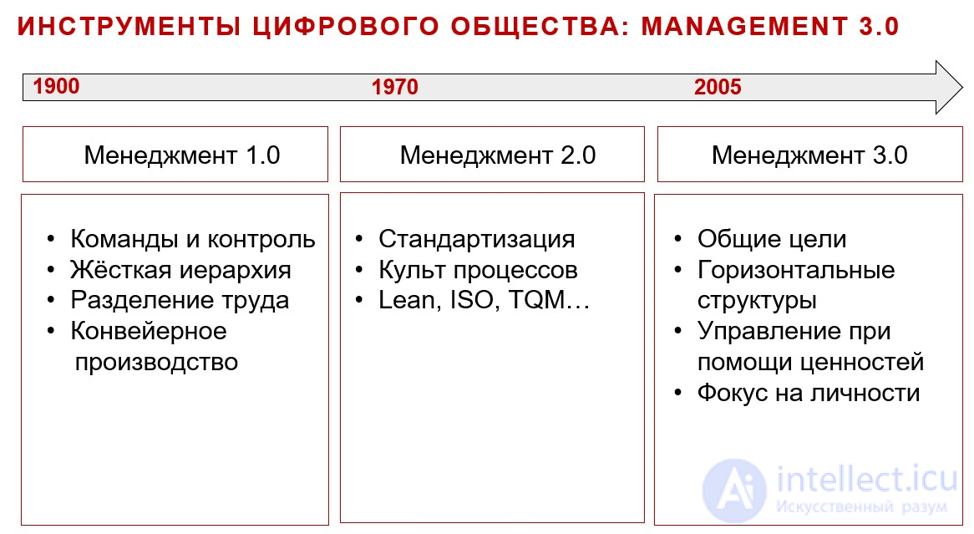
Theoretically, the surest solution for «red» organizations would be to move steadily upward, through a culture of rules, toward cultivating leaders who will create a culture of success. This is the evolutionary path. The pros are minimal stress and shock, and maximum retention. The cons are that it simply takes a long time. Sometimes from several years to a decade. Given the speed of market development and fierce competition, your organization may never live to see a «green» culture of effectiveness.
Is it possible to change quickly without building a cargo cult and without falling into cultural schizophrenia in the process?
I think this is the most acceptable option, and it is precisely this kind of «quick» path to «recovery» that we're going to talk about today.
Many of you, I think, have heard of a tool called OKR (Objectives and Key Results). Without going into a detailed discussion of the many interpretations of it, we can say that it is designed to fight the problem of business goals becoming distorted as they are passed down the pyramid of hierarchy, as well as to ensure that the KPIs of different departments are consistent with the company's overall goals.
Example: «The board of directors decided to double output by expanding existing capacity. The procurement department arranged for the necessary equipment to be delivered to the production sites, BUT when purchasing, it was guided primarily by its own KPI of reducing purchase price. As a result, it bought a cheap Chinese equivalent, which broke down in a short time and caused lengthy downtime, losses, and the disruption of the company's strategy».
In an ideal world, OKR provides a way to compare and eliminate contradictions among such KPIs across departments and levels. «In an ideal world» — because, as we already know, if the level of culture in your organization is low, then tools belonging to a higher culture (and OKR is exactly such a tool) simply won't work for you.
In this respect, the values-based management model that we recommend as the primary tool for rapid and effective transformation is built on the same principle, but solves the problem far more effectively, since it is aimed above all at building a highly effective culture in which any effectiveness tools will work the way they are supposed to
There are only three values in total; you can use them both for diagnosing your organization and for transforming and developing it.
The idea, on the whole, is simple – you look at every business decision, every process and regulation in your organization to see whether it ensures the implementation of these three values, and if not, you take steps to ensure that it does.
So, in general, here they are…
Three vaccines against «redness».
Value: Continuous improvement
I am writing these lines right now, and you are reading them only because, at a time very far removed from us, Nature built the Principle of continuous improvement into all living things. We also know it by another name – Evolution.
The idea is simple – it is impossible to foresee the ideal solution for every context and turn of events millions of years ahead. But it is possible to build into the design a mechanism for continuously reviewing the current status and making an immediate decision about change, based on the information and experience available at that particular moment. If the wrong decision was made – no big deal, this will come to light at the next improvement cycle and will be corrected.
Examples of the benefits of this value for business:
Cost reduction — more efficient and economical use of resources.
Improved retention — people are more satisfied because they have a direct impact on getting things done and feel their significance at work.
Increased competitiveness – improved quality of the company's products and services.
Improved teams — working together to solve problems helps build and strengthen existing teams.
Continuous improvement also means, among other things, increasing personal competence, constant self-assessment and cross-assessment of employees with identification of areas for development and the drawing up of clear and strict
продолжение следует...
Часть 1 Colour-Based Cultural Differentiation: Red, Blue, Orange and Green Corporate Cultures
Часть 2 See also - Colour-Based Cultural Differentiation: Red, Blue, Orange and

Comments