
Lecture
SWOT analysis – one of the most widespread analytical methods, which makes it possible to comprehensively assess a company's strengths and weaknesses, as well as the opportunities and threats affecting it.
The SWOT matrix includes:
S (strengths) – strengths. Business characteristics that set it apart from competitors.
For example: the best customer service on the market, more affordable prices.
W (weaknesses) – weaknesses. Traits that make a company vulnerable in the market.
For example: ineffective advertising, insufficient staff.
O (opportunities) – opportunities. Things a company can use to grow its business.
For example: the right location for production.
T (threats) – threats. Things that can cause damage to the company.
For example: high competition in the market.
The term “SWOT analysis” was first used by American academic Kenneth Andrews in 1963 at Harvard, at a conference on business policy issues.
It can be useful for both small startups and large firms.
To enter the market, a startup must understand all internal and external opportunities and threats. For example, when launching a new social network, one needs to assess the intensity of competitive rivalry, since a great many social networks already exist, the threat of substitute products or services, and the market power of consumers; and decide exactly what your USP (unique selling proposition) is, and so on.
Major market players should conduct an organizational SWOT analysis at least once a year. This makes it possible to stay relevant, since changes happen every day.
If everything is so ideal, then why do the analysis at all, one might ask? Like any other type of marketing, the email channel also has its own strategy, goals, budget, and so on. A SWOT analysis of this specific channel will help reveal what is working great and what can be improved. And if you look at SWOT across the whole marketing department and/or company, it will show how email affects the team's current state of affairs.
Get a free audit of your mailings and bonus emails
It is a universal method that helps a company identify and make use of:
internal opportunities (the ways in which the project/team/collective outperforms others in the market).
For example: a strong technical support team, an innovative business model;
internal threats (what inside the project/team/collective weakens its potential opportunities).
For example: an under-staffed team, outdated sales techniques;
external opportunities (factors that provide additional ways to reach the final goal and result).
For example: growing interest in omnichannel marketing, market expansion;
external threats (possible factors that, on the contrary, slow down the process of achieving the team's goal).
For example: heavy competition.
Helps identify potential threats and build a protection strategy.
SWOT is fairly simple to conduct and does not require specialized, narrow-focus training.
A SWOT analysis will not show clear-cut analytics. It gives you structured data, and beyond that it is up to your analyst or any other employee who helps shape the marketing strategy based on the data obtained.
SWOT shows the state of affairs at a given moment and remains static. That is exactly why it needs to be done at least once a year.
It is a fairly subjective analysis and depends on who is doing it.
A quality analysis requires a large amount of information from all areas (logistics, commercial, marketing, financial, etc.), which can be costly.
A few tips for greater SWOT effectiveness:
Do not run the analysis alone; it is better to do it in the format of a brainstorm involving employees from absolutely every department in the company. Managers gather current information about projects from their department: what is working well, what needs to be improved, what problems might be encountered – and bring it to the brainstorm. This way you get the chance to see the company's pluses and minuses from different angles.
Also do not forget that a company's strengths and weaknesses are subjective concepts. For top management these may be more global issues than the specific ones at the department level.
Formulate things as clearly and concisely as possible. Try to put yourself in the customer's shoes and look at your business through their eyes. But the most accurate and genuine answers will come from the customers themselves. You can run a survey on your site, develop a questionnaire with the right questions, or simply call loyal customers – there are plenty of options.
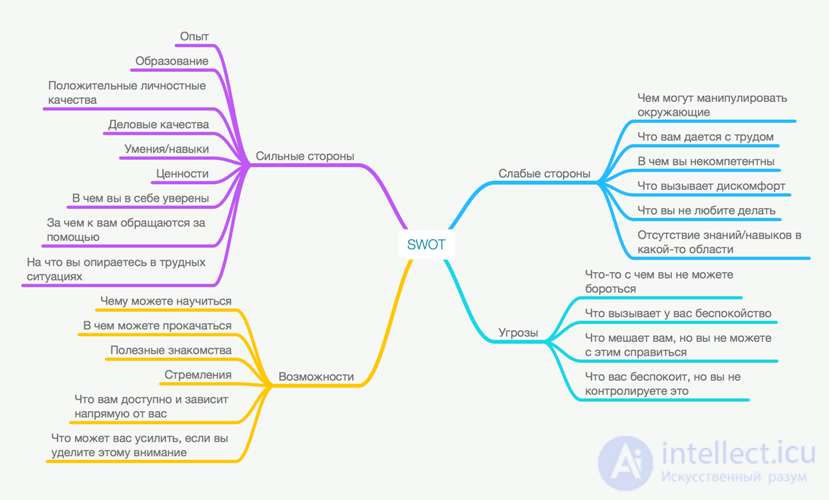
Example of a SWOT analysis
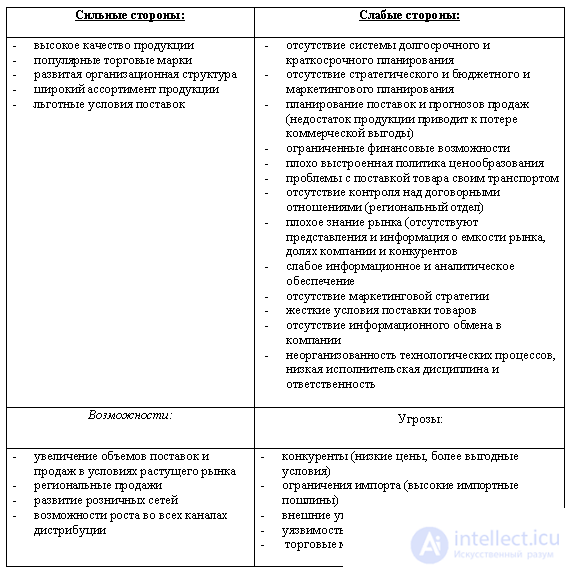
Example of a more elaborate form of SWOT analysis
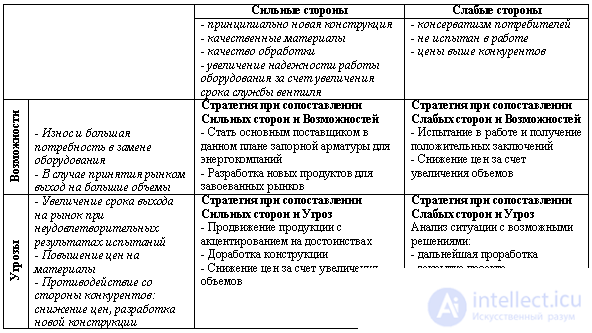

Comments