
Lecture
Time management, time organization, time management (Eng. time management) — a technology for organizing time and increasing the efficiency of its use.
Time management is the act or process of training conscious control over the time spent on specific activities, whereby efficiency and productivity are deliberately increased. Time management can help acquire a range of skills, tools, and methods used in performing specific tasks, projects, and goals. This set includes a wide range of activities, namely: planning, allocation, goal setting, delegation, analysis of time expenditure, monitoring, organizing, making lists, and prioritizing. Initially, management was attributed only to business or work activity, but over time the term expanded to include personal activity on the same basis. A time management system is a combination of processes, tools, techniques, and methods. Time management is usually a necessity in the development of any project, since it determines the project's completion time and scope.
In time management, the following processes can be distinguished
Working time — the time spent performing work, or the time of active presence at work devoted to carrying out direct job duties. Working time is actually considered to be the time recorded in the timesheet, that is, in the document for recording time spent at work .
Кэ = (Ф — Р)/Ф = 1 — Р/Ф,
where Ф — working time fund, min;
Р — regulated and unregulated work breaks, min.
Кп = Пз/Ф,
where Пз — working time losses that depend on the employee, min.
Кп = По/Ф,
where По — losses due to organizational and technical reasons, not dependent on employees, min.
Кол = ОЛ/Ф,
where ОЛ — time spent by the employee on personal needs (lunch break, workplace exercise, hygiene, etc.), min.
Similarly, one can analyze the time an employee spends performing functions inherent to their role (Ксв), functions not inherent to their role (Кнсв), performing creative work (Кт), organizational and administrative work (Коа), and so on.
Working time deficit (chronophages)— a shortage of the time resource caused by an employee's improper organization of their own activity, or by poor organization of activity on the part of management, which leads to haste, delays in completing work and tasks, poor-quality work, production losses, defects, etc., which ultimately significantly affects the efficiency and performance of the entire enterprise.
One of the methods for improving management at an enterprise is analyzing the working time expenditure of the enterprise's head and the heads of functional departments. To identify the causes of the time shortage, it is necessary to periodically conduct a time inventory over several working days. A manager's anxiety due to a lack of time can be identified by the following signs :
The most characteristic causes of time deficit
Planning means preparing for the achievement of goals and organizing working time. It is known from practice that spending 10 minutes on planning working time can save up to two hours daily.
To make rational use of their time, a manager must first of all clearly understand their main functions, goals, tasks, and time budget. The following basic rules should be taken into account when planning:
The basis of a specialist's time-use plan can be their long-term plan. Based on this multi-year plan, an annual plan is drawn up, which encompasses quarterly plans. Quarterly plans can be coordinated with the annual plan and broken down into monthly plans. Proceeding from this, the weekly-daily plan will be the most accurate plan for using a specialist's working time. The plan for the working day represents the most important step in planning working time; it is constantly monitored and adjusted in light of the situation.
Organizing daily plans using the «ALPEN» method. This method covers five stages:
The order of performing tasks can be established using the Pareto principle (in an 80:20 ratio). This principle means that within a given group or set, certain small parts are more significant than the group as a whole. In accordance with this theory, a conclusion can be drawn regarding a specialist's use of working time: during the first 20% of the time spent, 80% of the result is achieved. The remaining 80% of the time spent yields only 20% of the overall result.
Setting priorities using ABC analysis. This technique is based on the fact that the percentage shares of the most important and least important tasks remain constant overall. All tasks are divided into three classes according to their significance. ABC analysis is based on three regularities:
Table 1. Establishing task priorities using ABC analysis.
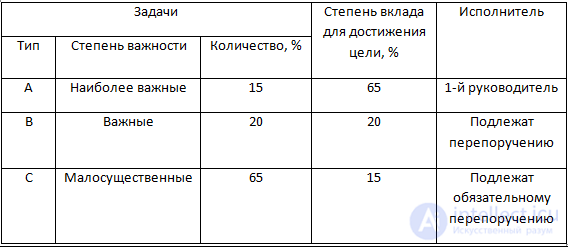
To use ABC analysis, the following rules must be followed:
Rapid analysis using the Eisenhower principle. This principle is auxiliary in cases when it is necessary to urgently decide on the priority of task execution. Priorities are established according to criteria such as the urgency and importance of the task. They are divided into four groups:
It is known from practice that operational daily planning of performers' work makes it possible to increase their labor productivity by 25—30%, and to save the manager's time on regulating processes due to unforeseen disruptions arising during work: due to raw material supply failures, power outages, transport problems, and other unforeseen factors.
The manager carries out daily operational planning of performers' work by issuing them assignments for the next day. Moreover, primary and backup assignments should be issued simultaneously (2—3 backup assignments can be issued). The assignments given by the manager to the performer are recorded in the performer's work notebook. This allows the performer, if the primary assignment cannot be carried out, to immediately switch to the backup assignment without losing time. This saves the performer's time in switching to other work, while the manager attends to their own tasks without wasting time preparing and issuing a new assignment. If the primary assignment cannot be carried out, the performer must immediately report this to the manager. If this is not possible, the performer must inform the manager at the end of the working day about having carried out the backup assignment. The performer can convey this information personally to the manager, through the executive secretary, or by making an entry in the work log.
Today there are many schools of time management. Classical training covers the following topics:
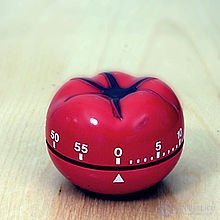
The creator of the method and others encourage a low-tech approach using a mechanical timer, paper, and pencil. Physically winding the timer emphasizes the user's determination to tackle the task, the ticking reminds them that time is passing, and the bell signals a break. Flow and attention are associated with these physical stimuli. Nevertheless, there are a number of applications for working with the method.
Cirillo insisted that any distraction can be postponed for 20-25 minutes, and did not recommend pausing the timer. If you cannot wait, you need to turn off the timer, do what you need to do, and then return to work by restarting the timer from the beginning.
In order to avoid procrastination, it is not recommended to turn off the timer early even after finishing work on a specific task: one should move on to the next matter or further planning.
Time management helps to use not only working time but also leisure time more effectively. In particular, it is recommended not to take work home, to organize daily life so that it takes up a minimum of time, to carefully plan free time in advance and follow these plans, in particular by regularly practicing emotional (theaters, concerts, exhibitions, etc.) and physical (sports, fitness) switching activities. In American companies, if a rank-and-file employee stays at work longer than specified in their employment contract, this fact can serve as grounds for dismissal, since it indicates that the employee is not managing to complete their tasks during their working hours. Use not only weekends but also at least one weekday evening per week for active recreation, and also use long weekends and holidays as mini-vacations. On business trips, plan free time (from several hours to two days) for sightseeing local attractions. For the duration of a vacation, establish rules for using the phone, email, the internet, etc., and stick to them.
Learn to manage your time Determine your main goals and tasks Compare the results achieved with the possibilities for implementation Learn to say No Delegate your authority Determine how you plan and allocate your time If the stressor is a large workload, try to change your workaholic image Concentrate your attention on what you like to do and minimize the tasks you dislike
Use your time and do not let time use you Leave free time in your schedule Learn to say No Arrange your own workplace to your taste Try not to forget the pleasant moments of your work Set aside time for family matters
Fraisse's Law Time has both an objective and a subjective magnitude. One should first do the work one likes, and put off the unpleasant work for later
Parkinson's Law The more time given to complete a task, the more time it consumes. One should proceed from the time actually needed, not from the time desired. Limit yourself in time. Set clear deadlines necessary for completing tasks
Douglass's Law Desk space gets filled with papers. Searching for what you need eats up time. Clear your workplace of unnecessary papers
Carlson's Law Any work that is interrupted and then resumed takes more time than work done without interruption. Once you start a task, finish it as completely as possible
Ilyich's Law The more time spent on completing a task, the less productive the work becomes. Work should be limited in time
Pareto's Law The main work takes less time, while secondary, less important work takes more – 20% of priorities provide 80% of success in each case. It is necessary to separate the main from the secondary, keeping more time for the essential
The Law of Alternatives There is always something to do; you should precisely choose the time for what. Do not do several things at once, but choose one and do it well
The Law of Freedom Inside us there is a rhythm, our own internal clock. Work should be coordinated with one's own inner rhythm

Comments