
Lecture
Organizational processes are the process of performing work according to a plan, which is broken down into stages
Over the last century, this aspect of management — organizational processes — has been in a state of active evolutionary development. The reasons for this include the constantly existing need for organizational development, the growth in the scale of activity and the increasing complexity of the external environment of organizations, the search for a perfect organizational management structure, and ensuring effective management of the organization in accordance with market requirements. The organizational process consists in forming the structure of the company.
Russian companies are characterized by features of organization-building aimed at implementing the concept of intensifying commercial efforts, transitioning to a marketing concept of enterprise management, seeking effective management of labor productivity to ensure competitiveness, and introducing a unified system for quality management and information flow. At the same time, these factors are bottlenecks for economic entities in the domestic economy. The transition to international standards of financial, personnel, and information technology management at Russian enterprises will make it possible to accelerate the integration of the domestic economy into the world economy, ensure civilized and «transparent» relations in the «employer — employee — state» chain, and increase labor productivity.
The main current goals of the organization process include:
The result of all actions to implement organizational goals should be:
It is generally accepted to define the concept of «organizational structure» as a formal scheme for the distribution and coordination of work assignments among the structural units and employees of an organization, consisting of relationships that determine the formal relations of employees, and built to achieve the goals and objectives of the organization.
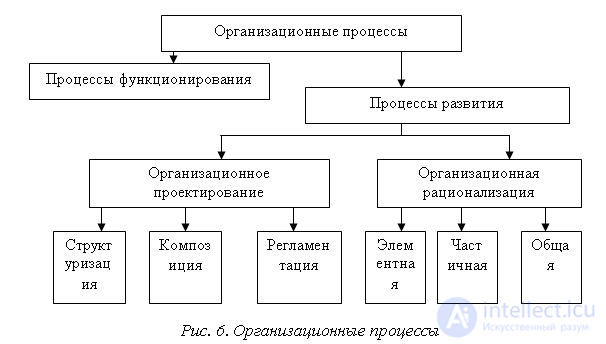
A classification of organizational processes is given in fig. 6.
The principal means of establishing formal relationships among employees within an organization, and of distributing authority and responsibility among them, is the process of delegating authority.
Delegation is the means by which management distributes among the organization's employees the set of tasks (jobs) whose performance is necessary to achieve the goals set. Delegation means transferring tasks and authority to a specific person who takes on the obligation to carry them out. In small businesses, the entrepreneur often performs all the main management functions and makes the necessary decisions personally. However, as the scale of the organization's activity grows, the manager must hand over part of their tasks to subordinates, since the time, knowledge, and experience of any manager are limited, and sole management becomes impossible or extremely inefficient. It is precisely the ability to get work done through others that constitutes the essence of management, and the ability to delegate is what turns a person into a manager. A diagram of the process of delegating authority in commercial-type organizations is shown in fig. 9.1.
When delegating tasks to an employee, the organization must provide them with the resources necessary for this; accordingly, along with the tasks, the manager must also delegate the corresponding amount of authority.
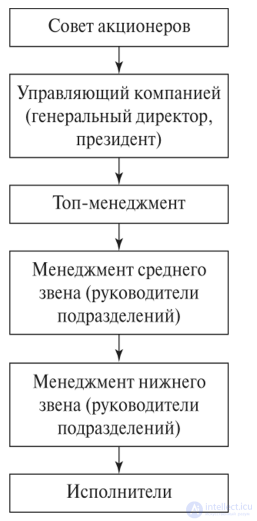
Fig. 9.1. Diagram of the process of delegating authority in commercial-type organizations
Authority is the limited right to dispose of resources and to determine the actions of an organization's employees. Constraints on the distribution and use of authority within an organization are imposed through organizational regulations (rules, regulations on structural units, job descriptions, etc.), as well as through corporate culture. External constraints are contained in various legislative acts and are shaped by the traditions, customs, and socio-cultural stereotypes of society.
When tasks and authority are delegated within an organization, the question arises of responsibility for the effective performance of the tasks assigned to an employee. Responsibility is an employee's obligation to perform the tasks inherent in the position held and to answer for the results of their activity according to the criteria set. A manager must clearly define the boundaries of responsibility within the organization and, when delegating part of their authority as necessary, cannot also transfer part of their responsibility to subordinates along with it, continuing to answer for their affairs. Therefore, unlike authority, responsibility is not delegated.
The main tasks that should not be delegated to subordinates include tasks:
When delegating authority and tasks, it is necessary to define the desired results, inform the employee of the basic rules and conditions, provide the necessary resources, and discuss the reporting procedure and measures of responsibility.
It is customary to distinguish two main types of organizational authority: line and staff.
Line authority is the principal type of authority, passed directly from a superior to a subordinate, and its delegation creates a hierarchy of management levels within the organization. It signifies the right of direct, sole command, of giving orders and instructions, and of making decisions on all matters arising within the team subordinate to the manager, within the limits established by the organization, the law, or custom. A manager endowed with line authority is called a line manager.
Another type of organizational authority is staff authority. Its emergence was caused by the increasing complexity of organizations and managerial labor, its division and, consequently, the specialization of managers. As a result of this specialization, a management apparatus (sometimes called a staff) took shape, whose main purpose is to assist line managers in making and implementing decisions (analysis of information, consulting, development and preparation of various decision options, expert evaluation, monitoring the implementation of decisions made, etc.). Within the management apparatus, various units can be distinguished — advisory, functional, and service units — whose heads are vested with special staff authority. The specific managerial functions performed by staff services include planning, marketing research, personnel management, documentation, resolving legal matters, and the like.
The delegation of authority and the formation of a scalar chain within an organization are linked to two of the most important principles of management: the principle of unity of command and the principle of manageability, which substantially influence the formation of the organizational structure.
The principle of unity of command means that an employee must have one direct manager, receive tasks and authority only from that person, and answer only to them. Implementing this rule presupposes strict subordination: an employee who has encountered a problem cannot go over the head of their direct manager to a higher-ranking manager. Likewise, a higher-ranking manager should not give orders to employees while bypassing their direct managers. This principle is enforced most rigidly in military and state bureaucratic organizations; in commercial structures, however, strict adherence to the principle of unity of command generally leads to a decrease in their efficiency, since with a long scalar chain the exchange of information and decision-making are substantially slowed down.
The principle of manageabilitymeans that a manager can effectively control the work of only a limited number of subordinates. In other words, for any manager there is a certain span of control — a specific number of employees directly subordinate to them. Until recently, it was customary to define the optimal norm as 7 to 10 people. However, modern research shows that this figure can vary very widely, since it is determined by a set of specific conditions that often act in opposite directions. These are, above all, the nature and degree of complexity of the tasks performed by subordinates, their motivation, i.e., their interest in their work and its results, the manager's level of qualification, ability and experience, the technology of control, and a number of other factors. It is clear, however, that in each specific case there is a certain limit beyond which a manager will be unable to effectively coordinate, monitor, and motivate the activity of their subordinates.
Primary organizational processes come down to the joining of previously independent systems or to their division into separate components.
The joining of systems and their components is called conjugation. The following types of conjugation are distinguished:
• simple merger – the joining of components without visible qualitative changes,
• collision – the joining of components leading to their destruction,
• transformation – the joining of components leading to the emergence of a new system possessing a different quality.
If the systems being joined have no common elements, an indirect joining is applied using the method of ingression, i.e., through the use of a connecting link that includes qualities characteristic of the systems being combined. In addition to ingression, degression is also used for joining systems, consisting of two connecting links — an external (plastic) one and an internal (skeletal) one
Egression is a method of joining systems in which one element maintains a connection with a number of other elements. This method sharply increases the capabilities of the system, since the central link concentrates and directs resources in the required directions.
Disingression is the disconnection of the elements of a system by eliminating the connecting link, leading to the disorganization of the system.

Comments