
Lecture
Management 3.0. It might seem like a strange name. Yet it captures the essence of the changes in the concept of management and the current direction of its development. Why exactly 3.0? Let’s try to figure it out.
Management (or «administration») is the process of planning, organizing, directing and controlling an organization in order to achieve coordination of the human, financial, natural and technological resources needed to carry out tasks effectively. According to Henri Fayol, «to manage is to forecast and plan, organize, command, coordinate and control». Management permeates the whole organization, touching virtually every area of its activity. However, the concepts behind it change over time, and we will look at them in more detail below.
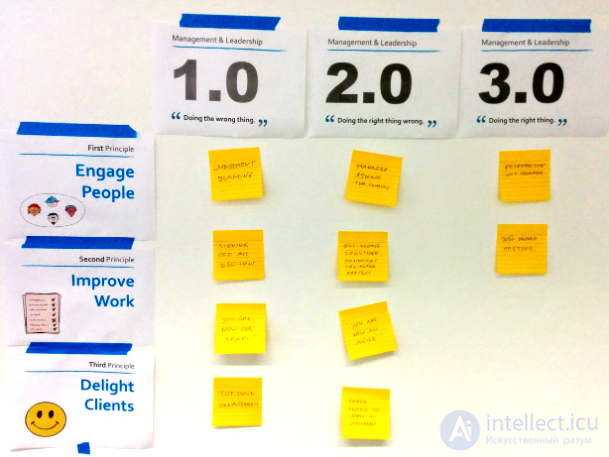
Some call Management 1.0 scientific management methods, others call it operational management. It is taught to university students. And it is precisely what executives ask you to forget when they hire “green” graduates.
The essence of it: the organization is built and run on a hierarchical model, with power concentrated in the hands of a small number of people. At the very top are the highest salaries, the most inflated egos and the most expensive chairs. The lower the level, the less money, little responsibility, and no motivation to do one’s job well.
To offset the dangers lying in wait for top executives in their high positions, they are allowed to play with employees’ bonuses, which more often leads to growth in the interest on personal bank accounts than in the company’s performance figures. A side effect of these risky games with bonus schemes is a worldwide decline in finances. Oops.
The lowest level of employees has no ability to influence decision-making or change the work process; here people are like cogs in a big assembly line. If one drops out, it is easily replaced by another. Individuality has no value here. There is no point in “standing tall” here and trying to bring in new ideas. And the middle level mimics its surroundings, turning into office plankton susceptible to social loafing.
Clearly, Management 1.0, although it is the most widespread management system in the world, has a number of serious shortcomings. It is old, outdated and in need of updating.
During the First Industrial Revolution people were already talking about serial, chain, or mass production. These terms reached their fullest development both with Frederick W. Taylor through Taylorism, and with Henry Ford through Fordism.
These production processes and much of the management systems are developed by engineers, and are characterized by:
In addition, they are based on:
If you think carefully about the previous 10 points, I would say the key lies in the word «machine». That's when it all makes sense, because these processes work well when we talk about machines, about how they operate, and about the types of tasks they perform: predictable and repeatable tasks.
The problem arises when we talk about creativity, innovation, conflict, behavior, networks and relationships, complexity, people ... Here the rules applied to machines remain overly simplistic and do not serve to manage these environments.
These models, which we call the «Management 1.0» concept, are probably the most widespread management styles today.
For many organizations it is common practice to be run like machines. We call this Management 1.0. In this management approach, leaders assume that improving the whole requires monitoring, repairing and replacing parts. It was engineers who developed scientific management, a command-and-control leadership style that was quite successful in the 20th century. Engineers developed most management systems with upfront design, top-down planning, and command-and-control structures and processes.

At some point people suddenly realized that outside of scientific publications Management 1.0 doesn't work too well, and came up with several “semi-scientific” updates. The Balanced Scorecard, Six Sigma, Theory of Constraints, Total and Systemic Quality Management, and so on.
Management 2.0 is a superstructure on Management 1.0. Here too it is said that the organization is run from the top, and Management 2.0 helps executives design their organization better. Sometimes it works. Sometimes it doesn’t.
All the add-on services are focused either on improving professional skills or on the art of management. Many books, such as “The One Minute Manager”, “The 21 Irrefutable Laws of Leadership”, “Good to Great”, provide guidance for managers. They prescribe practicing and gaining experience. And again, sometimes the advice works, and sometimes it doesn’t. Books and advice replace one another faster than a mom can change her baby’s diaper.
Yes, the hierarchical structure has become more flexible, and sometimes employees even manage to voice their opinion (gather best practices, for example, and send them by letter up to the executive). And yet, some executives still ask the question: “Why should I motivate employees and talk to them about why the work needs to be done well? After all, that’s their job responsibilities!” Sales departments still clash with logistics departments, and the whole company still dislikes accounting as one. It is still not possible to communicate with a higher-up manager “over the head” of one’s direct boss. Some decisions in companies still require a pile of memos. And so on, and so on, and so on…
Management 2.0 is an updated version of Management 1.0, an attempt to soften the problems of the old system. However, the structure of Management 2.0 still remains hierarchical and does not always allow it to keep up with change.
And some readers will certainly ask, so what should we do about it now?
Some people discovered that Management 1.0 doesn’t work right out of the box and that changes need to be made. Surge Management 2.0.
Organizations using this version of management generally recognize the following statements:
Although the ideas outlined above sound great and are very appealing, we still run into major problems in these organizations. The explanation is simple: as a solution for Management 1.0 we added a series of add-ons that were originally tied to version 1.0. That's why, although the problems get solved, the structures, architectures and hierarchies remain the same.
I like to highlight two consequences that occur when changing the «outward appearance» of Management 1.0 to move toward Management 2.0, namely:
Fortunately, many managers have realized that people are harder to work with than machines. In an organization that uses Management 2.0, everyone acknowledges that «people are the most valuable asset» and that every manager must become a «servant leader». But at the same time, managers prefer to stick with the hierarchy.

Complexity theory was born and began to develop several decades ago. At first it was applied mostly in mathematics and biology, then in economics and sociology. And it was a major breakthrough. Stephen Hawking considered it so important that he called the 21st century “the century of complexity”.
The first important discovery is that all companies are networks. People may even portray a company as a hierarchical structure, but that doesn't negate the fact that in reality a company is a network. Second, social complexity tells us that management concerns people and relationships first, and only then departments and profit.
Many of us already know this definition: “Leadership is the right way to do the right things”. Complexity thinking adds a new dimension to our existing vocabulary. And here it is worth understanding and viewing the company as a living being, not as a machine. It grows, develops, changes, experiments, and looks for what's best for itself. It can be flexible.
It's cool to give something a name. A name can be very powerful. The version “3.0” indicates that management needs updating. Usually a company like Microsoft, for example, needs three product releases to achieve an update and quality work. The author of this name spent a long time leading software development. And it makes sense that the name of his system matches his way of thinking.
Management 3.0 is about making people engaged, improvements continuous, and customers satisfied and happy. The role of the leader here is to make the team handle tasks on its own. Which frees up the leader's time for themselves, for working with even more people, for strategic planning and conquering new heights.
Management 3.0 does not deny the value of the tools of Management 1.0 and 2.0. But still, we ought to replace hierarchy with networks, because the 21st century is the century of complexity. Management 3.0 is a constantly changing set of games, tools and practices. A way of looking at the work system, a way of thinking and behaving.
So, Management 3.0 is about people and their relationships within organizations. Jurgen Appelo presented his concept in the form of a six-eyed little monster named Martie, each eye of which watches over a specific area of relationships: engagement, empowerment, boundaries, continuous improvement, competence, and structure.
When working with people it is important to pay attention to each of the six points. Then the team will work as a single whole and deliver results. In a complex world, it is often not only the end consumer of a product who doesn't know what they ultimately want to get. The leader, too, working with their team, doesn't always know what the outcome will be. That's why continuous improvement lies at the heart of the Management 3.0 concept. And experimentation.


The Management 3.0 system includes a number of tools as hints for leaders. We talk about them on our blog and on our group's page. As well as at Management 3.0 trainings. Information about the next training is right here.
The most important thing is to try, to pick the ones that suit your team, to ask questions and share experience and discoveries.
(Which, by the way, will be extremely helpful for those who decide to get a Management 3.0 Practitioner Certificate).
This is a movement of innovation, leadership and management in which organizations are viewed as complex social networks, where the systems need to be managed, not the people, together finding the most effective way for our company to achieve its goals while keeping your employees' happiness a priority.
In the following articles I will explain in more detail what «Management 3.0» is and how we can put the theory into practice.
Some people think of the organization as a community. An employee can do what they want, as long as the community benefits from their work. In a community, everyone is (partly) responsible for contributing to its success, and some are responsible for everything.
The principles themselves remain constant, but the practice of applying them changes. It depends on context and will therefore evolve over time. Some practices will succeed in some environments, and some won't.
Management 3.0 practices should conform to the following 5 principles:
1. Engage people. Draw people into the work, involve people in interacting with one another. Increase the interactions between people.
2. Improve the system. The system isn't just a single team. Everyone who interacts with the team is part of it. You need to try to improve the whole system, not just a part of it.
3. Delight customers. Customers aren't just our external customers, but also everyone who takes part in the system: employees, other teams, shareholders, etc. We should try to please everyone, not just stakeholders or just our employees.
4. Manage the system, not people. It is hard to change people's behavior. But people do have to adapt and change their behavior to fit a new environment. By changing the environment, people can manage themselves.
5. Co-create together. Employees create something together, and co-creation also means giving each other feedback.
Many organizations struggle with employees' self-education. A very effective way to make learning enjoyable for people is to organize research days. Hackathons or ShipIt days are meant to invite employees to learn and grow by running experiments and exploring new ideas.
Although orientation training is important, further self-education needs to be encouraged. Planning time for this kind of activity is essential to your organization's success.
This is one of the most controversial topics in management: who to pay, and for what. Paying people for their work without destroying their motivation is one of the hardest tasks in management. Unfortunately, most reward systems are considered unfair by employees and unscientific by experts.
How can we use bonus structures that can genuinely stimulate intrinsic motivation?
Bonuses are usually distributed based on performance rating, job title or position, salary, overtime, or some other variable. Decades of research confirm that traditional bonus systems rarely have a positive effect on people's performance when they are engaged in creative knowledge work. As for a single compensation system, it does not solve the problem of paying employees what they actually earn.
Management 3.0 adheres to a bonus system with the following constraints:
Always keep bonuses a surprise. When bonuses become frequent and expected, they should be converted into regular salaries.
When determining how much people should earn, the main criteria should be their collaborative work toward a shared goal.
Feedback from colleagues is the main performance indicator. Contributions to the common goal are best noticed and evaluated by colleagues.
Expect that people can (and will) act within any system and apply creativity, rather than failing to accept it and ignoring it.
Make money a reflection of people's curiosity, honor, recognition, mastery and all the other intrinsic motivators.
However, it is important to remember that what matters most is that each person can only acknowledge the contribution of other people, and that everyone's opinions carry equal weight.
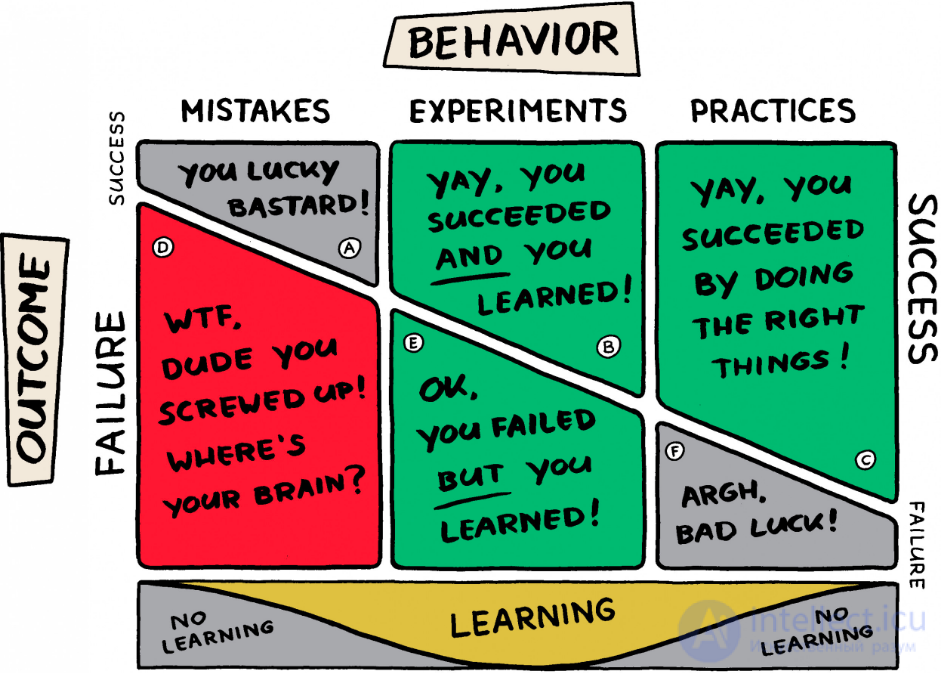
Does your organization value what employees have learned? Do you applaud colleagues who do their job well? Too often organizations live from one crisis to the next and forget to pay attention to achievements, records and successes. In work and in life we sometimes succeed and sometimes fail. Whether it's an achievement or a failure, we learn from experiments. That is exactly why a Celebration Grid is needed, for celebrating small wins.
The Celebration Grid is a visual way to present results, regardless of how successful they were. It shows us where a best practice is the result of a positive experiment, and where we can learn something from failures.
Potential areas for celebration are marked in green, while those colored gray and red are cases where we didn't learn anything or had a positive result. Ask everyone to fill in their own Celebration Grid, and then use it as a basis for discussion.
Management 3.0 is a global revolution in management that brings together thousands of project managers, mid-level managers, CEOs and entrepreneurs who jointly find solutions, using games to encourage employee feedback and team collaboration.
Practically every industry is ready for change and ready for a new outlook on management. Management 3.0 is the future of management.
In conclusion, here in a few words is a definition of each of the versions of management that we have seen:

Comments