
Lecture
Это окончание невероятной информации про цветовая культурная дифференциация.
...
schedules for implementing these plans, with results being submitted to a panel of colleagues more competent in the given field.
No improvement is possible if people are afraid to voice their ideas or criticize the existing state of affairs.
You can consider psychological safety in your company to be at a high level if:
Psychological safety is fertile ground for any kind of effectiveness. Let people be themselves, free them from fear and excessive stress, and you will be amazed at the leap in their productivity.
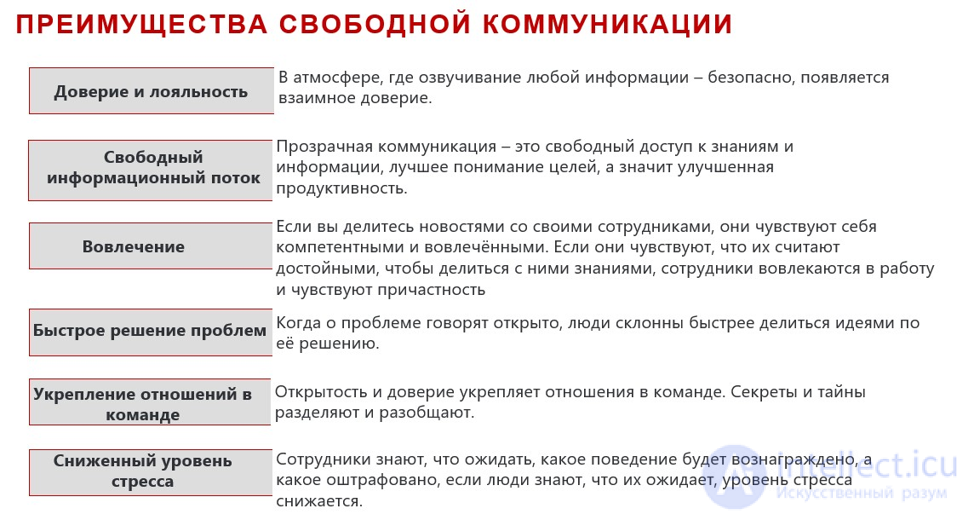
Like the two values above, Free communication does not exist without the others; it overlaps with and supports them.
Tools for maintaining and implementing these values.
The main advantage of management by values is the ability to take any of the existing effectiveness tools and apply them, either selectively or in combination, changing, adapting, and hybridizing them depending on your business context.
An example of combining and hybridizing well-known tools to uphold the three core values could be the following:
Some hybrid Agilean tools were mentioned in this article. You can read about examples of other hybrid adaptations at this link: www.agilean.ru/gemba
«Agilean – employees», or on the fact that it's not only managers who will have to change.
And last but not least, something we would like to mention in this article – is the transformation of the employees of such a highly effective Agilean enterprise.
We already talked, in earlier parts of this article, about the main problem with all cultural transformations, when management orders consultants to transform their enterprise, framing the request as «transform our employees, but we – the top management – are already good as we are».
However, this problem also has another side. It shows up in a rarer situation, when management has recognized the need for change and is ready to change itself, but encounters misunderstanding and resistance from employees who are not used to making independent decisions, showing initiative, and developing themselves.
Such employees mistake Psychological safety for permissiveness and a way to escape responsibility and criticism, Continuous improvement for a right to demand constant improvements to their own conditions from management regardless of their personal achievements, and Free communication for an opportunity to demand more privileges for themselves simply because it turns out other employees have them.
Yes, there are plenty of such inert employees, who feel quite comfortable in «red» organizations, unaccustomed to thinking, making decisions, and taking responsibility, and focused on their core competency – unconditional loyalty to any decision made by a manager. And it must be said plainly – in an Agilean organization they will only have the choice of transforming along with the company or leaving. Remaining in the status of an incompetent, inert deadweight in a continuously improving organization with transparent processes and constant cross-assessment will be impossible.
Those same employees who decide to stay will have to apply the three core Agilean values, first and foremost, to themselves.
And that means that…
What will you get for all this effort in the end?
Satisfaction from your own rapid development as a professional and from the overall success of your team. A rush of dopamine energy in the morning at the thought that you need to go to work, and a serotonin-fueled sense of completion and safety from having done valuable and useful work during the day. Reduced levels of stress and absurdity. A sense of meaning in your life.
Well, or, if you put all of the above together, what you get is that very thing called Happiness at work.
Часть 1 Colour-Based Cultural Differentiation: Red, Blue, Orange and Green Corporate Cultures
Часть 2 See also - Colour-Based Cultural Differentiation: Red, Blue, Orange and

Comments