
Lecture
Stakeholders are all individuals, groups, or organizations that influence a system/project or are affected by its influence.
More simply:
anyone who “is not indifferent” to what happens with the system
The difference between a customer and a stakeholder — a customer is one of the stakeholders, but not vice versa.
Key differences
| Criterion | Stakeholder | Customer |
|---|---|---|
| Scope | broad (all interested parties) | narrow (one role) |
| Money | not necessarily | almost always pays |
| Influence | can be indirect | direct influence |
| Goal | varied (UX, stability, security) | business goal / ROI |
| Involvement | can be passive | actively involved |
Stakeholder theory is a theory of organizational management and business ethics that accounts for the many stakeholders affected by business entities, such as employees, suppliers, local communities, creditors, and others. It examines morality and values in managing an organization, for example those related to corporate social responsibility, the market economy, and social contract theory.
The strategy concept based on accounting for stakeholder interests combines the resource-based and market-based approaches, while also adding a socio-political dimension. One common version of stakeholder theory seeks to identify a company's specific stakeholders (the normative theory of stakeholder identification), and then examines the conditions under which managers regard these parties as stakeholders (the descriptive theory of stakeholder salience).
In fields such as law, management, and human resource management, stakeholder theory has successfully challenged conventional analytical frameworks by proposing that the needs of stakeholders be placed at the forefront of any action. Some authors, such as Geoffroy Murat, have attempted to apply stakeholder theory to irregular warfare.
A business (or system) must consider the interests not only of shareholders, but of all stakeholders.
A system is successful if it balances the interests of:
and does not optimize for profit alone
System = a compromise between stakeholders
You cannot:
Stakeholders are not just a list of people.
They are:
Stakeholders directly influence:
in fact:
architecture = a reflection of stakeholder interests
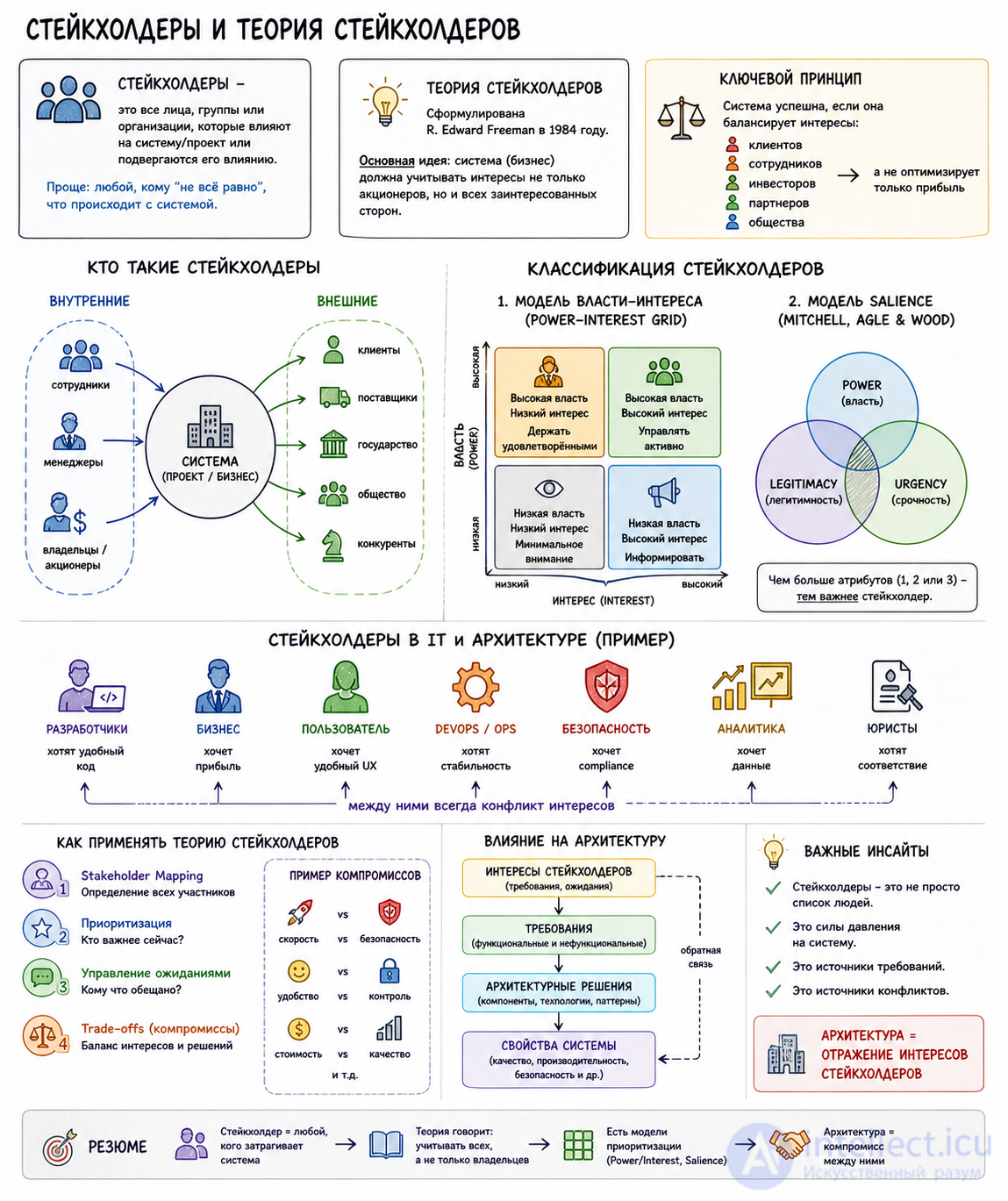
Divides stakeholders along 2 axes:
| Type | What to do |
|---|---|
| High power + high interest | manage actively |
| High power + low interest | keep satisfied |
| Low power + high interest | keep informed |
| Low power + low interest | minimal attention |
One of the most important in the theory.
A stakeholder is defined by 3 attributes:
The more attributes — the more important the stakeholder
1. Internal
2. External
Stakeholders are not just “business”.
and there is always a conflict of interest between them
Concepts similar to modern stakeholder theory date back to long-standing philosophical views on the nature of civil society itself and the relations between people. In Miles v. Sydney Meat-Preserving Co Ltd (1912), in which a shareholder was denied a legal right to dividends, the Chief Justice of Australia, Samuel Griffith, noted that:
The law does not require the members of a company, in managing it, to abandon all sentiments of altruism, or to maintain the character of the company as a soulless and heartless entity, or to wring from it the last penny in its commercial dealings, or to forbid them from conducting its business in a manner they consider favorable to the best interests of the community as a whole.
The term «stakeholder» in its modern usage first appeared in an internal memorandum of the Stanford Research Institute in 1963. Subsequently, a «multitude» of definitions and theories of stakeholders were developed. In 1971, Hein Kroos and Klaus Schwab published, in German, a booklet titled «Modern Enterprise Management in Mechanical Engineering», in which they argued that the management of a modern enterprise should serve not only shareholders but all stakeholders (die Interessenten) in order to achieve long-term growth and prosperity. This claim is disputed. It was followed by American authors; for example, in 1983 Ian Mitroff published, in San Francisco, the book «Stakeholders of the Organizational Mind». In early 1983, R. Edward Freeman published an article on stakeholder theory in the California Management Review, but did not mention Mitroff's work, attributing the development of the concept to internal discussions at the Stanford Research Institute. This article was followed by the book «Strategic Management: A Stakeholder Approach». This book defined and modeled the groups that are stakeholders of a corporation, and described and recommended methods by which management could properly take the interests of these groups into account. In short, it attempts to resolve «the principle of who or what really counts». In the traditional view of the company, the shareholder view, only the owners or shareholders of the company matter, and the company bears a binding fiduciary duty to put their needs first in order to increase value for them. Stakeholder theory, by contrast, holds that other parties are also involved in the process, including employees, customers, suppliers, financiers, communities, government bodies, political groups, trade associations, and unions. Even competitors are sometimes regarded as stakeholders — their status is determined by their ability to influence the firm and its stakeholders. The nature of what constitutes a stakeholder is a subject of fierce debate; there are hundreds of definitions in the scholarly literature.
Numerous articles and books devoted to stakeholder theory commonly refer to Freeman as the «father of stakeholder theory». Freeman's book «Strategic Management: A Stakeholder Approach» (1984) is widely cited in the field as the foundation of stakeholder theory, although Freeman himself references several strands of literature used in developing his approach, including strategic management, corporate planning, systems theory, organization theory, and corporate social responsibility. A related area of research examines the concept of stakeholder identification and stakeholder salience, or the importance of various stakeholder groups to a particular firm.
An anticipation of similar concepts as part of corporate social responsibility appears in a 1968 publication by the Italian economist Giancarlo Pallavicini, the creator of the «parameter decomposition method» for calculating results not directly related to a firm's economic activity, but concerning ethical, moral, social, cultural, and environmental issues.
Later scholarly works on the topic of stakeholder theory, illustrating research and theorizing in this field, include the works of Donaldson and Preston (1995), Mitchell, Agle and Wood (1997), Friedman and Miles (2002), and Phillips (2003).
Thomas Donaldson and Lee E. Preston argue that the theory has three distinct but complementary aspects: descriptive, instrumental, and normative:
Since this article was published in 1995, it has served as a foundational reference for researchers in this field.
Mitchell et al. derive a typology of stakeholders based on the attributes of power (the degree to which a party has the means to impose its will in a relationship), legitimacy (socially accepted and expected structures or patterns of behavior), and urgency (the time sensitivity or critical importance of a stakeholder's claims). By examining the combination of these attributes in a binary fashion, 8 types of stakeholders are identified, along with their implications for the organization. Friedman and Miles examine the consequences of conflicting relationships between stakeholders and organizations, introducing compatible/incompatible interests and necessary/contingent connections as additional attributes by which the configuration of these relationships can be studied. Robert Allen Phillips distinguishes between normatively legitimate stakeholders (those to whom the organization owes a moral obligation) and derivatively legitimate stakeholders (those whose stakeholder status is determined by their ability to influence the organization or its normatively legitimate stakeholders).
Stakeholder theory has become known not only in the field of business ethics; it is used as one of the foundations in corporate social responsibility methods. For example, ISO 26000 and the GRI (Global Reporting Initiative) include stakeholder analysis.
In the field of business ethics, Weiss, J. W. (2014) shows how stakeholder analysis can be supplemented with issue-management approaches to examine social, organizational, and individual dilemmas. Several case studies are offered to illustrate the application of these methods.
Stakeholder theory became widely adopted in higher education in the late 20th and early 21st centuries. One influential definition defines a stakeholder in the context of higher education as any person having a legitimate interest in education and thereby acquiring a right to intervene. Higher education research first began recognizing students as stakeholders in 1975. External stakeholders may include employers. In Europe, the growth of stakeholder regimes resulted from the transition of higher education from state-run bureaucracy to modern systems in which the government's role involves monitoring rather than direct control.
Economist and university professor Danuse Nerudova, a candidate in the 2023 Czech presidential election, is a proponent of stakeholder-oriented capitalism, in which «issues of sustainable development and global policy, as well as the development of national societies» would carry greater weight in decision-making by companies and the state. Researcher Benjamin Tallis has studied whether a shift from neoliberalism to stakeholder-oriented capitalism, «which implies a different role for the state, as well as an emphasis on building more cohesive and resilient societies», could affect public optimism in the Czech Republic.
1. Stakeholder Mapping
Identifying all participants
2. Prioritization
Who matters most right now?
3. Managing expectations
Who has been promised what
4. Trade-offs
For example:
Ignoring hidden stakeholders:
then problems “suddenly” arise
Political philosopher Charles Blattberg criticized stakeholder theory for assuming that the interests of various stakeholders can, at best, be traded off against or balanced with one another. Blattberg argues that this is a result of its emphasis on negotiation as the primary mode of dialogue for resolving conflicts between stakeholder interests. Instead, he recommends dialogue, and this leads him to defend what he calls a «patriotic» conception of the corporation as an alternative to the one associated with stakeholder theory.
Management scholar Samuel F. Mansell has argued that by applying the political concept of the «social contract» to the corporation, stakeholder theory undermines the principles on which the market economy is based, and may thereby increase, rather than decrease, the opportunities for weak stakeholders to be exploited by self-interested managers.

Comments