
Lecture
The core conceptual apparatus of program-target planning includes the following elements: the program-target approach, program-target planning, the integrated target program, and the program-target method.
The program-target approach is the most general concept, characterizing the application of individual elements of program-target planning in the practice of making planning decisions on the economic and social development of a management object (especially at the initial stages of plan development, when goals are being formed and the main ways of achieving them are being determined). In particular, the program-target approach can be used not only in developing integrated target programs, but also in business planning and in long-term and medium-term plans.
Program-target planning is a method of managing the economic and social development of a country (a region, an industry, a complex of enterprises) through the development and implementation of specific planning documents - integrated target programs. Program-target planning is built on a logical scheme: "goals - ways of achieving them - means (instruments) of achieving the goal - resources needed to achieve the goal." In this case, unlike in-house (corporate) planning, the goals are formed to solve an important problem and are more specific in nature.
The integrated target program (ITP, the program) is a directive and targeted document that coordinates, in terms of resources, executors, and implementation deadlines, a complex of socio-economic, production, research, organizational-economic and other tasks and measures aimed at solving the most important and pressing problem in effective ways within the established time frame.
The program-target method determines the techniques and ways of developing programs and reflects the sequence of making program decisions in time and space.
A distinguishing feature of this method is not the forecasting of the future states of the system, but the drawing up of a specific program for achieving the desired results.
Another feature of program-target planning is the way it influences the system being planned. What is placed at the forefront is not the system that has already taken shape, along with its structure, but the elements of the program, which may not coincide with the system (measures are developed to change the system).
The program-target approach to managerial decision-making is the most widespread and effective state method of regulating the economy.
The program-target approach to managerial decision-making is applied by the majority of the world's countries, having established itself as one of the most precise and reliable. The method has found wide application in the West, being used at all levels of planning and management.
In our country, owing to historical circumstances, the theory of management and planning developed in directions different from those in the West. As a result, a situation arises in which domestic scientific developments in this area are almost entirely absent.
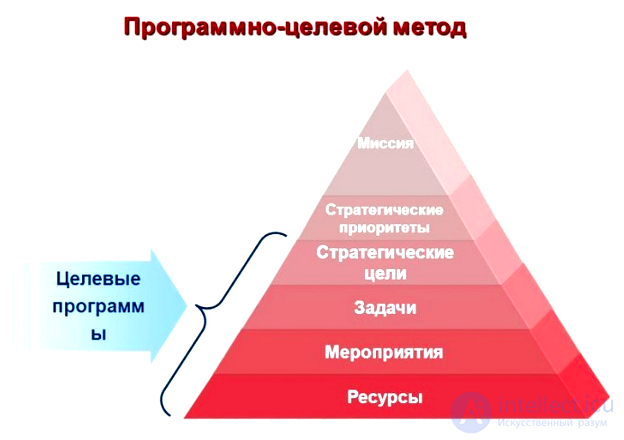
The program-target approach to managerial decision-making is a type of planning whose foundation is orienting activity toward achieving the set goals. In the program-target approach to managerial decision-making, the very process of planning is based on defining and setting goals with the subsequent selection of ways to achieve them.
The program-target approach to managerial decision-making is built in accordance with the logical scheme «goal — path — methods — means». First, the goals are determined, then the ways of implementing them are outlined, and finally detailed methods and means are defined.
Ultimately, by applying the program-target concept, the organizer sets specific goals for themselves and develops a program of actions to achieve them.
The program-target approach to managerial decision-making has a distinguishing feature, which consists in the fact that planning is carried out not through forecasting the future states of the system, but through forming a specific program for achieving the desired result.
The program-target approach to planning makes it possible not only to observe the situation, but also to exert influence on its consequences.
A feature of program planning can be considered the way it affects the system being planned. Here, the foundation is not the system itself, its components, and its organizational structure, but the process of managing the program's elements or program actions.
The program-target approach to managerial decision-making presupposes the use of programs. A program includes a system of measures in the course of implementing strategies, while the system of strategies and goals that are achieved with their help constitutes a plan.
The program-target approach in the process of managerial decision-making is primarily aimed at setting goals, after which the ways and specific methods of achieving them are developed.
Setting a goal for the program consists in creating a «goal tree«. Subsequently, based on the goal tree, a system of measures for achieving the goals is built, which is called an integrated target program.
The main advantage of the program-target method under present-day conditions is the concentration of resources on implementing interconnected measures, the possibility of monitoring their expenditure, and adjusting and stimulating their effective use.
An ITP may have deadlines that are not tied to plan periods. At the same time, program indicators are reflected in the plans of the executors of program tasks and measures, which predetermines the division of the program period into terms combined with plan periods. In Russia, such programs are mostly developed and implemented with the involvement of budgetary financing (from the federal, regional, or local budget), which has affected the structure of the programs and the deadlines for completing tasks (they are tied to the system of state planning and to the development and execution of budgets).
Subsequently, programs for developing one sphere of activity or another, the most important for the region, were developed in practically every region. In particular, regional programs supporting small business have been developed and are being implemented almost everywhere. At the federal level, about 100 target programs have been developed and are currently being implemented.
At enterprises, the most serious and strategically important problems are mostly solved with the help of business plans for investment or entrepreneurial projects. At the same time, enterprises take part in the process of developing and coordinating the measures of an ITP if the tasks or measures concern the enterprise's activity or if the enterprise participates in their implementation. At the same time, recently, at the level of large enterprises as well, integrated target programs have begun to be developed and implemented, which has formed a new direction in management - management by programs. This is due to the fact that an ITP is a fairly universal document, with the help of which it is possible to purposefully and effectively solve the most important problems.
Program-target planning has been used most intensively in Russia since 2000 to solve socio-economic problems related to quality of life, demographics, the priority development of knowledge-intensive industries, as well as service-sector industries (tourism, culture, the hotel industry, etc.).
The distinguishing features of an ITP as a planning document are as follows:
The rules, requirements, and framework for developing programs and organizing their execution are determined by principles, which are formed on the basis of the methodology of program-target planning. These principles can be conditionally divided into two groups:
The general principles of planning are set out in Chapter 1 of the textbook, so this chapter focuses mainly on the specific principles.
The principle of the comprehensiveness of program decisions determines the need to reflect in the program the measures and tasks along the chain of their interconnections, as well as by executors regardless of their industry or organizational-legal affiliation. In this way, an intersectoral coordination of program indicators is ensured that is stricter than in a plan, along with the reflection in the program not only of industry-specific tasks, but also of tasks for other industries and enterprises that ensure the achievement of the set goals. The requirement of this principle can be met provided the program's goal is clearly formulated and the main ways of its implementation are determined. At the same time, it is necessary to more clearly delineate the boundaries of the problem being solved and the range of organizations and enterprises included in the program.
The next principle of program development, closely interconnected with the principle of comprehensiveness, is purposefulness. The principle of purposefulness means ensuring the priority of the goal, defined as the final result, over resources.
A program is called a target program precisely because it is aimed at achieving a specific goal. When formulating a program's goal, account is taken, firstly, of the long-term development goal of the object of program-target planning, secondly, of the functions and tasks that the planning object will perform in the future, and thirdly, of the local problem that the program is aimed at solving.
The principle of the unity of goals and resources predetermines the interlinking of the program's planned tasks and measures with resources, executors, and deadlines. It is advisable to calculate the resources needed (financial, labor by qualification structure, material by their composition) for each task of the program, provided that increased efficiency of their use is ensured. In doing so, it is also necessary to determine the sources of resource inflow by their types, volume, and qualitative composition.
These fundamental principles of program development determine the main directions for using the program-target approach to effectively solve problems in the socio-economic development of a country, a region, an intersectoral complex, or an enterprise.
The principles of program-target planning find their concrete manifestation in the methods, techniques, and procedure for developing an ITP as a document.
At present, state planning is represented mainly by a system of program-target planning.
Program-target planning is one of the types of planning based on orienting activity toward the achievement of set goals. Program-target planning is built on a logical scheme «goals — paths — methods — means». First, the goals to be achieved are determined, then the ways of implementing them are outlined, and then – more detailed methods and means. Ultimately, having set certain goals for himself, the organizer develops a program of actions to achieve them. It follows from this that the distinguishing feature of this planning method is not merely forecasting the future states of the system, but drawing up a specific program for achieving the desired results. The program-target method of planning is «active»; it makes it possible not only to observe the situation, but also to influence its consequences, which distinguishes it favorably from most other methods.
Thus, the program-target method of planning consists in selecting the priority goals of economic, social, and scientific-technical development, developing interconnected measures for achieving them within the set time frame with maximum efficiency and with the required provision of resources. The method includes developing programs with account taken of strategic goals, and determining the ways, means, and organizational measures for achieving them.
A program is a scientifically substantiated representation of the state of some individual, local object of management after a certain period of time (5, 10 years, or more), based on the achievement of a set goal and the fulfillment of a set of measures coordinated in terms of resources, deadlines, and executors.
By content, economic, social, scientific-technical, innovation, investment, environmental, and defense programs are distinguished. They may be aimed at solving political, national, emergency, and religious tasks, problems of crime, etc. By time period, programs are: long-term (over 10 years), medium-term (3-5 years), and short-term (up to a year).
Planning is carried out in compliance with specific principles, i.e., rules for forming, substantiating, and organizing the development of planning documents. The main ones are: scientific soundness, social orientation, increasing production efficiency, proportionality and balance, priority-setting, and the coordination of short-, medium-, and long-term goals.
In the USSR, under the predominance of state ownership, the first program was the GOELRO plan – the comprehensive state plan for the electrification of the country, adopted in 1920. At the state level, programs were also applied in other countries. Thus, in the 1930s the US federal government adopted a program for developing industries in the Tennessee River valley. In the postwar period, a program was implemented to create, in the area of Silicon Valley (the state of California), a complex of laboratories, organizations, and enterprises for developing and producing electronic and computing equipment for the needs of the defense industry.
The following stages are distinguished in drawing up a program: selecting problems for inclusion in the program; making the decision to develop a target program and forming it; the expert review and evaluation of the target program; the approval of the target program; and managing the implementation of the target program and monitoring the progress of its execution.
The selection of problems for their program-based development and solution is determined by the following factors:
the significance of the problem;
the impossibility of comprehensively solving the problem within an acceptable time frame through the use of the existing market mechanism, and the resulting need for state support in solving it;
the fundamental novelty of technical, organizational, and other measures, extremely necessary for the large-scale dissemination of advanced scientific and technical achievements and for increasing the efficiency of social production on this basis;
the need to coordinate the intersectoral links of technologically interconnected industries and production facilities in order to solve the given problem.
The program-target method of planning and management presupposes a certain documentary base. The main document characterizing the socio-economic processes in Russia from the standpoint of planning and defining the regulatory role of the state is the forecasts of socio-economic development for the corresponding periods. Their content goes beyond the scope of pure forecasts, since they contain real proposals for influencing the country's economy.
More specific planning documents are the integrated target programs. An integrated target program is a document that reflects the goal and a set of production, research, organizational-economic, social, and other tasks and measures aimed at solving economic problems in the most effective way and coordinated in terms of resources, executors, and implementation deadlines.
By content, integrated target programs can be divided into several types.
1. Socio-economic programs ‑ envisage the solution of problems of a social nature and raising the material standard of living of the population.
2. Scientific-technical programs ‑ are aimed at solving scientific and technical problems, accelerating the introduction into production of achievements of science and technology that make it possible to secure a significant positive effect in the near term. The list of scientific-technical programs is formed on the basis of the priorities of economic development.
3. Production-economic programs ‑ are intended to solve major intersectoral problems in the field of production, contributing to increasing the efficiency of existing production facilities and the development of new ones.
4. Territorial programs ‑ are aimed at transforming regions, the comprehensive development of new territories, and solving other tasks in the regions.
5. Environmental programs – represent a set of measures of an environmental-protection nature.
6. Organizational-economic programs - are aimed at improving the organization of economic management.
Integrated target programs also differ in their time duration. They can be long-term, developed for a period of more than five years, and medium-term – with a duration of up to five years.
Another element of the program-target approach to managerial decision-making is the definition of the management system. Building the management system is the foundation for carrying out the program.
Planning the solution of a particular problem when using the program-target method mostly comes down to planning the management system. The main stages of this process are:
Thus, program-target planning is planning aimed at solving a particular problem and achieving a specific result. Programs developed on the basis of this method differ in time period, type of problem, and sphere of the national economy. A target program is formed on the basis of a forecast of socio-economic development and is made concrete in the form of integrated target programs.
Assignment.
Show in what case the application of program-target planning is necessary.
EXAMPLE 1
The stages of decision planning in accordance with the program-target approach include:
1) Developing the composition of the units,
2) Processing information in quantitative measures,
3) The quality of managerial decisions,
4) Methods of working out managerial decisions.
Answer 1
EXAMPLE 2
The system of measures in the course of implementing strategies represents.
1) The object of managerial decision-making,
2) The effectiveness of decision-making,
3) The program of decision-making,
4) The process of overcoming difficulties.
Answer - 3

Comments