
Lecture 8 min.
The Swiss psychologist Jean Piaget studied intelligence from the standpoint of the structural-genetic approach. Jean Piaget created the most profound theory of intelligence. He built his research at the junction of several psychological schools: behaviorism (the reaction was replaced by the operation), Gestalt psychology, and the teaching of P. Janet (from whom he borrowed the principle of interiorization). According to J. Piaget, the child's intellectual development was based on the development of the child's speech and thinking. From this it was concluded that up to a certain age the child's reasoning is egocentric in character, whereas the adult thinks socially. J. Piaget was the first to propose studying not what the child thinks about, but how he thinks. The intelligence of a healthy, fully developed person cannot be destroyed; the transition to a higher level of development simply promotes the emergence of new ways of assimilating and processing information. In J. Piaget's view, a more mature intelligence has a more complex scheme of development.
Piaget tried to interpret the facts of child development in terms of their vital, biological significance, and therefore linked the development of children's thinking with the general biological modes of an organism's life activity: assimilation, accommodation, and adaptation. In the constant interaction and contradiction of the processes of assimilation and accommodation, and in the constant tendency to bring them into equilibrium, Piaget saw the internal source of mental development.
J. Piaget advanced the hypothesis that the egocentrism characteristic of the child is overcome in the course of socialization. On this basis one can speak of the interiorization of external actions, i.e., thinking through one's own actions. He identified 4 main stages in the development of intelligence.
Each stage has its own characteristics and features.
J. Piaget regarded intelligence as a living biological structure thanks to which a person is able to take in certain knowledge at each stage of development; it is a kind of process of adaptation to the external world. A person's development depends in many respects on his activity. J. Piaget was the first among scientists to abandon the quantitative measurement of intelligence. He compared the structure of intelligence to a four-level barrel that can be filled only up to the second level (knowledge and skills). One can keep filling this barrel, but in that case the knowledge will overflow and only the skills will remain. He believed that a meaningless "building up" of intelligence can lead to the opposite process.
Piaget's views on the nature of the child's intelligence were reflected in his solution to the problem of the relationship between instruction and mental development. According to Piaget, instruction is subordinate to the laws of development. Like other external influences, instruction provides only "food for cognition," material for exercising and dissecting the spontaneously forming structures of intelligence. The only useful role of instruction is to create situations that require active functioning of the subject's action schemes. The effectiveness of instruction depends on the degree to which external conditions correspond to the current level of development.
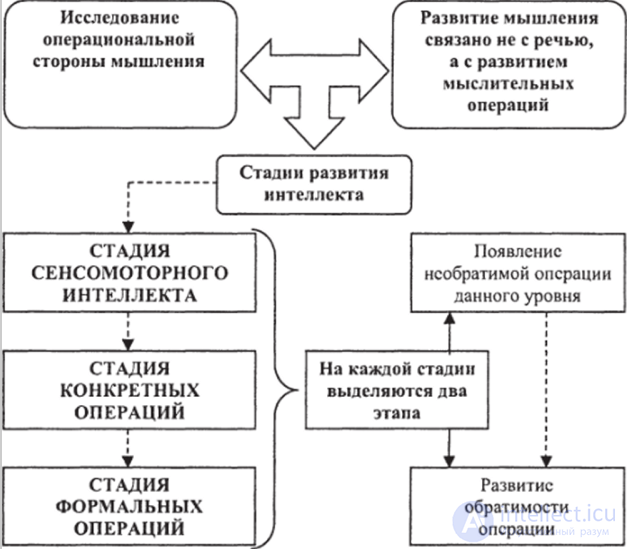
Jean Piaget's research, which began in the 1930s, was concerned with the study of the operational side of thinking. He came to the conclusion that the development of thinking is closely connected not with speech but with the development of mental operations, and he devised experiments to study them. In fact, Piaget was the only researcher who paid attention to precisely this problem, since most scientists studied not the process of thinking but the products of thinking activity.
He concluded that mental development is connected with interiorization, since the first mental operations — external, sensorimotor ones — subsequently move to the internal plane, turning into logical operations proper, that is, mental operations. Piaget also discovered the main property of these operations — their reversibility. He studied both the transition from external operations to internal, logical ones and the formation of reversibility at each of the stages.
In experiments with young children, Piaget studied their ability to find hidden objects, including those that disappeared before their eyes. In the same way, Piaget demonstrated that not only reversibility but also logical operations, such as general concepts, become available to children only at the end of the preschool age. Studies that revealed the difference between figurative (imagistic) and logical thinking were of great importance to Piaget.
Piaget's research has always attracted the attention of Russian psychologists. It is noted that the positive aspects of Piaget's concept lie in revealing the role of object-related action as the initial starting point for the development of intellectual processes, in the genetic approach to the study of thinking, in the description of the stages in the formation of intellectual operations, and in showing the complex relationships between perception and thinking, and between the cognitive and emotional sides of the child's mental development. However, even L. S. Vygotsky, while regarding Piaget's works as a major contribution to the development of psychological science, reproached him for approaching the analysis of the development of higher mental functions abstractly, without taking into account the social and cultural environment and the concrete setting surrounding the child. Piaget did not take into account that even the child's very first object-related actions are carried out in the context of his communication with adults, who organize the child's actions in accordance with the socially fixed function of the object. The differences between the views of Piaget and those of Russian psychologists are manifested in their understanding of the source and driving forces of mental development. Piaget regarded mental development as a spontaneous process, independent of instruction, that is subject to biological laws. Piaget reduced the influence of the environment to the retardation or stimulation of the process of mental development, and placed the very source of development inside the individual. In contrast to this understanding, Soviet psychologists held that the source of the child's mental development lies outside him, in his environment, and regarded development itself as a process of the child's appropriation of socio-historical experience. Hence the role of instruction in the child's mental development, which Russian psychologists particularly emphasize and Piaget underestimated, becomes understandable. In critically analyzing the operational concept of intelligence proposed by Piaget, contemporary Russian psychologists do not regard logic as the sole and principal criterion of intelligence and do not assess the level of formal operations as the highest level of development of intellectual activity. Experimental studies (A. V. Zaporozhets, P. Ya. Galperin, D. B. Elkonin) have shown that it is not logical operations but orientation in objects and phenomena that is the most important part of all human activity, and the results of that activity depend on its character. Thus Russian psychologists (from Vygotsky to our contemporaries) have spoken both "for" and "against" Piaget: "for" the facts and "against" their interpretation, i.e., against approaching the facts of child development as natural biological processes.
Thus the periodization of intelligence developed by Piaget acquired a complete form that is widely known today — the stage of sensorimotor intelligence, the stage of concrete operations, and the stage of formal operations. In each stage Piaget distinguished two phases — the appearance of an irreversible operation of the given level, followed by the development of its reversibility — and the periodization itself reflects the process of the complex formation of an adequate intellectual scheme, which consists in the operations moving to the internal plane and acquiring a reversible character.

Comments