
Lecture
Set (attitude) is an unconscious psychological state, an inner quality of the subject based on his previous experience, a predisposition to a certain activity in a certain situation. It is the deep content of implicit memory. Set precedes and determines the unfolding of any form of mental activity. It acts as a state of mobilization, of readiness for a subsequent action. It is conditioned by the corresponding situation in which the subject has a need and by the necessity of satisfying it. A person's having a set allows him to react in one or another particular way to a given political or social event or phenomenon.
Psychological set is a certain state which, without being a content of consciousness, nevertheless exerts a significant influence on its work. In this case the actual state of affairs could be defined as follows: ideas and thoughts, emotions and feelings, and acts of volitional decision are the content of conscious mental life, and when these mental manifestations begin to operate, they are necessarily accompanied by consciousness. To be conscious means to think and to imagine, to experience certain emotions and to perform volitional acts. For a set to arise, two conditions are necessary: an actual need present in the subject and a situation leading to its satisfaction. If both of these conditions are present, a set toward activity arises in the subject. A certain state of consciousness and its corresponding content are formed only on the basis of this set. Thus one must precisely distinguish, on the one hand, a particular set, and on the other, a particular content of consciousness. A set does not constitute anything definite from this content, and consequently it is impossible to characterize it in terms of the phenomena of consciousness.
The phenomenon was discovered by the German psychologist L. Lange (L. Lange, 1888); the general psychological theory of set, based on numerous experimental studies, was developed by D. N. Uznadze and his school (1956). The stages of set formation are most fully revealed on the basis of the concept of the contrast illusion. Along with unconscious elementary sets, more complex social attitudes, value orientations of the personality, and so on are distinguished. In addition, great attention to sets, especially to the role of sets in cognition, was paid by S. L. Rubinstein. In his works the concept of set is connected with the concept of the unconscious.
M. Rokeach drew a distinction between attitudes and values: a value characterizes a belief in a general concept, which may relate to several specific objects and situations, whereas an attitude is a set of beliefs that relate to a single object or situation .
It determines readiness for psychological activity and may vary; it is a dependent concept, depending on the person and the period of time, on spiritual motivation, expectation, conviction, and inclination, which influences not only the specific attitude toward various objects, facts, events, and opinions, but above all the form in which these phenomena are presented, that is, their realization in the world of perceptions.
The conscious and the unconscious are two sides of a single totality of the human psyche. These psychoanalytic concepts belong to the field of study of general psychology. Usually the conscious is contrasted with the unconscious, but from the point of view of psychoanalytic research these concepts are considered as a single whole, but at different levels.
The conscious (or consciousness) is one of the forms of reflection of objective reality in the human psyche. From the point of view of the cultural-historical approach to the problem of the unconscious and the conscious, the latter is characterized by the presence of an intermediate link between consciousness and the perception of objective reality. This intermediate link consists of elements of historical and social practice, which make it possible to build an objective picture of the surrounding world.
The unconscious (or the subconscious, the non-conscious) denotes mental processes that are not reflected in a person's consciousness and are not controlled by it. A characteristic feature of the unconscious is the absence of subjective control: this term can denote everything that is not an object of consciousness for the person.
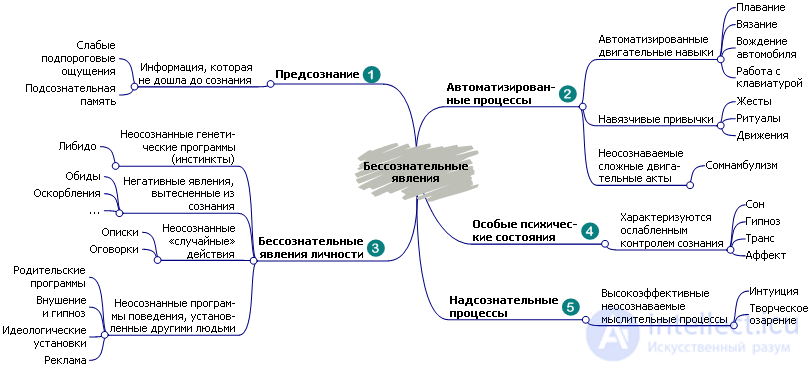
In the theory of the conscious and the unconscious there are several kinds of manifestation of the unconscious:
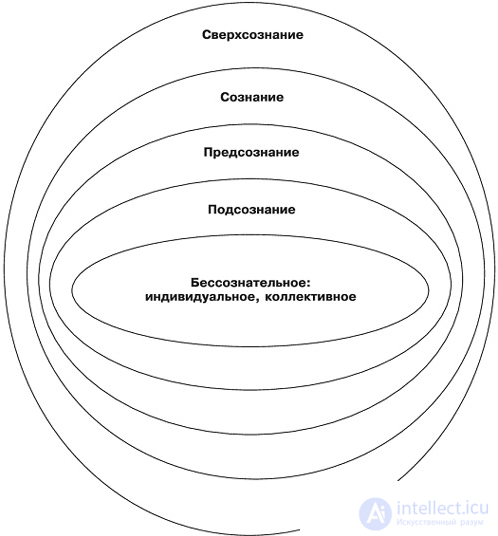
The collective unconscious, according to the psychologist C. Jung, is one of the forms of the unconscious, common to society as a whole and being a product of inherited brain structures. The main difference between the collective unconscious and the individual one is that it is common to all people and represents a kind of single "common denominator" for different people. However, it is important to emphasize that the word "collective" by no means implies problems of the social order; on the contrary, the collective unconscious is a part of the human psyche that is strictly individual (the individual, in the conception of C. G. Jung, is not isolated from society, but, being a person in the narrow sense, he is at once individual and a part of the collective), since it is precisely the collective unconscious that creates the conditions for the individuation of the person. Jung designated it as a deeper layer than the individual unconscious: behind the word stand not only direct meanings but also more hidden layers and meanings of the unconscious level.
The collective unconscious is the totality of universal personal problems that can arise before a person at all times .
The collective unconscious consists of archetypes (universal human primordial images).
In the unconscious Jung distinguished several layers corresponding to the life experience of various human communities. He believed that beneath the personal unconscious lie the group, family, national, racial, and universal human unconscious, and deeper still, the unconscious common to humans and animals. The historical process, in Jung's teaching, is determined by the natural development of the "mass soul," by mass psychological contradictions, but not by politics. According to his theory, spiritual values are stable and universal because they are rooted in the archaic layers of the soul. They have the ability to attract energy and information to themselves and serve as points of crystallization of artistic, mythological, and dream images. According to Jung, archetypes are infinite in number. Especially meaning-rich, powerful archetypes determine the formation of charismatic personalities and entire peoples. Some of the archetypes are symbolized in images of sociality. These are power, the church, the community. Archetypes are points of view or positions that govern our behavior and the course of the psychic process, both individual and collective-historical .
The term was introduced by Jung in 1916 in the article "The Structure of the Unconscious" ("Über das Unbewußte und seine Inhalte", CW 7) and is a central concept of analytical psychology. Later he replaced it with the more precise term "objective psyche," and subsequently with "transpersonal unconscious"
The famous Austrian psychiatrist and psychologist Sigmund Freud described the conscious and the unconscious on the basis of his experiments. The analysis of human behavior showed that a large number of actions of which a person is not aware are, as a rule, unreflective in nature and cannot be explained from the standpoint of consciousness. It was established that various kinds of motivations manifest themselves in neurotic symptoms, dreams and creative work. As a physician who also worked in neurology, Freud encountered the particular influence of unconscious experiences and motives on people's lives. He established that these processes can not only burden the lives of subjects considerably, but also cause neuropsychiatric illnesses. The results of the experiments led Freud to search for a means that could free a person from conflicts between the conscious and the unconscious. It was precisely the search for a compromise between what consciousness dictates and hidden, unconscious impulses that led to the emergence of the method of psychoanalysis.
The problem of the unconscious and the conscious has excited the minds of many psychologists. On the basis of the research of the Swiss psychiatrist Carl Gustav Jung, the founder of depth analytical psychology, a description of the "collective unconscious" was given. Jung believed that there exists not only the unconscious of the individual person, but also a racial, ancestral, national and familial unconscious, i.e. a collective unconscious. It represents the totality of information of the psychic world of a particular community of people, whereas the individual unconscious reflects only the information of the psychic world of a specific person.
Jung's analytical psychology defined the unconscious as established stereotypes and behavioral patterns that require actualization but are in fact innate.
In Jung's interpretation, the unconscious was subdivided into the following psychic processes and states:
Besides Carl Jung and Sigmund Freud, another researcher, the French philosopher and psychoanalyst Jacques Marie Émile Lacan, also studied the conscious and the unconscious. He formulated the hypothesis that the structure of the unconscious resembles that of language. From this point of view, psychoanalysis can be regarded as work with the patient's speech. The famous psychoanalytic technique developed by Lacan was called the "clinic of the signifier". It is based on work with the word, on the necessity and possibility of translation, so-called re-inscription within the psyche. All these actions can be used in therapy connected with complex disorders of mental activity. However, not all authors who study the problem of the unconscious and the conscious agree with Lacan's theory that the unconscious is a language and that psychoanalysis is a language game between the psychoanalyst and the patient. The unconscious is like a language and functions according to a similar algorithm, but the laws of linguistics do not apply to it.
The conscious and unconscious as formulated by Sigmund Freud have been made the basis of modern research. Psychophysiological evidence is obtained through the analysis of sleep, hypnotic trance, and manifestations of automatism in athletic and occupational activity. Theories are being developed on the possible use of cybernetic methods for modeling the unconscious.
The first studies of unconscious processes, conducted at the beginning of the twentieth century, showed that the problem of the unconscious is very broad. It turned out that the information a person is aware of is only the "tip of the iceberg". The amount of unconscious information many times exceeds the amount of conscious information.
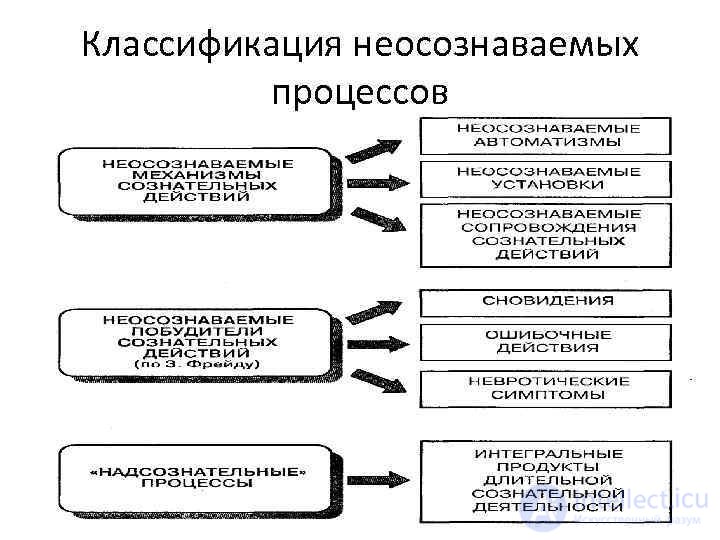
In Russian psychology, unconscious psychic processes are customarily divided into three classes:
Unconscious mechanisms of conscious actions are divided into three subclasses:
There are a large number of psychic processes and phenomena whose course or manifestation is not reflected in a person's consciousness: unconscious processes. The entire totality of unconscious processes is called the unconscious.
The first studies of unconscious processes, conducted at the beginning of the twentieth century, showed that the problem of the unconscious is very broad. It turned out that the information a person is aware of is only the "tip of the iceberg". The amount of unconscious information many times exceeds the amount of conscious information.
In Russian psychology, unconscious psychic processes are customarily divided into three classes:
Unconscious mechanisms of conscious actions are divided into two subclasses:
Among the unconscious mechanisms of conscious actions the following are distinguished:
The study of unconscious motivators of conscious actions is associated with the name of Freud. His interest in unconscious processes arose at the very beginning of his medical practice. The scientist's attention was drawn by the phenomena of posthypnotic suggestion. On the basis of an analysis of such facts, Freud created the theory of the unconscious. According to Freud, the psyche has three spheres: the conscious, the preconscious and the unconscious.
The preconscious - hidden, latent knowledge that a person possesses but that is not present in consciousness at the given moment; when necessary, however, it is easily moved into consciousness. The content of the unconscious, on the contrary, becomes accessible to consciousness only with difficulty, but at the same time it carries a large energetic charge and influences consciousness, penetrating into it in altered form as dreams, erroneous actions (parapraxes) or neurotic symptoms. Freud believed that the true causes of behavior are not realized by a person; they are hidden and closely connected with repressed drives, above all sexual ones. Awareness of the true causes of behavior is possible only through interaction with a psychoanalyst in a specially organized therapeutic process - psychoanalysis.
The outstanding Russian psychologist A. N. Leontiev also maintained that most motives of activity are not realized by a person. However, they can manifest themselves in the emotional coloring of certain objects or phenomena, in the form of a reflection of their personal meaning. A person can become aware of the motives of his behavior without resorting to the help of a psychologist, but this constitutes a special task. Quite often the awareness of a motive is replaced by motivation in the sense of rationalization - a rational justification of an act that does not reflect the person's actual impulses.
"Superconscious processes" are processes of the formation of a certain integral product of a great deal of unconscious work, which then "breaks into" a person's conscious life. For example, a person is occupied with solving some complex problem that he thinks about day after day over a long period. While reflecting, he sorts through and analyzes various impressions and events, puts forward hypotheses, tests them, argues with himself. And suddenly everything becomes clear - sometimes this happens unexpectedly, by itself, sometimes after some insignificant event that turns out to be, as it were, the last straw that makes the cup overflow. What has entered his consciousness is truly an integral product of the preceding process. However, he has no idea of the course of the latter. The "superconscious" refers to processes that occur above consciousness, in the sense that their content and time scales are larger than anything consciousness can contain. Passing through consciousness in separate segments, as a whole they lie beyond its limits.
The identified classes of unconscious psychic phenomena broaden our understanding of the psyche, not limiting it only to the facts of the conscious reflection of reality. Nevertheless, it should be said that the conscious and the unconscious are not opposites but particular manifestations of the psychic.
A distinction is made between internal sets, which are determined by needs and the direction of attention, and sets caused by particular external events: objective and subjective sets. In an intermediate position are sets that arose as a result of past experience connected with the given object and persisted over a long period of time (enmity, friendship, trust, respect, etc.).
Psychological set is a relation between a contemplating person and objects in which certain reactions arise not only upon repeated exposure but also when their occurrence is anticipated, which may be indicated by various warning signals. In studying psychological set, it is advisable to carry out observation over a long period of time.
For this it is necessary to fix it to a certain degree, which is achieved through repeated exposure to stimuli. Such experiments are called fixating or set-inducing experiments, and the set that arose as a result of these experiments is called a fixed psychological set.
Uznadze's theory of set arose and developed as a theory describing one of the forms of unconscious nervous activity. He tried to explain the phenomenon of perception as a reflection of reality and the behavior of a living being. It gradually became obvious that the facts and regularities considered by the theory of set are general psychological in nature. Therefore the theory of set began to claim the role of a general psychological concept.
A set has a three-part structure: 1) an affective component (a sensory image); 2) a behavioral component (actions toward the object of evaluation); 3) a cognitive component .
D. N. Uznadze's students T. T. Iosebadze and T. Sh. Iosebadze characterize set as "a concrete state of the whole subject, his mode, a definite psychophysiological organization, his modification in one or another concrete situation, a readiness to perform a definite activity, an orientation toward the satisfaction of an actual need. Being a reflection of the subjective (internal) and the objective (external), and also being a holistic state of the subject, set appears as a mediating link, a "principle of connection" both between his individual states, functions and elements (in the intrasubjective sphere) and between the latter (or the whole subject) and transsubjective reality. Set contains not only a "causal" moment (an impulse to activity, a need) but also a "goal-like" moment in the form of a general prospective, undeveloped model of future activity, which in its own way reflects its final result. Consequently, set, as a modification of the whole individual, determined by subjective (internal: the actual need, past experience in its broad sense, the characteristics of the given individual) and objective (external: the concrete situation) factors, reflects not only the present and the past but also the future".
A somewhat clearer position on this question is held by Sh. N. Chkhartishvili, who divides set into two types: fixed and primary. They are easily differentiated from each other and have different properties and functions. Shentsev also worked in this direction.
Owing to such features as "two-sided determination", "principle of connection", "dynamism" and at the same time "a certain stability", "integrity", etc., set in this understanding corresponds to the role of a system-forming factor better than such concepts as "goal", "task", "motive", etc. (which lay claim to this role). The concept of "set" should be regarded not as a general relation or position toward some object, phenomenon or person, but as a disposition - a readiness for a particular behavior in a concrete situation. This concept expresses a concrete connection between the internal and the external. Therefore we may have one, for example negative, attitude toward some person, yet many (possibly even mutually exclusive) sets with respect to this individual for various concrete situations (recall the well-known LaPiere paradox, in which the owner of a hotel, despite having a negative attitude toward Chinese people, nevertheless accepted them in his hotel). Thus, the presence of some attitude is not sufficient for the corresponding behavior to occur in a given concrete situation, whereas in such a case the corresponding set invariably guarantees its realization (provided the situation in its psychological sense is not changed)."
Two types of set are distinguished: general and differentiated. A general set arises in relation to large classes of phenomena, a differentiated set in relation to individual objects. Set underlies the integrity and consistency of a person's behavior and determines the norm of his reaction. Sets may be connected with various components of activity. Meaning sets determine the personal meaning of specific objects and phenomena, the readiness to act in a certain way toward a significant object. Goal sets ensure a stable direction of actions; they are expressed in a tendency to complete an action under any circumstances, which can sometimes lead to inflexibility of behavior. Operational sets provide the individual's psychophysiological pre-tuning to perform an action in certain ways, through a consistent system of habitual operations using means that are habitual for the person.
Over time, the concept of the unconscious was also partly transformed in the works of D. N. Uznadze's students. In an article by F. V. Bassin, A. S. Prangishvili and A. E. Sherozia we read: "the unconscious is in any case a much broader concept than 'psychological set'. It is indisputable that among the forms of concrete expression of unconscious psychic activity, psychological sets are assigned a very important place". This idea is expressed more concretely in the work of A. E. Sherozia, who summarizes his position as follows: "In interpreting the theory of unconscious psychic set, we rely on the three-term scheme of analysis of the human psyche 'set - consciousness - unconscious psychic', instead of the two-term 'set - consciousness'. Thus, A. E. Sherozia does not identify set with the unconscious psychic, regarding them as separate but interconnected realities. In this, according to A. E. Sherozia, set performs the function of a link between (a) the psychic and the transpsychic, (b) individual conscious psychic acts, and (c) conscious and unconscious psychic processes. However, with such an interpretation, as with other interpretations, declaring set to be a psychic reality is, it seems to us, at the very least an inconsistent step. A. E. Sherozia asserts that the connection between the conscious-psychic and the unconscious psychic is mediated by set, which he declares to be a psychic reality .
Types of set: 1 - social - readiness for perception and action in a certain key; 2 - motor - readiness for action; 3 - sensory - readiness to perceive; 4 - mental - readiness for certain stereotypes of thinking; 5 - diffuse - a set formed by the subject during a single encounter with an object or phenomenon;
Usually, the stronger the emotional reaction after an event, the more firmly the set is consolidated.
The deep mechanisms underlying many psychological manifestations are closely connected with the concept of set. Thus, prejudice, or the "us versus them" notion, relies on an internal norm formed subconsciously in the person. From this norm, a usually unconscious reckoning of the observed "deviation" proceeds, that is, an evaluation of the situation as normal or deviant (pathological, hostile, etc.). The phenomenon of set explains both the shiftability of the internal standard, which ensures a person's ability to adapt to changing social and psychological conditions of the environment, and such phenomena as prejudice, xenophobia and nationalism.
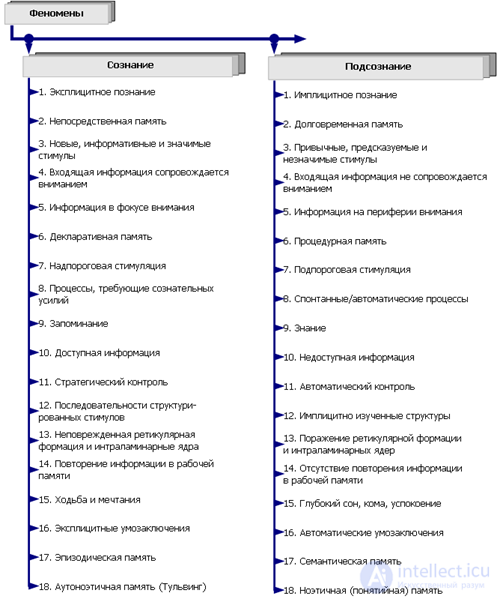
The concept of the "unconscious" is often replaced by the term "subconscious" (English: subconsciousness), which is not strictly scientific from the point of view of psychological science. Fig. 2.8 shows various psychological characteristics assigned to the phenomena of consciousness and the subconscious.
The preconscious (English: preconscious) is
The concept of the "preconscious" denotes phenomena of the psyche that are at the given moment outside the focus of consciousness, yet are closely connected with it, influence its functioning, and, with a change of conditions, pass relatively easily into its sphere.
The unconscious can become conscious, and what is conscious can become temporarily unconscious. There are no special boundaries or insurmountable obstacles between consciousness and the unconscious. Through conscious sets, a person can change the state of unconscious psychic phenomena in a way that promotes the functioning of consciousness.
1. The ability to focus consciousness on itself is the . . . function.
2. The essence of consciousness is characterized by the . . . function.
3. The ability to convey to other people, by means of language and other sign systems, what a given person is aware of is such a characteristic of consciousness as . . .
4. According to Yu. B. Gippenreiter's classification, the unconscious mechanisms of conscious actions include . . .
5. The phenomenon of unconscious set was described by . . .
6. ... are illustrated by our involuntary gestures, facial expressions and various vegetative reactions, and serve as means of communication.
7. A person temporarily forgets the names of objects, has difficulty perceiving external stimuli, and behaves like a child – this is . . . , a disturbance of consciousness.
8. Alienation, one's own thoughts and actions are perceived as if from the outside, and the perception of the body is also disturbed – this is . . . ,
9. Unconscious processes include
10. THE INFLUENCE OF THE UNCONSCIOUS ON HUMAN BEHAVIOR:
Answers 1 2 3 4 5 6 7 8 9 10
c b a a c c d c a 4

Comments