
Lecture
Gestalt psychology (from German Gestalt "personality; image, form") is a general psychological approach concerned above all with attempts to explain perception, thinking and personality. As its main explanatory principle, Gestalt psychology puts forward the principle of wholeness. It was founded by Max Wertheimer, Wolfgang Köhler and Kurt Koffka in 1912.
Gestalt psychology (from German gestalt – "image, form") is a trend in Western psychology that arose in Germany in the first third of the twentieth century and put forward a program of studying the psyche in terms of holistic structures (gestalts) that are primary with respect to their components. Gestalt psychology (G.) opposed the principle advanced by structural psychology (W. Wundt, E. B. Titchener and others) of dividing consciousness into separate elements and building complex psychic phenomena out of them according to the laws of association or creative synthesis. The idea that the internal, systemic organization of a whole provides the properties and functions of its constituent parts was first applied to the experimental study of perception (chiefly visual). With its help, a number of important components of perception can be studied: constancy, structure, the dependence of an object's image ("figure") on its immediate surroundings ("ground"), and others.
In analyzing intellectual behavior, the role of the sensory image in shaping motor reactions was traced. The construction of this image was interpreted as a special psychic act of insight, of rapid grasping of relations in the perceived field. Gestalt psychology contrasted these propositions with behaviorism, which explained an organism's behavior in a problem situation by a sequence of "blind" motor trials that by chance led to a successful solution. In the study of human thinking processes, the main emphasis was placed on the transformation ("reorganization", new "centering") of cognitive structures, thanks to which these processes acquire a productive character that distinguishes them from formal-logical manipulations, algorithms and the like. Although the ideas of Gestalt psychology and the results it obtained contributed to the development of knowledge about psychological processes (above all the category of the mental image) and also led to the establishment of the systems approach, its idealist methodology (going back to phenomenology) hindered a scientific, causal analysis of these processes. Psychic "gestalts" and their transformations were interpreted as properties of individual consciousness, whose dependence on the objective world and on the activity of the central nervous system was conceived on the model of isomorphism (structural similarity), which is a variant of psychophysical parallelism. The main representatives were the German psychologists M. Wertheimer and K. Koffka. Close to it in general scientific position were K. Lewin and his school, who extended the principle of systemicity and the idea of the priority of the whole in changing psychic formations to the motivation of human behavior.
Other representatives: K. Goldstein, an advocate of "holism" (wholeness) in pathopsychology; F. Heider, who introduced the concept of the gestalt into social psychology in order to interpret interpersonal perception; and others.
The primary data of psychology are holistic structures (gestalts), which in principle cannot be derived from the components that form them. Gestalts possess their own characteristics and laws, in particular the "law of grouping" and the "law of relation" (figure/ground).
Christian von Ehrenfels (1859—1932), one of the precursors of Gestalt psychology, already at the beginning of the twentieth century emphasized that "the whole is a reality distinct from the sum of its parts". A gestalt (German Gestalt — form, image, structure) is the spatially visual form of perceived objects, whose essential properties cannot be understood by summing the properties of their parts. One vivid example of this, according to Köhler, is a melody, which is recognized even when it is transposed into other keys. When we hear a melody a second time, we recognize it thanks to memory. But if its key changes, we still recognize the melody as the same one.
If the similarity of two phenomena (or physiological processes) is determined by the number of identical elements and proportional to it, then we are dealing with sums. If there is no correlation between the number of identical elements and the degree of similarity, and the similarity is determined by the functional structures of the two holistic phenomena as such, then we have a gestalt.
— Karl Duncker .
Gestalt psychology arose from studies of perception. At its center is the psyche's characteristic tendency to organize experience into an intelligible whole. For example, when perceiving letters with "holes" (missing parts), consciousness strives to fill in the gap, and we recognize the whole letter.
Gestalt psychology owes its emergence to the German psychologists Max Wertheimer, Kurt Koffka and Wolfgang Köhler, who put forward a program of studying the psyche in terms of holistic structures — gestalts. Opposing the principle advanced by psychology of dividing consciousness into elements and building complex psychic phenomena out of them, they proposed the idea of the wholeness of the image and the irreducibility of its properties to the sum of the properties of its elements. In the view of these theorists, the objects that make up our environment are perceived by the senses not as separate objects but as organized forms. Perception is not reducible to a sum of sensations, and the properties of a figure are not described through the properties of its parts. The gestalt itself is a functional structure that orders the multiplicity of separate phenomena.
All the above-mentioned properties of perception — constancies, figure, ground — enter into relations with one another and produce a new property. This is the gestalt, the quality of form. The wholeness and orderliness of perception are achieved thanks to the following principles:

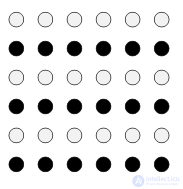

Formed gestalts are always wholes, completed structures with clearly delimited contours. The contour, characterized by the degree of sharpness and by the closedness or openness of the outline, is the basis of the gestalt. One of the fundamental properties of the gestalt is the striving for completeness, manifested in particular in the Zeigarnik effect.
In describing a gestalt, the concept of importance is also used. The whole may be important while its members are unimportant, and vice versa. The figure is always more important than the base — the ground. Importance may be distributed so that as a result all members turn out equally important (this is a rare case, found, for example, in some ornaments).
The members of a gestalt may have different ranks. For example, in a circle, the center corresponds to the 1st rank, a point on the circumference has the 2nd rank, and any point inside the circle has the 3rd. Every gestalt has its own center of gravity, which acts either as a center of mass (for example, the middle of a disk), or as a point of attachment, or as a starting point (the impression is created that this point serves as the beginning for constructing the whole, for example the base of a column), or as a directing point (for example, the tip of an arrow).
The quality of "transposability" is manifested in the fact that the image of the whole remains even if all the parts change in their material, for example if they are different keys of the same melody, but it may be lost even if all the elements are preserved, as in Picasso's paintings (for example, Picasso's drawing "The Cat").
As the basic law of grouping of separate elements, the law of Prägnanz was postulated. Prägnanz (from Latin praegnans — meaningful, pregnant, rich) is one of the key concepts of Gestalt psychology, denoting the completeness of gestalts that have acquired a balanced state, a "good form". Pregnant gestalts have the following properties: closed, sharply defined boundaries, symmetry, and an internal structure that takes the form of a figure. In addition, factors were identified that promote the grouping of elements into holistic gestalts, such as the "factor of proximity", the "factor of similarity", the "factor of good continuation", and the "factor of common fate".
The law of the "good" gestalt, proclaimed by Metzger (1941), states: "Consciousness is always predisposed to perceive, from among the perceptions given together, preferably the simplest, unified, closed, symmetrical one, one that fits into the main spatial axis". Deviations from "good" gestalts are noticed not immediately but only on intensive scrutiny (for example, an approximately equilateral triangle is seen as equilateral, and an almost right angle as a right angle).
Size constancy consists in the fact that the perceived size of an object remains constant regardless of changes in the size of its image on the retina. The perception of simple things may seem natural or innate. In most cases, however, it is formed through one's own experience. Thus, in 1961, Colin Turnbull took a pygmy who lived in the dense African jungle to the boundless African savanna. The pygmy, who had never seen objects at a great distance, perceived herds of buffalo as swarms of insects until he was driven closer to the animals.
Shape constancy consists in the fact that the perceived shape of an object remains constant when its shape on the retina changes. It is enough to look at this page first straight on and then at an angle. Despite the change in the "picture" of the page, the perception of its shape remains unchanged.
Brightness constancy consists in the fact that the perceived brightness of an object remains constant under changing lighting conditions. Naturally, this holds provided the object and background are the same.
The simplest formation of perception consists in singling out in visual perception an object as a figure located against a ground. Separating a figure from the ground and holding it as the object of perception involves psychophysiological mechanisms. Brain cells that receive visual information respond more actively when looking at a figure than when looking at the ground (Lamme, 1995). The figure is always brought forward, the ground is pushed back; the figure is richer than the ground in content and brighter than the ground. And a person thinks about the figure, not about the ground. However, their role and place in perception are determined by personal and social factors. Therefore the phenomenon of the reversible figure becomes possible, when, for example, during prolonged perception the figure and ground exchange places.
By the 1920s Gestalt psychology had taken up fairly solid positions in Germany. But politics hindered its further development. In 1933 the government of Adolf Hitler expelled all Jews working in German universities. Max Wertheimer and Kurt Koffka were Jews, and together with the other leading Gestalt psychologists they emigrated to the United States. However, behaviorism, which adhered to a completely different approach, dominated the United States at the time, and Gestalt psychology was unable to occupy as prominent a place in that country as it had in Germany. As a result, Gestalt psychology ceased to exist as a separate scientific school in the 1960s, with the death of Wolfgang Köhler .
Gestalt psychology held that the whole is not derived from the sum of the properties and functions of its parts (the properties of the whole are not equal to the sum of the properties of its parts) but has a qualitatively higher level. Gestalt psychology changed the earlier view of consciousness, proving that its analysis is meant to deal not with separate elements but with holistic psychic images. Gestalt psychology opposed associationist psychology, which dissects consciousness into elements. Together with phenomenology and psychoanalysis, Gestalt psychology formed the foundation of F. Perls's Gestalt therapy, which carried the ideas of the Gestalt psychologists from cognitive processes to the level of a worldview as a whole.
Abraham Maslow, one of the founders of humanistic and transpersonal psychology, was influenced by Max Wertheimer in creating his theory of self-actualization, and considered Wertheimer one of the exemplars of the self-actualized personality.
Akṛti (Devanagari अकृति akṛti IAST from the root kṛ "to manifest", with the prefix ā) — the observable individual form of a thing, configuration, silhouette, outline, contour (cf. the "eidos" of Greek philosophy and the modern concept of the "gestalt"). The term is used in discussions of the meaning of the word, its relation to the object and to ritual action.
The German word Gestalt translates as 'form' or 'figure'. But in Gestalt psychology it has rather the meaning of wholeness or of a whole not reducible to the sum of its parts. For example, if we speak of perception, wholeness (the gestalt) will be understood as the so-called good or equilibrium organization of the visual field.
Gestalt psychologists try to describe everything in the language of force interactions and assume that all the elements of the surrounding world, when we perceive them, are subject to the interaction of two types of forces: binding forces, which try to join all these elements into a single whole, and restraining forces, which do not let the whole surrounding world collapse into a single point or a single blot. Achieving equilibrium between these forces is precisely the finding of what we call a gestalt. When we simply perceive the surrounding world, we may not notice this. We notice it when we deal with configurations that are, for example, ambiguous or broken. We recognize a triangle even where its sides are not completely closed. One can see how this whole (gestalt) is formed using the phenomenon described by the Danish Gestalt psychologist Edgar Rubin — Rubin's vase (or "faces and vase").
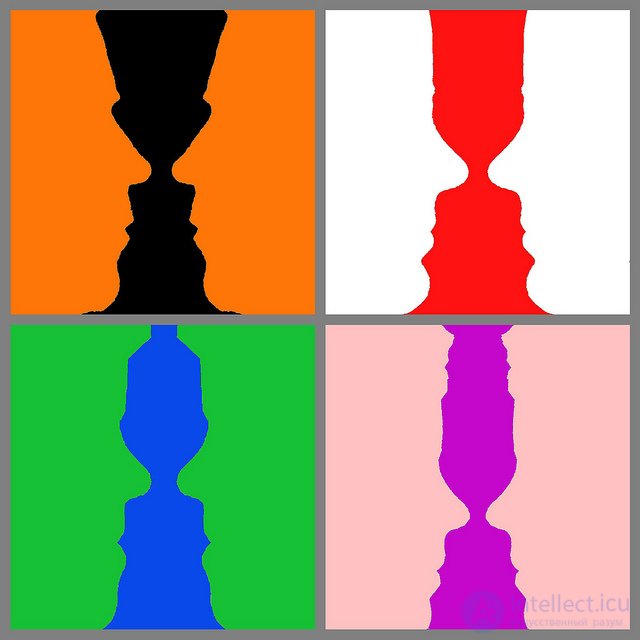
This picture with two profiles at the sides can be perceived as profiles, or it can be perceived as a vase. And when we see the vase, it seems to come forward toward us, while the profiles disappear and turn into the ground — the vase becomes the figure, the gestalt. And when we begin to perceive the profiles, then they seem to come forward toward us, and the vase no longer exists — it is the ground lying behind them.
On the basis of this law of the formation of a holistic figure — the so-called law of Prägnanz, the law of wholeness — it becomes clear that any psychic organization will always be as good as the conditions of perception allow. Gestalt psychologists begin to formulate specific laws of perceptual organization, indicating on what basis elements in the visual field are grouped, and still used in design today. Elements may be grouped on the basis of proximity, similarity, good continuation, closure, or belonging to a common region.

Behind these laws of perceptual organization lies a supposed "play" of forces in the phenomenal field, in the field of our consciousness, which forms the gestalt, a whole. The idea of organization, as opposed to the idea of summation (putting things together from separate elements), is key to Gestalt psychology.
The main question now at the center of attention of contemporary Gestalt psychologists of perception is: when does perceptual organization occur? In the early stages of information processing? In the late stages? Does it require attention? Or do the elements first organize themselves, and only then do we direct attention to the object that has already taken shape? And there are quite a few such questions.
Very soon after Wertheimer published his study of apparent movement, Wolfgang Köhler, another future founder of Gestalt psychology, was engaged in a seemingly distant field of research: he studied problem solving in anthropoid apes. During the years of the First World War he worked on the island of Tenerife and investigated how apes solve problems and get a lure when they cannot simply reach it, but can do so only with the help of some tool, such as a stick, or when they have to assemble that tool from several parts, or when they have to remove an obstacle or build a structure out of several boxes in order to reach a banana hanging from the ceiling.
Before the Gestalt psychologists, it was believed that animal behavior in such a situation is governed by the rule of trial, error, and chance success. It was assumed that animals behave in the most varied ways, but only successful movements receive reinforcement and are then consolidated in the animal's experience. But for that movement to be found, the animal must first move chaotically, twitching and thrashing about in all directions.
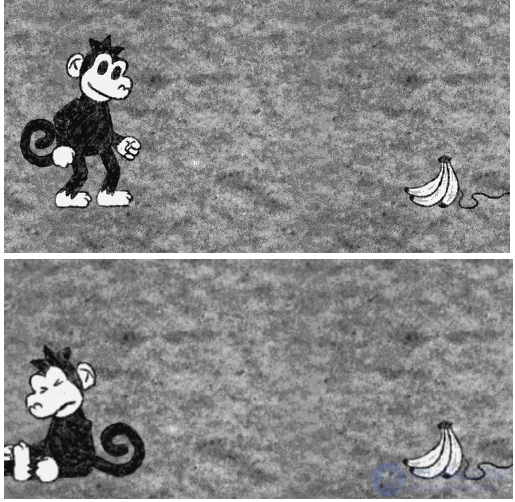
But the apes in Köhler's experiments did not behave this way. At first they tried to do something, perhaps got angry, and then they became pensive, froze, and found the solution. For example, an ape would grab a stick and pull a banana toward itself, or drag over boxes, stack them one on top of another, climb up, and again get the banana. And Köhler suggested that this phenomenon can be explained only by relying on the holistic structure of the situation and on the concept of the gestalt: a situation in which there is a conflict between what we have and what we want (that is, between the conditions and the requirements of the task) is not a whole situation, not a gestalt, whereas a solved task is a gestalt, a good, integral configuration.
Later Karl Duncker carried this over to the solving of creative problems by humans, calling it restructuring of the situation, the transition from a "bad" conflicting structure to a "good," integral one in which the gap has been eliminated. One of Duncker's main ideas was that solving a creative problem is always a restructuring of the initial situation, and therefore past experience, consisting of frozen "ready-made" structures, hinders the solving of creative problems. This idea stood in opposition to all earlier psychology, which tried to explain human thinking and problem solving through the use of past experience.
In Gestalt psychology, such restructuring came to be designated by another important term, which later entered everyday language with a somewhat different meaning: the term "insight." Originally, in Köhler's experiments, insight was defined as a sudden change in behavior that leads to the solution of a task. Later Karl Duncker, studying how people solve small creative problems (which we now call "yes-no riddles"), defined insight as a restructuring of the problem situation that leads to the elimination of the main conflict and the solution of the task. But the underlying idea is the same: in visual perception, thinking, and problem solving, as well as in the work of memory and attention, the fundamental law is the principle of wholeness, or of finding a "good configuration," a gestalt. The Russian psychologist of the early twentieth century Lev Semyonovich Vygotsky, who wrote the well-known work on the crisis in psychology, wrote somewhat mockingly on this point: "And God said: let there be gestalt, and there was gestalt." Indeed, when we take a single explanatory concept and try to reduce everything to it, sometimes this is done with a stretch.
Gestalt psychology of perception developed quite rapidly until the 1940s: first Wertheimer described apparent movement (the phi phenomenon), then Kurt Koffka, the third founding father of Gestalt psychology, used the concept of the field and the forces acting in it, publishing the book "Principles of Gestalt Psychology." Then Wolfgang Köhler, who by that time had stopped studying the thinking of anthropoid apes, introduced another important principle for Gestalt psychology, the so-called principle of isomorphism (equality of forms). He suggested that the structure of the external world, the physical field, is isomorphic to the electromagnetic processes in the brain and to the processes in our consciousness, the "phenomenal field." In other words, one can speak of an "equality of forms" in the physical, physiological, and phenomenal fields.
After this, Gestalt psychology of perception effectively went into a sluggish mode: most of the leaders of Gestalt psychology were forced to flee from Germany to America because of the rise of Nazism, and in the 1950s the cognitive revolution broke out in the United States, and it turned out that Gestalt psychology ended up, in essence, inside the cognitive psychology of perception. Although even now one can name several active Gestalt psychologists.
Another direction in Gestalt psychology is associated with the name of Kurt Lewin, who tried to apply the ideas and principles of Gestalt psychology, but in his own interpretation, to the behavior of the person in the surrounding world. He regarded human behavior as a function of the person, seen as a system of tense needs, and of the structure of the environment, for the description of which he again used the concept of the field. His ideas were as follows. Our personality at any given moment is a changing, dynamic system of temporary needs. At one moment we need one thing, at another moment, something else... Lewin called them quasi-needs, contrasting them with genuine needs, which we always have. These quasi-needs are coordinated with objects of the surrounding world, which have this or that valence for us: they either attract us or repel us. It is easiest to catch these quasi-needs and valences in a situation where a person owes nothing to anyone and wants nothing, for example, sits in a laboratory waiting for an experiment to begin. If various objects are scattered around him, say a bell, a pencil, or something else, one can watch from around the corner as he now rings the bell, now twirls the pencil in his fingers, now picks up something else. Or if we are riding the subway and see a person standing in front of us in a black coat on which a white thread has caught, it is terribly hard to resist and not remove that thread.

Here Lewin introduces a contrast between so-called field behavior, which is governed by the structure of the environment, and voluntary behavior, behind which stands the person. If a person can rise above the field, get above it, then he will be able not to remove the thread. But it is important that in any case this whole system, which includes the person and the environment, also strives for equilibrium, just like the gestalt in perception, just like conflicting, unfinished situations in thinking. And from this point of view, it turned out that this toolkit is very convenient for analyzing conflicts as such, because a conflict is the presence of two oppositely directed tendencies in behavior.
Kurt Lewin described the basic types of conflicts, which later entered the field of conflictology as its gold standard. In essence, Lewin became its founder. When are we in a state of conflict? For example, when we want two different things at the same time: we want both to stay at home and to go to an exhibition, for instance. We have two valent objects that pull us in different directions; this is a conflict of the double-attraction type (approach-approach). Or there may be a conflict of the double-repulsion type (avoidance-avoidance): we terribly do not want to do our homework, but we terribly do not want to get a failing grade. The third type of conflict is simultaneous attraction and repulsion (approach-avoidance): for example, we very much want to ask to play with some neighborhood group of kids, but we are very afraid of being driven away. Here we see that the same object has both a positive and a negative valence, but one of these tendencies has to outweigh the other.
A person cannot remain in a state of conflict for too long. After Lewin, one more type of conflict was described, double approach-avoidance, when there are two objects, each of which has both valences; this is, for example, the situation of a person who is trying to leave an old family and create a new one. Then social-psychological theories began to grow out of these Gestalt-psychological ideas as applied to the person. First Fritz Heider proposed the theory of cognitive balance, assuming that balance, equilibrium, can be achieved in a person's head (in his cognition, hence the term "cognitive balance"), and not necessarily in interaction with the field, as Lewin assumed. Our mental life, according to this theory, strives for equilibrium. If, for example, there is a certain person A whom I like and a person B whom I like, I will feel comfortable if they like each other as well.
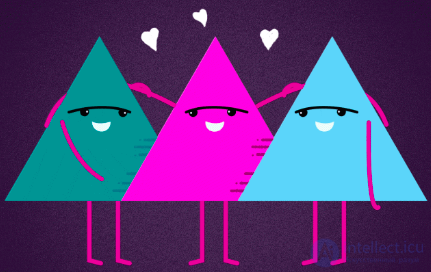
But if I like A and like B, while A and B hate each other, I will get out of such a situation by seeking balance: either I will reconcile them, or I will begin to think badly of A, or I will begin to think badly of B. Such a configuration will become balanced. This theory went rather unnoticed: it was displaced by the theory of cognitive dissonance proposed by Leon Festinger. Ultimately it goes back to the same Gestalt psychology. Through the idea of getting rid of dissonance, that is, finding equilibrium, finding a good configuration, Festinger tried to explain the motivation and behavior of individuals and social groups, and various social-psychological phenomena such as the spread of rumors, and so on. If we have two sources of information that contradict each other, then we need to do something either about one source of information or about our attitude toward it, and ultimately all human behavior can be explained on this basis. For example, if an inveterate smoker is insistently told that smoking is harmful, thereby creating cognitive dissonance (a mismatch between two beliefs), he can either quit smoking, or devalue the source of information (for example, decide that they are telling him this because they are envious), or start looking for opposing examples (cases when smokers lived long and happy lives).
Gestalt psychology has one big advantage over many other schools: it attempts to use a single explanatory principle that would embrace all spheres of reality. But perhaps this is also its weakness, because it turns out that when we utter the magic word "gestalt," ultimately we explain practically nothing.
At present, Gestalt psychology is rather a historical trend. There is no Gestalt psychology of thinking as such left, although specific studies using its methodological toolkit are conducted. Kurt Lewin's dynamic psychology yielded a great many interesting research results, but it effectively flowed, with numerous modifications, into the field of social psychology and now exists there.
Gestalt psychology of perception exists either very locally or in synthesis with cognitive psychology. It is a rather discrete community, primarily in the United States, where there are individual people who use the apparatus of Gestalt psychology mainly in the area of perceiving configurations and separating figure from ground (for example, Stephen Palmer, James Pomerantz, and the Israeli researcher of perception and attention Ruth Kimchi). Although in 2012, for the centenary of the publication of Wertheimer's work on the phi phenomenon, a fairly large review of contemporary research on perception in the Gestalt tradition by Johan Wagemans and colleagues appeared. They also created the GestaltRevision project, an attempt to rehabilitate the principles of Gestalt psychology on the basis of new knowledge about how the brain works (http://www.gestaltrevision.be/en/).
There is a school called "Gestalt therapy," which has a rather distant relation to Gestalt psychology, except that it, too, is based on the idea of reorganizing (restructuring) a person's experience at a given specific moment in time, finding some equilibrium structure. Probably the best-known technique of Gestalt therapy is the so-called empty chair method. The person is given a chair, asked to imagine that he is sitting there, and to talk to himself, and they observe what happens to the person: when emotions and resistance arise in him, when he shows heat, and so on.
Moreover, what is very important, and where Gestalt therapy sets itself against psychoanalysis, is the analysis of the current, present situation, that is, of what is happening here and now. Psychoanalysis is directed to the past; it is precisely in the past that the problems of a person's current life are sought. Gestalt therapy always works with the present, and in this sense it resonates with Gestalt psychology, where there is a structure of the field here and now. But Fritz Perls, who is considered the founder of Gestalt therapy, was not a Gestalt psychologist. He used certain terms, above all the beautiful word "gestalt," but the conceptual foundations were not taken from Gestalt psychology as a school of psychology; it is simply a certain set of techniques for working with the patient's current self-perception, bringing him to a stable, integral state. Gestalt psychology as such tries to formulate general psychological laws: to explain cognition (perception, thinking, the work of memory and attention) on the basis of the principle of the gestalt, of integral organization and structure; there are works on dynamic psychology that explain situational human motivation and the behavior of the person. And separately from this there is Gestalt therapy as a direction of psychological practice that uses a certain set of techniques and attitudes, although perhaps colleagues working within this direction may correct me here. However, it is not Gestalt psychology but precisely Gestalt therapy that first comes to the mind of a modern person when he hears the word "gestalt."

Comments