
Lecture
A "learning management system" (LMS) is a software product or an online platform designed for organizing, running and interacting with the educational process. Such systems are used in educational institutions, in corporate environments and in other fields to provide effective management of learning and development.
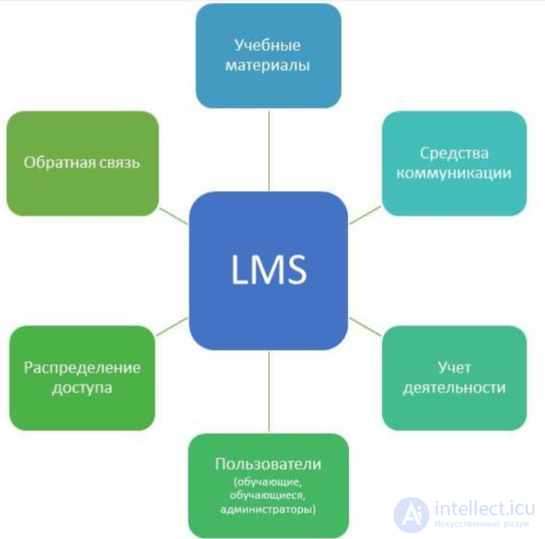
The main functions of learning management systems include:
Registration and authentication: providing the ability to register and to authenticate securely in order to access the platform.
Course management: creating, editing and deleting courses. The ability to assign teachers or trainers to each course.
Instruction and materials: uploading and sharing learning materials, which may include text, video, audio and other formats.
Interaction and communication: providing the ability for course participants to discuss topics and communicate with one another, as well as the ability to interact with the teacher or trainer.
Assessment and reporting: administering tests, grading performance and generating reports to evaluate learning progress.
Progress monitoring: tracking and analyzing the progress of every course participant.
Flexibility and adaptability: the ability to adapt to different learning needs and formats.
Integration with other systems: the ability to integrate with other corporate systems, such as human resource management systems or corporate portals.
Mobile access: providing the ability to study materials and interact with the platform from mobile devices.
History
In the second half of the 20th century, the development of dedicated applications for managing courses of study became a natural continuation of the idea of distance learning, especially in the academic sector. Universities became the birthplace of the first learning management systems (LMS) because of the heavy student load, which called for efficient management of instruction. At the same time, universities provided the resources needed for software development.
Prototypes of modern LMS platforms, however, appeared long before the computer age. In 1728, Professor Caleb Phillips organized a correspondence course in shorthand through the Boston Gazette. In the 1840s, the British linguist Isaac Pitman introduced two-way distance learning, sending assignments to students and receiving them back for grading. In 1856, Gustav Langenscheidt and Charles Toussaint founded the first school of distance learning for foreign languages.
The advent of audio and video recording opened up new possibilities for distance learning. In 1909, Edward Forster, in one of his stories, predicted the appearance of the Internet and its use for delivering lectures at a distance. In 1920, a prototype "teaching machine" was built that made it possible to test students.
The development of electronics made it possible to create modern learning management systems. In 1960, Donald Bitzer built the prototype of the first e-learning system, PLATO. By the 1970s, the system had several thousand terminals around the world.
The appearance and growth of the Internet led to an explosive expansion of learning management systems in the 1990s, when they became an integral part of education and professional development. In 2004, the SCORM standard appeared, making it possible to share materials between different courses.
Initially, e-learning systems were developed for on-premises deployment: an organization either purchased a software license or developed the software itself, and then installed it on its own servers. Every learning management system had its own course editor, which limited the possibility of using that editor to build courses for other systems.
With the arrival of modern web technologies, most learning management systems moved to online platforms. In order to standardize content such as courses of study, international formats were developed, the most widespread of which is SCORM (later superseded by Tin Can). The AICC and cmi5 standards are also used. These formats make content created in different editors compatible with different learning management systems, and they also make it possible to integrate an LMS with other systems, such as CRM.
Today many learning management systems are delivered as SaaS (software as a service), which means that users can access the platform over the Internet while hosting is handled by the vendors, making the systems more convenient and efficient to use and to update.
The main advantages of learning management systems follow from the very concept of e-learning and from the ways it differs from traditional instruction
The disadvantages of learning management systems (and of e-learning in general) are, as is often the case, reflections of their strengths:
The first learning management systems were built for a specific project and, most often, by the same organization (or its subsidiary) in which they were then used. With the emergence of specialized LMS vendors (during the boom of the 1990s), general-purpose solutions were developed that were used — with enhancements and customizations — in various industries. The next stage in the development of the market was the specialization of learning management systems by area of use, with functionality "sharpened" to match the corresponding requirements.
The following main groups can be distinguished today:
In the United States market as of 2018, the big three learning management systems were Blackboard (38%), Canvas (31%) and Moodle (18%).
The learning management systems widespread in Russia are eTutorium, Moodle, Getcourse, Mirapolis, AntiTrainings, Teachbase, WebTutor and 1C:E-Learning
Learning management systems help to provide an effective and well-organized system of instruction, facilitating interaction between the participants of the learning process and the teacher

Comments