
Lecture
A hierarchical control system (HCS) is a form of control system in which a set of devices and governing software is arranged in a hierarchical tree. When the links in the tree are implemented by a computer network, such a hierarchical control system is also a form of networked control system.
A man-made system with complex behavior is often organized as a hierarchy. For example, a command hierarchy has among its notable features an organizational structure of superiors, subordinates and lines of organizational communication. Hierarchical control systems are organized in a similar way in order to divide up decision-making responsibility.
Each element of the hierarchy is a linked node in the tree. Commands, tasks and goals to be achieved flow down the tree from superior nodes to subordinate nodes, whereas sensations and the results of commands flow up the tree from subordinate to superior nodes. Nodes may also exchange messages with their siblings. Two distinctive features of a hierarchical control system are related to its levels.
Besides artificial systems, the control systems of animals have been proposed to be organized as a hierarchy. Perceptual control theory, which postulates that an organism's behavior is a means of controlling its perceptions, proposes that an organism's control systems are organized as a hierarchical structure, because that is how its perceptions are built up.
The accompanying diagram is a general hierarchical model that shows the functional levels of manufacturing under computerized control by an industrial control system.
Referring to the diagram;
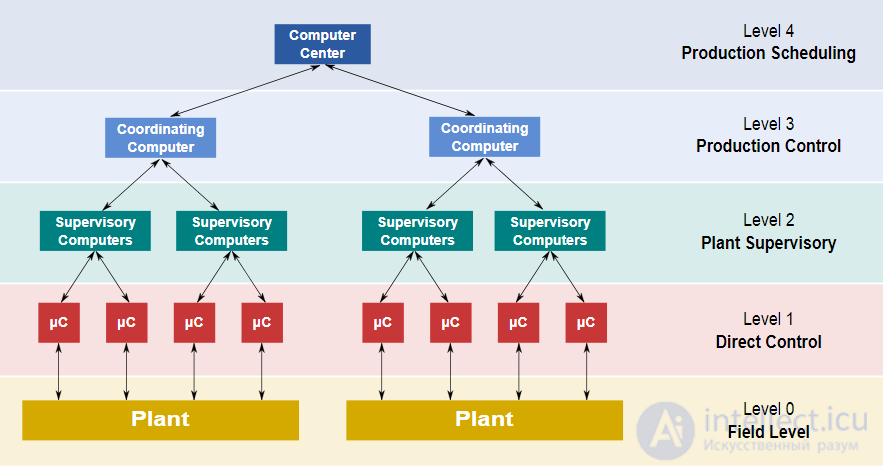
Functional levels of a manufacturing control operation.
Among the robotic paradigms is the hierarchical paradigm, in which a robot operates in a top-down fashion, with a strong emphasis on planning, and on motion planning in particular. Computerized design of manufacturing has been a focus of NIST research since the 1980s. Its Automated Manufacturing Research Facility was used to develop a five-level model of production control. In the early 1990s, DARPA sponsored research aimed at developing distributed (that is, networked) intelligent control systems for applications such as military command and control systems. NIST built on earlier research to develop its Real-time Control System (RCS) and the Real-time Control System software, a generic hierarchical control system that has been used to control a manufacturing workcell, a robot crane and an autonomous vehicle.
In November 2007 DARPA held the Urban Challenge. The winning entry, Tartan Racing, used a hierarchical control system with layered mission planning, motion planning, behavior generation, perception, world modeling and mechatronics.
The subsumption architecture is a methodology for developing artificial intelligence that is closely associated with behavior-based robotics. This architecture is a way of decomposing complex intelligent behavior into many "simple" behavior modules, which are in turn organized into levels. Each level implements a particular goal of the software agent (that is, of the system as a whole), and the higher levels become increasingly abstract. The goal of each level subsumes the goals of the levels beneath it; for example, the decision to move forward taken by the eat-food level takes into account the obstacle-avoidance decision of the lowest layer. A behavior need not be planned by a superior layer; rather, a behavior may be triggered by sensory signals and is therefore active only in circumstances where it may be appropriate.
Reinforcement learning has been used to acquire behavior in a hierarchical control system in which each node can learn to improve its behavior with experience.
James Albus, while working at NIST, developed a theory for the design of intelligent systems called the Reference Model Architecture (RMA) , which is a hierarchical control system inspired by RCS. Albus specifies that each node contains the following components.
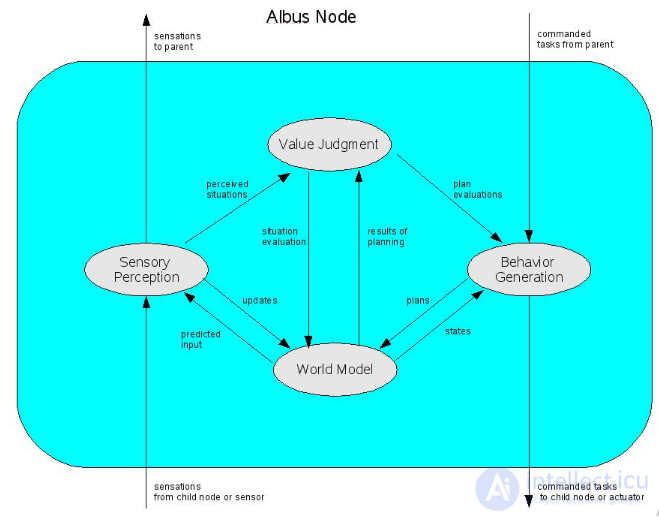
The components within a node of James Albus's Reference Model Architecture
At the lowest levels, the RMA may be implemented as a subsumption architecture, in which the world model maps directly onto the controlled process or the real world, avoiding the need for mathematical abstraction, and in which time-constrained reactive planning can be implemented as a finite state machine. At its higher levels, however, the RMA may have complex mathematical models of the world and behavior implemented by means of automated planning and scheduling. Planning is required when a particular behavior cannot be triggered by current sensations, but rather by predicted or expected ones, especially those that result from the node's own actions.

Comments