
Lecture
Radioactivity is the instability of the nuclei of certain atoms, manifested in their capacity for spontaneous transformations (decay) accompanied by the emission of ionizing radiation, or radiation. Below we will speak only of the radiation associated with radioactivity.
Radiation, or ionizing radiation, consists of particles and gamma quanta whose energy is high enough that, upon interacting with matter, they create ions of different signs. Radiation cannot be produced by means of chemical reactions.
NATURAL RADIATION [Lat. radiatio, radiance, glow] — radiation to which a person is exposed on the Earth's surface; it includes γ-radiation from the Earth's radioactive materials, radiation from radionuclides in body tissues that enter with food, and cosmic radiation.
Cosmic radiation (cosmic rays) — electromagnetic or corpuscular radiation of extraterrestrial origin; it is divided into primary and secondary. In a narrow sense, cosmic radiation is sometimes identified with cosmic rays.
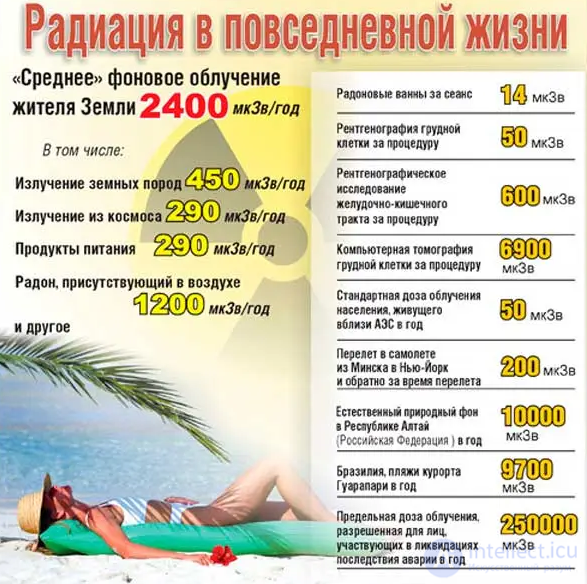
The dose of exposure we receive from sources of ionizing radiation:
Thus, we receive the largest dose of radiation not in medical offices and not as a result of long-past technogenic accidents, but in our own homes and workplaces.
Natural radiation has always existed: even before the appearance of humans, and even of our planet. Everything around us is radioactive: soil, water, plants, and animals. Depending on the region of the planet, the level of natural radioactivity can range from 5 to 20 microroentgens per hour. According to the prevailing view, such a level of radiation is not dangerous for humans and animals, although this viewpoint is not unanimous, since many scientists claim that radiation, even in small doses, leads to cancer and mutations. However, since we can practically do nothing to influence the natural level of radiation, we should try to protect ourselves as much as possible from factors that lead to a significant excess of permissible values.
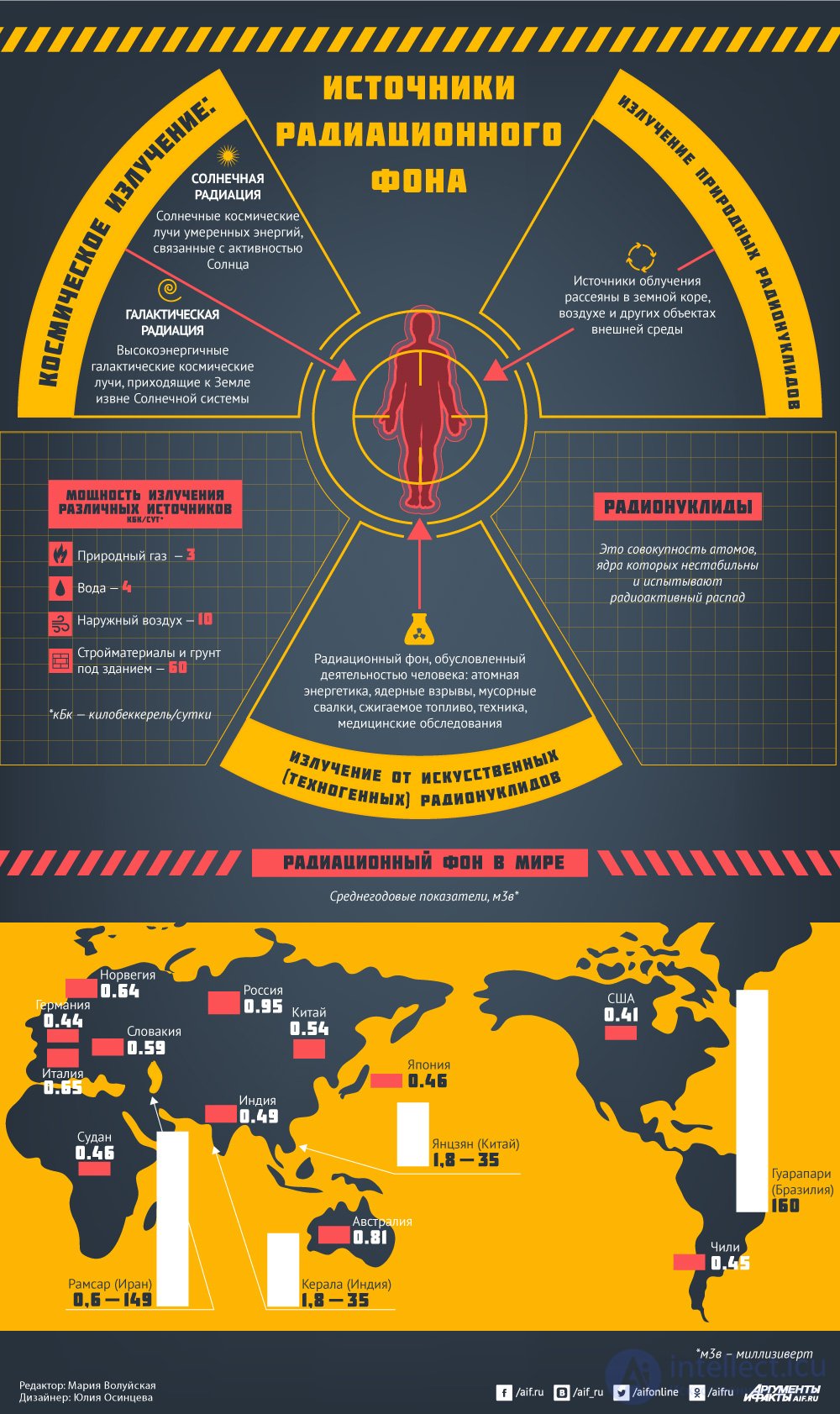
Where, then, does natural radioactivity come from? There are three main sources:
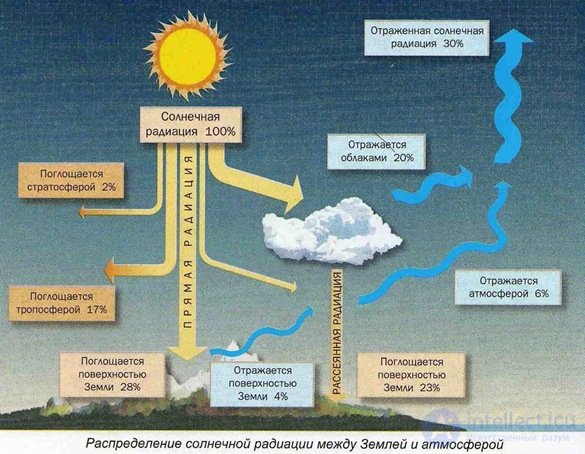
1. Cosmic radiation and solar radiation — these are sources of colossal power that could destroy the Earth and all life on it in the blink of an eye. Fortunately, we have a reliable protector against this type of radiation — the atmosphere. However, intense human activity leads to the appearance of ozone holes and the thinning of the natural shield, so in any case direct sunlight should be avoided. The intensity of cosmic radiation's effect depends on altitude above sea level and latitude. The higher you are above the Earth, the more intense the cosmic radiation; with every 1000 meters the intensity doubles, and at the equator the radiation level is much stronger than at the poles.
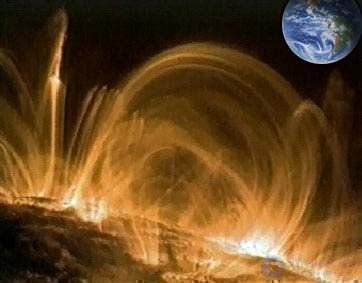
Solar flares are one of the sources of the «natural» radiation background.
Scientists note that it is precisely the effects of cosmic radiation that are linked to the frequent cases of infertility among flight attendants, who spend most of their working time at altitudes above ten thousand meters. However, ordinary citizens who do not fly frequently need not worry about cosmic radiation.
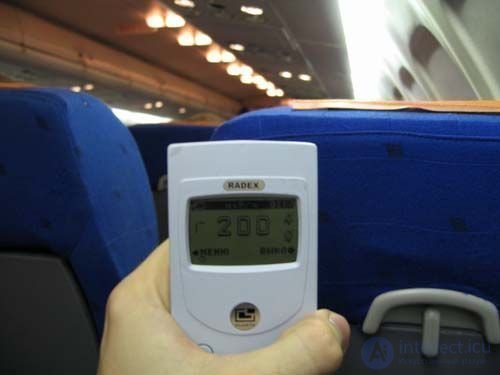
The radiation level inside an aircraft cabin at an altitude of 10,000 meters exceeds the natural background by a factor of 10.
2. Radiation from the Earth's crust. Besides cosmic radiation, our planet itself is also radioactive. Its surface contains many minerals that retain traces of the Earth's radioactive past: granite, alumina, and the like. By themselves they pose a danger only near deposits, but human activity leads to radioactive particles entering our homes in the form of construction materials, into the atmosphere after coal is burned, onto land in the form of phosphate fertilizers, and then onto our tables in the form of food products. It is known that in a brick or panel house the radiation level can be several times higher than the natural background of the given area. Thus, although a building can largely protect us from cosmic radiation, the natural background is easily exceeded through the use of hazardous materials. The only way to protect against such «surprises» is by using dosimeters. According to specialists at www.dozimetr.biz, this is the only way to measure the radiation level under everyday conditions and avoid acquiring materials that are hazardous from a radiological standpoint.
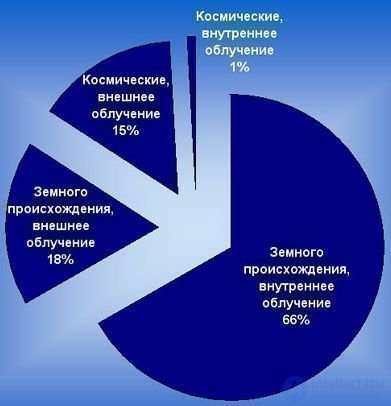
The proportion of natural sources of radiation.
3. Radon — a radioactive inert gas with no color, taste, or smell. It is 7.5 times heavier than air, and, as a rule, it is what causes the radioactivity of building materials. Radon tends to accumulate underground in large quantities, and it reaches the surface during the extraction of mineral resources or through cracks in the Earth's crust.
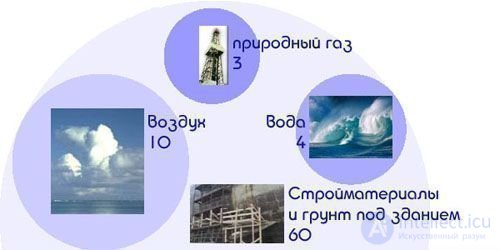
Sources of radon entry into houses and apartments.
Radon actively enters our homes with household gas, tap water (especially if it is drawn from very deep wells), or simply seeps through microcracks in the soil, accumulating in basements and on lower floors. Reducing radon levels, unlike other sources of radiation, is very simple: it is enough to ventilate the room regularly, and the concentration of the dangerous gas will decrease several times over.
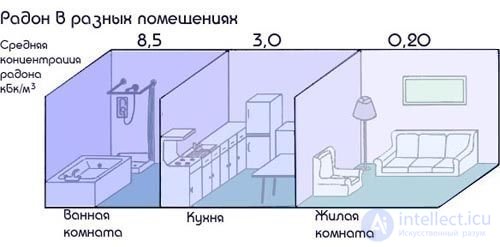
Accumulation of radon in different rooms.
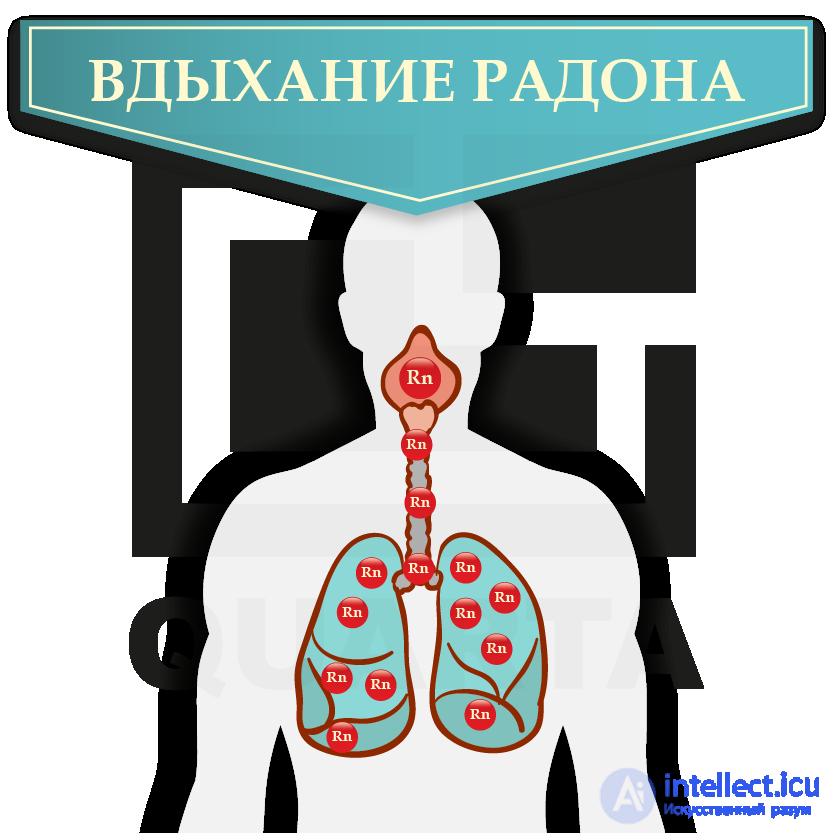 This factor acts stealthily — it is imperceptible, but no less dangerous for that. The natural radioactive gas radon is formed in large quantities in the depths of the earth as a result of the decay of natural radionuclides. One of its two isotopes emits radioactive particles. They enter the body through breathing, irradiating it from within. Radon accumulates the most in our apartments. It enters there:
The largest amount of radon is inhaled by owners of single-story country cottages and dacha residents. The gas accumulates in basements, from where it rises through gaps and cracks in the floors into the living areas of the house. If you live in a cottage and use water from an artesian well, check the radon background in your bathroom with a radon detector after first turning on the hot water. Elevated radon concentrations are often recorded within just 5 minutes.
The problem of radon contamination in indoor spaces is compounded by the fact that most of Russia's territory lies in a cold-climate zone. People tend to keep their windows closed to conserve heat, thereby «trapping» the radioactive gas inside. Few people know that regular, frequent ventilation helps reduce its concentration to a safe level.
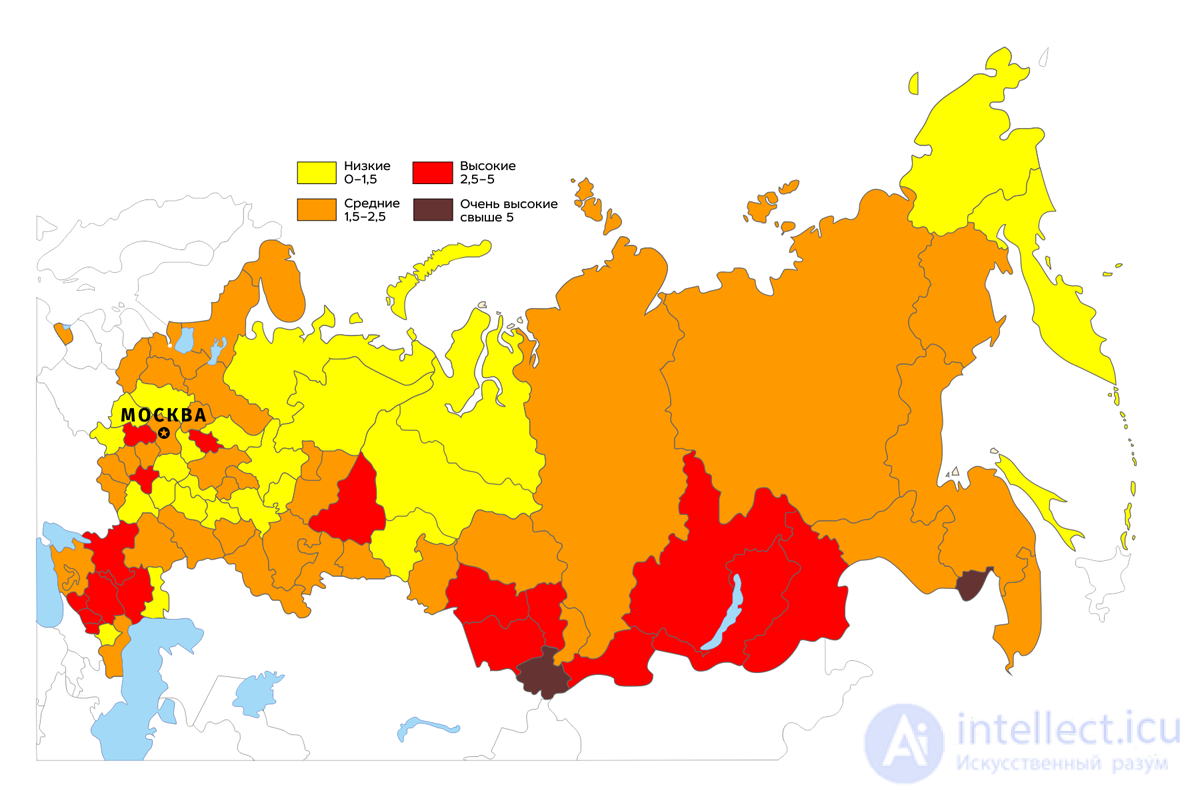
The map below shows the doses received from radon by residents of various regions of Russia (in mSv/year).

Unlike natural sources of radiation, artificial radioactivity arose and spreads solely through human activity. The main technogenic radioactive sources include nuclear weapons, industrial waste, nuclear power plants, medical equipment, antiques removed from «forbidden» zones after the Chernobyl nuclear power plant accident, and certain precious stones.
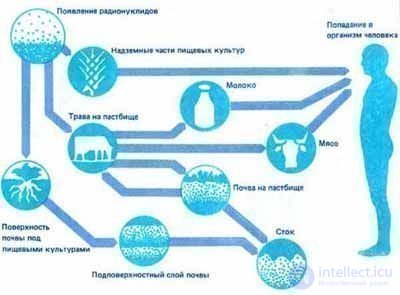
Sources of radiation entry into the human body.
Radiation can enter our bodies in all sorts of ways, and objects that arouse no suspicion in us are often to blame. The only way to protect yourself is to buy a radiation dosimeter. This miniature device will render you an invaluable service: you will always be able to independently monitor the safety of your family members, without trusting the «tricks» of sellers of building materials, antiques, or market traders who vouch for the safe origin and environmental cleanliness of their goods. We ourselves are responsible for our own life and health. Protect yourself from radiation!
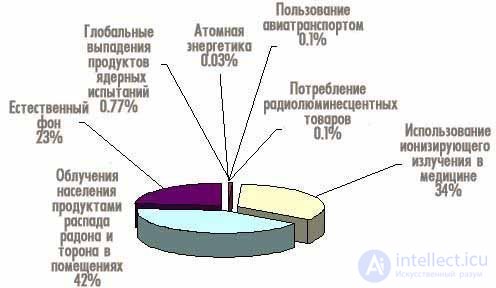
Sources of radioactive exposure for the average Russian per year.
Precise measurement data show that both humans themselves and all the surrounding objects of living and non-living nature are radioactive. Let us take a closer look at the radioactive elements that account for the radioactivity of the world around us. In this section we will discuss only so-called natural radioactivity, i.e., those radioactive substances that have long existed in nature. Their origin is not connected with either nuclear and thermonuclear weapons testing or with the development of the nuclear industry.
Naturally radioactive substances are present in small quantities in all of the Earth's shells and in its core. Of particular importance for humans are the radioactive elements of the biosphere, i.e., that part of the Earth's shell inhabited by animals, plants, and humans. Radioactive elements are dispersed throughout the entire biosphere, though they are rarely found in any significant quantities. Their origin dates back to the period of the Earth's formation. It appears that several billion years ago, on the eve of our planet's formation, the matter of the Earth was in conditions that favored the emergence of both radioactive and non-radioactive elements. During this period the bulk of the radioactive isotopes arose — both long-lived ones that have survived to the present day, and short-lived ones that have by now completely decayed. Depending on their origin, all naturally radioactive elements of the Earth can be divided into three groups.
The first group includes elements united into three radioactive families. In addition to the long-lived progenitors of these families — uranium, thorium, and actinouranium — this group also includes their decay products, including relatively short-lived ones such as radium, radon, mesothorium, and others. The quantity of radioactive elements in this group gradually decreases in accordance with the law of radioactive decay. The most widespread elements of this group are uranium, whose quantity in the Earth's crust is greater than that of silver or mercury, and thorium. Natural uranium is a mixture of three isotopes — uranium-238 (99.28%), uranium-235 (0.71%), and uranium-234 (0.006%). Uranium-238 and uranium-235 (actinouranium) are the progenitors of two radioactive families.
One of the decay products of uranium-238 is radium, which was already mentioned above. Despite its relatively short half-life, the content of radium in the Earth's crust is relatively stable, since the decrease in its quantity due to decay is compensated by the continuous formation of new radium from the decay of uranium.
Radium has found wide application in medicine, not only as a source of gamma rays for irradiating patients (in this area it is being displaced by significantly cheaper artificial radioactive substances), but also as a source of radon for radon baths, frequently used by physiotherapists.
Radon, whose half-life is 3.8 days, is a radioactive gas formed as a result of the decay of radium. Baths made from water containing dissolved radon are used to treat diseases of the cardiovascular system, joints, the peripheral nervous system, gynecological conditions, and other ailments. For such baths, either water from natural radioactive springs is used, or ordinary fresh water artificially enriched with radon.
Thorium, which is significantly more abundant in nature than uranium, has also found application in nuclear power. Among the decay products of thorium, radium-mesothorium (half-life 6.3 years) is used in medicine. It is used for irradiation instead of radium, since its cost is significantly lower than that of radium. Mesothorium is often used in the production of luminous compounds applied to the dials of clocks and other instruments.
The second group of the Earth's radioactive elements consists of radioactive isotopes of elements that are not part of the radioactive families. They also arose during the period of the Earth's formation, and their quantity gradually decreases due to radioactive decay.
Of the elements in this group, potassium is of the greatest importance; its radioactivity was discovered in 1906. Potassium is one of the most abundant elements. Its share amounts to 1.1% of the total number of atoms forming the Earth's crust. Potassium is necessary for the normal development of plants and is also an integral component of every living organism, including humans. Natural potassium is a mixture of three isotopes K39, K40 and K41, of which only one is radioactive — K40. The quantity of this isotope in the natural mixture is small – only 0.0119%; in 1 g of natural potassium there occur about 30 decays per second. Despite this seemingly insignificant activity compared to radium and uranium, potassium, owing to its abundance, plays a major role in nature.
Among the other radioactive elements of the second group, rubidium Rb deserves attention, having the property of accumulating in certain plants (1 L of grape juice contains 1 mg of rubidium). However, the activity it causes is significantly lower than that of K40.
The third group of naturally radioactive substances forming part of the biosphere is made up of radioactive isotopes arising in the atmosphere as a result of cosmic rays, which we will discuss in more detail below. Such isotopes include radioactive carbon (C14), phosphorus (P32), and several others. The quantity of these isotopes in nature is relatively small, and the activity they cause is not of significant importance.
So, we already know which radioactive elements occur on Earth. Let us now examine the cycle of radioactive elements in nature and how these elements are distributed within the biosphere around us.
The bulk of the Earth's radioactive elements is contained in the rocks that make up the Earth's crust. From there, radioactive elements pass into the soil, then into plants, and finally, along with plants, into the bodies of animals and humans. This cycle of radioactive elements, which occurs continuously in nature, is clearly shown in Fig. 1.
A major role in this cycle belongs to groundwater. It leaches radioactive elements out of rocks, carries them from one place to another, and effects an exchange between living and non-living nature. Another process leading to the spread of radioactive substances in the biosphere is the weathering of rocks. The tiniest particles, formed as a result of rock breakdown under the action of water, ice, continuous temperature fluctuations, and other factors, are carried by the wind over considerable distances.
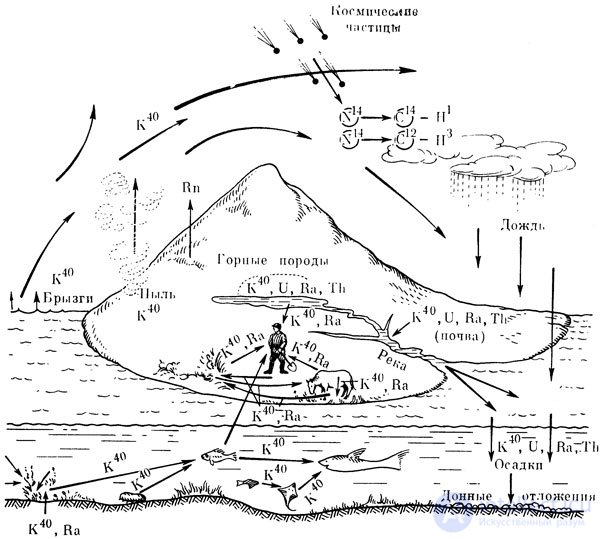
Fig. 1. The cycle of natural radioactive isotopes in nature
Radioactive elements are by no means distributed evenly throughout the thickness of the Earth. Their highest concentration is observed in the upper layer of the Earth's crust, whose thickness does not exceed 15 km. With depth, radioactivity gradually decreases, and in the Earth's core it is approximately 30 times lower than in igneous rocks (granites, basalts, and others).
Soils constitute an intermediate stage in the process by which radioactive elements pass from non-living nature into living nature. As a rule, the radioactivity of soils is noticeably higher than that of the parent soil-forming rocks. This is explained by the fact that certain radioactive substances present in the atmosphere are absorbed by plants (both directly and from precipitation), and after a plant dies they become part of the soil. Interestingly, in most cases more fertile soils also correspond to a higher level of natural radioactivity.
1 kg of soil contains 1.1 · 10-9-1.9 · 10-9 g of radium, 1.10-4-1.8 · 10-3g of uranium and 1-30 g of potassium, whose gamma radiation is what accounts for the radioactive emission of the Earth's surface (owing to their low penetrating power, beta and alpha radiation are of practically no significance).
It is well known what an enormous role water, which covers most of our planet, plays in human life and in nature. Therefore, it is quite natural that we are interested in the radioactivity of the water of oceans, seas, lakes, rivers and other bodies of water.
The radioactivity of the water of seas and oceans is due mainly to potassium and amounts to 3 - 5 · 10-10curies per 1 L. The waters of rivers and lakes in most cases have considerably lower radioactivity. However, the waters of certain radioactive springs (Tskhaltubo, Belokurikha, Mirgorod, Mironovka, and others) possess elevated radioactivity, hundreds of times greater than that of seawater and ocean water.
Drinking water in municipal water systems undergoes purification and filtration and therefore contains a relatively small amount of radioactive substances.
The air we breathe is also radioactive. Its radioactivity is due to gaseous decay products of the radioactive elements of the Earth's crust (primarily radon) and to aerosols — the tiniest rock particles formed as a result of their weathering. Depending on the content of radioactive elements in the soil, the radioactivity of the atmospheric air above it may also vary.
In the course of their life activity, plants absorb, and some plants also accumulate, radioactive substances contained in the soil, water, and air. Of all radioactive substances, potassium is absorbed best by plants. In the ash of certain plants (legumes, fungi, cereals, ferns), the potassium content reaches 25 - 30%.
The amount of radioactive substances (radium, uranium) in plants can vary considerably depending on their content in the soil. The uranium and radium content in plant ash usually increases where large quantities of these elements are present in the soil.
The radioactivity of plants increases with the application of potassium fertilizers, which simultaneously lead to increased yields and improved quality of various agricultural crops (increased sugar content in sugar beets, increased starch content in winter wheat grains, and others).
The radioactivity of animal organisms and plants mainly depends on the presence of potassium. In young animals, the radioactivity of tissues and organs is higher than in old ones.
Some tissues of the animal organism have the ability to accumulate radioactive elements. For example, radium is concentrated mainly in bone tissue. In some animals and plants, the concentration of radioactive elements can be many times greater than in the surrounding environment. Radioactive strontium (formed during nuclear explosions) is concentrated in the bones of sea bass in an amount that is 20-30 thousand times greater than in water. In certain cases, for example, during nuclear weapons tests in 1954, such fish could not be eaten.
The radioactivity of plants and animals is the cause of the radioactivity of food products. Radioactive substances enter the human body together with food. Table 2 shows approximate data on the potassium content in various products consumed by humans.
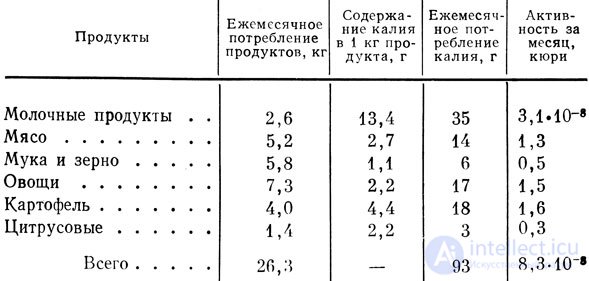
Table 2. The amount of potassium consumed by humans with food
Besides potassium, radium and other radioactive elements also enter the human body. Thus, on average, the activity of radium entering the human body amounts to 1 · 10-12-1.5 · 10-11 curie.
It is interesting that during the culinary processing of food products, the content of radioactive elements in them can change significantly. For example, butter made from milk containing radioactive strontium is practically not radioactive, since all the strontium passes into the whey. If fish containing radioactive strontium is boiled in a neutral or slightly alkaline medium, about 10% of the strontium passes into the broth. This percentage increases to 40 if the fish is boiled in an acidic medium.
Together with food, water and air, a certain amount of radioactive elements enters the human body. If all of them remained in the body, human radioactivity would be high. However, this is not the case - a certain, fairly significant part of them is excreted from the body with urine, feces, sweat, and so on. Therefore, the overall radioactivity of a human largely depends on the intensity of metabolic processes.
Radioactive isotopes that enter the human body, interacting with substances that make up tissues and plasma, form a number of compounds that are deposited in individual organs and tissues. Potassium, the main element determining human radioactivity, is concentrated mainly in nervous and muscular tissue; uranium, radium and strontium - in bone tissue, and so on.
Some scientists became interested in what changes in human radioactivity have occurred over the past millennia and whether modern humans and their ancestors differ in radioactivity. In order to get an answer to these questions, the following experiment was carried out. A rib of an Egyptian who died 4 thousand years ago was taken from a museum, and its radioactivity was measured. It turned out to be close to the average radioactivity value of human bones of our time.
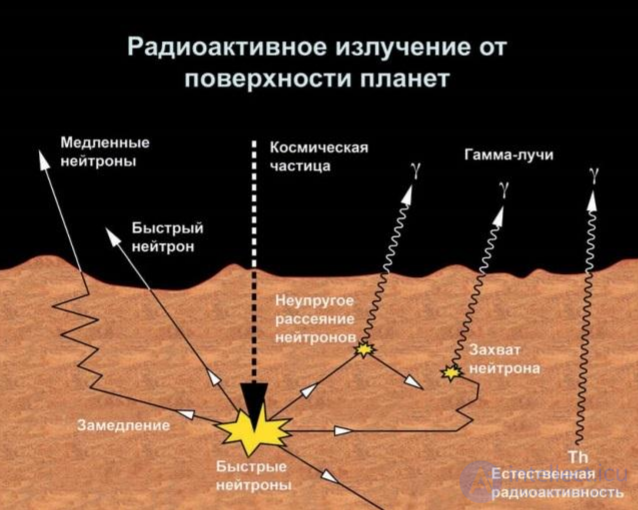
Radioactive emission from the surface of planets.
Radioactivity is the instability of the nuclei of certain atoms, which manifests itself in their ability to spontaneously transform (scientifically - decay), accompanied by the release of ionizing radiation. The energy of such radiation is quite high, so it is able to affect matter, creating new ions of different signs. It is impossible to induce radiation through chemical reactions; this is a purely physical process.
Several types of radiation sources are distinguished:
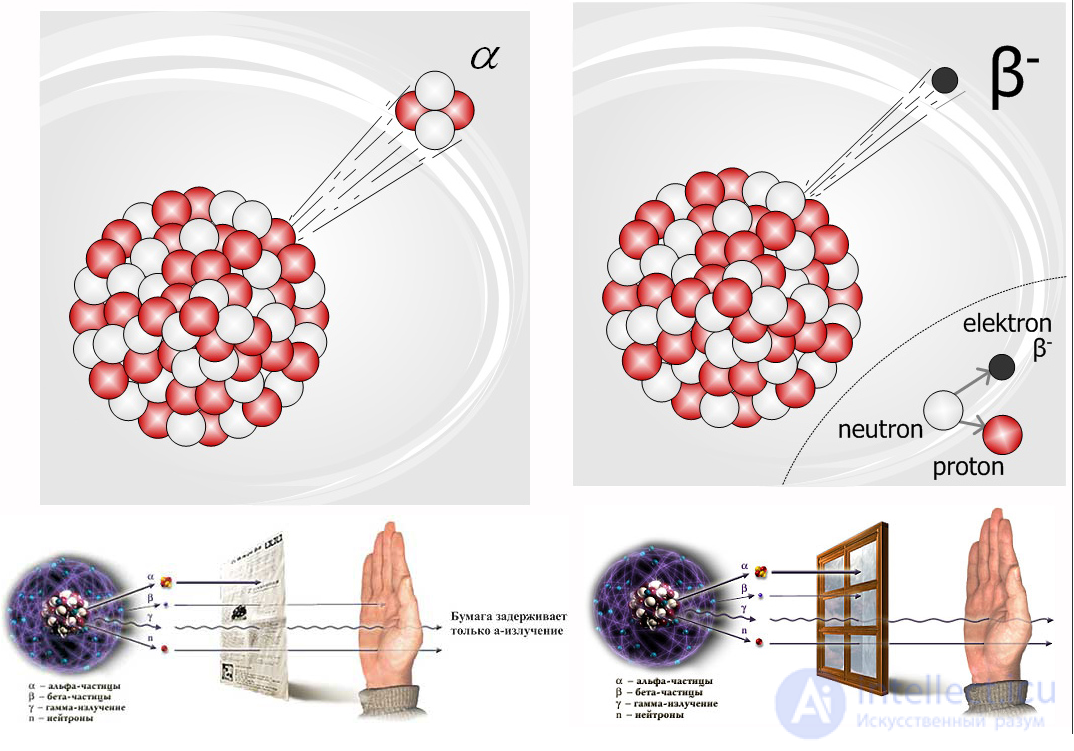
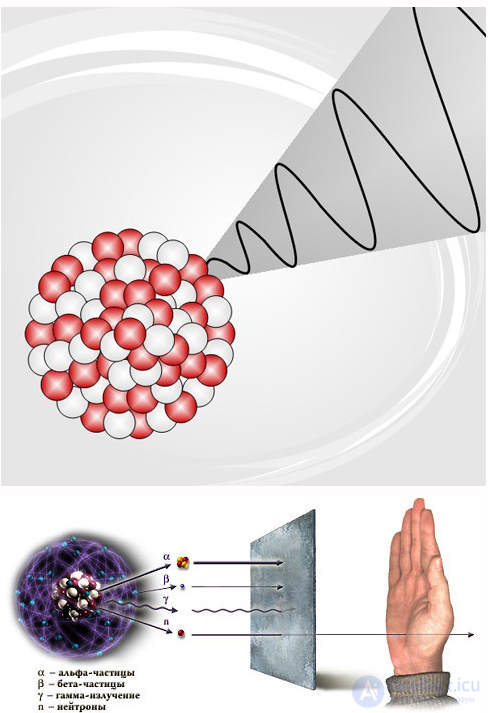
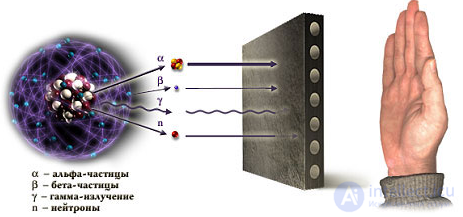
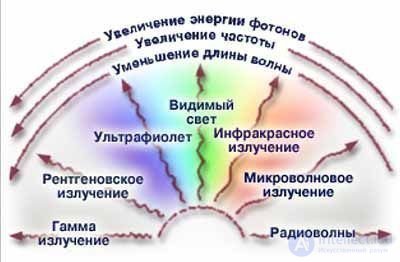
Types of radioactive emission.
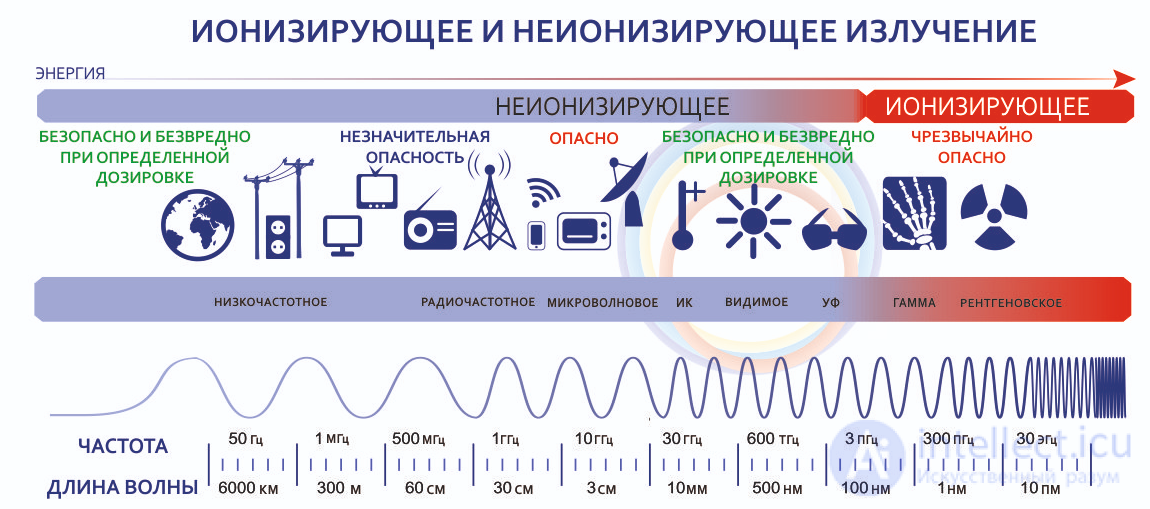
The most dangerous to humans are Alpha, Beta and Gamma radiation, which can lead to serious diseases, genetic disorders and even death. The degree of radiation's effect on human health depends on the type of radiation, time and frequency. Thus, the consequences of radiation, which can lead to fatal cases, occur both during a single stay near a very powerful source of radiation (natural or artificial), and when storing weakly radioactive items at home (antiques, gemstones treated with radiation, items made of radioactive plastic). Charged particles are very active and interact strongly with matter, so even a single alpha particle may be enough to destroy a living organism or damage a huge number of cells. However, for this same reason, a sufficient means of protection from this type of radiation is any layer of solid or liquid substance, for example, ordinary clothing.
According to specialists from www.dozimetr.biz, ultraviolet radiation or laser radiation cannot be considered radioactive. So what is the difference between radiation and radioactivity?
Sources of radiation are nuclear technical installations (particle accelerators, reactors, X-ray equipment) and radioactive substances. They can exist for a considerable time without manifesting themselves in any way, and you may not even suspect that you are near an object of very strong radioactivity.
Radioactivity is measured in Becquerels (Bq), which corresponds to one decay per second. The content of radioactivity in a substance is also often assessed per unit of weight - Bq/kg, or volume - Bq/cubic m. Sometimes a unit called Curie (Ci) is encountered. This is a huge value equal to 37 billion Bq. When a substance decays, the source emits ionizing radiation, the measure of which is the exposure dose. It is measured in Roentgens (R). 1 Roentgen is a fairly large value, so in practice a millionth (µR) or thousandth (mR) part of a Roentgen is used.
Household dosimeters measure ionization over a certain time, that is, not the exposure dose itself, but its rate. The unit of measurement is microRoentgen per hour. It is this indicator that is most important for humans, since it allows one to assess the danger of a particular source of radiation.
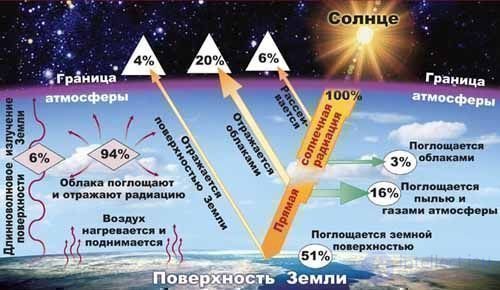
The Earth's atmosphere is a natural protection from solar and cosmic radiation.
«Radiation» is not in itself a measurable quantity; there are various units for measuring different types of emissions, as well as contamination. Separately, the concepts of absorbed, exposure, equivalent and effective dose are used, as well as the concept of equivalent dose rate and background. In addition, for each radionuclide (radioactive isotope of an element), the activity and specific activity of the radionuclide are measured. It is quite easy to get confused here, but we will nevertheless figure it out.
Radiation emitted by a radioactive substance is absorbed by any material it encounters, whether inanimate material or living cells. Each kilogram (kg) of material absorbs a certain amount of energy (joule or J). This unit - J/kg - is used to measure the absorbed dose. In radiation protection it is called the gray (Gy) - in honor of a classic of radiobiology, the Englishman Louis Gray.
The absorbed dose itself does not indicate any possible biological effect. One Gy of alpha radiation is approximately 20 times more severe than one Gy of gamma radiation. Gamma radiation creates a relatively lower biological risk than alpha radiation. The degree of biological risk created by different types of radiation can be calculated by multiplying the absorbed dose of radiation (Gy) by the radiation weighting factor. The lowest - 1 - is for gamma radiation and the highest - 20 - for alpha radiation. When the absorbed dose is multiplied by the corresponding radiation weighting factor, the result is a value called the equivalent dose, measured in sieverts (Sv) - named in honor of the Swedish physicist Rolf Sievert, one of the founders of radiobiology. "Receiving one sievert" means that one joule of energy was delivered per kilogram of biological tissue. Since 1 sievert is a rather frightening dose and, fortunately, is not often encountered, it is usually a matter of millisieverts (one thousandth) or microsieverts (one millionth). All doses given in Sv are comparable regardless of the type of radiation.
To give an idea of what a sievert is: the average dose received by a person as a result of natural background radiation is 1-2 mSv per year. Radon gas in dwellings on average creates additional doses of approximately 1-3 mSv per year, although in heavily contaminated dwellings this level can be ten or a hundred times higher. X-ray examinations in most cases result in exposure to a dose of 0.2 to 5 mSv.
Rem (biological equivalent of Roentgen) - This unit is not used now, but it can often be found in old reports. It is practically the same as the sievert, only a hundred times smaller (100 rem = 1 Sv).
Roentgen (R) - This unit is used to assess the degree of ionization of air due to the effect of radiation. A dose of 1 roentgen corresponds to the formation of 2.0×10⁹ ion pairs in 1 cm3 of air at normal atmospheric pressure and a temperature of 0° Celsius. If we are talking about the biological effect, then with some approximation roentgens can be converted to sieverts at a rate of 100 R = 1 Sv.
Rad (radiation absorbed dose) - Also an outdated unit. It assesses the absorbed dose of radiation. 1 rad = 0.01 Gy.
Becquerel (Bq) - the unit of measurement of the activity of a given amount of substance, at which, on average, one radioactive decay occurs per second. Previously, a non-system unit of measurement - curie - was used to measure radioactivity. After radioactive fallout, the concentration of activity in milk can be 100 Bq per liter, or in meat - 300 Bq per kilogram. This means that in a liter of milk 100 nuclear decays occur per second, or in a kilogram of meat - 300 decays per second. At such levels of activity, milk and meat can be considered acceptable for consumption. In some countries, the upper limit of activity concentration in food products for certain radionuclides is approximately 1,000 Bq per kilogram.
Banana equivalent dose - a concept used to characterize the activity of a radioactive source by comparing it with the dose of radiation contained in an ordinary banana. Many products are naturally radioactive due to the potassium-40 they contain. In a gram of natural potassium, an average of 32 decays of potassium-40 occur per second (32 becquerels, or 865 picocuries). The banana equivalent dose is defined as the amount of radiation introduced into the body by eating one banana. Radiation leaks at nuclear power plants are often measured in tiny units such as picocuries (one trillionth of a curie). Comparing this amount of radioactivity with that contained in a banana allows one to intuitively assess the degree of risk of such leaks. An average banana contains approximately 520 picocuries. The equivalent dose received over a year from eating one banana a day amounts to 36 microsieverts. The radioactivity of bananas has repeatedly caused false alarms of radiation detectors used to prevent the illegal importation of radioactive materials into the USA.
In many cases, including with background radiation and the operation of nuclear power plants, the radiation dose is distributed evenly over the entire body. But exposure can also be directed at a limited area of the body (radiation therapy) or individual organs (exposure of the skin to beta radiation or of the thyroid gland to radioactive iodine). Since some organs are more sensitive to radiation than others, tissue weighting factors are used to show the equivalent risks of exposure of a particular site and dose to the entire body. In order to emphasize the use of the tissue weighting factor, the term "effective dose" is used. For example, for exposure of the thyroid gland, it is recommended to use a tissue weighting factor of 0.05. Thus, if the thyroid gland receives an absorbed dose of gamma radiation of 1000 mGy, the corresponding effective dose (radiation weighting factor 1) will be 50 mSv (0.05 x 1 x 1,000). The concept of effective dose equalizes ionizing radiations in terms of their potential ability to cause harm.
Dose rate refers to the dose received per unit of time, for example per hour. If a dose of 0.5 mSv is received within an hour, then the dose rate is 0.5 mSv/hour. Over two hours the dose received will be 1 mSv and over six hours - 3 mSv. If the dose rate in a room where a person works is 0.1 mSv per hour, and the dose limit for this person is 20 mSv, then the work must be completed within 200 hours.
Table 3
Short-term (up to 4 consecutive days), general (i.e. whole-body - the most dangerous case), single exposure
// The exposure dose "accumulates" in the body, so it is necessary to sum up continuous measurements from a radiometer or individual dosimeter, in places with an elevated level of radiation. Over an entire lifetime, in total, the values of the "accumulated dose" should not exceed 100-700 mSv (depending on the local, habitual background level).
If the total dose of short-term exposure is less than 10 µSv (ten microsieverts), then it is considered that radiation is effectively absent and it can be disregarded.
Radiation-hazardous work carried out by professionals, in which individual exposure doses may exceed, within just one work shift, 0.2 mSv (millisievert) - is carried out under dosimetric assignments.
up to 100 mSv (10 rem) - permissible emergency exposure of the population (single). No noticeable changes in tissues and organs are observed by medical methods.
Single effective doses (according to the risk of long-term consequences of exposure of the entire human body and its individual organs and tissues, taking into account their radiosensitivity) above 200 mSv - are potentially dangerous, critical doses for health.
Exposure to a dose of 500-1000 mSv causes a feeling of fatigue, moderate changes in blood composition are observed. The condition normalizes within a short time. The main share of radiation risk is the possibility, in the future, of the appearance of oncological diseases (cancer of the blood, skin, thyroid gland, etc.)
At a dose of 1 Gy (1 Sv), radiation sickness begins.
1000-1500 mSv - pronounced somatic effects (nausea, vomiting) may appear, impairment of working capacity, various forms of acute radiation sickness occur.
1.5-2.5 gray (1500-2500 mSv) - a short-term mild form of radiation sickness is observed, which appears in the form of pronounced, long-lasting leukopenia (a decrease in the number of leukocytes). In 30-50% of cases, vomiting may be observed in the first day after exposure. At doses greater than 2 gray, the risk of fatal outcome is high.
2.5-4 Gy (2500-4000 mSv) - radiation sickness of moderate severity occurs. In all those exposed, nausea and vomiting are observed in the first day after exposure, the leukocyte count sharply decreases and subcutaneous hemorrhages appear. Such doses cause substantial, irreparable damage to health, baldness and leukemia. Treatment requires a bone marrow transplant and stay in a sterile box.
Lethal doses of penetrating radiation:
3-4Gy - damage to the bone marrow, within a month after exposure a fatal outcome is possible in 50% of those exposed (without medical intervention).
4-7 Gy (4000-7000 mSv) - a severe form of radiation sickness develops and mortality is high.
above 7 Gy (7000 mSv) - an extremely severe form of acute radiation sickness. Leukocytes completely disappear from the blood. Multiple subcutaneous hemorrhages appear. Mortality 100%. The cause of death, most often, is infectious diseases and hemorrhages.
10Gy (10 sievert) - death within 2-3 weeks. A value above ten Gray of dose load from exposure is considered absolutely fatal for a human.
15 Gy - 1 - 5 days until inevitable fatal outcome.
| Degree of radiation sickness | Equi- valent dose, Sievert |
Primary reaction | Latent period | Peak of illness | Outcome of illness |
| Mild | 1-2 | Duration 1-3 days. Weakness, headache, nausea, vomiting |
Duration 3-5 weeks. Condition quite satis- factory |
Condition satis- factory. Weakness, headache, nausea |
Recovery in 1-2 months, complete restoration of blood composition - in 2-4 months. |
| Moderate | 1.5-3 | The same; emotional excitement turning into depression | Duration 2-3 weeks. Condition satis- factory, but weakness, insomnia noted |
Duration 2-3 weeks. General weakness, insomnia, temperature rise to 38 °C, skin bleeding, infectious complications |
Recovery in 2-3 months, blood restoration in 3-5 months. As a result of complications, a fatal outcome is possible |
| Severe | 3-6 | Duration 2-4 days. After 10-60 minutes, repeated uncontrollable vomiting within 4-8 hours, sharp weakness, thirst, stomach upset, temperature rise to 39 °C |
Duration up to 10 days. Weakness, insomnia, headache |
Duration 2-3 weeks. Severe condition, chills, temperature up to 40 °C, hemorrhages and bleeding, exhaustion, infectious septic complications |
Recovery is possible with timely treatment in 5-10 months. With complications, death occurs after 10-35 days |
| Extremely severe | Above 6-7 | After 10-15 minutes, uncontrollable vomiting for 5-6 hours, clouding of consciousness, diarrhea, high temperature | Absent | Intensification of primary reactions, intestinal obstruction, peritonitis, disturbance of water-salt metabolism. | Death after 5-10 days |
The International Commission on Radiological Protection has set recommended dose limits for different categories of the population. They are not mandatory, but in many countries they have been adopted as legally binding regulatory provisions. The dose threshold is the safe level of dose that has no damaging effect on the irradiated organism of any age or on the offspring of irradiated parents. In our country this concept was made the basis of the Radiation Safety Standards NRB-99/2009.
For workers. According to ICRP recommendations, occupational exposure in any single year should not exceed 50 mSv, and the annual average dose over five years should not exceed 20 mSv.
For the public. Dose limits for the public are lower than for workers. It is recommended that the public not be exposed to doses exceeding an average of 1 mSv per year over 5 years, and no more than 5 mSv in a single year.
For patients no limits are set. In many X-ray examinations people receive doses that many times exceed the limits set for the public and for workers. Since the dose is given in order to determine whether a person is ill, or in order to treat a sick patient, the benefit provided by the treatment is regarded as significantly outweighing the harm even from high doses.
In contaminated areas, radiation can accumulate in plants, fish, and game.
For root vegetables (beets, carrots), it is recommended to remove, cutting off 1.5 centimeters from the top, where radioactive and toxic substances (lead, cadmium, etc.) are concentrated. Cabbage accumulates them in the stalk and between the leaves (in the form of dust that has settled there).
When boiling — up to half of the radionuclides end up in the broth, so it is better to pour it out (in salted water — it draws out more, up to 50%. Cesium is leached out — more, strontium — very little). If broth is nevertheless needed — drain the first, ten-minute one, and then — cook until done. Meat, before cooking, can be soaked in water — for about an hour (cutting it, first, into small pieces), with a sufficient amount of vinegar.
Radioactive elements are practically absent in starch, sugar, and refined vegetable oil.
Plants and fruits that do not accumulate or contain radioactive elements: Jerusalem artichoke.
Strontium-90 accumulates in fish — in the bones, fins, and scales. Detecting strontium requires a radiometer that measures not only gamma but also beta radiation.
To check food for radiation at home — a device called a «household radiometer» is needed (if you have not yet bought a personal one — ask friends who have one, for a while). With it you can measure, by power, «gamma radiation» (it should be no more than 50 microroentgens per hour). More serious instruments can measure the flux density of «beta radiation» from the surface of food, to detect strontium isotopes (normally, the device will show less than 50 particles per square centimeter per minute) and the specific activity of the radionuclide cesium-137 (the permissible, allowed activity values of a sample in becquerels — up to 3.7 x 10³ Bq/kg). «Alpha particles» (< 5 c/min . cm2) — are recorded only by professional instruments, directly next to the source (at a distance of a few centimeters).
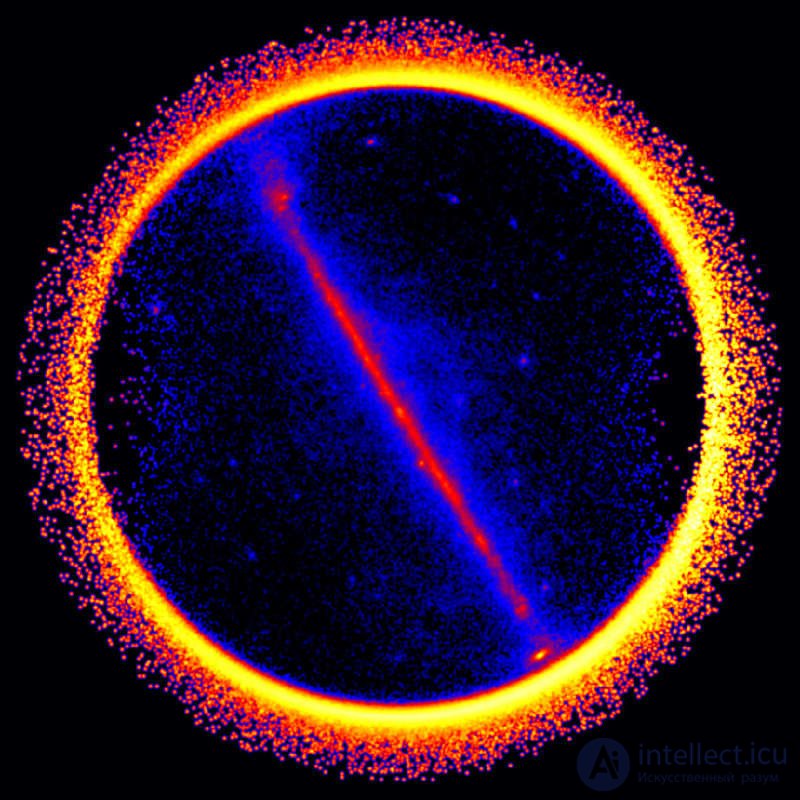
Explanation: For an orbital gamma-ray telescope, the Earth is actually the brightest source of gamma radiation — the most energetic form of light. Gamma rays coming from the Earth are born when high-energy cosmic ray particles collide with the atmosphere. And although this interaction prevents harmful radiation from reaching the Earth's surface, terrestrial gamma radiation dominates this remarkable image of the Earth and sky, obtained with the LAT (Large Area Telescope) mounted on the Fermi orbital gamma-ray observatory. The image was constructed only from observations when the Milky Way passed near the zenith, that is, directly above the Fermi satellite. In the picture the zenith is at the center. The Earth and points near the nadir, located directly beneath the satellite, are at the edges of the image, forming a projection of the Earth and the entire sky from Fermi's point of view. Low-intensity gamma radiation is shown in blue, and brighter areas are depicted in yellow shades on a logarithmic scale. The edge of the image is filled with a yellow ring of bright gamma radiation, which shows the location of the limb of our modest planet. Relatively weak gamma radiation from sources in the Milky Way has drawn a band stretching diagonally. The Fermi observatory was launched into space on June 11, 2008 to explore the high-energy Universe, and this week it celebrates its 2000th day in low Earth orbit.
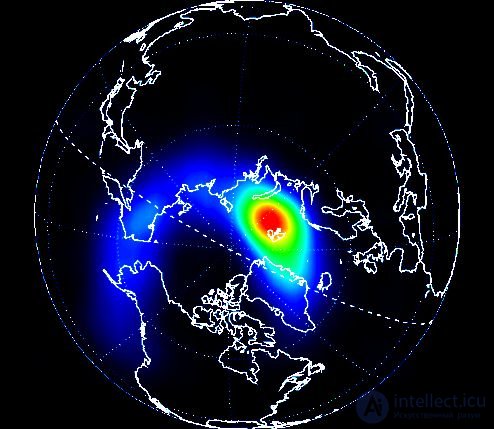
Explanation: This is a photograph of the Earth in X-rays, taken in March 1996 from aboard the Polar satellite. Mostly dark — except for the red region of X-ray radiation near the North Pole — the image of the globe has a coordinate grid and continental outlines superimposed on it. Why does the Earth glow in X-rays? In fact, the source of the X-ray radiation detected by spacecraft is not the Earth itself, but auroras in the upper atmosphere. High-energy ion showers arriving from the Sun cause distortions in the Earth's magnetosphere, due to which high-energy electrons, moving along the magnetic field lines, gain the ability to burst into the upper atmosphere in the region above the magnetic poles. As a result, the auroras observed on Earth arise, as well as X-ray, ultraviolet, and radio emission. X-ray radiation poses no danger to life on Earth, since it is absorbed in the dense lower atmosphere.
The Earth is photographed by many spacecraft that operate in near-Earth orbit or are sent to other objects in the solar system. Usually the Earth in these images is partly covered by clouds. In the images presented here there are no signs of cloud cover at all, since they were taken in the gamma wavelength range. Such photographs of the Earth were taken by the Compton space telescope, which operated in near-Earth orbit from 1991 to 2000. The different colors in these images reflect only different regions of the gamma spectrum: red is gamma radiation with the lowest energy, green corresponds to a medium level, and blue – to radiation with the highest photon energy. The fourth image (bottom right) – is a combination of all three previous photographs.
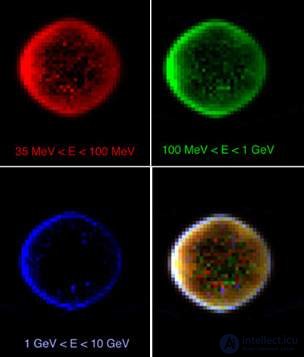
The Compton telescope was designed to study gamma-ray bursts, which are considered the most powerful explosions in the Universe. And gamma radiation from the Earth's atmosphere is formed when cosmic rays and other high-energy radiation collide with atoms of atmospheric gases.
The effect of radiation on the human body is called irradiation. During this process, the energy of the radiation is transferred to cells, destroying them. Irradiation can cause all kinds of diseases: infectious complications, metabolic disorders, malignant tumors and leukemia, infertility, cataracts, and much more. Radiation acts especially sharply on dividing cells, which is why it is especially dangerous for children.
The body reacts to the radiation itself, not to its source. Radioactive substances can enter the body through the intestines (with food and water), through the lungs (by breathing), and even through the skin during medical diagnostics with radioisotopes. In this case, internal exposure occurs. In addition, external exposure — that is, when the source of radiation is outside the body — also has a significant effect on the human body. Internal exposure is, without a doubt, the most dangerous.
How can radiation be removed from the body? This question, of course, worries many people. Unfortunately, there are no particularly effective and fast ways to remove radionuclides from the human body. Some foods and vitamins help cleanse the body of small doses of radiation. But if the exposure is serious, then one can only hope for a miracle. Therefore it is better not to take risks. And if there is even the slightest danger of being exposed to radiation, it is necessary to get away from the dangerous place as quickly as possible and call in specialists.
Sources of external human exposure are radioactive substances contained in the soil, in the rocks surrounding us, in the air, in the building materials from which our dwellings are built, and, finally, rays that reach us from the depths of outer space and bear the name of cosmic rays. Radioactive substances located outside the body (soil, rocks, building materials, etc.) emit all three types of radioactive radiation — alpha, beta, and gamma rays. Of these, only gamma rays are taken into account when determining the dose received by a person. The low penetrating power of beta rays, and especially alpha rays, is the reason that the overwhelming majority of them are absorbed by the air, by organic substances on the Earth's surface, by the upper layers of building materials, and by a person's clothing, and only a small amount of them reaches the human body, and even that is absorbed by the surface layer of the skin.
Numerous measurements carried out in various places around the globe show that, owing to the radioactive substances contained in the soil and rocks, a person receives on average a dose of 1–2.4 mrad per week, or 50–130 mrad per year. Lower values are obtained at sea level, higher ones — over rocks of volcanic origin. In winter this value is lower than in summer, since a 30 cm layer of snow already reduces the intensity of gamma radiation by half.
There are, however, places on the globe where the natural level of exposure significantly exceeds the values given above. Thus, in India (the states of Kerala and Madras) there is a narrow strip of land only a few hundred meters wide, but about 200 km long, covered with monazite sands containing a significant amount of radioactive thorium. The dose rate within the strip is 130–2800 mrad/year. About 100 thousand people living within the strip are exposed to such radiation. Similar phenomena can be observed in Brazil (the states of Minas Gerais, Goias and Espirito Santo), where the annual dose of external exposure reaches 12 rad. Elevated background levels are also found in other places around the globe.
Most people spend a significant part of their lives indoors. Do they thereby receive a larger or smaller dose than those who are outdoors? On the one hand, the walls of houses should protect them from the radiation of the soil and rocks; on the other hand, a number of building materials (brick, concrete, etc.) contain a certain amount of radioactive substances. To answer this question, in 1954/55 measurements of the natural exposure background were carried out in Sweden in 986 apartments located in 677 houses selected in 13 cities. The houses were built before 1946, that is, before the start of mass nuclear weapons testing. The measurement data showed that in wooden houses the dose rate is somewhat lower, and in brick and concrete houses somewhat higher, than outdoors. The highest background values were obtained in buildings built of granite.
The atmospheric air always contains a certain amount of radioactive substances — gamma emitters. This is radon, released from radium contained in the Earth's crust, its decay products, radioactive aerosols formed by the weathering of rocks, and radioactive isotopes arising in the air under the action of cosmic rays. The dose created by all sources is small and amounts on average to about 0.013 mrad per week.
Finally, to the listed sources of external human exposure one must add the dose received owing to cosmic rays. For an area located in mid-latitudes (latitude 50°), this dose is about 50 mrad per year at sea level, increasing significantly with altitude. At an altitude of 1 km above sea level it rose to 90 mrad per year, and at an altitude of 5 km — to 800 mrad per year.
In addition to external exposure, the human body is also subject to internal exposure, the source of which is radioactive isotopes that form part of the body. These are — K40, contained predominantly in nervous and muscle tissue, radium, deposited in bone tissue, gaseous decay products of radon, accumulating in the respiratory tract, and radioactive isotopes of carbon — C14, rubidium — Rb87, and polonium — Po210.
Internal exposure, compared with external exposure, differs in a number of features:
1. Whereas in external exposure only gamma radiation was taken into account, in internal exposure the main effect is produced by alpha and beta radiation, which have the ability to act directly on vital tissues and organs of the human body.
2. Most radioactive isotopes accumulate in certain tissues, which leads to uneven irradiation of individual parts of the body.
3. Internal exposure acts the entire time that radioactive substances remain inside the body.
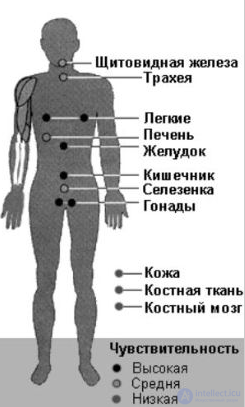
Data from radiobiological studies show that not all organs and tissues of the human body have the same sensitivity to radiation. The gonads — the sex glands — and the hematopoietic organs are the most sensitive. Therefore, in addition to the total dose of exposure received by a person, it is also necessary to know the dose received by the gonads.
The table below presents the latest data from the United Nations Scientific Committee on the Effects of Atomic Radiation — the dose rates of external and internal exposure from natural sources in areas that do not have an elevated radioactivity background . The table separately shows the dose received owing to alpha particles and neutrons, which have greater biological effectiveness than gamma rays and beta particles.
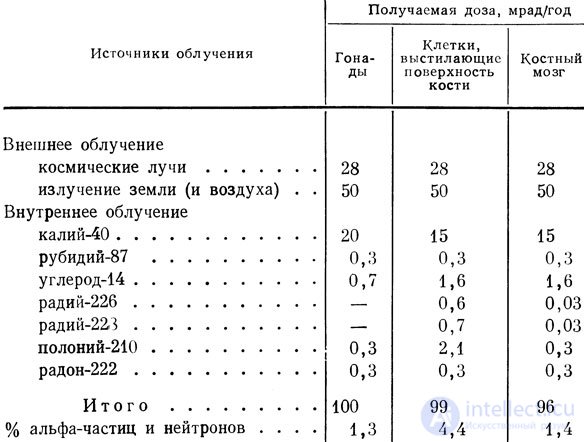
Table 3. Annual doses received by the human body as a result of external and internal exposure from natural sources
The data given for external exposure can vary depending on geographic conditions. In this regard, the results of measuring annual doses of background external exposure for population groups of individual cities are of interest. Residents of Baku, Vladivostok, Yerevan, Chisinau, Sochi, and Yakutsk receive on average 60–80 mrad per year; Kiev, Moscow, Novosibirsk, Tallinn, Tbilisi, Vilnius — 80–100; Ashgabat, Irkutsk, Lvov, Minsk, Riga — 100–120; Dushanbe, Leningrad, Tashkent — 120–140; Sevastopol — 45 mrad.
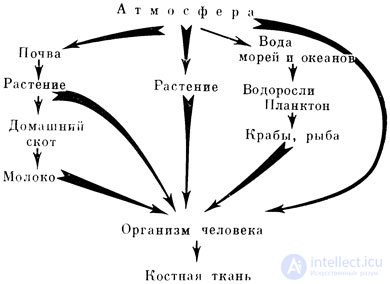
Fig. 11. Diagram of the pathways of circulation of strontium-90 from the atmosphere into the human body
The existence of mysterious cosmic rays became known relatively recently. At the beginning of the present century, in order to study the peculiarities of the radioactivity of the Earth's rocks, scientists began to investigate the intensity of air ionization near the Earth's surface. And it turned out that up to a certain altitude the ionization of the air decreases with increasing distance from the Earth (as would be expected if the source of radiation is the Earth's soil and rocks). But from a certain level, the intensity of the radiation causing ionization begins to grow rapidly, and at great altitudes it exceeds the level of ionization at the Earth's surface many times over. For example, at an altitude of 9 km it is 10 times higher than at sea level.
It had to be concluded that the rays causing ionization of the air at great altitudes are not of terrestrial but of cosmic origin; they came to be called cosmic rays. Thus arose yet another most interesting scientific problem: what, physically, are cosmic rays? How did they arise? Where is the source (or sources) of their formation located? What is their role in nature and their effect on life on Earth? Until recently, the solution of all these questions was of purely theoretical significance, of interest only to astronomers and specialists in the field of nuclear physics and elementary particle physics. But now humanity has entered the era of the exploration of outer space. And cosmic rays, from a purely scientific problem, have become a problem of direct practical importance for flights beyond the Earth's atmosphere, one of the real dangers threatening the bold inhabitants of our planet, limiting the possibilities of space exploration. Even in flights of modern jet aircraft, the influence of cosmic radiation must be taken into account. At an altitude of 15 km the exposure dose increases owing to it. Over 1 hour of flight this increase amounts to approximately 0.5% of the annual dose received owing to the natural background. However, the time spent at such an altitude by airplane passengers is small, and the increase in background cannot be of significance for their health.
The task of studying cosmic rays was quite complex. After all, the Earth's surface is reliably protected from cosmic "unpleasantness" by the atmosphere, whose thick covering absorbs short-wave ultraviolet, X-ray, gamma rays, and cosmic radiation, all of which are destructive to life on Earth. Scientists, in pursuit of these cosmic visitors, had to ascend in airplanes and balloons, climb high mountains, and haul bulky and complex scientific instruments up with them.
It turned out that cosmic rays are streams of material particles, the same as those from which the matter of the Earth and the entire Solar System is built. 85% of them consist of protons — positively charged nuclei of hydrogen, the lightest element. The main mass of the remainder consists of alpha particles — nuclei of helium, the element following hydrogen, standing second in Mendeleev's table. Heavier nuclei account for approximately 1.5–1.6% of the total number of cosmic particles. Among them are distinguished light nuclei with atomic number 3–5 (nuclei of lithium, beryllium, boron), medium ones — with number 6–9 (carbon, nitrogen, oxygen, fluorine), heavy ones — with atomic number 10–20, and superheavy ones — with number above 20. The latter account for only about 0.1% of the radiation.
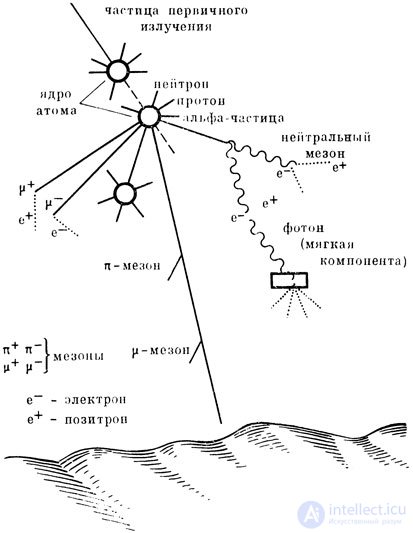
Fig. 20. Diagram of the formation of secondary cosmic particles when a primary particle of cosmic radiation enters the atmosphere
Moving through the boundless expanses of space, these particles accelerate, reach speeds close to the speed of light, and carry with them colossal energy, exceeding 1020 eV. To picture the magnitude of this energy more vividly, it is enough to say that it is many millions of times greater than the energy generated in the most powerful particle accelerators built by human hands. Bursting into the Earth's atmosphere, such a particle gradually loses its energy, expending it in numerous collisions with air molecules. Fragments of molecules that find themselves in the path of a cosmic particle, acquiring part of its energy, themselves become factors of ionization, destroying other atoms and knocking electrons and other particles out of them. The primary particle of cosmic radiation, as a rule, does not reach the Earth's surface. But its appearance within the Earth's atmosphere is evidenced by an avalanche of secondary particles formed as a result of the ionization of atmospheric gases (Fig. 20). By the number and composition of the secondary particles, and by the area of the avalanche, one can to some extent judge the energy of the primary particle.
The existence of "showers" of secondary cosmic particles was discovered by the Soviet scientist D. V. Skobeltsyn, whose research laid the foundation for the systematic study of cosmic ray physics. To study showers of secondary cosmic ray particles, special systems are built. Over an area of several tens of square kilometers, a large number of charged-particle counters are positioned and interconnected in such a way that they are triggered only when many particles strike them simultaneously.
Since scientists have not yet learned to produce such high particle energies under terrestrial conditions, they make good use of the gigantic natural accelerator that propels cosmic rays, applying it also to the study of the structure of matter. It was precisely with the help of cosmic rays that the existence of such elementary particles as mu- and K-mesons, and certain types of hyperons, was discovered. Scientists learn the "character" and "biography" of elementary particles from the traces - tracks - they leave in photographic plates, which physicists carry up into the upper layers of the atmosphere using balloon probes, stratospheric balloons, rockets, aircraft, and artificial Earth satellites.
On average, according to scientists' calculations, the intensity of cosmic radiation beyond the Earth's atmosphere is about 2 particles per 1 cm2 per second. This value is almost independent of the time of day or the season, and remains practically constant. Since the Earth moves around its own axis and around the Sun, and these motions do not affect the intensity of cosmic radiation, one is forced to conclude that these rays arrive at Earth from all directions in outer space with approximately equal intensity; and if that is so, the Sun is unlikely to be their principal source.
The mystery of the origin of cosmic rays continues to trouble scientists today, although much has already been done toward solving it. First of all, the Sun's role was clarified. It turned out to be very small. The Sun is mainly responsible for the periodic increases in radiation intensity observed from time to time, associated with solar flares. These are discussed in the following section.
But perhaps other stars of our Galaxy also emit streams of particles that together create cosmic rays? Scientists tested this hypothesis as well. It turned out that if all the stars of the Galaxy radiated with the same intensity as our Sun, the total intensity of cosmic rays would be hundreds of times lower than actually observed. Moreover, the Sun and other "quiet" stars emit particles with lower energy and a different composition than the particles of cosmic radiation.
It had to be assumed that within our stellar system there exist far more powerful sources of cosmic radiation. Advances in radio astronomy and other new methods of studying outer space made it possible to identify the main "culprits" behind the formation of cosmic rays. They turned out to be the so-called "supernova" stars.
For millennia, a tiny star shines from immeasurable cosmic depths, visible only through the most powerful telescopes. And suddenly a miracle occurs: at its location in the expanses of the Universe a new star flares up, whose light may for a time rival the brilliance of the Sun. We can only guess at the scale of the giant cosmic catastrophe that gave rise to such a star (which is called a "supernova"). After all, the brightness of its glow suddenly increases by many billions of times. Only for this reason does the light of a supernova, separated from us by a distance of thousands of light-years, approach in intensity the glow of the Sun - our nearest stellar neighbor.
More than 900 years ago, in 1054, a supernova flared up that was so bright that the star could easily be seen in daylight, as recorded in Chinese and Japanese chronicles. And today, at the site of the supernova that once flared up, scientists have observed the so-called Crab Nebula, separated from us by a distance of 4,500 light-years. Over the 900 years since the explosion that led to the formation of the supernova (or more precisely, since the moment when the inhabitants of Earth saw its flash), the masses of stellar matter ejected by the explosion have formed the shell of the nebula, which even today continues to move away from the core of the exploded star at a speed of 1000 km/sec. It is precisely such cosmic catastrophes that are the main source of cosmic rays within our Galaxy, where, according to scientists' estimates, supernova outbursts occur every 10 to 100 years.
However, there is one more possible source of cosmic radiation, located beyond our Galaxy. In recent years, scientists have discovered the possibility of even more grandiose cosmic catastrophes than supernova explosions: explosions of galactic nuclei - the central, especially dense regions of incredibly distant stellar systems. The streams of especially heavy particles carrying colossal energy that arise in such explosions are capable of overcoming the gravitational and magnetic fields of their own Galaxies, escaping into intergalactic space, and, after wandering through the expanses of the Universe, reaching the Solar System. It is possible that the heaviest cosmic particles, possessing maximum energy, are of extragalactic origin.
The Sun is the star nearest to us. Our Earth, as is well known, is no more than a speck of dust fluttering around a lamp. Therefore, everything that happens on the Sun has the most direct bearing on us, the inhabitants of Earth. And above all, everything connected with sunlight concerns us. After all, it is the most important condition for the emergence, development, and continued existence of life on Earth, the source of energy for the synthesis of all organic substances (photosynthesis), which is subsequently transformed into the energy of muscular movement, into the beat of human thought, into a girl's smile, and into a scientist's discovery. Only one two-billionth part of solar radiation reaches the Earth. A significant percentage of these rays, moreover, is scattered, radiated back into outer space, or absorbed by the atmosphere. And yet the remaining amount of solar heat is sufficient to warm the Earth, turning it into a cozy cradle of humanity.
What a gigantic amount of energy the Sun releases every second into the silent expanses of space! According to scientists' calculations, it amounts to 3.7 · 1026 joules per second; this energy would be enough to melt and bring to a boil a layer of ice around the Earth more than 1000 km thick. Not a single one of the energy sources known to science, except for the process of thermonuclear fusion of heavy nuclei from lighter ones, is capable of providing a constant output of such significant amounts of energy.
The Sun, like other stars for that matter, is a giant thermonuclear reactor, in whose depths hydrogen nuclei, fusing, form helium nuclei, and the latter, in turn, form carbon nuclei. According to astronomers' calculations, the fuel reserves of our luminary are quite sufficient to ensure stable radiance for at least another 5 to 6 billion years. Every second, 5 million tons of matter burn in the furnace of the solar reactor. For the Sun to shrink by half at this rate would take 6 thousand billion years.
If the temperature of the Sun's surface is close to 6 thousand degrees, then in its depths it reaches 20 - 100 million degrees. The radiant energy constantly generated in the interior of the Sun cannot break through to the surface directly. Constantly absorbed and re-emitted by the solar matter, compressed by gigantic gravitational pressure, this energy finally reaches a comparatively rarefied layer of solar material that no longer completely absorbs the radiant flux coming from the depths, although it still glows brightly enough itself. It is this layer, called the photosphere, that forms the brilliant surface of the Sun, the sharp outline of the solar disk.
The Sun emits not only visible light but also higher-energy quanta of ultraviolet, X-ray, and gamma radiation, which have a far stronger photochemical and biological effect. These rays are absorbed by the atmosphere, and during space flights the spacecraft's hull also reliably protects against them.
The situation is different with the Sun's corpuscular radiation, the streams of particles of solar matter. Observations of the solar surface, carried out continuously, reveal the restless, turbulent character of our stellar neighbor. Its visible surface - the photosphere - is in constant motion, perpetually seething. In various regions of the solar disk, more or less bright filaments (flocculi), tongues (spicules), and even larger protrusions - prominences, rising many thousands of kilometers above the photosphere and reaching the next layers - the chromosphere and the solar corona - loom above it. All of this consists of local eruptions of solar matter, sources of its ejection into the surrounding space. Part of the ejected matter then falls back onto the Sun under the influence of gravity. Streams of matter that have reached a speed exceeding 619 km/sec (the second cosmic velocity at the Sun's surface) move radially in all directions from the Sun, successively crossing the orbits of the planets of the Solar System.
Since such ejections, on a larger or smaller scale, occur constantly on the Sun, a continuous stream of matter is created, mainly protons, flowing from the Sun toward the Earth and further into outer space. This stream, called the "solar wind," carries about 1014 - 1015 g/sec of protons toward the Earth at speeds of 300 - 4000 km/sec. Owing to the solar wind, the concentration of matter in interplanetary space is hundreds of times higher than outside the Solar System. Part of the solar wind protons is captured by the Earth's gravitational field and becomes part of the so-called gravitational belts. But more on those in the next section.
Thus, the upper layers of the Earth's atmosphere are subject to constant bombardment. Gusts of solar wind replenish the atmosphere with easily volatile hydrogen and cause its ionization. Solar wind protons do not reach the Earth's surface; their energy is too low for that.
However, from time to time the solar surface is shaken by storms far more grandiose than the largest of the prominence eruptions.
The occurrence of such catastrophes is strangely connected with other unusual phenomena observed on the surface of the Sun - sunspots. Against the bright solar disk they appear dark because their temperature is 1100 - 1200° C lower than that of the photosphere. The floor of a spot lies 1000 - 1400 km below the surface of the photosphere. In the region of a spot, cooler matter rises from the depths and spreads over the surface, rotating slowly. The direction of this vortex motion is clockwise in the Sun's northern hemisphere and counterclockwise in the southern hemisphere.
The most interesting property of sunspots is that they represent, as it were, the poles of gigantic magnets arranged along the radii of the Sun and hidden in its depths. The strength of their colossal magnetic fields (2 - 5 thousand gauss) is thousands of times greater than the strength of the Sun's general magnetic field. Both the spots and the powerful magnetic fields accompanying them are manifestations of gigantic thermonuclear processes occurring in the interior of our luminary.
The appearance of spots on the Sun follows a strict pattern. Periods of maximum spot activity recur every 11 years. During these periods, particularly large spots are also observed - up to 100-230 thousand km across. Spots more than 40 thousand km in diameter are already visible to the naked eye. Between maxima of solar activity, there are few spots or none at all. Maxima are characterized not only by a large number of particularly large spots; from time to time, in those places on the solar surface where the configuration of spots is especially bizarre and the gradients of magnetic fields are especially large, flares occur. These are gigantic explosions lasting 15-30 seconds or somewhat longer. The brightness of a flare at its maximum can exceed the brightness of the photosphere several times over; the solar disk appears dark against its background. The temperature of solar matter at the site of the flare reaches 10 - 15 thousand degrees, and it radiates several times more light energy than an equal area of the photosphere. The shortest-wavelength gamma, X-ray, and ultraviolet radiation increases especially sharply.
The most serious result of a solar, or chromospheric, flare is the ejection into outer space, at a speed of 1 - 4 or more thousand km per second, of masses of solar matter - rapidly flying particles, mainly protons with an energy of 100 million electron-volts or more, up to 10 billion eV, as well as electrons.
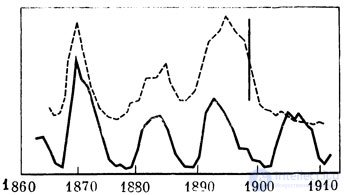
Fig. 21. Dynamics of solar activity (solid line) and the diphtheria morbidity curve (dashed line). The vertical line marks the start of preventive vaccinations against diphtheria
Magnetic disturbances and storms, bright auroras, disruptions of radio communication, radio noise, and interference - these are the most frequent companions of chromospheric proton showers reaching the Earth's atmosphere. The difference between these streams and the ordinary solar wind is not merely quantitative: protons from solar flares carry incomparably greater energy, have greater penetrating power, and cause more significant damage when interacting with matter. The most powerful and high-energy chromospheric streams are capable of causing serious, though short-lived, shifts in the atmosphere that are also reflected on the Earth's surface and in the biosphere (Fig. 21).
If chromospheric flares are somehow connected with changes and anomalies in the Sun's magnetic fields, then the Earth's magnetic field is responsible for the origin and existence of the near-Earth radiation belts. Protons and electrons of the solar wind and chromospheric flares, moving through Earth's orbit on their way out of the Solar System, are partially captured by the Earth's magnetic field and begin to move inside a "trap," along magnetic field lines in a helical, spiral trajectory. Another source of charged particles is neutrons (which decay fairly quickly into a proton and an electron), knocked out of air atoms by cosmic radiation.
Moving along the lines of force of the Earth's magnetic field and, in the polar regions, entering areas of enhanced magnetic field - the so-called "magnetic mirrors" - charged particles are reflected from them and begin moving in the opposite direction. The Earth thus represents a giant "magnetic trap" capable of accumulating charged particles.
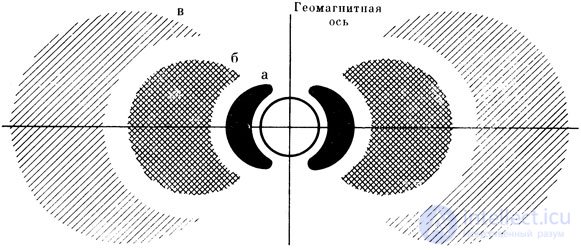
Fig. 22. Diagram of the Earth's radiation belts. a - inner belt, b, c - outer belts
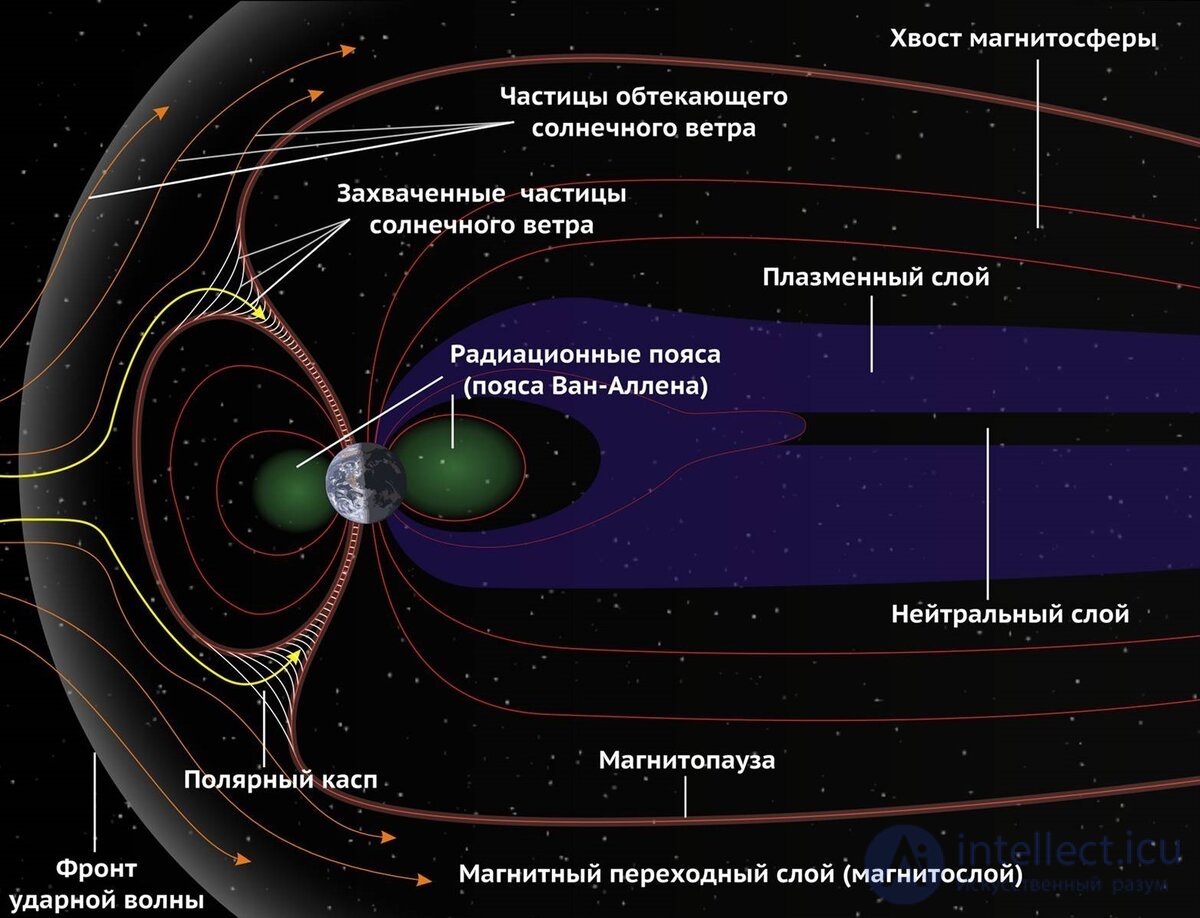
The existence of the Earth's radiation belts became known only after flights of Soviet and American artificial Earth satellites equipped with special instruments. The so-called inner radiation belt is located at altitudes from 400 to 7 - 10 thousand km above the Earth's surface (over the region of the magnetic equator). Toward the poles, the thickness of the inner belt and its altitude above the Earth's surface gradually decrease. Over regions with enhanced magnetism, the so-called magnetic anomalies, the belt descends lower, to altitudes of 320 - 350 km. Maximum radiation intensity is observed at altitudes of 3.4 - 3.5 thousand km. The bulk of the particles of the inner radiation belt consists of protons with energies mainly of 10 - 100 MeV - million electron-volts; the maximum is 600 MeV. Particles of higher energy are not captured or retained by the Earth's magnetic field. The average concentration of protons in the inner radiation belt (at an altitude of 3.5 thousand km) is about 20 thousand protons passing through 1 cm2 per second. In addition to protons, the inner belt includes electrons with energies of 20 - 100 thousand eV (keV) and in a quantity of about 10 million per second (through 1 cm2).
At considerably greater distances from the Earth's surface (12 - 50 thousand km) lies yet another, outer radiation belt, also called the electron belt, since it contains predominantly these particles with an energy of 400 - 500 keV (Fig. 22). Toward the poles, the altitude of this belt decreases especially sharply; moreover, the boundaries of the belt are mobile and depend on solar and other magnetic disturbances.
Finally, still farther from the Earth's surface, at altitudes of 50 - 75 thousand km, there exists a third - outermost - radiation belt, also consisting of electrons, though their energy is even lower, averaging only about 200 eV.
The invisible multilayered cover of radiation belts at high latitudes adjacent to the magnetic poles forms openings - these are the regions where the Earth's magnetic field lines enter and exit. When planning the routes of future space flights, scientists must take into account the existence of the Earth's radiation belts and their thickness.
Cosmic rays, including the corpuscular streams of solar flares, even without directly reaching the Earth's surface, indirectly cause, through the appearance of showers of secondary particles, an increase in the number of ionizations in the surface layer, including in the biosphere. Therefore we may assert that radiation from space is a component part of the Earth's natural radioactive background, under the conditions of which terrestrial life arose and developed, and that cosmic rays, like other components of the radioactive background, have been and remain mutagenic factors, one of the causes of the variability of organic forms and, ultimately, drivers of the evolution of life on Earth.
If, on average for the Earth, the radioactivity of air in the surface layer amounts to 0.1 - 0.12 R per year, then the share attributable to cosmic rays out of this amount is about 0.03 - 0.04 R per year. Significant fluctuations in the intensity of this radiation do not occur over historically relatively short periods of time. Only chromospheric flares on the Sun introduce small variations into the magnitude of the cosmic ray flux reaching the Earth.
But life on Earth, according to scientists' calculations, has existed for 3 - 4 billion years. Over such a span, the intensity of cosmic radiation could have changed much more substantially, and this would have had a serious effect on developing terrestrial life. Having investigated this possibility, the Soviet astronomer I. S. Shklovsky showed that during the lifetime of life on Earth, the intensity of hard cosmic radiation could have increased by dozens of times during supernova outbursts. Within the Galaxy, such outbursts occur on average once every 10 - 100 years. Only a supernova outburst occurring in relative proximity to the Earth, at a distance of about 10 - 20 light years, can affect terrestrial life. According to I. S. Shklovsky's calculations, such outbursts may occur approximately once every 750 million years. This means that over the course of the Earth's sufficiently long biography, as well as of life on it, the appearance of a supernova neighbor could have occurred at least once or twice.
What would happen in such a case? The nebula formed around the supernova, expanding at a speed of several thousand km per second and carrying with it masses of stellar matter, including powerful streams of high-energy particles, would reach the Solar System after 10 thousand years. Over the following several tens of thousands of years, the Earth, together with the entire Solar System, would remain immersed in this nebula, where the density of primary cosmic rays is tens, and in places even hundreds, of times higher than normal.
Such a prolonged and substantial increase in the radiation background could not fail to have a serious effect on terrestrial life. Long-lived organic forms would have had to endure an especially severe shock. Whereas doubling the mutation frequency in microorganisms, algae, and simple multicellular organisms requires an increase in the radioactive background of hundreds or thousands of times, for humans and other highly developed, long-living organisms, the radiation dose that doubles the mutation frequency amounts to something around 1 R per year. In other words, a supernova outburst in the cosmic vicinity of the Earth could have led to the death of the longest-lived organic forms and to a general acceleration of the mutation process.
I. S. Shklovsky believes that the widespread extinction of giant reptiles on Earth at the end of the Cretaceous period could have been caused by a supernova outburst. Strong confirmation of this hypothesis would be proof that dinosaurs died out simultaneously, within a span of a few tens of thousands of years, across the entire Earth. Unfortunately, modern methods of dating fossil remains are not yet precise enough for such calculations.
As for earlier stages in the development of life on Earth, a significant increase in the radioactive background could have played the role of a trigger, an additional driver of evolution, or even a factor that stimulated the very emergence of life on Earth.
Humanity does not yet possess precise facts and proof of the existence of life beyond Earth. The various hypotheses that exist today rest on more or less plausible analogies, assumptions, and a relatively small number of facts. One of the hypotheses existing today was first formulated back in 1907 by the Swedish chemist Svante Arrhenius. He suggested that life on Earth did not arise from non-living matter but was brought in from other worlds in the form of spores of microorganisms. It is known that such spores can withstand, without harm, the cosmic cold and vacuum of outer space, and that light pressure, discovered and demonstrated by our compatriot Professor P. N. Lebedev, could serve as the "engine" that would make it easier for tiny particles of living matter to accomplish grandiose cosmic journeys.
S. Arrhenius's theory has never been refuted by anyone. But objections, mainly of a philosophical nature, made it unpopular. Yet Arrhenius's hypothesis in no way contradicts the tenets of materialist philosophy, since it does not deny the material nature of life.
In recent years, Arrhenius's hypothesis has been reinforced by new data. According to calculations by the American astronomer Sagan, light pressure can "help" particles (including living ones) leave a planet and even an entire planetary system, if the size of these particles is within 0.2 - 0.6 microns. Viruses and spores have such small sizes. Consequently, spores can in principle leave the bounds of their home planet and, under the influence of light pressure, travel through interplanetary and even interstellar space.
But in the path of the traveling "molecules of the living," alongside cold and vacuum, stands yet another, quite significant obstacle - cosmic radiation, both corpuscular and quantum (ultraviolet and X-rays). How serious is this obstacle? While ultraviolet and soft X-rays, owing to their low penetrating power, can be completely absorbed by the shell of spores and cause them no significant harm, penetrating corpuscular radiation undoubtedly reaches living protoplasm and acts upon it. Evidently, upon reaching a certain cumulative dose of radiation, the traveling spores perish. Thus, cosmic radiation limits, in time and hence in space, the possibilities of "pollinating" lifeless planets with living cosmic dust.
According to Sagan's calculations, spores ejected beyond the Earth's atmosphere could reach the orbit of Mars within a few weeks, and the orbit of Neptune within a few years. Reaching neighboring star systems might require several tens of thousands of years. It is difficult to say how far the spores of terrestrial microorganisms, driven by the solar wind, might fly. In any case, the resistance of some of them to radiation is so great that a journey within the Solar System appears, apparently, feasible.
Arrhenius's hypothesis can be finally accepted or rejected only once people obtain direct data on the presence and characteristics of life on the Moon, Mars, and other planets. And it is not out of the question that there we will encounter old, though somewhat changed, terrestrial acquaintances.
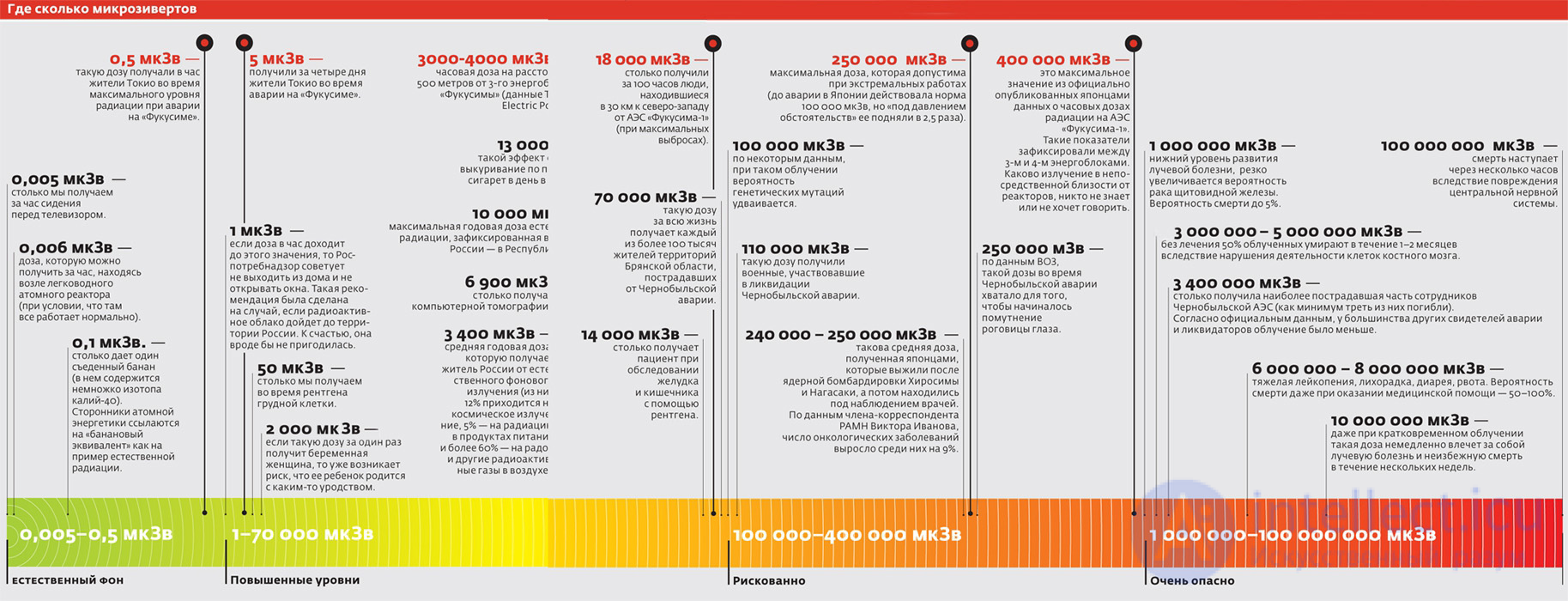
Back in 2011, Randall Munroe compiled a superb table of radiation doses, which clearly shows what doses of radiation a person receives from various sources. The table has been translated into Russian. Most importantly, it provides a sense of perspective, that is, it allows one to compare, in a single picture, the absorbed radiation from that notorious eaten banana (0.05 μSv) with a lethal dose (8 Sv).
Absorbed radiation is measured in sieverts (Sv). A large dose received over a short time usually causes greater harm, but "accumulated" radiation also matters, because it produces a constant destructive effect on the body's cells. The accumulated dose plays a role in matters such as cancer risk.
Randall Munroe begins his table with the simplest and most natural sources of exposure: a person sleeping in bed next to you, an eaten banana, and so on. It is specifically noted that a mobile phone is not included in the list of everyday sources of small radiation doses, because it does not produce ionizing radiation and does not cause cancer.
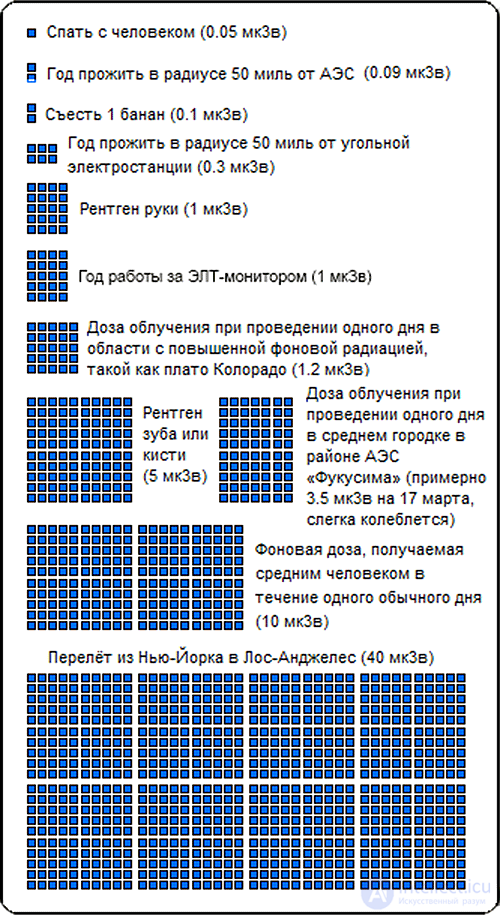
The total dose from all the items in the blue table is 60 μSv. This is less than the absorbed radiation from 1 year of living in a stone, brick, or concrete building (now it's clear why people buy eco-friendly and high-strength houses made of 24-layer cardboard).
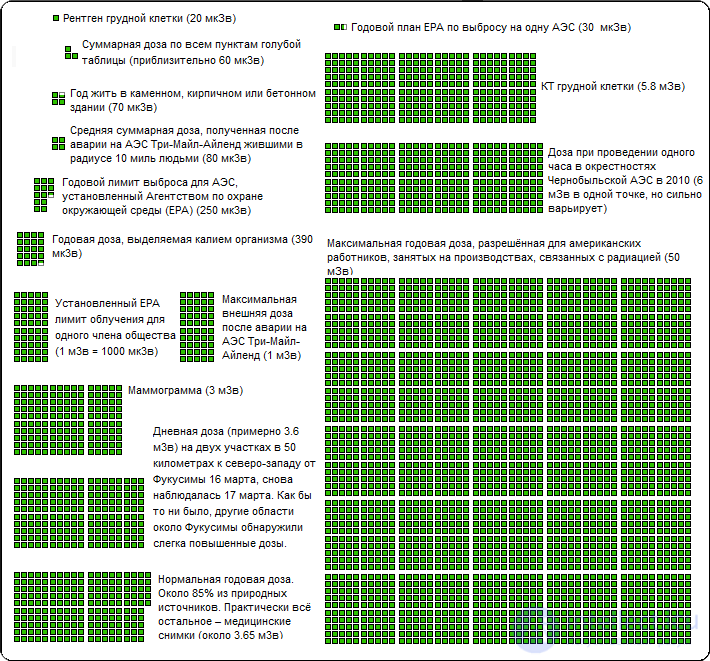
But even all the items in the green table are only a tiny fraction of the absorbed radiation capable of causing any noticeable harm to human health - see the full table.
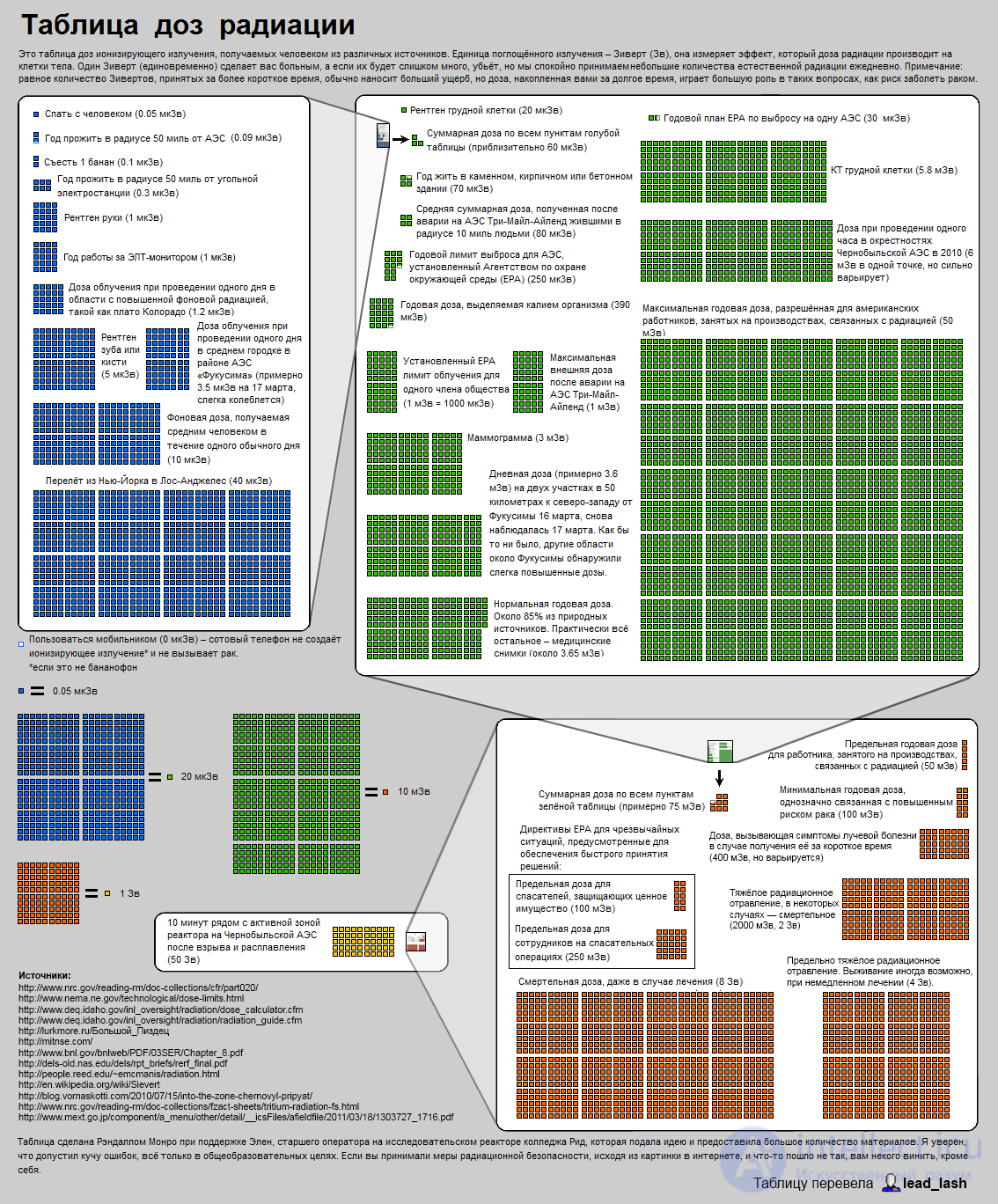
Presented here are maps and map-diagrams demonstrating the radiation situation on the territory of Ukraine that arose as a result of the man-made disaster at the Chernobyl Nuclear Power Plant. The maps characterize the state of surface contamination of the territory of Ukraine with the radionuclides cesium-137 (137Cs), strontium-90 (90Sr), and americium-241 (241Am).
To determine the effect of the Chernobyl accident on the environment of Ukraine, it is useful to know the levels of contamination of the territory of Ukraine before the accident. Below are maps of Ukraine's contamination with cesium-137 and strontium-90.
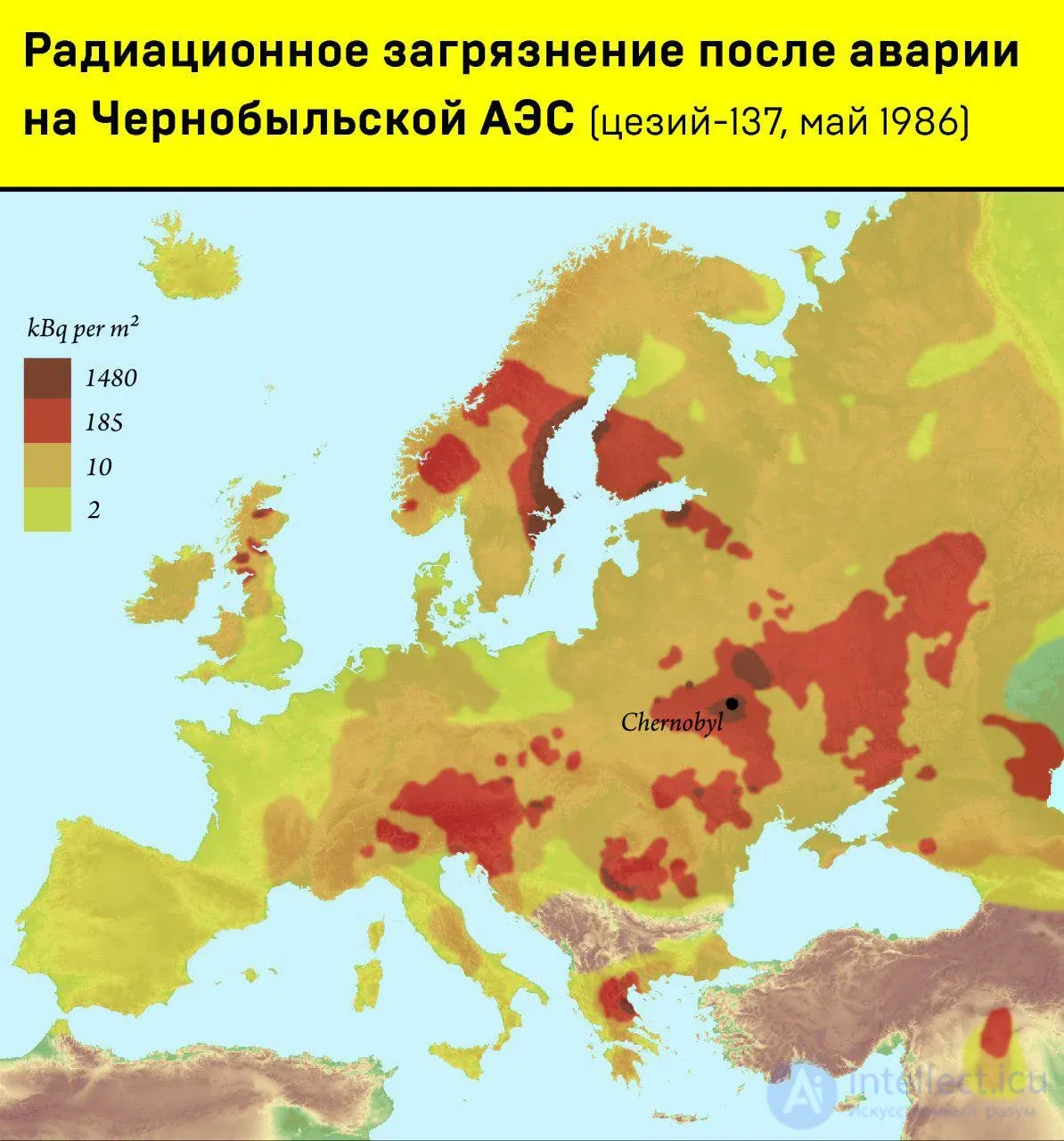
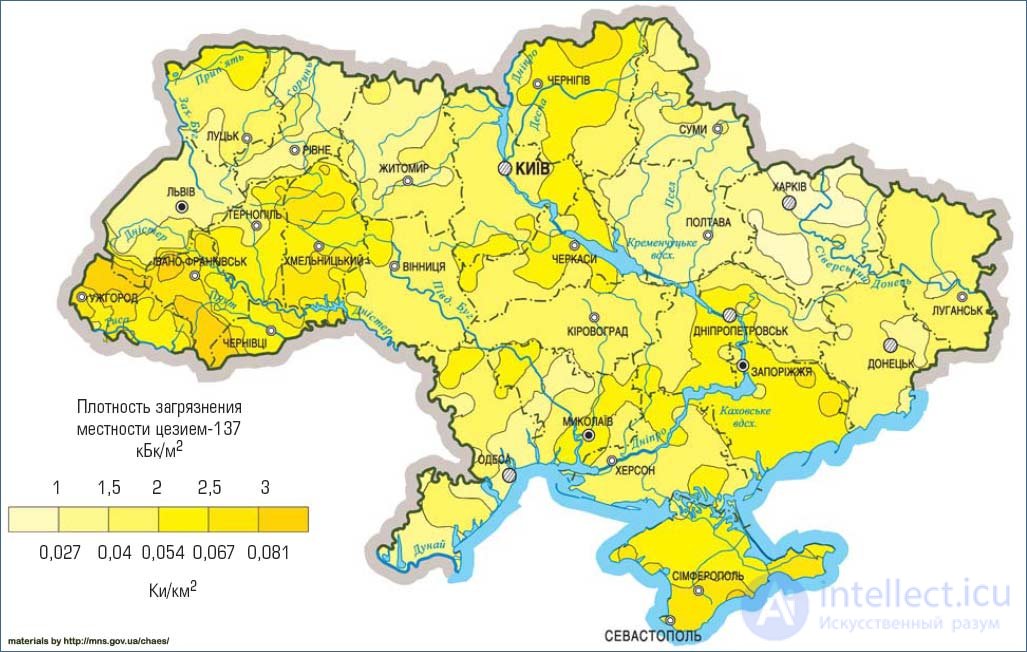
Map of Ukraine's contamination with cesium
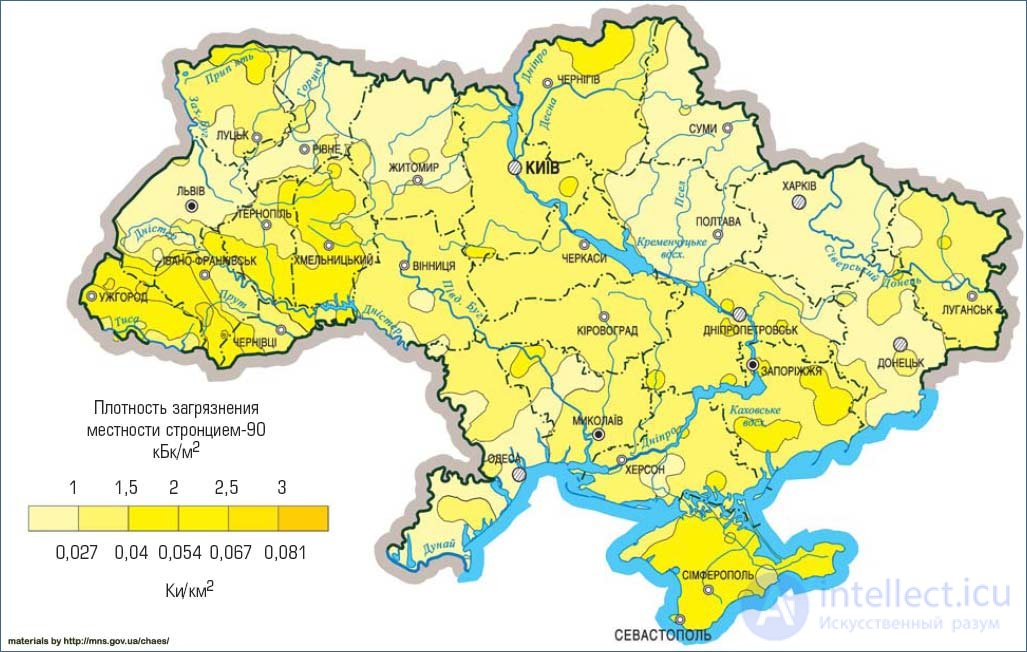
Map of Ukraine's contamination with strontium
Contamination of the territory of Ukraine with cesium-137 (137Cs) after the Chernobyl accident, in 1986 and 2006, kBq/m2
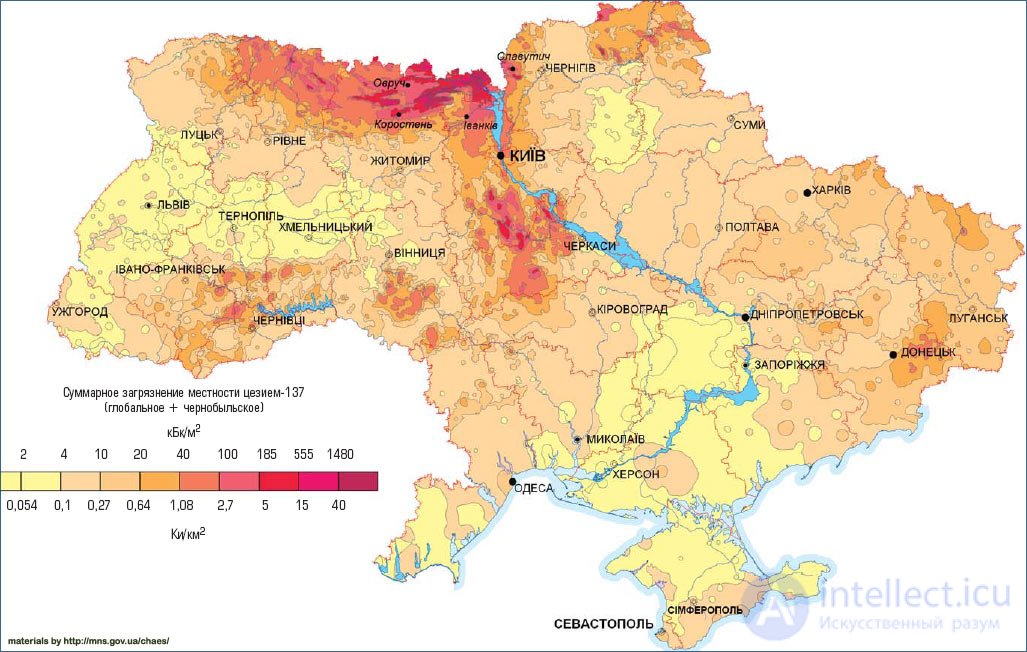
Map of Ukraine's contamination - cesium, 1986
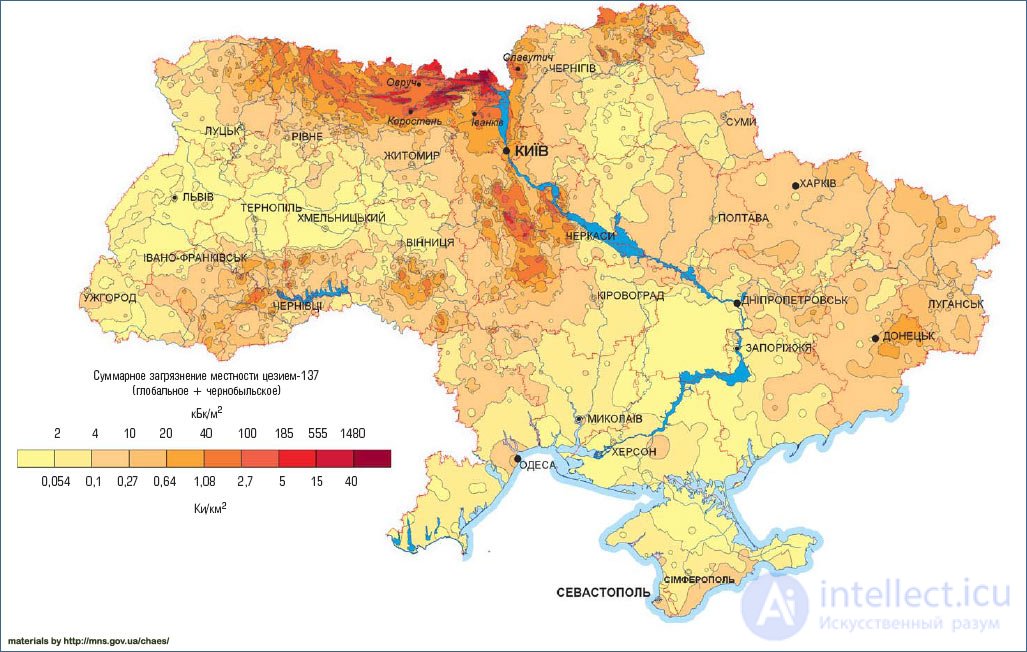
Map of Ukraine's contamination with cesium, 2006
Contamination of the territory of Ukraine with strontium-90 (90Sr) after the Chernobyl accident, in 1986 and 2006, kBq/m2
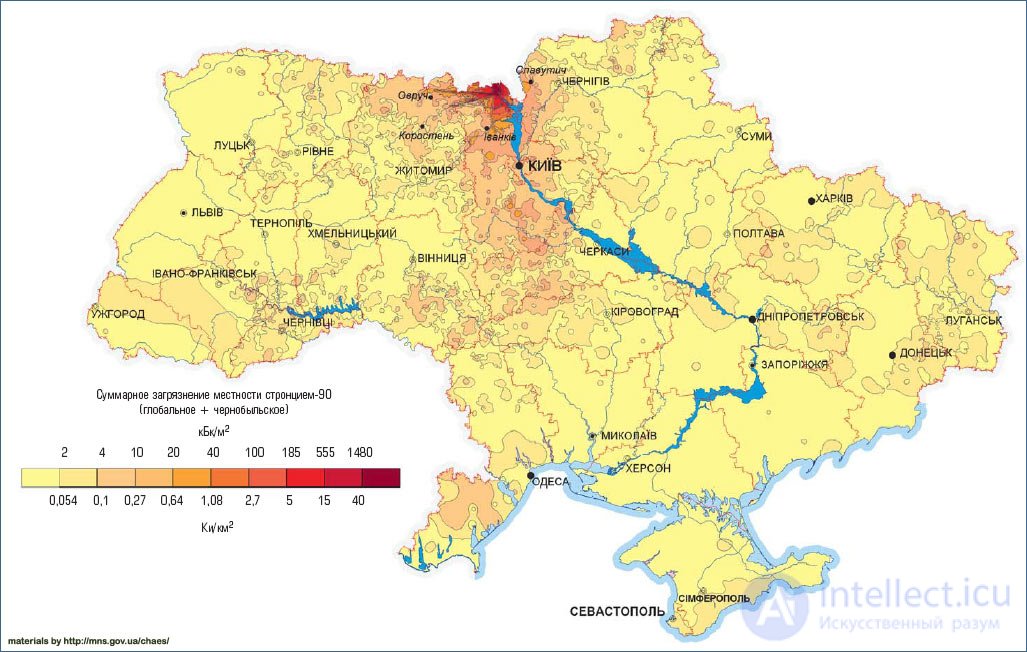
Map of 90Sr contamination of Ukraine, 1986
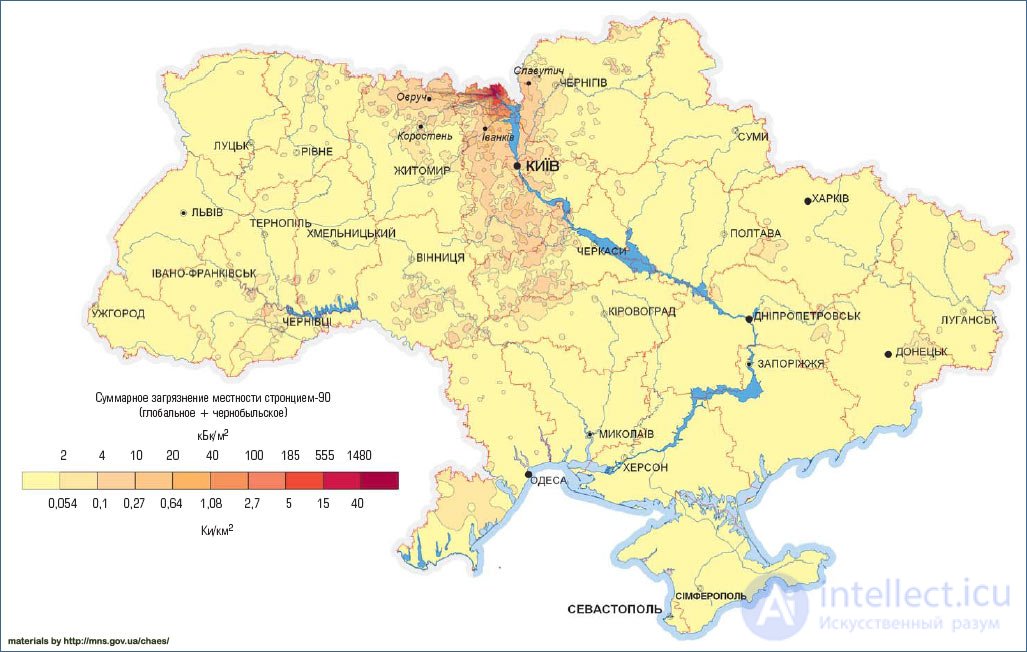
Map of 90Sr contamination of Ukraine, 2006
Contamination of the territory of Ukraine with americium-241. Current state and forecast for the year 2050, kBq/m2
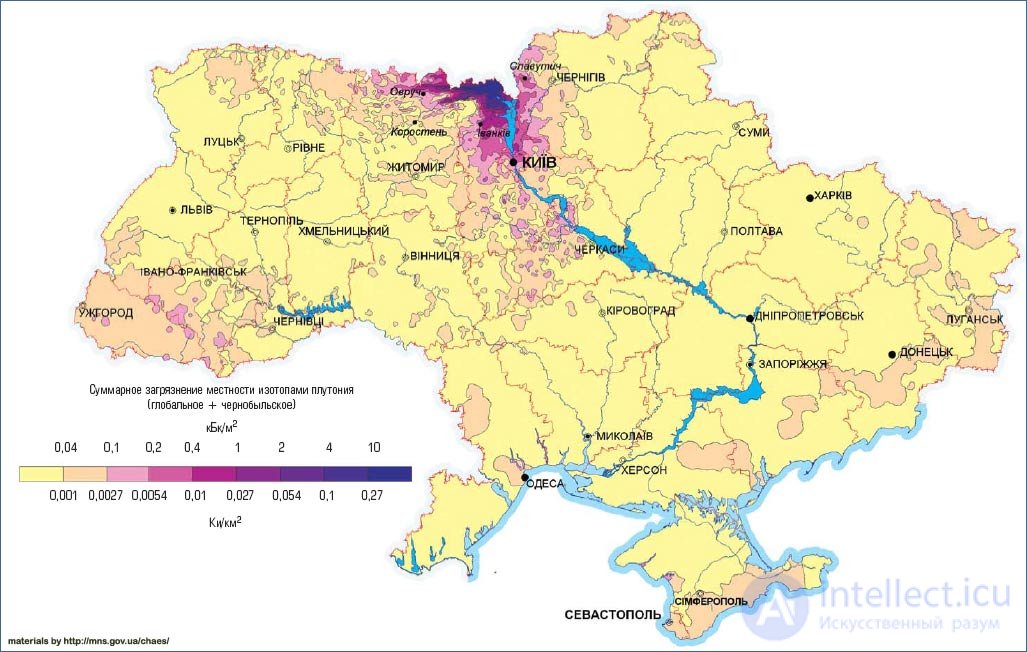
Map of Ukraine's contamination with americium, 2008
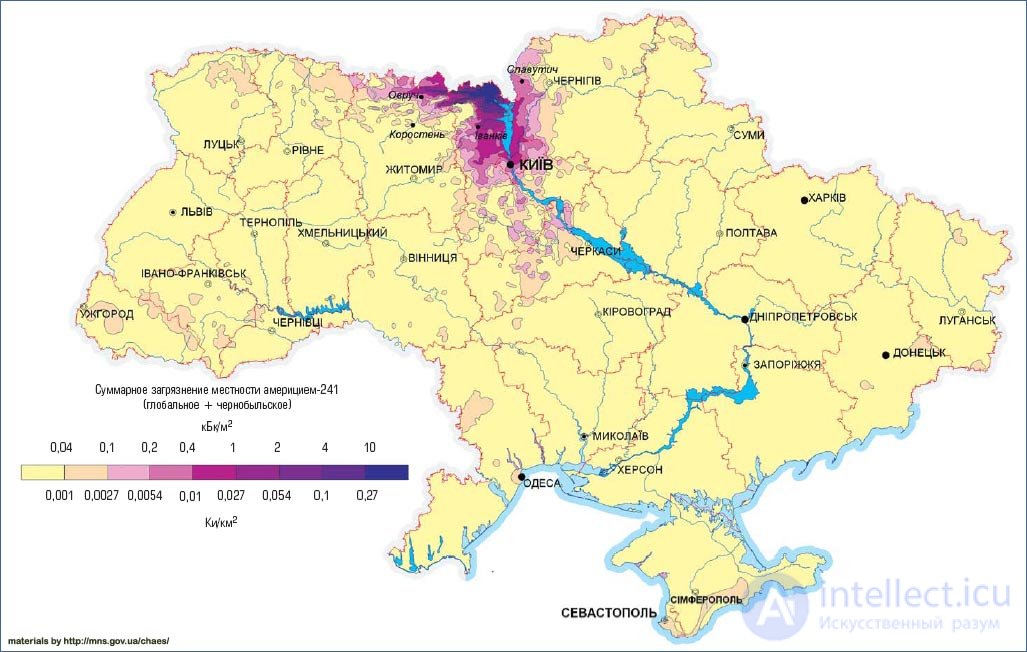
Forecast of Ukraine's contamination with americium-241
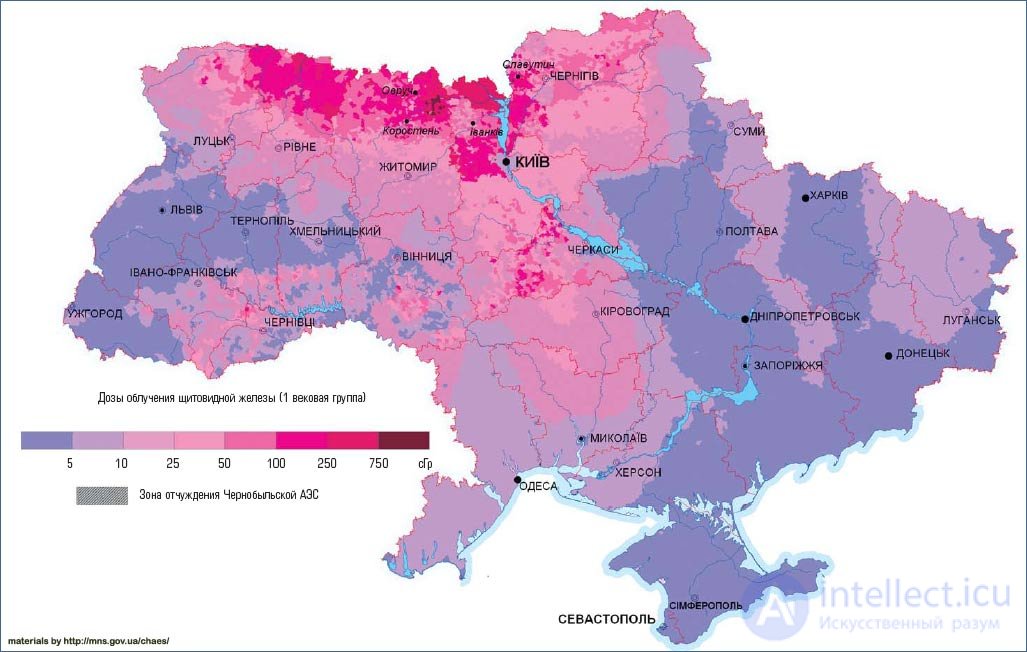
Map of expected thyroid radiation doses
Map-diagram of the total effective doses of external and internal exposure (from the radioisotopes Cs, Sr, and transuranic elements) of the population of Ukraine, which may accumulate over 70 years after the Chernobyl accident (1986 - 2055).
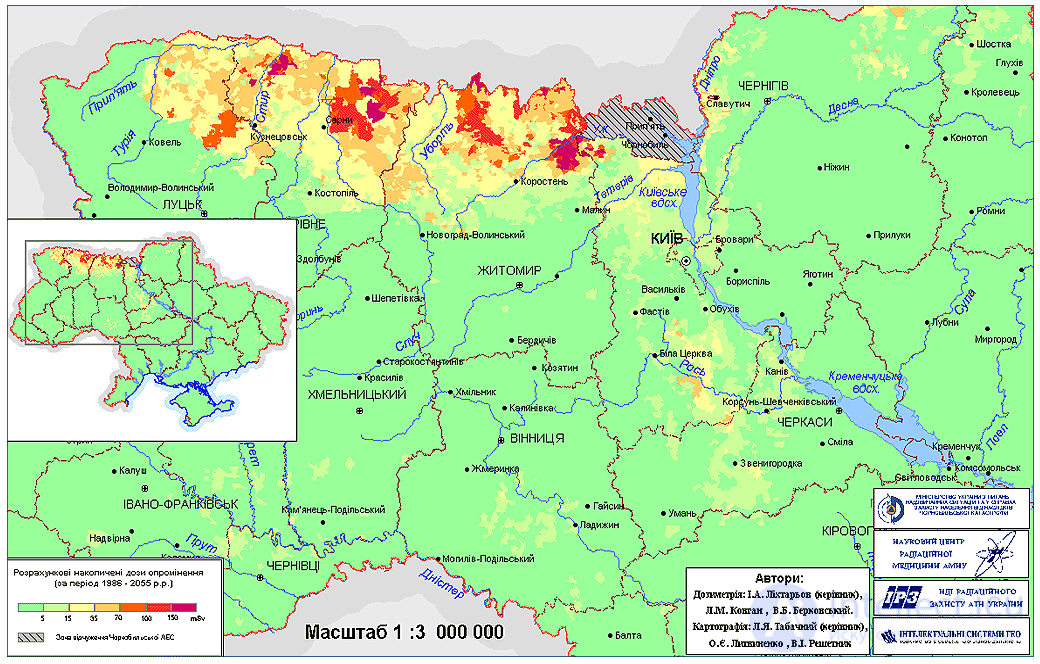
Map of radiation doses to the population of Ukraine
The most effective methods are these:
In the simplest homemade radiometer, the sensor consists of elongated strips of thin newsprint paper or petals of foil. They are attached to a metal rod placed in a glass jar. From the side, through the glass, such an indicator responds to gamma rays, and if an object is brought up from above, it also responds to beta and alpha radiation (at a distance of up to 9 cm, directly, since alpha radiation is absorbed even by a sheet of paper and a ten-centimeter layer of air). The detector must be electrified with static electricity so that the full discharge time is not less than 30 seconds, as timed by a stopwatch (only with a sufficiently long transient process is measurement accuracy ensured). An ordinary plastic comb can be used for this. Any device, not only a homemade one, should begin and end measurements by determining background values (if everything was done correctly, they will be approximately the same). To reduce the humidity of the air in the jar (so that the electroscope holds its charge), it should be heated and granules of silica gel or activated alumina placed inside it (having first been dried out, calcined on some sufficiently hot surface, such as a frying pan).
// When searching for the first uranium deposits, for the defense purposes of our country (potential adversaries, the Americans, were already testing their nuclear weapons at the time, and their plans included using it against the USSR), Soviet geologists, for lack of anything else, also used such primitive sensors (before measurements, the jar was dried in a hot Russian stove) to check the level of radioactivity of the ore samples found.
Example of measurements with a homemade petal radiometer on building materials:
background value - 42 seconds (based on the results of several measurements, background = (41+43+42) / 3 = 42 sec.
quartz sand - 43 sec.
red brick - 32 sec.
crushed granite - 15 sec.
RESULT: the crushed stone appears to be radioactive - its radiation almost triples (42 : 15 = 2.8) the background (the value is not absolute but relative, but a multiple excess of background values is a fairly reliable indicator). If measurements by specialists, using professional equipment, confirm the result (a threefold excess of background), the problem will be taken up by the local SES (sanitary-epidemiological station) and the Ministry of Emergency Situations. They will carry out a detailed radiometric survey of the contaminated zone and the adjacent territory and, if necessary, decontaminate the site.
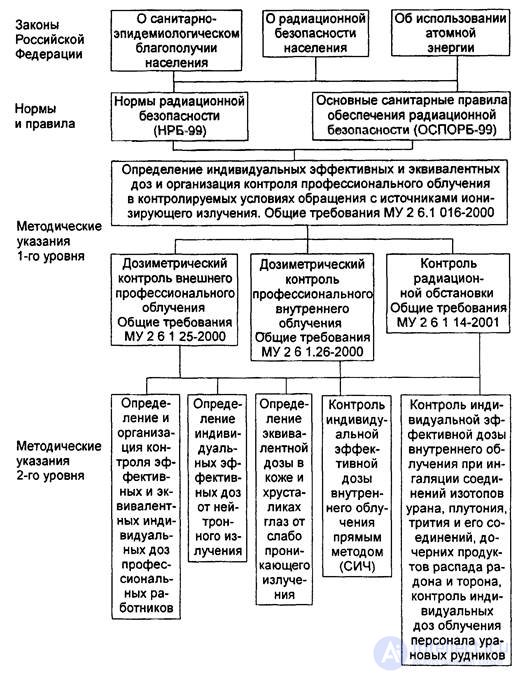
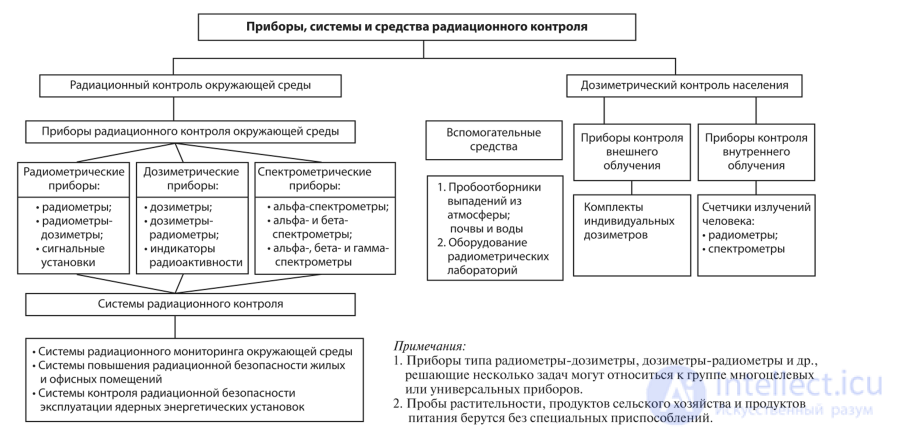
Monitoring the radiation situation, determining measures to protect the population in accidents at radiation (nuclear) hazardous facilities (NPPs) - Life Safety


Comments