
Lecture
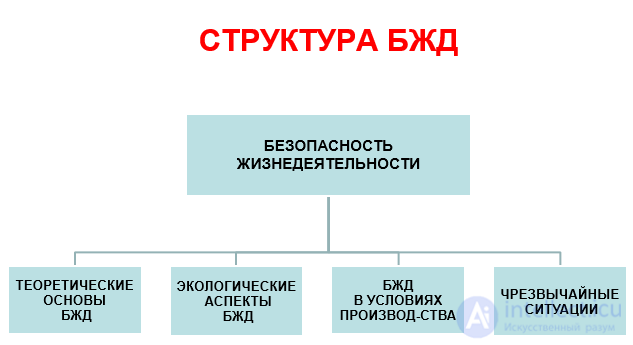
Life Safety (LS) —
1) a favorable, normal state of the human environment, of working and study conditions, of nutrition and rest, in which the likelihood of hazardous factors threatening a person's health, life, property, and legitimate interests is reduced;
2) the science of the safe interaction of a person with the environment;
3) an academic discipline within the system of secondary vocational and higher education, forming the knowledge, skills, and abilities needed to ensure one's own safety and to act in hazardous conditions, including emergency situations .
4) Fundamentals of Life Safety (FLS) — a school subject taught in institutions of primary, general, and secondary vocational education. The Ministry of Education of the Russian Federation recommended teaching the FLS course in general education institutions in all grades (from grade 1 to grade 11). The initiators of introducing the FLS course were the Ministry of Education and the State Committee for Civil Defense, Emergency Situations and Elimination of Consequences of Natural Disasters.
The main goal of Life Safety as a science is to protect people in the technosphere from negative hazards (impacts) of anthropogenic and natural origin and to achieve comfortable or safe conditions of life activity.
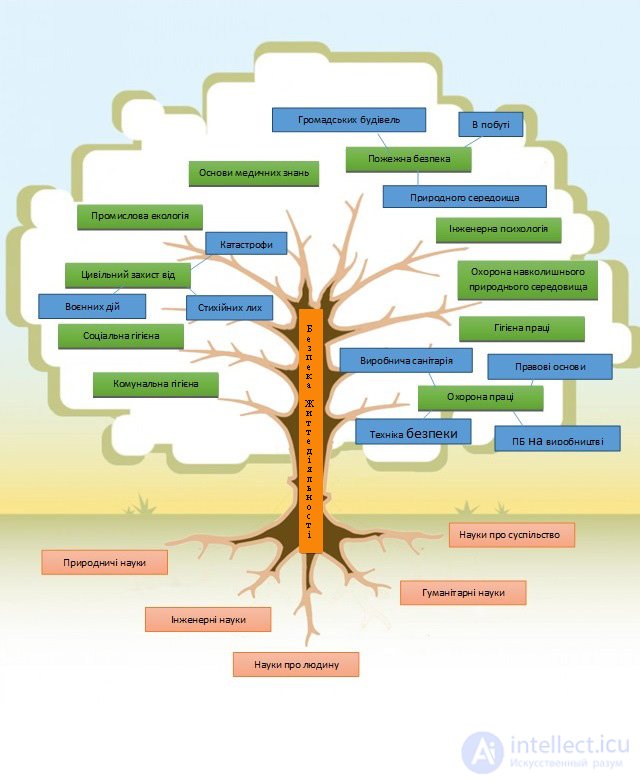
Fig. Tree "Life Safety"
The impact of anthropogenic hazards disrupts the normal life activity of people, causing accidents that lead to emergency situations (ES) and catastrophes, including environmental ones. At present, an alarming tendency toward an increasing destructive impact of hazardous natural phenomena and processes has taken shape. Despite the specifics of the situation in particular countries and regions, they are driven by population growth, the concentration of population and material wealth in relatively limited territories, and by changes in the nature and genesis of natural disasters. By intruding into nature and creating ever more powerful engineering complexes, humanity is forming a new, extremely complex system that includes the technosphere, the laws governing whose development are as yet unknown. This leads to an increase in the uncertainty of information about the functioning of the technosphere, in the entropy of the processes occurring within it, and to the risk of technological catastrophes — large-scale accidents in industry, energy, and transport, and contamination of the biosphere with highly toxic and radioactive production waste, threatening the health of millions of people.
Life Safety includes the system of civil defense.
The institution of civil defense begins to operate after the declaration of martial law, that is, in wartime. In Russia in peacetime, all matters of protecting citizens are handled by the Commission for the Elimination of Consequences of Emergency Situations and Natural Disasters (RSChS). To prevent the death and injury of citizens in emergency situations, which constitutes the main damage to the state, regulated principles and methods of protecting the population have been developed, adopted, and are in effect on the territory of Russia by the RSChS authorities.
A hazard is any phenomenon that threatens human life and health, the natural and surrounding environment; a property of living and nonliving matter capable of causing harm to a person, leading to a persistent loss of working capacity.
BASIC CONCEPTS OF LIFE SAFETY
Habitat – the environment surrounding a person, determined at a given moment by a combination of factors capable of exerting a direct or indirect, immediate or delayed impact on human activity, health, and offspring. Hazards – processes, phenomena, and objects that have a negative impact on human life and health. Safety – a state of activity in which potential hazards affecting a person's health are excluded with a certain probability.
Identification (recognition) of hazards – a detailed analysis of the hazards formed in the activity under study. Protection of the person and the habitat from identified hazards based on a comparison of costs with benefits. Protection is based on certain principles, methods, and means. Protection from the residual risk of a given activity, since ensuring absolute safety is impossible: the study of patterns and the construction of models for the development of emergency situations; the principles, methods, techniques, and means of their forecasting and elimination.
HAZARD
Axiom of the potential hazard of activity: Any activity is potentially hazardous. Corollaries: it is impossible to develop (find) an absolutely safe type of human activity, or to develop absolutely safe equipment; no type of activity can ensure absolute safety for a person (zero risk does not exist).
A HAZARD is any phenomenon that threatens human life and health, or the natural surrounding environment; a property of living and nonliving matter capable of causing harm to a person, leading to a persistent loss of working capacity. Hazards arise when flows of substance, energy, or information acting on a person or the natural surrounding environment exceed permissible values. Hazards act on the person, elements of the technosphere, and the natural surrounding environment simultaneously. The action of a hazard is accompanied by damage to the person, elements of the technosphere, and the natural surrounding environment.
Hazards are processes, phenomena, and objects that have a negative impact on human life and health
Hazards can be real and potential. Two important qualities of hazards: the potential nature of hazards – that is, hazards may exist but not cause harm, manifesting themselves only under certain, often difficult-to-predict, conditions; a limited zone of influence (the zone of hazard action). Sources of hazard formation: internal and external.
Hazards are processes, phenomena, and objects that have a negative impact on human life and health
Causes – a set of circumstances under which hazards manifest themselves and give rise to various undesirable consequences or damage. Hazard, causes, and consequences are the main characteristics of events such as accidents, emergency situations, fires, and so on. The triad "hazard – causes – undesirable consequences" characterizes the logical process of development that turns a potential hazard into actual damage (a consequence).
Nomenclature of hazards – a list of names and terms systematized according to a particular criterion. Quantification of hazards – the introduction of quantitative characteristics for the assessment of complex, qualitatively defined concepts. Identification of hazards – the process of detecting and establishing the quantitative, temporal, spatial, and other characteristics necessary and sufficient for developing preventive and operational measures aimed at ensuring life safety.
Taxonomy of hazards
By origin: natural, technogenic, anthropogenic, environmental, social, biological. According to the official standard: physical, chemical, biological, psychophysiological. By the time of manifestation of negative consequences: impulsive and cumulative. By localization: associated with the lithosphere, hydrosphere, atmosphere, or space. By the consequences caused: fatigue, illness, injury, fatalities, and so on. By the damage caused: social, economic, technical, environmental, and so forth. Spheres of manifestation: domestic, sporting, road-transport, industrial, military, and others. By structure (composition): simple and complex. By the nature of the impact on humans: active and passive.
Sequence for studying hazards
Stage 1. Preliminary hazard analysis (PHA). Step I. Identification of hazard sources: explosion, fire, release of toxic or radioactive products, etc. Step II. Determination of the parts of the system that may cause these hazards (reactors, pipelines, etc.). Step III. Introduction of limitations on the analysis, i.e., exclusion of hazards that will not be studied. Stage 2. Identification of the sequence of hazardous situations, construction of a tree of causes and hazards. Stage 3. Analysis of consequences.
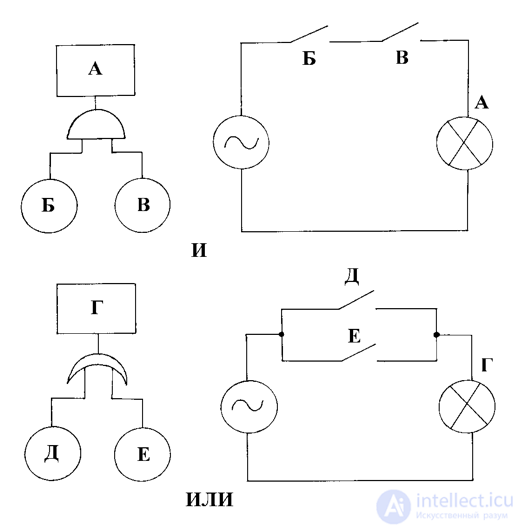
Fig. logical operations
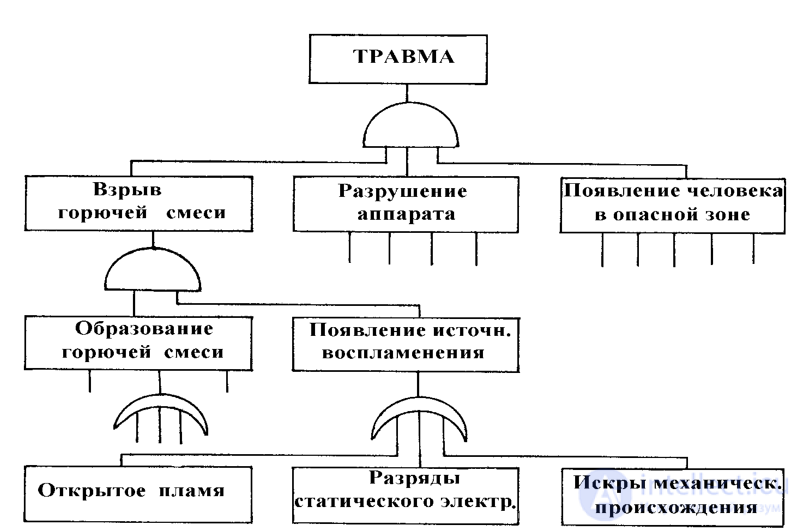
Fig. tree of causes and hazards
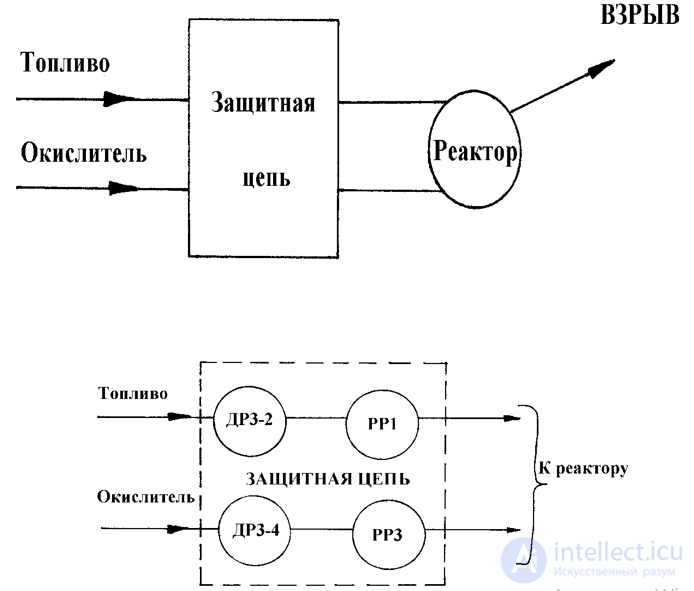
Fig. fault tree
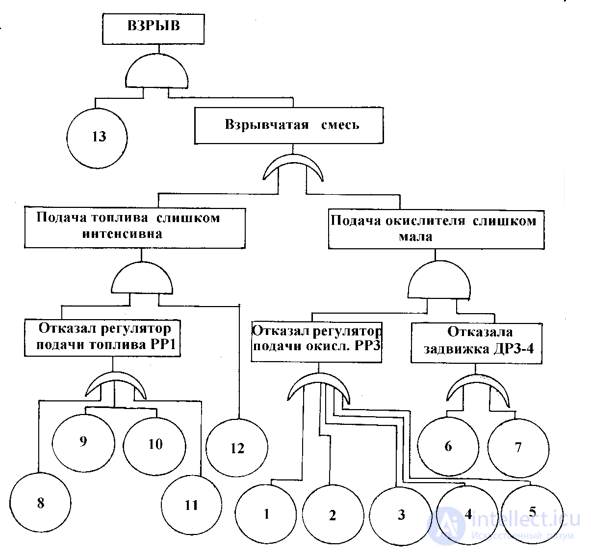
Fig. fault tree
Risk — the probability (frequency) of a hazard being realized.
Risk is expressed by the formula:  where n — the number of realized cases of hazard; N — the total possible number of cases of hazard manifestation.
Methodological approaches to studying risk
Risk – a quantitative characteristic of the action of hazards formed by a specific human activity, i.e., the ratio of the number of unfavorable manifestations of a hazard to their possible number over a given period of time (the frequency of hazard realization).
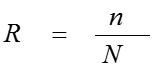
Where: n – the number of unfavorable manifestations of a hazard over a given period of time (a year);
N – the possible number of manifestations of the hazard over the same period.
Example: Every year in Russia, about 50 thousand people die in accidents and catastrophes. Let us determine the risk of a person's death in an accident or catastrophe, 1/year:
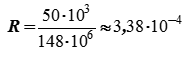
(N = 148 million people – the population of Russia).
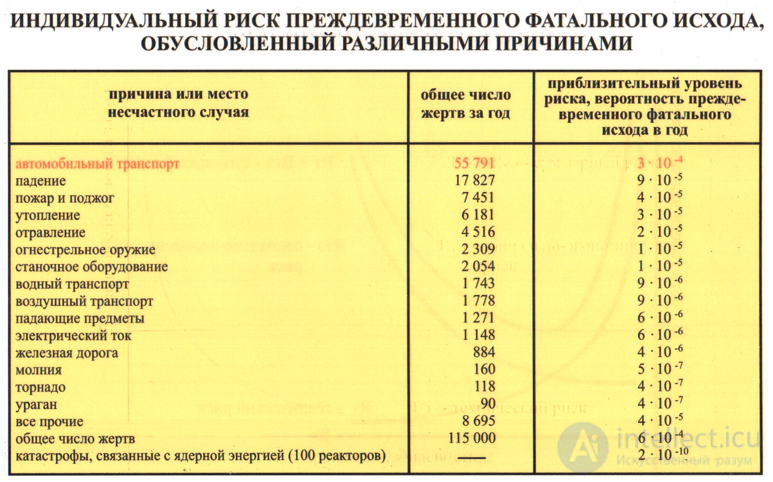
see [[b5088]]
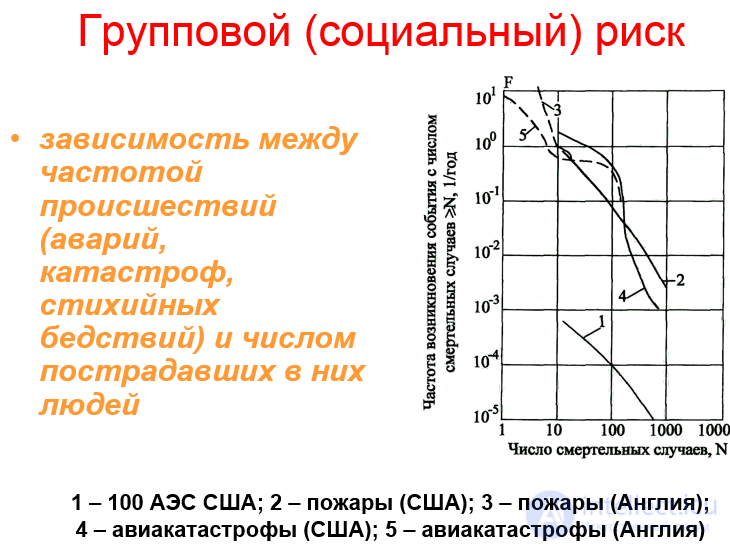
Fig. Group (social) risk
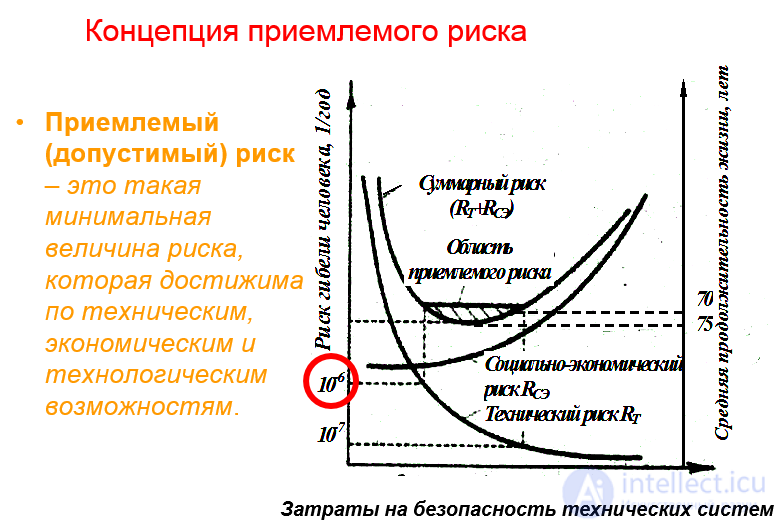
Fig. Concept of acceptable risk
A priori analysis. The researcher selects undesirable events that are potentially possible for a given system and attempts to compile a set of various situations leading to their occurrence.
A posteriori analysis. Carried out after an undesirable event has already occurred. The purpose of such an analysis is to develop recommendations for the future.
The method used may be direct or inverse.
Orienting principles – these are fundamental ideas that determine the direction of the search for safe solutions and serve as a methodological and informational basis.
Technical principles – based on the use of physical laws and aimed at directly preventing the action of hazardous factors.
Managerial principles – determine the relationship and connections between individual stages and phases of ensuring safety.
Organizational principles – aimed at implementing the provisions of the scientific organization of activity for the purposes of safety.
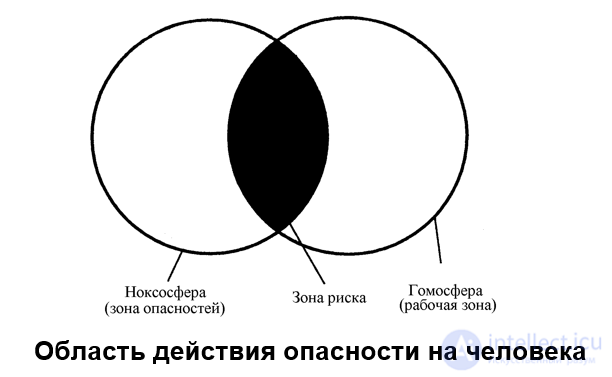
Methods of ensuring life safety
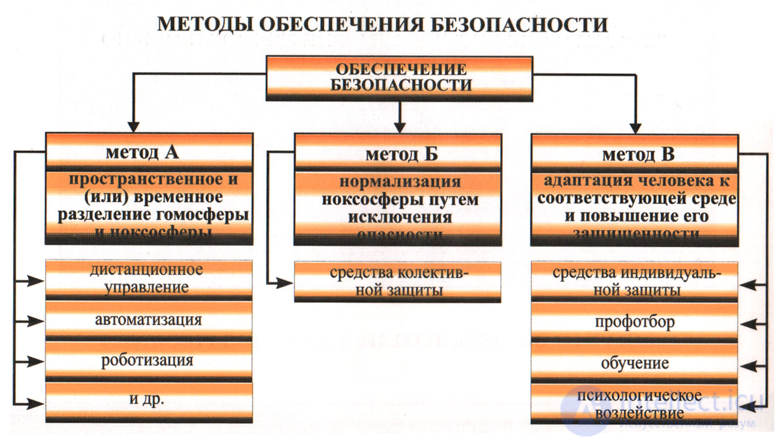
This is an organized influence on the system "person – environment," "person – production," "person – machine," with the goal of moving the object from one hazardous state to another, less hazardous one.
Directions of Life Safety management:

Comments