
Lecture
Throughout a person's life, they are exposed to numerous environmental factors, which determine approximately 25% of the population's health. Environmental factors have the peculiarity of acting not in isolation, but in combination, in the form of various combinations of chemical, physical (noise, vibration, electromagnetic fields, etc.), and biological effects. Of all the variety of physical factors that increase the level of risk to public health, according to the World Health Organization, the leading position is occupied by the noise factor, in particular its above-standard levels at night. The second most significant physical factor is electromagnetic fields (EMF), which in World Health Organization terminology are referred to as «global electromagnetic pollution of the environment».
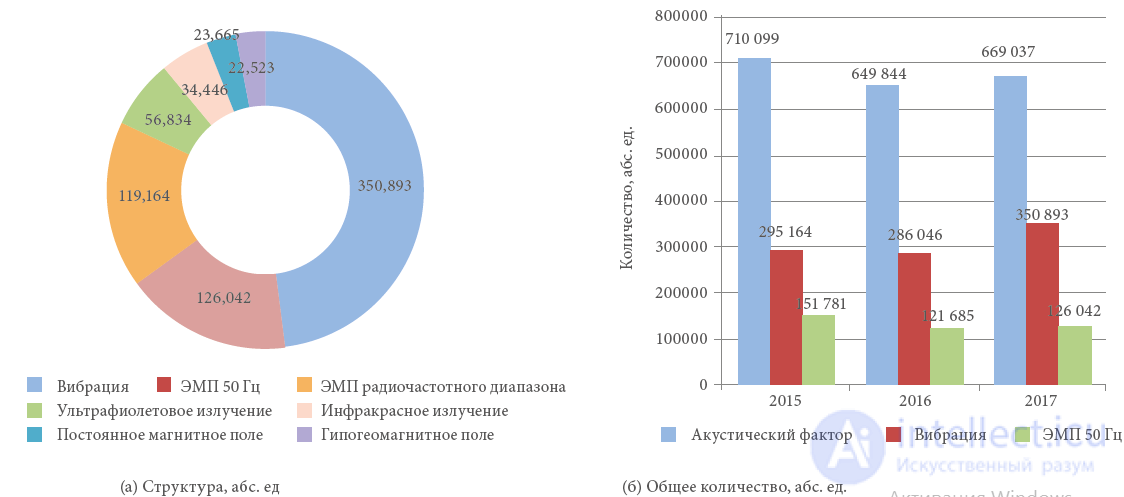
In 2017, as in previous years, the main contributor to the overall set of physical factors under consideration was acoustic noise. Its contribution to the factor load amounted to 47.7%. In second place was the vibration factor, whose contribution amounted to 25%. In third place in terms of significance were electromagnetic fields with a frequency of 50 Hz, whose contribution stood at around 9%. An analysis of the dynamics of the number of facilities that are priority sources of physical factors over the period 2015-2017 shows that in 2017, compared with the previous year, there was an increase in the number of noise-source facilities of 2.95%, in vibration-source facilities of 22.67%, and in electromagnetic-radiation-source facilities of 3.58%.
Structure and dynamics of the total number of facilities that are sources of non-ionizing physical factors identified on the territory of the Russian Federation
Source: State Report «On the State of Sanitary and Epidemiological Welfare of the Population in the Russian Federation in 2017» / Federal Service for Surveillance on Consumer Rights Protection and Human Welfare. 2018.
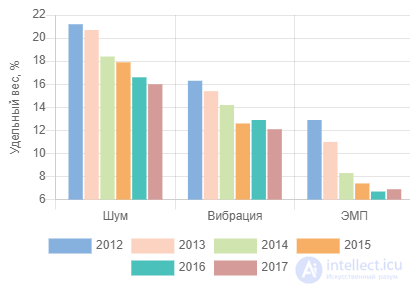
The proportion of facilities at which levels of physical factors were found not to comply with sanitary legislation requirements remained consistently high over the period 2012-2017: from 21.2% to 16.0% of measurements for noise levels exceeding sanitary norms, from 16.3% to 12.1% of measurements for vibration levels, and from 12.9% to 6.9% of measurements for electromagnetic radiation levels.
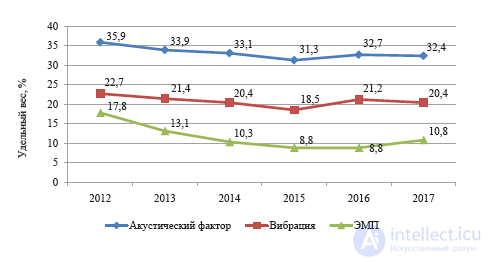
An analysis of the dynamics of the proportion of industrial enterprises not complying with sanitary and epidemiological requirements for physical factors over the period 2012-2017 shows a fairly steady decline in the number of hygienically unfavorable facilities. Noise exposure remains hygienically significant.
Dynamics of the proportion of facilities not complying with sanitary and epidemiological requirements for priority physical factors, 2012-2017, %
Source: State Report «On the State of Sanitary and Epidemiological Welfare of the Population in the Russian Federation in 2017» / Federal Service for Surveillance on Consumer Rights Protection and Human Welfare. 2018.
Dynamics of the proportion of the number of enterprises whose impact in terms of physical factors does not comply with sanitary norms for physical factors, 2012-2017
Source: State Report «On the State of Sanitary and Epidemiological Welfare of the Population in the Russian Federation in 2017» / Federal Service for Surveillance on Consumer Rights Protection and Human Welfare. 2018.
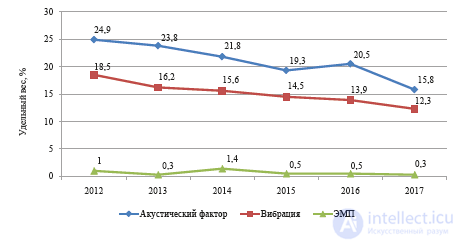
An analysis of the dynamics of the proportion of vehicles not complying with sanitary and epidemiological requirements for physical factors over the period 2012-2017 shows a steady decline in the number of hygienically unfavorable facilities. Noise and vibration exposure from vehicles is the most significant.
An analysis of the dynamics of the proportion of communal and social-purpose organizations not complying with sanitary and epidemiological requirements for physical factors over the period 2012-2017 shows a trend similar to that of the previous categories of facilities, namely a steady decline in the number of hygienically unfavorable facilities. At the same time, it should be noted that there was a slight increase in the proportion of acoustically unfavorable organizations, amounting to 7.63%.
Dynamics of the proportion of the number of vehicles not complying with sanitary requirements for physical factors, 2012-2017, %
Source: State Report «On the State of Sanitary and Epidemiological Welfare of the Population in the Russian Federation in 2017» / Federal Service for Surveillance on Consumer Rights Protection and Human Welfare. 2018.
Dynamics of the proportion of the number of communal and social-purpose organizations not complying with sanitary requirements for physical factors, 2012-2017, %
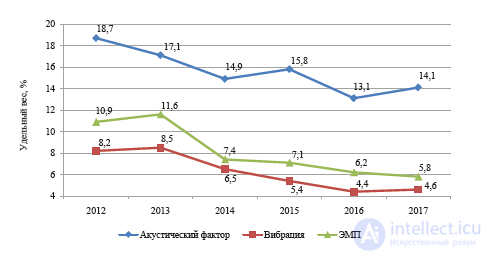
Source: State Report «On the State of Sanitary and Epidemiological Welfare of the Population in the Russian Federation in 2017» / Federal Service for Surveillance on Consumer Rights Protection and Human Welfare. 2018.
The most unfavorable effect of transport noise exposure is its non-specific impact on health, primarily manifested in negative changes in the nervous-psychological system and the circulatory system. The results of assessing the public health risk from noise exposure are presented in the form of two-dimensional and three-dimensional noise maps built on the basis of mathematical modeling of sound wave propagation; spatial cross-sections of public health risk values, as well as comfort and discomfort zones based on exposure load and risk acceptability criteria.
Fragments of noise maps for assessing public health risk from the impact of highways (using the city of Yaroslavl as an example)
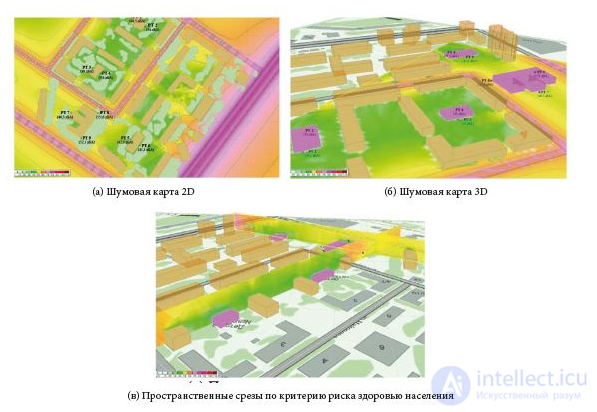
Note: in figures a, b, and c, the colors denote the following zones: green – the zone of sound levels corresponding to the maximum permissible level and acceptable risk; pink – the zone of above-standard noise and unacceptable risk; yellow and orange – transitional zones. In figures b and c – buildings shown in pink are significant for health risk assessment
Source: based on materials from the research project «Development of Proposals for the Optimal Planning of Urban Territory Based on Public Health Risk Assessment from Road Transport Noise Impact» / ANO NIPI «Kadastr». 2017.
According to Rospotrebnadzor, the radiation factor in 2017 was not a leading factor of harmful impact on public health in any constituent entity of the Russian Federation. The radiation situation has not changed significantly in recent years and has generally remained satisfactory. The results of radiation-hygienic certification show that in the structure of collective exposure doses, the leading position everywhere is occupied by doses from natural (85.3%) and medical (14.44%) sources.
Structure of sources of natural population exposure by average individual annual effective dose in 2017, %
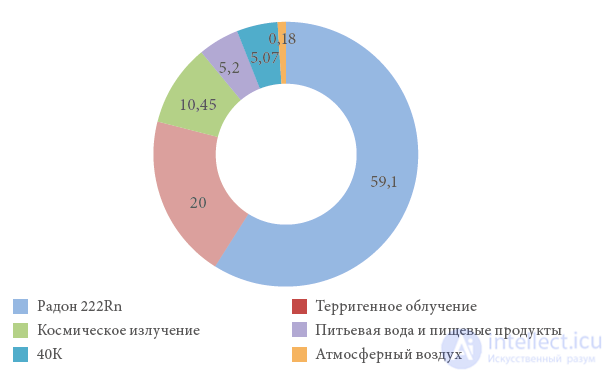
Source: State Report «On the State of Sanitary and Epidemiological Welfare of the Population in the Russian Federation in 2017» / Federal Service for Surveillance on Consumer Rights Protection and Human Welfare. 2018.
Overall, in 2017, no facts were established of increased background radiation or radionuclide content in environmental objects on the territory of the Russian Federation capable of causing harm to public health.

Comments