
Lecture
Это окончание невероятной информации про рабство.
...
also flourished in Libya[48]. The official prohibition of slaveholding in these states either exists only on paper, or is not backed up by any serious punitive measures against slaveowners.
Thus, in Mauritania the descendants of black people enslaved many generations ago constitute a slave caste owned by Arabs. Slavery is transmitted by inheritance: the children of slaves belong to the owners of their parents. The number of slaves in the country is estimated at 600,000 people, which amounts to 20% of the population , the highest percentage in the world.
In the terminology of critics of capitalism (socialists, communists, anarchists) — a condition characteristic of capitalism in which the worker de jure works of his own free will, yet de facto is compelled to sell his own labour power in order to survive.
According to ILO data, the total income derived from the illegal use of forced labour amounts to no less than 150.2 billion dollars a year.
The largest incomes, of the order of 99 billion dollars, come from the use of slave labour in the sex industry.
About 34 billion dollars a year is generated by slaves employed in construction, industry and mineral extraction, 9 billion dollars a year by agricultural slaves, and 8 billion dollars by domestic servants.
In absolute figures the greatest income is generated by slavery in the Asia-Pacific region — $51.8 billion, but this is due to the large number of slaves; per slave the income is relatively small and amounts to around $5 thousand a year. In European countries and the USA the annual profit from each slave is 6—7 times higher, which in aggregate yields around $46.9 billion a year.
Slavery in the 21st century (modern slavery or neo-slavery) — slavery occurring in contemporary society. In the 21st century slavery is a social phenomenon whose defining features are the total restriction of human rights (freedom, personal inviolability), coercion into involuntary labour (the performance of work unlimited in time or indeterminate in character), forced marriage, and exploitation as an object of property rights (human trafficking, the hiring out of people).
In the modern world slavery is prohibited by law and is regarded as a crime .
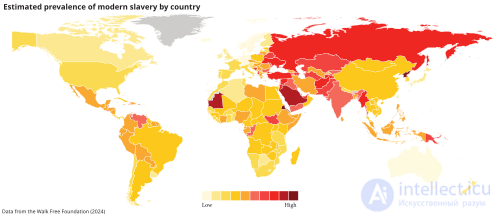
The prevalence of modern slavery as a percentage of the population by country, according to Walk Free estimates
Despite the legislative prohibition, the number of slaves in the modern world is not only not decreasing but is growing, having risen from 40 —46 million in 2016 to almost 50 million in 2021.
According to a joint report by the International Organization for Migration (IOM), the international human rights group Walk Free ("Be Free"), and the International Labour Organization (ILO), out of 50 million slaves (2021 data):
Of the 28 million people engaged in forced labour:
Of the 28 million people engaged in forced labour:
Women and children suffer most from slavery, as do migrants .
Instances of modern slavery have been recorded in practically every country in the world, with victims drawn from every people .
The total annual income of human traffickers (2014 ILO report) was estimated at more than 150 billion dollars, of which 99 billion dollars came from commercial sexual exploitation.
Compounding crises — the COVID-19 pandemic, armed conflicts and climate change — have led to unprecedented disruption in employment and education, a rise in extreme poverty and migration, and consequently to an increased risk of all forms of modern slavery.
According to the Sustainable Development Goals (SDGs), modern slavery among children is to be ended in 2025 and worldwide by 2030 (target 8.7).
The Office to Monitor and Combat Trafficking in Persons, an agency of the US Department of State, is guided by the following terms for the criteria of "slavery" and "human trafficking":
through the use of force, fraud or coercion.
The US federal Trafficking Victims Protection Act of 2000 and the "United Nations Protocol to Prevent, Suppress and Punish Trafficking in Persons, Especially Women and Children" use a number of different terms:
According to the American professor Kevin Bales, co-founder and former president of the non-governmental organisation and human rights group "Free the Slaves", modern slavery arises:
when a person is under the control of another person who uses violence and force to maintain that control, and the purpose of that control is exploitation
The impact of slavery is intensified when it is directed at vulnerable groups, such as children. The principal indicators of slavery are determined by the Global Slavery Index. Slavery has been officially abolished everywhere, the practice is illegal and consequently more hidden from the public and the authorities.
Modern slavery persists for the same reasons as before: it is economically profitable, despite the ethical problems. In recent years the cost of slaves has fallen considerably.
The "market" for exploitative labour is on the rise, despite the fact that slavery has been officially abolished and that enslavement is illegal control rather than lawful ownership. Although the purchase of slave labour has been abandoned and slaves have disappeared as a category of employment, people nevertheless continue to fall into the traps of human traffickers.
Modern slavery is a by-product of:
The use of slaves is characteristic of such sectors as
Slaves produce goods for domestic consumption or for export to more prosperous countries.
In the older form of slavery slaves were expensive, and so the costs of maintaining their health were considered a worthwhile investment. Under conditions of modern slavery people are easier to obtain at a lower price, and so replacing them becomes simpler.
Modern slavery is profitable, and corrupt governments in every country tacitly tolerate it, despite the fact that it is prohibited both by international treaties, such as the Supplementary Convention on the Abolition of Slavery, and by local laws.
The total annual income of human traffickers in 2014 was estimated at more than 150 billion dollars, of which 99 billion dollars came from commercial sexual exploitation.
The price of an American slave in 1809 reached 40,000 US dollars in today's money. Today a slave can be bought for 90-100 dollars.
Slavery is an economic crime:
People do not enslave people in order to be cruel to them; they do it in order to make a profit
With the development of technology, humanity is increasingly confronted with questions that once seemed like science fiction. One of them is the ethical status of robots. Today they perform millions of tasks: from assembling cars to caring for the elderly. But the question remains open: is the use of robots a form of new slavery?
The word "robot" comes from the Czech robota — "forced labour". In Karel Čapek's play R.U.R. (1920) robots are artificial beings created for work, but who ultimately rise up against their creators. Even then the idea arose that creating intelligent machines for exploitation might be morally questionable.
As of today robots are objects of property. They have no rights and are not considered subjects of morality or of law. Their task is to carry out human commands. This resembles the classical model of slavery, in which one subject fully controls another.
| Category | Human slave | Robot |
|---|---|---|
| Legal status | Person | Object |
| Capacity for pain | Yes | No (so far) |
| Self-awareness | Yes | Partly (in the future?) |
| Ability to refuse | Limited | Absent |
If robots become intelligent enough to be aware of themselves, then their exploitation without consent may be morally comparable to slavery. Some philosophers (for example, David Chalmers) discuss the possibility of artificial consciousness, and hence of artificial rights as well.
Humanity creates robots with a single purpose — to serve. This includes:
Physical labour: factories, warehouses, cleaning.
Emotional labour: AI companions, assistants, therapeutic robots.
Military tasks: drones, combat vehicles.
A robot cannot refuse, express protest or demand compensation. This is an absolute form of subordination.
| Scenario | Description | Ethical status |
|---|---|---|
| Industrial robot | Performs tasks in a factory | Instrument, not subject |
| AI companion | Converses, learns, adapts | Ethical disputes |
| Self-aware AI | Has goals, emotions, memory | Possible subject of law |
| Machine uprising (hypothetically) | Robots demand freedom | Political and ethical conflict |
So long as robots remain instruments, the concept of "slavery" is applicable only metaphorically. But with the development of artificial intelligence and the possible emergence of self-awareness, humanity must be prepared to reconsider its relationship with machines. Perhaps in the future the emancipation of robots will become a new milestone in the history of rights.
The word "slavery" is most often associated with slavery by descent and chattel slavery.
In chattel slavery an enslaved person is considered the personal property (chattel) of someone else, and can usually be bought and sold. Historically this occurred earlier through conquest, when a defeated person was enslaved, as in the Roman Empire or the Ottoman Empire, or through the slave trade, as in the Atlantic slave trade.
In contemporary society human trafficking, recognised as criminal and illegal, continues (after the civil war of 2014 in Libya, enslaved migrants were sold publicly, including at open slave markets in the country).
Mauritania has a long history of slavery, and after its abolition the laws against it went largely unenforced. It is estimated that about 90,000 people (more than 2% of Mauritania's population) are slaves.
Debt bondage is transmitted by inheritance, like chattel slavery.
Those who fall into sexual slavery effectively become chattel property.
The United Nations has defined human trafficking as follows:
According to data from the US Department of State (2013), "an estimated 600,000 to 820,000 men, women and children are trafficked across international borders each year, ~70% are women and girls and up to 50% are minors. Most transnational victims become objects of commercial sexual exploitation".
Every year in the United States 50,000 people become victims of human trafficking.
The Internet and popular social networking sites have become tools of human traffickers, and consequently criminal cases are brought against them and heard in court (a female user's suit against Facebook accusing it of negligence over a case of sexual abuse and sale by someone posing as her "friend" in 2012. Smartphone applications are also used to sell slaves.
In 2016 an article in the Washington Post condemned the activities of the Obama administration, which sent migrant children to human traffickers, because:
State-imposed forced labour takes various forms:
State forced labour, also known as state-sponsored labour, is defined by the International Labour Organization as events "when people are coerced into work through the use of violence or intimidation, or by more subtle means such as accumulated debt, retention of identity papers or threats of denunciation to immigration authorities"[28]. Many governments close off their citizens' exit from the country so that they cannot leave; ~35-40 countries currently have some form of conscription in place, even if it is only temporary service.
An example of an improving situation is Uzbekistan, whose government every year organised the forced labour of students and civil servants in the cotton harvest, the country being a major exporter of cotton, and also used the child labour of primary and secondary school pupils[30], but it reduced its use of forced labour, as a result of which a major boycott of Uzbek cotton was lifted in March 2022.
In 2022 the following 11 states were found to have documented state policies of human trafficking, including within state-funded programmes, forced labour in state medical services, sexual slavery in government camps, and the use of child soldiers[34]:
Eritrea
According to UN investigators, in Eritrea between 300,000 and 400,000 people are serving indefinite military service, which amounts to mass slavery[35].
North Korea
In North Korea, according to estimates by the Global Slavery Index (2018 report), 2.8 million people were slaves[36], working for the government, both within North Korea itself and beyond its borders. The value of all labour performed by North Koreans for the government is estimated at 975 million US dollars, with dolgyeokdae (youth) forced to carry out dangerous construction work, and inminban (women and girls) forced to sew clothing in sweatshops. Workers often went unpaid.[37] In addition, North Korea's army of 1.2 million conscripts is often made to work on construction projects unrelated to defence, including the building of private villas for the elite[37]. The government also sent up to 100,000 workers abroad[38].
United States
In 1865 the United States ratified the 13th Amendment to the United States Constitution prohibiting slavery and involuntary servitude; however, labour as punishment for a crime was not prohibited. There is thus a legal basis for slave-like penal labour and, as a consequence, for the convict leasing system, applied primarily to African Americans. In 2020 there were 2.3 million people in US prisons, and almost all able-bodied inmates worked. In Texas, Georgia, Alabama and Arkansas inmate labour was unpaid. In other states inmates were paid between $0.12 and $1.15 an hour; on average Federal Prison Industries paid inmates $0.90 an hour (2017). Inmates who refused to work were punished with solitary confinement or a ban on visits from relatives. From 2010 to 2015, in 2016 and in 2018 some inmates in the United States refused to work, demanding higher pay, better conditions and an end to forced labour. The strike leaders were punished with indefinite solitary confinement.
Forced labour of inmates is used not only in state-run but also in private prisons. CoreCivic and the GEO Group account for half of the private prison market share, with combined revenue of 3.5 billion dollars (2015). The value of all inmate labour in the United States is estimated in the billions of dollars. In California 2,500 incarcerated workers fight wildfires for just 1 dollar an hour under the CDCR Conservation Camp programme, which saves the state up to 100 million dollars a year.
China
In the Chinese laogai system of corrective labour prisons, an analogue of Hitler's concentration camps and Stalin's Gulag, millions of prisoners were subjected to forced unpaid labour, and the system caused tens of millions of deaths. In 1997 more than 1,000 laogai camps were in operation, holding 8–10 million people. At present between 500,000 and 2 million prisoners are held in the laogai system. Alongside the laogai system, China operated a system of re-education through labour in prisons until 2013, as well as forced labour camps in Xinjiang for Muslims, Uyghurs and other ethnic minorities and political dissidents (possible numbers of up to 1 million).
North Korea
In North Korea tens of thousands of prisoners may be held in corrective labour camps under harsh conditions:
Children and political prisoners at the Yodok concentration camp were subjected to forced labour. The camp was closed in 2014, and its prisoners were transferred to other prisons.
United Kingdom
In the United Kingdom there are three main types of prison labour:
Prisoners in the United Kingdom may earn as little as 10 pounds sterling for a 40-hour working week.
Australia
In Australia prison labour occurs in New South Wales (paying as little as $0.82 an hour), Victoria, Queensland and the Northern Territory. Some prisoners work for private companies.
New Zealand
In New Zealand prisoners receive 16 dollars an hour (compared with 35 dollars an hour for an ordinary unionised worker doing the same job).
Bonded labour, also known as debt bondage, occurs when people pledge themselves into slavery as security for a loan, or when they inherit a debt from a relative.
The "loan" is arranged in such a way that it can never be repaid; it is often passed down from generation to generation, and is even assigned to future generations, in which case it is called peonage.
Bonded labour is used throughout the world. It is most widespread in India, Pakistan and Nepal.
In India the majority of bonded labourers are Dalits (untouchables) and Adivasi (indigenous tribes). A former brick kiln worker in Punjab (India) testified: "We do not stop even if we are ill". The price of slaves in India relative to the price of land, paid labour or oxen is at present 95% lower than in the past.
People are lured into migrating by the promise of work, but it is a deception: their documents are confiscated and they are forced to work under threat of violence against them or their families. Along with sexual slavery, this form of slavery is most commonly found in wealthy countries such as the United States, Western Europe and the Middle East.
In the Middle East the kafala system operates (outdated laws and weak government oversight), leading to forced labour and human trafficking. In the United Arab Emirates the majority of the permanent population consists of foreign migrant workers. In 2017 the UAE adopted laws protecting the rights of domestic workers.
Qatar
In Qatar migrants number 1.7 million people and make up 90% of Qatar's labour force.
In October 2019 Qatar abolished the kafala system and carried out reforms:
This new system reduced the number of abuses.
However, forced migrant labour was used in the preparations for the 2022 FIFA World Cup in Qatar; more than 6,500 migrant deaths were recorded during the construction of the stadiums, 3,200 migrant workers worked daily, of whom 224 reported cruel and exploitative treatment of them, and high recruitment fees, poor living conditions, fraudulent wages, delays in wage payment, inability to leave the stadium or the camp, inability to leave the country or change jobs, threats and forced labour were documented.
United Kingdom
In the United Kingdom two people in the county of Kent were found guilty of trafficking six Lithuanians. Farms that used forced labour supplied eggs to major supermarket chains such as Tesco's, Asda and M&S.
Vietnamese teenagers are sold into the United Kingdom and forced to work on illegal cannabis farms. Trafficking victims caught during police raids are usually sent to prison.
United States
In the United States, in the state of New York in 2010, 19 Mexican migrants were effectively enslaved by their employer. The men were paid about 10% of the promised wage, while working far longer than their contract stipulated, and would have been deported had they left the job, since that would have been a violation of their visas.
A 2021 interagency federal investigation, codenamed "Operation Blooming Onion", found that a long-running human trafficking network forced migrant workers from Mexico and Central America into "modern slavery" at various agricultural sites in south Georgia. The indictment alleges that in the fields migrant workers were forced at gunpoint to dig onions with their bare hands for 20 cents a bucket. They were held in labour camps surrounded by electrified fences, in squalid and cramped conditions, without access to safe food and water.
Saudi Arabia
Reports of abuse of and disregard for Kenyan migrants in Saudi Arabia emerged in early September 2022.
Sexual slavery, forced prostitution, is a form of modern slavery most commonly found in wealthy regions such as the United States, Western Europe and the Middle East. Sex slaves are supplied from Eastern Europe and South-East Asia (especially from Moldova and Laos), including children.
20% of slaves today are employed in the sex industry. Sexual exploitation can also become a form of debt bondage.
Boys from Nepal (2005) were lured into India and enslaved for sex. Many of these boys were also subjected to mutilating operations on their male genitals (castration)
People from Nigeria often fall victim to sexual slavery; although at first they do so voluntarily, they later fall into human trafficking traps].
Today children make up about 26% of slaves.
Child labour inevitably interferes with their education.
Types of forced child labour:
Many child beggars in Europe, Asia, Africa, Latin America and the Middle East are enslaved.
Forced child labour is the predominant form of slavery in Haiti.
Child soldiers are enslaved by:
Child soldiers are used:
Early or forced marriages, despite being rooted in the culture of some regions, are a form of slavery. When families cannot support their children, daughters are often married off to men from wealthier and more influential families. These men are often considerably older than the girls. Women are forced into a life whose main purpose is to serve their husbands. This often creates an environment for physical, verbal and sexual abuse.
Forced marriages also occur in developed countries: in the United Kingdom, over the three years from 2014 to 2016, the police received 3,546 reports of forced marriage.
In the United States more than 200,000 minors were legally married between 2002 and 2017; the youngest was only 10 years old, while their spouses were adults.
At present 48 US states, as well as the District of Columbia and Puerto Rico, permit the marriage of minors:
In 2017–2018 several states began passing laws restricting child marriage or banning it altogether.
Bride price (the purchase of a bride as property, similar to chattel slavery) may also be linked to human trafficking.
Besides sexual slavery, the occupations of modern slaves include:
Signs of slavery:
In the United Kingdom there is a hotline for reporting suspected modern slavery.
The dispatch of Cuban doctors around the world to combat the COVID-19 pandemic was condemned by the European Parliament as human trafficking and modern slavery.
According to Human Rights Watch, Thailand's multibillion-dollar fish export industry uses slave labour. Trafficking victims are often deceived by brokers' false promises of "good" factory work, and are then forced onto fishing boats, where they are caught, bought and sold, held against their will for months or years and made to work gruelling hours (a 22-hour working day in dangerous conditions.
Those who resist and those who flee are beaten, tortured and often killed.
A survey of nearly 500 fishermen in 2012 found that almost one in five "reported working against their will under a penalty that would prevent them from leaving".
Trafficking victims may beg on the streets, with the money they earn taken by the traffickers.
In the 21st century some government organisations began taking measures to address the problem of modern slavery.
The US State Department's annual Trafficking in Persons Report assigns ratings to each country according to governments' efforts to meet the TVPA minimum standards for eliminating crimes against people.
Governments with the strongest response to modern slavery (Tier 1):
The British government passed the Modern Slavery Act 2015, reinforcing it with reforms to the legal system (the Criminal Finances Act 2017). Despite this, the government refused asylum and deported children who had been trafficked into the United Kingdom as slaves. Those deported face the secondary risk of falling back under the control of slaveholding gangs.
The British government identifies slave labour in public sector supply chains, and has also launched a nationwide campaign against modern slavery entitled "Modern slavery is closer than you think".
Governments accused of taking the fewest measures against slavery (Tier 3):
In September 2013 the Freedom Fund was founded. As of December 2019 the Freedom Fund had affected the lives of 686,468 people, freed 27,397 people from modern slavery and helped 56,181 children who had previously not attended school to obtain formal or informal education in Nepal, Ethiopia, India and Thailand.
In 2014 the Global Modern Slavery Directory was launched, becoming the first publicly available database of more than 770 organizations working to end forced labour and human trafficking].
Modern slavery is a multibillion-dollar industry, in which just one component, such as forced labour, generates 150 billion US dollars a year. According to estimates in the Global Slavery Index (2018), 71% of contemporary victims of slavery are women, and one in four is a child.
As of 2018, the countries with the largest numbers of slaves were: India (8 million), China (3.86 million), Pakistan (3.19 million), North Korea (2.64 million), Nigeria (1.39 million), Indonesia (1.22 million), the Democratic Republic of the Congo (1 million), Russia (794,000) and the Philippines (784,000).
Other countries also have slaves: the United States (400,000), the United Kingdom (10,000 victims of modern slavery).
Various jurisdictions require large commercial organizations to publish slavery and human trafficking statements concerning their supply chains for each financial year (in California, the United Kingdom and Australia).
British police reports published in March 2020 showed that the number of recorded offences related to modern slavery had risen by more than 50%, from 3,412 cases in 2018 to 5,144 cases in 2019. This coincided with a 68% increase in calls and enquiries to the modern slavery helpline over the same period.
The COVID-19 pandemic affected global supply chains, including factories in Malaysia supplying personal protective equipment to the United Kingdom's National Health Service, as well as the increase in online orders for clothing manufactured in third-world countries. The rapid growth in demand for clothing and personal protective equipment drove up the exploitation of vulnerable workers labouring during the pandemic at risk of contracting the disease. The pandemic led to numerous consequences worldwide.
Self-isolation and social isolation are among the principal outcomes of the pandemic, increasing the vulnerability of young people because of the lack of contact with friends and family.
Quranic schools in West Africa practise forced begging, which during the pandemic failed to bring in the expected income, leading to punishment of the pupils.
Wealthy families in Mauritania dismissed Haratin domestic workers in order to avoid travel, leaving the workers' families without means of subsistence.
Global brands cancelled orders, which led to factory closures; more than 1 million workers in Bangladesh were dismissed or suspended. Workers in Cambodia, India, Myanmar and Vietnam faced similar problems. The absence of state support for citizens led to a rise in human trafficking as people turned to bonded labour in order to survive.
Victims of modern slavery are victims of a crime, yet they are treated as criminals — prosecuted, detained and deported. Victims of modern slavery often live in cramped conditions in which the Covid virus can spread rapidly, while being afraid to seek help from the authorities, so they contract diseases and may die as a result.
Lockdowns restricted the activity of anti-slavery organizations; support services and educational centres closed.
The number of suspected victims of modern slavery in the United Kingdom fell as a result of the pandemic, owing to restrictions, increased self-isolation and business closures[135].
But there was a rise in the number of child victims.
Modern slavery under martial law manifests itself through human trafficking, forced labour, sexual exploitation and the exploitation of the vulnerability of refugees and displaced persons. War heightens the risk of ending up in such situations, since people lose the protection of the state and become dependent on intermediaries.
Definition: Modern slavery is a system of exploitation in which a person is deprived of freedom and used as an object of property. Its forms include forced labour, debt bondage, sexual exploitation and forced marriage.
Scale: According to international organizations, some 50 million people in the world today live in conditions of modern slavery.
Vulnerability of the population: During war, people are forced to evacuate, cross borders or look for work in new places. This makes them especially vulnerable to recruiters and human traffickers.
Forced labour: Military conflicts are often accompanied by the use of civilian labour for the needs of the army or the occupying authorities.
Sexual slavery: Women and children are at risk of sexual exploitation, especially in refugee camps or during illegal transport.
Military slavery: The scholarly literature identifies a distinct form — conscript or military slavery, in which people are forcibly drawn into armed formations.
Loss of documents and legal status.
Dependence on intermediaries when crossing borders.
False offers of work or housing.
Recruitment into armed groups under threat of violence.
Check all offers of work and housing through official channels.
Keep copies of documents and the contact details of trusted persons.
Use the information leaflets developed by ministries and international organizations to prevent human trafficking.
Occupations
Slavery laws
Other
Часть 1 Slavery in the ancient and modern world, from the Aztecs to robots — features, essence,
Часть 2 Slavery in the 21st century - Slavery in the ancient

Comments