
Lecture
Metamaterial — a composite material whose properties are determined not so much by the properties of its constituent elements as by an artificially created periodic structure . Metamaterials are artificially formed media with a specially engineered structure, possessing electromagnetic or acoustic properties that are technologically difficult to achieve or do not occur in nature at all . Such properties should be understood as special values of the medium's physical parameters — for example, negative values of both the dielectric permittivity ε and the magnetic permeability μ, spatial structuring (localization) of the distribution of these parameter values (in particular, a periodic variation of the refractive index, as in photonic crystals), and the possibility of controlling the medium's parameters through external influences (metamaterials with electrically tunable dielectric and magnetic permeability), etc.
The prefix «meta-» is translated from Greek as «beyond», which allows the term «metamaterials» to be interpreted as structures whose effective electromagnetic properties go beyond the properties of the components that make them up . Metamaterials are synthesized by embedding, into an original natural material, various periodic structures of very different geometric shapes, which modify the dielectric  and magnetic χ susceptibilities of the original material. As a very rough approximation, such embedded structures can be regarded as artificially introduced atoms of extremely large size within the original material. When synthesizing metamaterials, the designer has the freedom to choose (vary) a range of free parameters — the size of the structures, their shape, the constant or variable period between them, and so on.

One of the possible properties of metamaterials is a negative (or left-handed) refractive index, which appears when the dielectric permittivity and the magnetic permeability are simultaneously negative .
The propagation equation for electromagnetic waves in an isotropic medium has the form:
 (1)
(1)
where  is the wave vector,
  is the wave frequency,
  is the speed of light, and
  is the square of the refractive index. From these equations it is evident that a simultaneous sign change of the medium's dielectric permittivity
  and magnetic permeability
  has no effect whatsoever on these relations.
Equation (1) is derived from Maxwell's theory. For media in which the dielectric and magnetic susceptibilities of the medium are simultaneously positive, the three vectors of the electromagnetic field — the electric field  , the magnetic field
  and the wave vector
  — form what is known as a right-handed system of vectors:
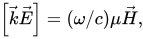
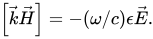
Such media are accordingly called «right-handed».
Media in which and are simultaneously negative are called «left-handed». In such media the electric field , the magnetic field and the wave vector form a left-handed system of vectors.
In the English-language literature these materials may be called right- and left-handed materials, or RHM (right-handed) and LHM (left-handed) for short, respectively.
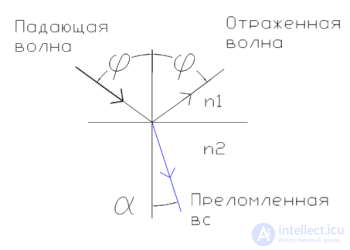
Light passing through the boundary between media in which both refractive indices are positive 

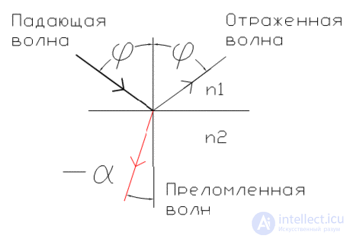
, while the other has a negative one 
The flux of energy carried by a wave is given by the Poynting vector  , which is equal to
 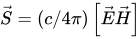 . The vector always forms a right-handed triple with the vectors and . Thus, for right-handed substances and point in the same direction, while for left-handed ones they point in opposite directions. Since the vector coincides in direction with the phase velocity, it follows that left-handed substances are substances with what is called a negative phase velocity. In other words, in left-handed substances the phase velocity is opposite to the energy flux. In such substances, for example, a reversed Doppler effect and backward waves are observed.
The existence of a negative refractive index in a medium is possible only if the medium has frequency dispersion. If  and
and  simultaneously, then the wave energy
  would be negative(!). The only way to avoid this contradiction is for the medium to have frequency dispersion
  and
and  .
.
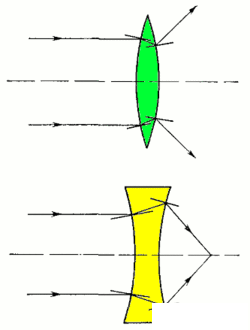
A biconvex lens made of a material with a negative refractive index defocuses light, while a biconcave one focuses it.
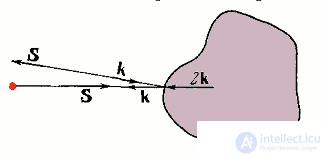
 from an ideally reflecting surface. Upon reflection from the body, the light ray's momentum increases by
  , (N being the number of incident photons). Radiation pressure exerted by light on absorbing right-handed media is replaced by attraction in a left-handed medium.
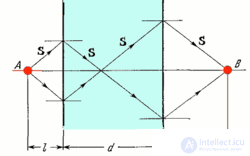
John Pendry and his colleagues, writing in Physical Review Letters, argue that in materials with a negative refractive index it is possible to overcome the diffraction resolution limit of conventional optics. In a right-handed medium, the image space of a lens is not identical to the object itself, since it is formed without evanescent waves. In a left-handed medium, evanescent waves do not decay — on the contrary, their amplitude increases with distance from the object — so the image is formed with the participation of evanescent waves, which can make it possible to obtain images with resolution better than the diffraction limit.
The first experimentally demonstrated superlens with a negative refractive index had a resolution three times better than the diffraction limit. The experiment was carried out at microwave frequencies . A superlens in the optical range was realized in 2005 . This was a lens that did not use negative refraction, but instead used a thin layer of silver to amplify the evanescent waves.
The latest advances in the development of superlenses are presented in a review in C&EN. To create a superlens, alternating layers of silver and magnesium fluoride are deposited on a substrate, on which a nanograting is then cut. This produces a three-dimensional composite structure with a negative refractive index in the near-infrared region. In the second case, the metamaterial was created using nanowires electrochemically grown on a porous aluminum oxide surface.
In early 2007, it was announced that a metamaterial with a negative refractive index in the visible range had been created. The material's refractive index at a wavelength of 780 nm was −0.6.
The two-dimensional analog of metamaterials is metasurfaces. Metasurfaces are especially well suited to controlling light, since their losses are generally lower than those of bulk metamaterials, and they are simpler to fabricate.
A metasurface used as a lens for light is called a metalens. It is small in size, flat in shape, no more than a micrometer thick, and covered with nanostructures in the form of protrusions or holes.
It has been announced that a metamaterial with a negative refractive index in the visible range has been created that is capable of concealing a three-dimensional object. The material consists of gold nanoantennas on a substrate of gold and magnesium fluoride. Using metamaterials to create camouflage smart clothing for military purposes is more promising than alternative approaches.
Because metamaterials have a negative refractive index, they are ideal for concealing objects, since they cannot be detected by radio-reconnaissance means. Nevertheless, existing metamaterials only approximate a negative refractive index in a first approximation, which leads to significant secondary re-radiation.
Interest in using metamaterials in radio-engineering applications, and in antenna engineering in particular, is growing considerably. Their main areas of application are: fabricating substrates and radiating elements in printed antennas to achieve wide bandwidth and reduce the size of antenna elements; compensating the reactance of electrically small antennas over a wide frequency band, including bands exceeding the Chu fundamental limit; achieving narrow spatial directivity of elementary radiators embedded in a metamedium; fabricating surface-wave antennas; reducing mutual coupling between elements of antenna arrays, including in MIMO devices; and matching horn antennas and other antenna types.
The earliest work in this direction dates back to the 19th century. In 1898, Jagadish Chandra Bose conducted the first microwave experiment investigating the polarization properties of curved-configuration structures he had created . In 1914, Lindman experimented on artificial media consisting of a large number of randomly oriented small wires twisted into helices and embedded in a medium that held them fixed . In 1946–1948, Winston E. Kock was the first to create microwave lenses using conducting spheres, discs and periodically arranged metal strips, which in effect formed an artificial medium with a specific effective refractive index . A detailed account of the history of the subject can be found in the work of V. M. Agranovich and Yu. N. Gartstein, as well as in the publications of Vadim Slyusar . In most cases, the history of materials with a negative refractive index begins with a mention of the work of the Soviet physicist Victor Veselago, published in the journal «Uspekhi Fizicheskikh Nauk» in 1967. The article discussed the possibility of a material with a negative refractive index, which was called «left-handed». The author concluded that with such a material almost all known optical wave-propagation phenomena would change substantially, although at that time materials with a negative refractive index were not yet known. Here, however, it should be noted that in fact such «left-handed» media had been discussed considerably earlier, in the work of Sivukhin and in the articles of Pafomov.
In recent years there has been intensive research into phenomena associated with negative refractive index. The reason for this surge of interest was the emergence of a new class of artificially engineered materials with a special structure, known as metamaterials. The electromagnetic properties of metamaterials are determined by the elements of their internal structure, arranged according to a specific pattern at the microscopic level. This makes it possible to tailor the properties of these materials so that they exhibit a wider range of electromagnetic characteristics, including a negative refractive index.
Veselago predicted that certain optical phenomena would be completely different in materials with a negative refractive index. Perhaps the most striking of these is refraction — the bending of an electromagnetic wave as it crosses the boundary between two media. Under normal conditions, the wave emerges on the opposite side of the line running perpendicular to this boundary (the surface normal). However, if one material has a positive refractive index and the other — a negative one, the wave will emerge on the same side of the surface normal as the incoming wave. Another distinctive property of metamaterials is strong dispersion.
Examples of metamaterials with unusual mechanical properties include auxetics (materials with a negative Poisson's ratio) based on an "inverted honeycomb" structure, and layered materials that, with a special selection of layer properties, exhibit a negative coefficient of expansion across the layers.
Mechanical metamaterials are rationally engineered artificial materials/structures with precise geometric arrangements that give rise to unusual physical and mechanical properties. These unprecedented properties often stem from their unique internal structures rather than from the materials they are made of. Inspiration for designing mechanical metamaterials frequently comes from biological materials (such as honeycombs and cells), from the molecular and crystalline structures of unit cells, and from the artistic fields of origami and kirigami. Whereas early mechanical metamaterials featured regular repetitions of simple unit-cell structures, increasingly complex building blocks and architectures are now being studied. Mechanical metamaterials can be regarded as an analogue of the well-known family of optical metamaterials and electromagnetic metamaterials. Mechanical properties, including elasticity, viscoelasticity and thermoelasticity, are central to the design of mechanical metamaterials. They are also often called elastic metamaterials or elastodynamic metamaterials. Their mechanical properties can be engineered to have values not found in nature, such as negative stiffness, negative Poisson's ratio, negative compressibility and a vanishing shear modulus. In addition to classical mechanical metamaterials, there is growing interest in active mechanical metamaterials with expanded functionality. These enable «intelligent mechanical metamaterials», which are programmable material systems capable of sensing, harvesting energy, actuating, communicating and processing information, interacting with the environment, optimizing their response, and creating a «sense–decide–react» cycle .
Acoustic metamaterials control, guide and manipulate sound in the form of audible, infrasonic or ultrasonic waves in gases, liquids and solids. Like electromagnetic waves, sound waves can exhibit negative refraction.
Control of sound waves is achieved primarily through the bulk modulus β, the mass density ρ, and chirality. The bulk modulus and density are analogous to permittivity and permeability in electromagnetic metamaterials. Related to this is the mechanics of sound-wave propagation in a lattice structure. These materials also have mass and an inherent degree of stiffness. Together they form a resonant system, and mechanical (acoustic) resonance can be excited by appropriate acoustic frequencies (for example, sound pulses).
Structural metamaterials are a type of mechanical metamaterial that provide properties such as crushability and lightweight characteristics. Using projection microstereolithography, microlattices can be fabricated with shapes very similar to trusses and beams. Materials have been created that are four orders of magnitude stiffer than conventional aerogel while having the same density. Such materials can withstand loads at least 160,000 times their own weight through excessive constraint of the material.
A ceramic nanolattice metamaterial can be flattened and returned to its original shape.
Materials found in nature are typically thermally isotropic when homogeneous. That is, heat passes through them at roughly the same rate in all directions. Thermal metamaterials, however, are usually anisotropic because of their highly organized internal structure. Composite materials with highly ordered internal particles or structures, such as fibers and carbon nanotubes (CNTs), are examples of this.
Metamaterials can be fabricated that incorporate some form of nonlinear medium whose properties change with the power of the incident wave. Nonlinear media are essential for nonlinear optics. Most optical materials have a relatively weak response, meaning their properties change only slightly even under large variations in electromagnetic field intensity. The local electromagnetic fields of inclusions in nonlinear metamaterials can be much larger than the average field value. In addition, remarkable nonlinear effects have been predicted and observed when the effective permittivity of the metamaterial is very small (an epsilon-near-zero medium). Moreover, exotic properties such as a negative refractive index create opportunities for tuning the phase-matching conditions that must be satisfied in any nonlinear optical structure.
Metafluids offer programmable properties such as viscosity, compressibility and optics. One approach used air-filled elastomeric spheres 50-500 microns in diameter suspended in silicone oil. The spheres compress under pressure and recover their shape when the pressure is released. Their properties differ between these two states. Without pressure they scatter light, making them opaque. Under pressure they collapse into crescent shapes, focusing light and becoming transparent. Their response to pressure can allow them to act as a sensor or as a dynamic hydraulic fluid. Like cornstarch, such a fluid can behave as either a Newtonian or a non-Newtonian fluid. Under pressure it becomes non-Newtonian — that is, its viscosity changes in response to shear force.
In 2009, Marc Briane and Graeme Milton mathematically proved that it is in principle possible to invert the sign of a 3D composite based on three materials made only from constituents with either a positive or a negative Hall coefficient. Later, in 2015, Muamer Kadic et al. showed that simple perforation of an isotropic material can change the sign of the Hall coefficient. This theoretical claim was ultimately demonstrated experimentally by Christian Kern et al.
In 2015, Christian Kern et al. also demonstrated that anisotropic perforation of a single material can lead to an even more unusual effect, namely the parallel Hall effect. This means that the induced electric field inside a conducting medium is no longer orthogonal to the current and the magnetic field, but is in fact parallel to them.
Meta-biomaterials are a type of mechanical metamaterial specifically designed to interact with biological systems, combining principles from both metamaterial science and the biological disciplines. Engineered at the nanoscale, these materials skillfully manipulate electromagnetic, acoustic or thermal properties to facilitate biological processes. Through careful tuning of their structure and composition, meta-biomaterials promise to advance a range of biomedical technologies, such as medical imaging, drug delivery, and tissue engineering. This underscores the importance of understanding biological systems through the interdisciplinary lens of materials science.

Comments