
Lecture 6 min.
The central concepts of the course in automatic control theory are the concepts of control and of a control system.
Control is a purposeful action on an object (a controlled process) that leads to a specified change (or maintenance) of its state.
A complex (system) of interconnected elements participating in the control process is called a control system.
The concepts introduced are illustrated in Fig. V.1, which presents the main elements (blocks) of the system, showing the nature of their interaction in the process of controlling the object.
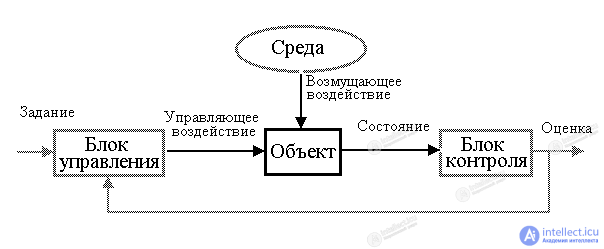
Fig. V.1. Control system
The following types of objects and controlled processes are distinguished:
The state of an object is characterized by certain quantitative values that change over time, i.e. state variables (see item 3.1.1). In natural processes, such variables may be temperature, density, or the content of a particular substance in an organism or in the environment, the volume of output, the price of securities, etc. For technical objects, these are mechanical displacements (angular or linear) and their velocities, electrical variables, temperatures and concentrations of substances, etc.
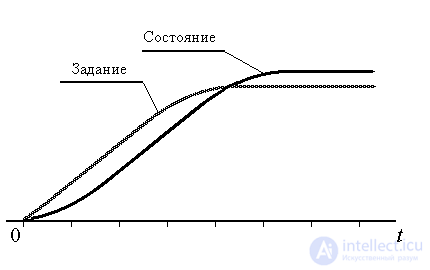
Fig. V.2. Purposeful change of state
The goal of control is to change the state of an object in accordance with a specified law (the reference input, Fig. V.2). Such a change occurs as a result of the action of external factors, among which are distinguished
Physically, control of an object is realized by means of control blocks and monitoring blocks, while disturbing actions result from the influence of the external environment. All these blocks together form the control system.
The monitoring block is a complex of means involved in evaluating (identifying) the state of the controlled process and/or the external environment. Such means include
A complex of interconnected elements participating in evaluating the state of the object (the object, the monitoring block, and the external environment) is called a monitoring system. The latter can be regarded as an independent system and, at the same time, is a necessary integral part of the control system.
The control block is a complex of factors that exert a control action on the object, taking into account the task and information about the current state of the object (the estimate). The main functions of this block reduce to information processing, i.e. they are computational in nature. The control blocks of natural and technical systems can include:
Depending on the nature of the controlled objects and other elements of the system, one can distinguish biological, ecological, economic and technical control systems. These are systems for stabilizing the temperature of living organisms and focusing the organs of vision; stabilizing the concentration of substances in organisms and of gases in the atmosphere, systems for managing trading enterprises, stabilizing securities prices, and regulating supply and demand. As examples of technical systems of various complexity levels, one can cite:
The main subject of automatic control theory is automatic control systems, automatic monitoring systems, and, in part, automated systems.
Automatic control systems (ACS) and automatic monitoring are technical and natural systems that perform their functions automatically, i.e. without the conscious participation of a human.
An automated system is a system, part of whose functions is performed automatically and part by an operator (organizer).

Comments