
Lecture 9 min.
Over-the-horizon radar (OTH radar; Russian abbreviation ZGRLS; also OTHR) is a radar that surveils airspace at long distances, up to thousands of km ("over the horizon"). Several OTH radar systems were built in the 1950s and 1960s as part of missile attack warning systems.
An over-the-horizon radar (OTH radar) is a high-precision radar system designed to detect, track, and determine the coordinates of airborne objects located beyond the horizon, that is, beyond the curvature of the Earth. These stations are an important element of early warning and air surveillance systems in various fields, such as civil and military aviation, detection and tracking of ballistic missiles, counterterrorism activities, and others.
The main characteristics of OTH radars include:
Detection range: OTH radars are capable of detecting airborne objects at long distances, even when they are beyond the curvature of the Earth.
High accuracy: OTH radar systems provide high accuracy in measuring the coordinates and parameters of airborne objects.
High throughput: OTH radars can simultaneously detect and track many airborne targets.
Operation in electromagnetic interference conditions: OTH radars are resistant to various kinds of electromagnetic interference and can operate under electronic warfare conditions.
Automated control: Modern OTH radars are often equipped with automated control systems, which ease the work of operators and improve system efficiency.
VHF and microwave radio waves suitable for radar cannot bend around the curvature of the planet's surface by diffraction. Because of this, the range of conventional radars is limited by the radio horizon (such radars are sometimes called over-the-horizon-limited or line-of-sight radars). For example, for a radar mounted on a 10-meter mast, the horizon is about 13 km (taking atmospheric refraction into account). For targets located at some altitude above the ground, the radar range increases; for example, a target at an altitude of 10 meters will be detected by the same radar at a distance of about 26 km. In practice, ground-based line-of-sight radars are designed to detect atmospheric targets at distances of no more than a few hundred kilometers. Over-the-horizon radars use several technologies to detect targets beyond the radio horizon, which makes them particularly effective as radars in missile attack warning systems.
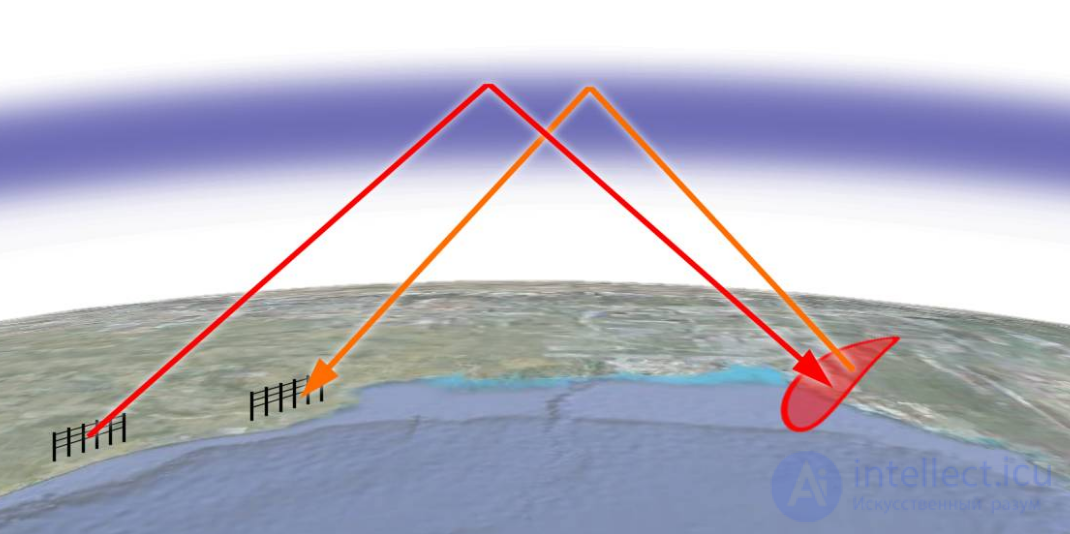 Operating principle of OTH-B over-the-horizon radars. The diagram shows ionospheric reflection of rays from the ionosphere (the region of the Earth's atmosphere at altitudes of 60-150 km).
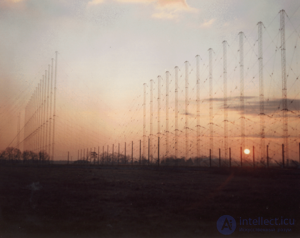
US Navy radar "Relocatable Over-the-Horizon Radar" (ROTHR)
Most often, over-the-horizon radars use the effect of reflection of short radio waves (3 to 30 MHz; decameter waves) from the ionosphere. Such radars are called sky-wave OTH radars. For given atmospheric conditions, part of the radio signals radiated into the ionosphere is reflected and changes direction. Upon reaching the ground, the reflected radio signals are scattered, and a small fraction of them may be reflected from the ionosphere in a similar manner and return to the radar. Depending on the state of the atmosphere, only part of the short-wave band will be reflected, so an OTH radar requires constant monitoring of the state of the ionosphere and frequency adjustment. Because of significant signal losses during propagation, OTH radars hardly developed until the 1960s, when low-noise amplifiers began to be mass-produced. There is also the problem of "dead zones" (skip zones), which make OTH radars ineffective at short distances.
Since the signal reflected from the surface (land or water) is considerably stronger than the signal reflected from the target, OTH radars use systems that make it possible to extract the useful signal. The simplest systems use the Doppler effect, in which a moving object changes the frequency of the reflected radio waves. By filtering the received signal against the original frequency, the radar can extract moving targets. This principle is used in almost all radars (including line-of-sight ones), but in the case of over-the-horizon radar it is considerably complicated by the motion of the ionosphere itself.
"Multi-hop" over-the-horizon radar is sometimes used, in which the radio signal is reflected several times from the ionosphere and the ground.
There are also OTH radars that use the effect of the surface electromagnetic wave (SEW, ground wave), which propagates along the water surface at distances of up to 200—400 km. Such radars operate at frequencies from 3 to 18 MHz and are often implemented as a bistatic radar. They are used to monitor coastal areas, including 200-mile exclusive economic zones, and to study meteorological conditions.
In 1946, the Soviet scientist and designer Nikolay Kabanov proposed the idea of early (over-the-horizon) detection of aircraft in the short-wave band at distances of up to 3000 kilometers. He discovered that probing rays with a wavelength of 10-100 m can, after reflection from the ionosphere, illuminate a target and return along the same path to the radar.
Currently in Russia there are two main organizations developing OTH radars: the Scientific Research Institute of Long-Distance Radio Communications (NIIDAR) and the A. A. Raspletin Scientific Research Institute of Radiophysics (NII RF) (now JSC "Radiofizika".
It is reported that China operates a number of OTH-B and OTH-SW radars. However, data transmission from these radars creates serious interference for other internationally licensed users.
On Google Maps one can find one set of Chinese OTH-B radars, both the transmitter and the receiver .
Iran is working on an OTH radar called "Sepehr" with a range of 3000 kilometers. It is currently in operation.
The OTH 0100 radar is capable of monitoring ships at a distance of more than 200 miles (370 km) from the coast, which exceeds the line of sight of conventional radars.
India has developed many long-range and short-range radars. Although it does not currently have an operational over-the-horizon radar, the Indian Swordfish long-range tracking radar, part of India's ballistic missile defense system, has a maximum range of 800 kilometers and is currently being upgraded to 1,500 kilometers.
LRDE DRDO is working on a prototype OTH radar. The system design work has already been completed, and the OTH prototype is expected to be built by the end of 2021. The prototype will have two different types of arrays and will itself determine the best frequency for tracking objects. It is expected that, after successful testing of the existing system, India will develop a large OTH radar based on the same design.
Another common application of over-the-horizon radar uses surface waves, also known as ground waves. Ground waves provide a method of propagation for medium-wave AM broadcasting at frequencies below 1.6 MHz and for other transmissions at lower frequencies. Ground-wave propagation yields a signal that attenuates rapidly with increasing distance above the ground, and many such broadcast stations have a limited range. However, seawater, with its high conductivity, supports ground waves at distances of up to 100 kilometers (62 miles) or more. This type of radar, surface-wave OTH radar, is used for surveillance and most often operates in the range from 4 to 20 MHz. Lower frequencies propagate better but give poorer radar reflection from small targets, so there is usually an optimal frequency that depends on the type of target.
Another approach to over-the-horizon radar is to use creeping waves, or electromagnetic surface waves, at much lower frequencies. Creeping waves are scattering at the rear of an object due to diffraction , which, for example, is the reason why both ears can hear a sound coming from one side of the head, and why in the early stages of the development of communications and broadcasting. In the radar role, the creeping waves in question diffract around the Earth, although processing the returned signal is difficult. The development of such systems became practical in the late 1980s because of the rapidly growing available computing power. Such systems are known as OTH-SW , which stands for "Surface Wave" .
The first deployed OTH-SW system was apparently a Soviet system designed to monitor traffic in the Sea of Japan . A new system was recently used to monitor coastal areas in Canada and is currently being offered for sale by Maerospace. Australia has also deployed a high-frequency surface-wave radar.
OTH radars can be used for both civil and military purposes. For example, in civil aviation they help to track and manage long-haul flight traffic, while in military applications they play an important role in air defense systems and in missile launch early warning systems.

Comments