The basic radar equation, which relates the received signal power to the range to the target. This equation can be represented as follows:
- For active monostatic radars (with a shared transmitting and receiving antenna):
The received signal power (Pr) is inversely proportional to the fourth power of the range (R) to the target:
Pr ~ 1 / R4
This means that as the range to the target increases, the received signal power drops sharply, which makes detecting distant targets difficult.
- For passive radars:
The received signal power (Pr) is inversely proportional to the square of the range (R) to the target:
Pr ~ 1 / R2
In passive radars, which rely on receiving signals emitted by the target or by other sources, the power decreases with range less steeply than in active radars. Nevertheless, even here the signal power decreases as the distance from the target grows.
These equations serve as the basis for understanding the limitations of radar and its range in various types of radars.
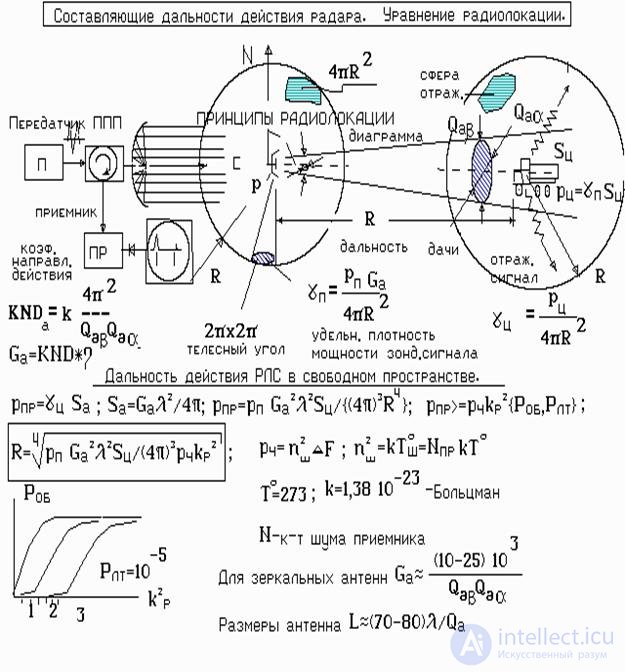
The transmitter radiates some microwave power into space pt. If the antenna is omnidirectional, then all the power is distributed over a sphere of radius R. The power arriving at 1 m2 of the sphere's area is called the power flux density gt. If an antenna reflector is placed at the point of radiation, the power flux density increases by a factor equal to the antenna gain Ga .
A target moving at range R from the radar intercepts some power ptg. Its magnitude is equal to the flux density multiplied by the target RCS σ.
In turn, the target re-radiates the intercepted power diffusely in all directions of space, including toward the radar. The power flux density of the signal from the target at the radar antennagtg is calculated similarly togt. Only that part of the power which is intercepted by the antenna area Sa. is received. But the antenna area is related to its gain Ga and the wavelength λ. Taking the above considerations into account, the power of the reflected signal at the receiver input can be calculated pr. The final formula is the first form of the radar equation.
The first form of the radar equation makes it possible to calculate the power of the reflected signal. However, it does not allow the radar range to be calculated, since it does not take into account the internal noise power of the receiving path. It is known from the previous lecture that a reflected signal can be detected with certain probabilities of correct detection Pd and false alarm Pfa. For the calculation, one needs to know the noise and signal powers and the threshold level in the automatic detector. As shown earlier, it is sufficient to know their values at the receiver input. How to calculate the noise level referred to the receiver input was given in the previous lecture. The calculated noise power at the receiver input can be interpreted as its "technical" sensitivity ps.
A specific design of the automatic detector is not always needed. To simplify the calculation, the concept of a generalized receiver with an automatic detector is introduced, in which the threshold level is optimized for the given probabilities of detection and false alarm. For given values of Pfa curves of Pd versus signal-to-noise ratio have been plotted. This ratio is often called the "discernibility factor" kd The resulting family of curves is called the "operating characteristics" of the generalized receiver. From the given Pd and Pfa and the curves of the generalized receiver, the discernibility factor can be found kd .
Now we have taken into account the receiver's internal noise at the input and know that the signal must exceed it by a factor of kd so that it can be detected with the given probabilities.
Solving the first radar equation for R, and taking the above considerations into account, one can obtain the second form of the radar equation for calculating the radar range.
Received power
The power of the received echo of the radio signal is given by the equation:

Notation:
- Pr — signal power at the receiving antenna;
- Pt — radio transmitter power;
- Gt — transmitting antenna gain;
- Ar (sometimes S) — effective area (aperture) of the receiving antenna, Ar = Gr*λ²/4π, where Gr — receiving antenna gain, λ — wavelength.
- σ — radar cross section of the target at the given aspect angle;
- F — propagation loss factor;
- Rt — distance from the transmitting antenna to the target;
- Rr — distance from the target to the receiving antenna.
When the transmitting and receiving antennas are at the same distance from the target, that is, in all monostatic radars (single-site radar systems) and sometimes in other types, the formula simplifies because Rt = Rr = R, which leads to a factor of R4:
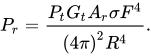
Thus, the received power decreases in proportion to the fourth power of the range.
The factor F can be taken equal to 1 if the wave is assumed to propagate in vacuum without losses and without interference.
Minimum receiver sensitivity
The minimum power at which the receiver can detect a signal reflected from the target is given by the formula

- k — Boltzmann constant;
- T — absolute temperature of the receiver;
- Δfr — receiver bandwidth;
- kn — receiver noise factor;
- kd — discernibility factor (the signal-to-noise energy ratio at the receiver input at which signals with the specified parameters are received).
Range of a radar with a passive response
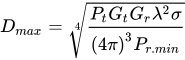 ,
,
where:
 — transmitter power;
 — antenna gain on transmission;
— antenna gain on reception;
 — wavelength;
 — radar cross section of the target;
 — minimum sensitivity of the receiver.
Range of a radar with an active response
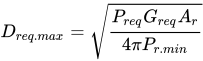
The active response comes from a radar transponder (repeater) installed on the target.
Maximum range on the interrogation channel
Maximum range on the response channel
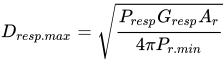
With an active response, the range enters the formulas with an exponent of 2 rather than 4, because the transponder power is fixed and does not depend on the power of the radar radiation incident on the "target". In the case of a passive response, the target, according to the Huygens-Fresnel principle, acts as a secondary re-radiator whose power is directly proportional to the radar radiation incident on it. Thus, in passive radar the signal from the radar transmitter is attenuated on its way to the target by a factor of  , is reflected, and then on its way from the target to the radar receiver is attenuated by a further factor of 2
 . The result is a factor
  , and when Rt = Rr = R, this factor equals
  .
.
The radar equation for narrowband signals
By the radar equation for narrowband signals we mean a relation of the form
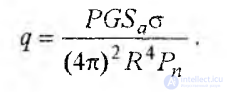
Here q is the signal-to-noise ratio at the receiver input;
P is the radiated signal power;
G is the transmitting antenna gain;
Sa is the effective area of the receiving antenna;
σ is the radar cross section (RCS) of the target;
R is the radar observation range;
Pn is the noise power at the receiver input
See also


Comments