
Lecture
Dye-sensitized solar cells — are photoelectrochemical cells that use photosensitive mesoporous oxide semiconductors with a wide bandgap. These cells were invented in 1991 by Grätzel et al., after whom they were named Grätzel cells.
Solar cells of this type are promising because they are made of cheap materials and do not require complex equipment in production. The cells have a simple structure, consisting of two electrodes and an iodine-containing electrolyte. One electrode consists of highly porous dye-saturated titanium dioxide (TiO2), deposited on a transparent electrically conductive substrate. The other electrode is simply a transparent electrically conductive substrate. The operation of the cell is often compared to photosynthesis, since both processes use a redox reaction taking place in the electrolyte. The energy conversion efficiency of the cell has not yet reached the level of silicon solar cells. Currently it is about 10%. Theoretically it is possible to reach a level of 33%.
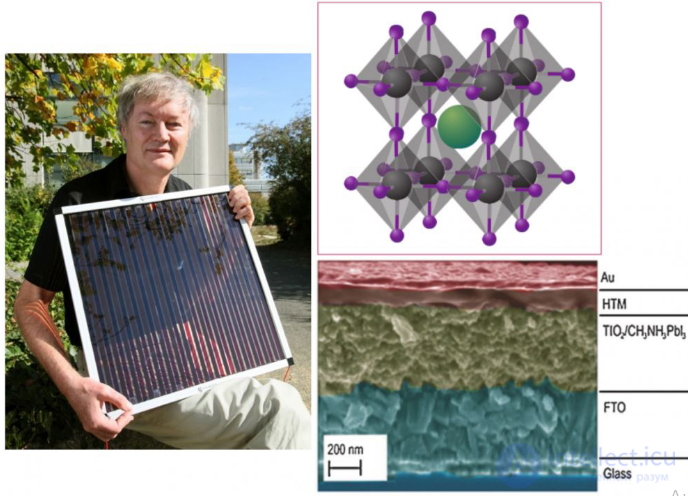
It is based on a semiconductor formed between a photosensitive anode and an electrolyte, a photoelectrochemical system. The modern version of the dye-colored solar cell, also known as the Grätzel cell, was originally invented in 1988 by Brian O'Regan and Michael Grätzel at the University of California, Berkeley [3]. And this work was later developed by the aforementioned scientists at the Fédérale de Lausanne Polytechnic School before the publication of the first high-efficiency DSSC in 1991. [4] Michael Grätzel was awarded the Millennium Technology Prize for this invention in 2010. [5]
DSSC has a number of attractive features; It is simple to manufacture using traditional roll printing technologies, is semi-flexible and semi-transparent, which offers many applications not applicable to glass-based systems, and most of the materials used are inexpensive. In practice, it has proven difficult to eliminate a number of expensive materials, in particular platinum and ruthenium, and the liquid electrolyte poses a serious problem for creating a cell suitable for use in any weather conditions. Although its conversion efficiency is lower than that of the best thin-film cells, theoretically the price/quality ratio should be good enough to allow them to compete with electricity generation from fossil fuels by achieving grid parity. Commercial applications, which were suspended due to chemical stability problems, [6], according to the forecast in the European Union's « Photovoltaic Systems Roadmap», will make a significant contribution to the production of electricity from renewable sources by 2020.
In a traditional solid-state semiconductor, a solar cell is made of two doped crystals, one doped with n-type impurities (n-type semiconductor), which add an additional band of free conduction electrons, and the other doped with p-type impurities (p-type semiconductor), which adds additional electron holes. Upon contact, some of the electrons in the n-type part flow into the p-type to «fill» the missing electrons, also known as electron holes. Eventually, enough electrons will flow across the boundary to align the Fermi levels of the two materials. The result is a region at the interface, the pn-junction, where charge carriers are depleted and/or accumulated on each side of the interface. In silicon, this transfer of electrons creates a potential barrier of approximately 0.6 to 0.7 V. [7]
When placed in the sun, photons of sunlight can excite electrons on the p-type side of the semiconductor, a process known as photoexcitation. In silicon, sunlight can provide enough energy to push an electron from the lower-energy valence band into the higher-energy conduction band. As the name suggests, electrons in the conduction band can move freely through the silicon. When a load is placed across the cell as a whole, these electrons will flow out of the p-type side toward the n-type side, lose energy as they move through the external circuit, and then return back into the p-type material, where they can recombine with the hole in the valence band that they left behind. Thus, sunlight creates an electric current.[7]
In any semiconductor, the bandgap width means that only photons with that amount of energy or more will contribute to current generation. In the case of silicon, most of the visible light from red to violet has enough energy for this to happen. Unfortunately, photons with higher energy, those at the blue and violet ends of the spectrum, have more than enough energy to cross the bandgap; although some of this extra energy is transferred to the electrons, most of it is lost as heat. Another problem is that in order to have a reasonable probability of capturing a photon, the n-type layer must be thick enough. This also increases the likelihood that a freshly emitted electron will meet a previously created hole in the material before it reaches the pn-junction. These effects give an upper limit to the efficiency of silicon solar cells,[8] see the Shockley – Queisser limit.).
Undoubtedly the biggest problem with the traditional approach is cost; solar cells require a relatively thick layer of doped silicon to have reasonable photon capture rates, and processing silicon is expensive. Over the last decade there has been a whole range of different approaches to reducing these costs, in particular thin-film approaches, but to date their application is limited due to a host of practical problems. Another line of research is to significantly increase efficiency using a multi-junction approach, although these cells are very expensive and are only suitable for large commercial deployments. Broadly speaking, the types of cells suitable for rooftop deployment have not changed significantly in efficiency, although costs have decreased somewhat due to increased supply.
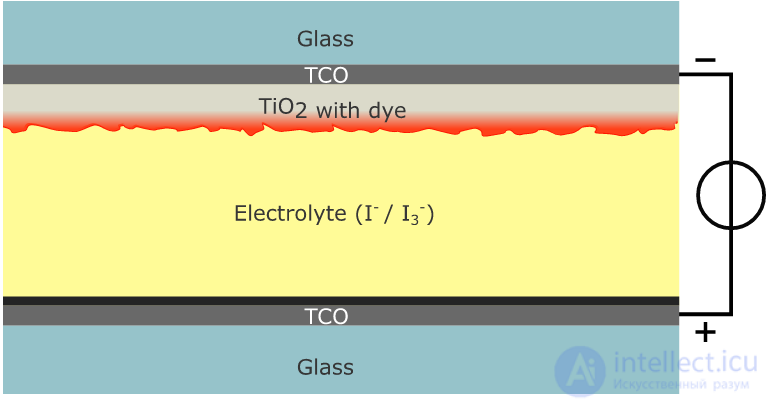
A type of cell made at EPFL by Grätzel and O'Regan
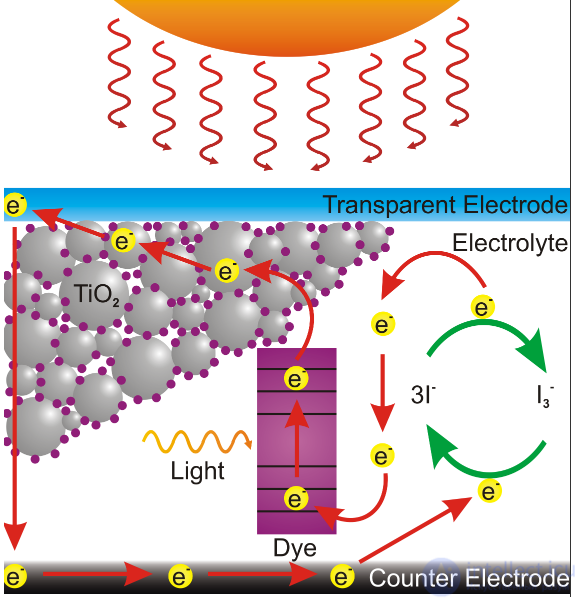
Operating principle of the Grätzel cell.
In the late 1960s it was discovered that illuminated organic dyes could generate electricity on oxide electrodes in electrochemical cells. [9] In an attempt to understand and model the primary processes in photosynthesis, this phenomenon was studied at the University of California, Berkeley with chlorophyll extracted from spinach (a bio-mimetic or bionic approach). [10] Based on such experiments, the generation of electricity by the principle of dye sensitization (DSSC) was demonstrated and discussed in 1972. [11] The instability of the solar cell dye was identified as the main problem. Its efficiency could be improved over the following two decades by optimizing the porosity of the electrode prepared from a finely divided oxide powder, but instability remained a problem. [12]
A modern DSSC consists of a porous layer of titanium dioxide nanoparticles coated with a molecular dye that absorbs sunlight, like chlorophyll in green leaves. The titanium dioxide is immersed in an electrolyte solution, above which is a platinum-based catalyst. As in a conventional alkaline battery, the anode (titanium dioxide) and cathode (platinum) are located on either side of a liquid conductor (the electrolyte).
Sunlight passes through the transparent electrode into the dye layer, where it can excite electrons, which then enter the titanium dioxide. The electrons flow to the transparent electrode, where they are collected to power the load. After passing through the external circuit, they are reintroduced into the cell at the metal electrode on the back wall, entering the electrolyte. The electrolyte then carries the electrons back to the dye molecules.
Dye-sensitized solar cells separate two functions provided by silicon in a traditional cell design. Normally silicon acts as the source of photoelectrons and also provides the electric field for charge separation and current generation. In a dye-sensitized solar cell, the bulk of the semiconductor is used exclusively for charge transport, while the photoelectrons are supplied by a separate light-sensitive dye. Charge separation occurs at the surfaces between the dye, the semiconductor, and the electrolyte.
Dye molecules are quite small (nanometer-sized), so in order to capture enough of the incoming light, the layer of dye molecules must be made thick enough, much thicker than the molecules themselves. To solve this problem, a nanomaterial is used as a scaffold to hold a large number of dye molecules in a three-dimensional matrix, increasing the number of molecules for any given cell surface area. In existing designs this scaffold is provided by the semiconductor material, which performs a dual function.
In the case of the original design by Grätzel and O'Regan, the cell consists of 3 main parts. On top is a transparent anode of fluoride-doped tin dioxide (SnO 2 : F), deposited on the back side of a (usually glass) plate. On the reverse side of this conductive plate is a thin layer of titanium dioxide (TiO 2 ), which is turned into a highly porous structure with an extremely large surface area. (TiO 2 ) is chemically bonded by a process called sintering. TiO 2 absorbs only a small fraction of solar photons (those in the UV). [13] The plate is then immersed in a mixture of a light-sensitive ruthenium-polypyridyl dye (also called a molecular sensitizer [13] ) and a solvent. After soaking the film in the dye solution, a thin layer of dye remains covalently bonded to the surface of the TiO 2 . The bond is an ester, chelate, or bidentate bridging bond.
A separate plate is then made with a thin layer of iodide electrolyte spread over a conductive sheet, usually metallic platinum. The two plates are then joined and sealed to prevent electrolyte leakage. The construction is simple enough that there are hobby kits for making them by hand. [14] Although they use a number of "advanced" materials, they are inexpensive compared to the silicon required for normal cells, because they do not require costly manufacturing steps. For example, TiO 2 is already widely used as a base for paint.
One of the efficient DSSC devices uses a molecular dye based on ruthenium, for example [Ru (4,4'-dicarboxy-2,2'-bipyridine) 2 (NCS) 2 ] (N3), which is bound to the photoanode through carboxylate groups. The photoanode consists of a 12 µm thick film of transparent TiO 2 nanoparticles 10–20 nm in diameter, covered by a 4 µm thick film consisting of much larger particles (400 nm in diameter), which scatter photons back into the transparent film. The excited dye rapidly injects an electron into the TiO 2 after absorbing light. The injected electron diffuses through the network of sintered particles, collecting at the transparent conducting oxide (TCO) electrode on the front side, while the dye regenerates by reduction with the help of a redox shuttle, I 3 - / I- , dissolved in the solution. Diffusion of the oxidized form of the shuttle to the counter electrode completes the circuit. [15]
The following steps convert photons (light) into current in a DSSC:
2 The photosensitizers are excited from the ground state (S) to the excited state (S ∗ ). The excited electrons are injected into the conduction band of the TiO 2 electrode. This leads to oxidation of the photosensitizer (S + ).
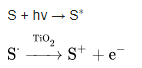
3 The injected electrons in the conduction band of TiO 2 are transported between TiO 2 nanoparticles by diffusion toward the back contact (TCO). The electrons finally reach the counter electrode through the circuit.
4 The oxidized photosensitizer (S + ) accepts electrons from the redox mediator I - ions, which leads to regeneration of the ground state (S), and two I - ions are oxidized to elemental iodine, which reacts with I - to form the oxidized state, I 3 - .

5 The oxidized redox mediator, I 3 - , diffuses to the counter electrode and is then reduced back to I - ions.

The efficiency of a DSSC depends on four energy levels of the component: the excited state (approximately the LUMO) and ground state (HOMO) of the photosensitizer, the Fermi level of the TiO 2 electrode, and the redox potential of the mediator (I - / I 3 - ) in the electrolyte. [16]
In DSSCs the electrodes were composed of sintered semiconductor nanoparticles, mainly TiO 2 or ZnO. These nanoparticle DSSCs rely on trap-limited diffusion through the semiconductor nanoparticles for electron transport. This limits the efficiency of the device, since it is a slow transport mechanism. Recombination occurs more often at longer emission wavelengths. In addition, sintering the nanoparticles requires a high temperature of about 450 ° C, which limits the fabrication of these cells to durable, rigid, solid substrates. It has been shown that the efficiency of a DSSC increases if the sintered-nanoparticle electrode is replaced with a specially designed electrode possessing an exotic «nanoplant-like» morphology. [17]
Sunlight enters the cell through the transparent top contact SnO 2 : F, striking the dye on the surface of TiO 2 . Photons that hit the dye with enough energy to be absorbed create an excited state of the dye, from which an electron can be «injected» directly into the conduction band of TiO 2 . From there it moves by diffusion (as a result of the electron concentration gradient) to the transparent anode above.
Meanwhile, the dye molecule has lost an electron, and the molecule will decompose if another electron is not supplied. The dye strips an electron from iodide in the electrolyte below the TiO 2 , oxidizing it to triiodide. This reaction occurs quite quickly compared to the time it would take for the injected electron to recombine with the oxidized dye molecule, thereby preventing this recombination reaction, which would effectively short-circuit the solar cell.
The triiodide then recovers its missing electron by mechanical diffusion to the bottom of the cell, where the counter electrode reintroduces electrons after they have passed through the external circuit.
Several important measures are used to characterize solar cells. The most obvious is the total amount of electrical energy produced for a given amount of solar energy shining on the cell. Expressed as a percentage, this is known as solar conversion efficiency . Electrical power is the product of current and voltage, so the maximum values for these measurements are also important, J sc and V oc respectively. Finally, to understand the underlying physics, «quantum efficiency» is used to compare the probability that a single photon (of a given energy) will produce a single electron.
In terms of quantum efficiency, DSSCs are extremely efficient. Because of their "depth" in the nanostructure, there is a very high probability that a photon will be absorbed, and the dyes are very efficient at converting them into electrons. Most of the small losses that exist in DSSCs are due to conduction losses in the TiO 2 and the transparent electrode, or to optical losses in the front electrode. The overall quantum efficiency for green light is about 90%, with the «lost» 10% mainly explained by optical losses in the top electrode. The quantum efficiency of conventional designs varies depending on their thickness, but is roughly the same as that of DSSCs.
Theoretically, the maximum voltage produced by such a cell is simply the difference between ( quasi -) the Fermi level of TiO 2 and the redox potential of the electrolyte, about 0.7 V under conditions of solar illumination (V oc ). That is, if an illuminated DSSC is connected to a voltmeter in an «open circuit», it will show about 0.7 V. As for voltage, DSSCs offer a slightly higher V oc voltage than silicon, about 0.7 V compared to 0.6 V. This is a fairly small difference, so the real-world difference is dominated by the current output, J sc .
Although the dye is very efficient at converting absorbed photons into free electrons in the TiO 2 , only photons absorbed by the dye ultimately create current. The rate of photon absorption depends on the absorption spectrum of the sensitized TiO 2 layer and on the spectrum of the solar flux. The overlap between these two spectra determines the maximum possible photocurrent. Commonly used dye molecules typically have lower absorption in the red part of the spectrum compared to silicon, which means that fewer photons in sunlight are suitable for generating current. These factors limit the current generated in a DSSC; for comparison, traditional silicon-based solar cells offer about 35 mA/cm 2, whereas modern DSSCs offer about 20 mA/cm 2 .
The overall peak power conversion efficiency for modern DSSCs is about 11%. [18] [19] The current record for prototypes stands at 15%. [20] [21]
DSSCs degrade when exposed to ultraviolet radiation. In 2014, air infiltration of the commonly used amorphous hole-transport layer Spiro-MeOTAD was identified as the main cause of degradation, rather than oxidation. The damage can be avoided by adding an appropriate barrier. [22]
The barrier layer may include UV stabilizers and/or UV-absorbing luminescent chromophores (which emit at longer wavelengths that can be reabsorbed by the dye) and antioxidants to protect and improve the efficiency of the cell. [23]
Currently, DSSCs are the most efficient third-generation solar technology [24] (2005). Other thin-film technologies typically range from 5% to 13%, while traditional low-cost commercial silicon panels operate at 14% to 17%. This makes DSSCs attractive as a replacement for existing technologies in «low density» applications, such as rooftop solar collectors, where the mechanical strength and light weight of a glass-free collector are a major advantage. They may not be as attractive for large-scale deployments, where more expensive and more efficient cells are more viable, but even a small increase in DSSC conversion efficiency could make them suitable for some of these roles as well.
There is one more area where DSSCs are especially attractive. The process of electron injection directly into TiO 2 is qualitatively different from the process occurring in a traditional cell, where the electron is «promoted» within the host crystal. Theoretically, given low production rates, a high-energy electron in silicon can recombine with its own hole, emitting a photon (or another form of energy), which does not result in current generation. Although this particular case may not be common, an electron generated by another atom can quite easily combine with a hole left behind by a previous photoexcitation.
For comparison, the injection process used in a DSSC does not introduce a hole into TiO 2 , only an extra electron. Although it is energetically possible for the electron to recombine back into the dye, the rate at which this happens is quite slow compared to the rate at which the dye recovers an electron from the surrounding electrolyte. Recombination directly from TiO 2 to species in the electrolyte is also possible, although, again, for optimized devices this reaction is quite slow. [25] In contrast, electron transfer from the platinum-coated electrode to species in the electrolyte is necessarily very fast.
As a result of this favorable "differential kinetics", DSSCs work even under low-light conditions. Thus, DSSCs are able to operate under cloudy skies and without direct sunlight, whereas traditional designs will suffer from a «cutoff» at some lower illumination limit, when charge-carrier mobility is low and recombination becomes the dominant problem. The cutoff is so small that they are even proposed for indoor use, harvesting energy for small devices from light sources in the home. [26]
A practical advantage that DSSCs share with most thin-film technologies is that the mechanical strength of the cell indirectly leads to improved efficiency at higher temperatures. In any semiconductor, an increase in temperature will cause some electrons to enter the conduction band «mechanically». The fragility of traditional silicon cells requires them to be protected from the elements, usually by enclosing them in a glass box resembling a greenhouse, with a metal base for strength. Such systems experience a noticeable decrease in efficiency as the cells heat up inside. DSSCs are typically made with only a thin layer of conductive plastic on the front layer, which allows them to dissipate heat much more easily and, consequently, operate at lower internal temperatures.
The main drawback of the DSSC design is the use of a liquid electrolyte, which has problems with temperature stability. At low temperatures, the electrolyte can freeze, stopping power generation and potentially causing physical damage. Higher temperatures cause the liquid to expand, making sealing the panels a serious problem. Another drawback is that producing DSSCs requires expensive ruthenium (dye), platinum (catalyst), and conductive glass or plastic (contact). A third major drawback is that the electrolyte solution contains volatile organic compound (or VOC) solvents, which must be carefully sealed because they are hazardous to human health and the environment. This, together with the fact that solvents penetrate plastics, precludes the possibility of large-scale outdoor application and integration into a flexible structure. [27]
Replacing the liquid electrolyte with a solid substance has been a major ongoing area of research. Recent experiments using solidified molten salts have shown some promise, but currently they suffer from higher degradation during prolonged operation and are not flexible. [28]
Dye-sensitized solar cells operate as a photoanode (n-DSC), where the photocurrent arises from electron injection by the sensitizing dye. Photocathodes (p-DSC) operate in the opposite mode compared to conventional n-DSC, where excitation of the dye is accompanied by rapid electron transfer from the p-type semiconductor to the dye (hole injection into the dye-sensitized hole, instead of electron injection), Such p-DSC and n-DSC can be combined to create tandem solar cells (pn-DSC), and the theoretical efficiency of tandem DSCs is much higher than that of single-junction DSCs.
A standard tandem cell consists of one n-DSC and one p-DSC in a simple multilayer configuration with an intermediate electrolyte layer. The n-DSC and p-DSC are connected in series, which means the resulting photocurrent will be controlled by the weakest photoelectrode, while the photovoltages are additive. Thus, photocurrent matching is very important for building high-efficiency tandem pn-DSCs. However, unlike n-DSC, rapid charge recombination following the dye-sensitized hole usually resulted in low photocurrents in p-DSC and thus hindered the efficiency of the entire device.
Researchers found that using dyes incorporating perylenemonoimide (PMI) as the acceptor and a triphenylamine-linked oligothiophene as the donor significantly improves p-DSC efficiency by reducing the rate of charge recombination after introduction of the dye-sensitized hole. The researchers created a tandem DSC device with NiO on the p-DSC side and TiO 2 on the n-DSC side. Photocurrent matching was achieved by adjusting the NiO and TiO 2 film thicknesses, which control optical absorption and, accordingly, match the photocurrents of both electrodes. The energy conversion efficiency of the device is 1.91%, which exceeds the efficiency of its individual components, but is still far lower than that of high-performance n-DSC devices (6–11%). The results are still promising, since the DSC tandem itself was in its infancy. A significant improvement in p-DSC performance could ultimately lead to tandem devices with much greater efficiency than single n-DSCs. [29]
By using electron-transport materials such as PCBM [30] , TiO 2 [31] [32] and ZnO [33] instead of the usual liquid redox-couple electrolyte, researchers succeeded in fabricating solid-state p-DSCs (p-ssDSCs), targeting solid-state tandem dye-sensitized solar cells. [34]
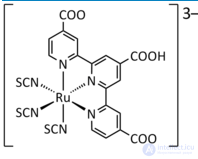
«Black Dye», an anionic Ru-terpyridine complex
Dyes used in early experimental cells (around 1995) were sensitive only at the high-frequency end of the solar spectrum, in the ultraviolet and blue colors. Newer versions were soon introduced (around 1999) that had a much wider frequency response, namely «tricarboxy-ruthenium terpyridine» [Ru (4,4 ', 4 "- (COOH) 3- terpy) (NCS) 3 ], which extends effectively right into the low-frequency range of red and infrared light. The wide spectral response causes the dye to have a deep brownish-black color, and it is simply called "black dye". [35]The dyes have an excellent ability to convert a photon into an electron, initially about 80%, but improving to nearly ideal conversion in later dyes, the overall efficiency is about 90%, with the «lost» 10% mainly accounted for by optical losses in the top electrode.
A solar cell must be capable of producing electricity for at least twenty years, without a significant decrease in efficiency ( lifetime ). The "black dye" system was subjected to 50 million cycles, equivalent to ten years of sun exposure in Switzerland. No noticeable decrease in performance was observed. However, the dye is subject to degradation under conditions of increased illumination. Over the last decade, an extensive research program has been carried out to address these problems. Newer dyes have included 1-ethyl-3-methylimidazolium tetracyanoborate [EMIB (CN) 4 ], which is extremely resistant to light and temperature, copper diselenide [Cu (In, Ga) Se 2 ], which provides higher conversion efficiency, and others with various target properties.
DSSC devices are still in the early stages of their development cycle. Efficiency improvements are possible, and a broader range of research has recently begun. These include the use of quantum dots to convert higher-energy (higher-frequency) light into multiple electrons, the use of solid-state electrolytes for a better temperature response, and changing the doping of TiO 2 to better match the electrolyte used with it.
2003
A group of researchers from the Swiss Federal Institute of Technology reportedly improved the thermal stability of the DSC by using an amphiphilic ruthenium sensitizer combined with a quasi-solid gel electrolyte. The stability of the device matches that of a conventional inorganic silicon-based solar cell. The cell withstood heating for 1000 h at 80 ° C.
Earlier, the group had prepared the ruthenium amphiphilic dye Z-907 (cis-Ru (H 2 dcbpy) (dnbpy) (NCS) 2 , where the ligand H 2 dcbpy is 4,4'-dicarboxylic acid-2,2'-bipyridine and dnbpy is 4,4'-dinonyl-2,2'-bipyridine) to increase the water resistance of dyes in electrolytes. In addition, the group also prepared a quasi-solid gel electrolyte with a liquid electrolyte based on 3-methoxypropionitrile (MPN), which was cured with the photochemically stable fluoropolymer polyvinylidene fluoride-hexafluoropropylene (PVDF-HFP).
The use of the amphiphilic dye Z-907 in combination with a polymer gel electrolyte in the DSC made it possible to achieve an energy conversion efficiency of 6.1%. Even more importantly, the device was resistant to thermal stress and withstood light exposure. The cell's high conversion efficiency was maintained after heating for 1000 h at 80 ° C, retaining 94% of its original value. After accelerated testing in a solar simulator with 1000 h of light soaking at 55 ° C (100 mW cm -2 ), the efficiency fell by less than 5% for cells coated with a UV-absorbing polymer film. These results are within the range typical of traditional inorganic silicon solar cells.
The improved characteristics may arise from reduced solvent penetration through the sealant due to the use of the polymer gel electrolyte. The polymer gel electrolyte is quasi-solid at room temperature and becomes a viscous liquid (viscosity: 4.34 mPa · s) at 80 ° C, compared with the traditional liquid electrolyte (viscosity: 0.91 mPa · s). Such significantly improved device stability, both under thermal stress and light soaking, had never before been observed in DSCs, and they meet the durability criteria applied to solar cells for outdoor use, which makes these devices viable for practical application. [36] [37]
2006
The first successful solid-hybrid dye-sensitized solar cells were reported. [28]
To improve electron transport in these solar cells while preserving the large surface area needed for dye adsorption, two researchers developed alternative semiconductor morphologies, such as nanowire arrays and a combination of nanowires and nanoparticles , to provide a direct path to the electrode through the semiconductor conduction band. Such structures may provide a means of increasing the quantum efficiency of DSSCs in the red region of the spectrum, where their performance is currently limited. [38]
In August 2006, to demonstrate the chemical and thermal stability of a 1-ethyl-3-methylimidazolium tetracyanoborate solar cell, researchers subjected the devices to heating at 80 ° C in the dark for 1000 hours, followed by light soaking at 60 ° C for 1000 hours. After dark heating and light soaking, 90% of the initial photovoltaic efficiency was retained — the first time such outstanding thermal stability had been observed for a liquid electrolyte exhibiting such high conversion efficiency. Unlike silicon solar cells , whose performance declines as temperature rises, dye-sensitized solar cell devices showed only a minor effect when the operating temperature was raised from ambient temperature to 60 ° C.
April 2007
Wayne Campbell of Massey University , New Zealand, experimented with a wide range of organic porphyrin-based dyes . [39] In nature, porphyrin is the basic building block of hemoproteins , which include chlorophyll in plants and hemoglobin in animals. He reports an efficiency of about 5.6% using these low-cost dyes. [40]
June 2008
A paper published in Nature Materials, demonstrated a cell efficiency of 8.2% using a new solvent-free liquid redox electrolyte made of a molten mixture of three salts, as an alternative to the use of organic solvents as the electrolyte solution. Although the efficiency with this electrolyte is less than 11% when using existing iodine-based solutions, the team is confident that the efficiency can be improved. [41]
2009
A team of researchers from Georgia Tech created dye-sensitized solar cells with a higher effective surface area by wrapping them around a quartz optical fiber. [42] [43] The researchers stripped the cladding off the optical fibers, grew zinc oxide nanowires along the surface, treated them with dye molecules, surrounded the fibers with electrolyte and a metal film that carries electrons away from the fiber. The cells are six times more efficient than zinc oxide cells with the same surface area. [42]Photons bounce around inside the fiber as they travel, so there is a greater chance of interacting with the solar cell and producing more current. These devices collect light only at the tips, but future fiber cells could be made so that they absorb light along the entire length of the fiber, which would require both a conductive and a transparent coating. [42] Max Stein of the University of Michigan said that such cells do not need a sun-tracking system, and they will work on cloudy days when the light is diffused. [42]
2010
Researchers from the Ecole Polytechnique Fédérale de Lausanne and the University of Quebec in Montreal claim to have overcome two major problems of DSC: [44]
2011
In June, Dyesol and Tata Steel Europe announced the development of the world's largest dye-sensitized photovoltaic module, printed on steel by a continuous line.
Dyesol and CSIRO announced in October the successful completion of the second phase of the joint Dyesol / CSIRO project. Dyesol Director Gordon Thompson said: «The materials developed during this collaboration are capable of significantly advancing the commercialization of DSC in a number of application areas where performance and stability are essential requirements. Dyesol is extremely encouraged by breakthroughs in chemistry enabling the production of target molecules. This creates a path to immediate commercial use of these new materials". [47]
In November, Dyesol and Tata Steel Europe announced the targeted development of BIPV solar steel, competitive at Grid Parity, which does not require government-subsidized tariffs. Currently, TATA-Dyesol "Solar Steel" roofing is being installed at the Building Envelope Centre (SBEC) in Shotton, Wales. [
2012
Researchers from Northwestern University [50] announced a solution to the main problem of DSSC, which is related to the difficulties of using and maintaining a liquid electrolyte and, as a consequence, the relatively short service life of the device. This is achieved through the use of nanotechnology and the conversion of the liquid electrolyte into a solid substance. Current efficiency is about half that of silicon cells, but they are lightweight and potentially much cheaper to produce.
2013
Over the past 5–10 years, a new type of DSSC has been developed - the solid-state dye-sensitized solar cell. In this case, the liquid electrolyte is replaced by one of several solid hole-conducting materials. From 2009 to 2013, the efficiency of solid-state DSSCs increased sharply from 4% to 15%. Michael Grätzel announced the creation of solid-state DSSCs with an efficiency of 15.0%, achieved using the hybrid perovskite CH 3 NH 3 PbI 3 , subsequently deposited from separate solutions of CH 3 NH 3 I and PbI 2 . [21]
The first architectural integration was demonstrated in the new EPFL conference center in partnership with Romande Energie. Total area 300 m 2 , in 1400 modules of 50 cm x 35 cm. Designed by artists Daniel Schlaepfer and Catherine Bolle. [51]
2018
Researchers investigated the role of surface plasmon resonances present on gold nanorods in the operation of dye-sensitized solar cells. They found that as the concentration of nanorods increased, light absorption grew linearly; however, charge extraction also depended on the concentration. By optimizing the concentration, they found that the overall energy conversion efficiency improved from 5.31 to 8.86% for Y123 dye-sensitized solar cells. [52]
The synthesis of one-dimensional TiO 2 nanostructures directly on fluorine-doped tin oxide glass substrates was successfully demonstrated using a two-sided solvothermal reaction. [53] In addition, thanks to TiO 2 sol treatment, the performance of dual TiO 2 nanowire cells was improved, achieving a power conversion efficiency of 7.65%. [54]
Stainless-steel-based counter electrodes for DSSC have been reported, which further reduce cost compared to a conventional platinum-based counter electrode and are suitable for outdoor use. [55] [56]
Researchers from EPFL developed DSSCs based on redox electrolytes of copper complexes, which achieved 13.1% efficiency under standard AM1,5G conditions, 100 mW / cm 2 , and recorded 32% efficiency under indoor illumination of 1000 lux. [57] [58]
Researchers from Uppsala University used n-type semiconductors instead of a redox electrolyte to fabricate p-type solid-state dye-sensitized solar cells. [59] [60]

Comments