
Lecture
The external characteristic of a transformer is the dependence of the secondary winding voltage U2 on the current I2. If we neglect the no-load current, the equivalent circuit of the transformer under rated conditions takes the form shown in Figure 1.
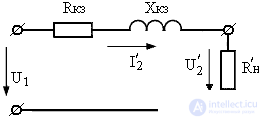
Figure 1 Equivalent circuit of a transformer for constructing its external characteristic
Given that Zsc = Rsc + jXsc, the voltage on the secondary winding of the transformer can be expressed as follows:
 (1)
(1)
Let us construct a vector diagram, relative to the current vector  , as shown in Figure 2.
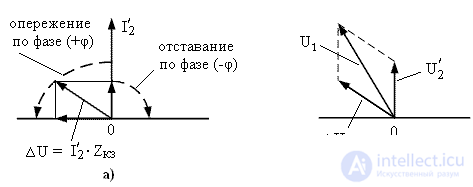
Figure 2 Vector diagram of the currents and voltages of the transformer's secondary winding
If the load resistance  is resistive (active), then the voltage
  is in phase with the current . The sum
  . Since the applied voltage U1= const, it is obvious that as the current changes, the voltage drop ΔU across the internal resistance of the transformer will also change. That is, the external characteristic has a drooping shape, as shown in Fig. 2.25.

Comments