
Lecture
Lithium-ion batteries are widely used in portable electronics, electric vehicles, and energy storage systems. Despite their efficiency, they are subject to risks — overheating, short circuit, overcharging, mechanical damage.
List of the main hazardous effects on lithium-ion batteries that can lead to failures, fire, or explosion:
Mechanical damage: punctures, impacts, and case deformation can cause internal short circuits.
Vibration and drops: especially dangerous for batteries without a rigid casing.
Loss of seal integrity: a breach of the case leads to electrolyte leakage and contact with air.
Overheating: at a temperature above 60–70 °C, electrolyte degradation and the risk of thermal runaway begin.
Overcooling: at a temperature below −20 °C, lithium can plate onto the anode, causing a short circuit.
Sharp temperature swings: lead to microcracks and loss of seal integrity.
Overcharging: charging above the rated voltage causes overheating and gas generation.
Deep discharge: a voltage below the allowable level leads to degradation of the cells.
Short circuit: an instantaneous high-power current can cause an explosion.
Surge overloads: sharp current spikes when powerful loads are switched on.
Contact with water or air: especially dangerous for lithium — a reaction releasing heat and gas is possible.
Corrosion of contacts: from prolonged exposure to moisture or aggressive environments.
Storage at high humidity
Use of uncertified chargers
Absence of protection circuits (CID, PCM, BMS)
To prevent emergency situations, various protective means are built into the design of cells and battery packs.
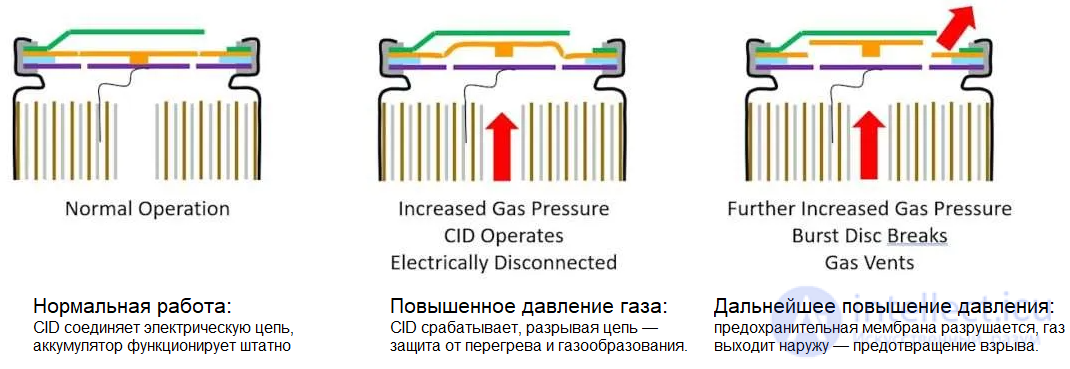
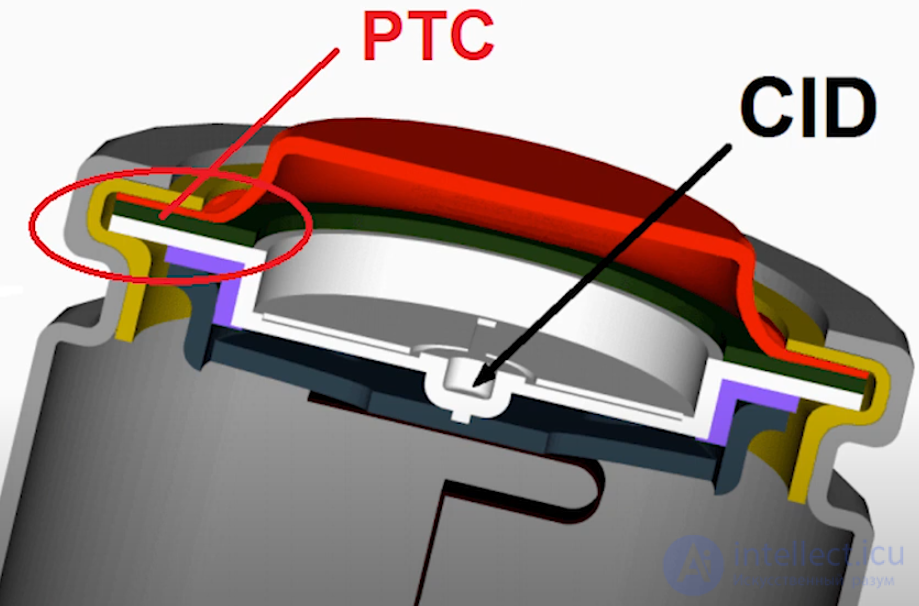
CID (Current Interrupt Device) — a mechanical fuse built into the top part of a cylindrical cell.
Operating principle: when internal pressure rises (due to overheating or gas generation), a metal membrane bends and breaks the electrical circuit.
Advantage: instantaneous disconnection under critical conditions.
When the CID's circuit opens, there is a possibility of an arc forming. The situation is very similar to the arc that occurs when contactors are opened under load. As a result, the cell can burn or explode.
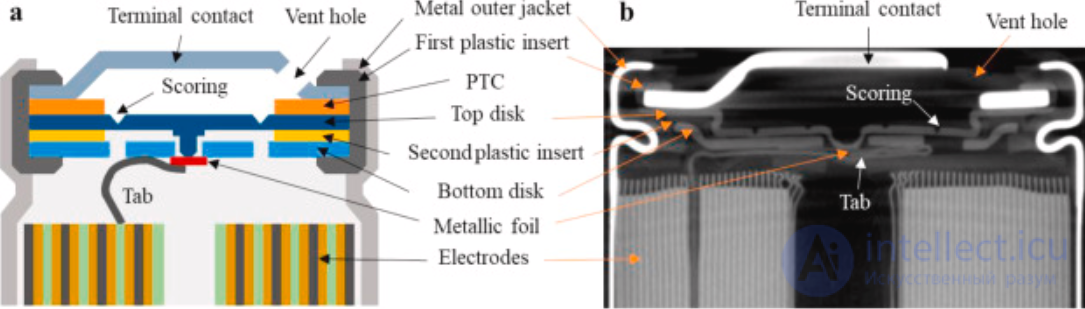
PTC (Positive Temperature Coefficient) — a component whose resistance increases when heated.
A PTC in lithium batteries – is a self-resetting protective element that uses a thermistor with a positive temperature coefficient (Positive Temperature Coefficient) to prevent overheating and overload. At normal temperatures it has low resistance, but when overheated its resistance rises sharply, limiting the current and protecting the battery. After cooling, the thermistor regains its low resistance, restoring its functionality.
Function: limits the current during overheating, preventing a short circuit.
Application: often used in a circuit in parallel with the cell.
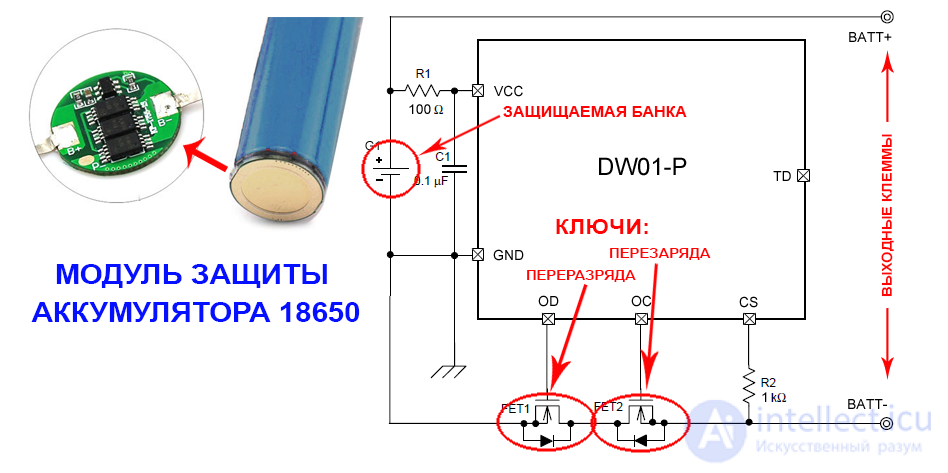
PCM (Protection Circuit Module) — an electronic board that monitors the battery's parameters.
Functions: protection against overcharge, over-discharge, and current overload.
Composition: MOSFET, voltage and current sensors, microcontroller.
BMS (Battery Management System) — an intelligent system that manages the entire battery.
Functions: cell balancing, temperature monitoring, condition diagnostics.
Application: electric vehicles, industrial ESS, medical equipment.
A thermal fuse — a single-use component that breaks the circuit when a critical temperature is reached.
Principle: melting or mechanical destruction upon overheating.
Role: protection against fire and case destruction.
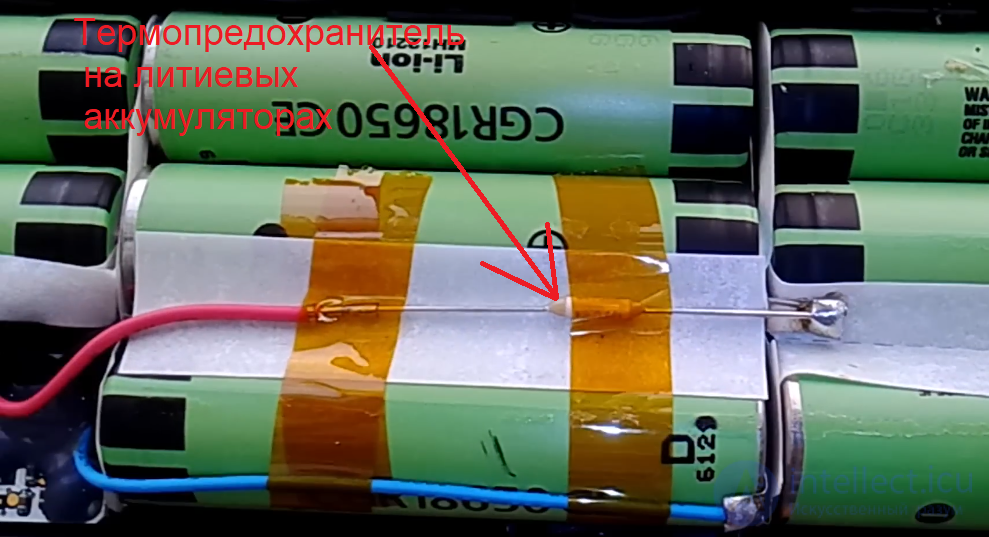
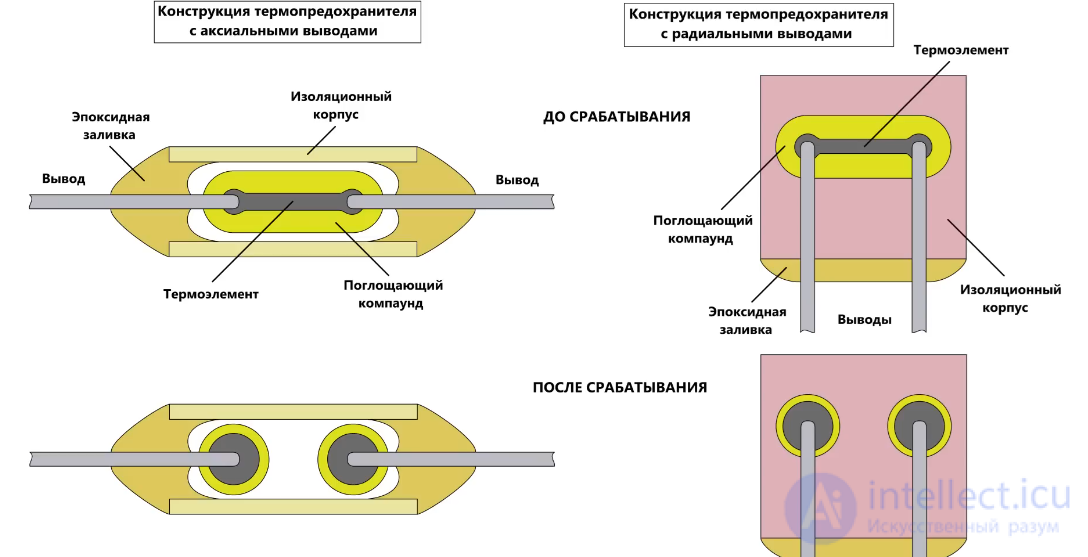
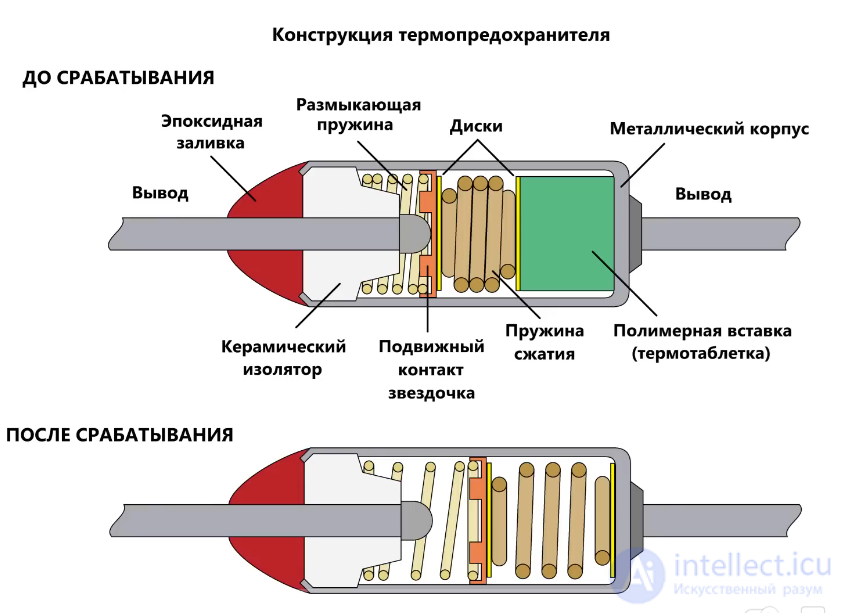
Diodes and transistors — elements that control the direction of current.
Functions: preventing reverse current, protection against incorrect connection.
Application: in charging, balancing, and switching circuits.
| Name | Purpose |
Reusability
|
Type Operating principle, Protects from
|
Application |
|---|---|---|---|---|
| CID (Current Interrupt Device) | Overpressure protection |
no
|
Mechanical. Mechanically breaks the circuit when the pressure inside the cell exceeds normal. Pressure, overheating |
Lithium-ion batteries |
| PTC (Positive Temperature Coefficient) | Protection against overheating and short circuit |
yes |
Passive. Increases resistance as temperature rises, limiting current. Overheating, short circuit | Built into cells or external circuits |
| PCM (Protection Circuit Module) | Electronic protection against overcharge, over-discharge, overload |
yes
|
Electronic. Uses a MOSFET, current and temperature sensors for control. Overcharge, current | Digital devices, lithium-ion batteries |
| BMS (Battery Management System) | Comprehensive management and protection |
yes
|
Intelligent. Monitoring of voltage, current, temperature, cell balancing. All parameters | Electric vehicles, ESS, industrial batteries |
| Thermal fuses | Overheating protection |
no
|
Mechanical. Break the circuit when the critical temperature is reached. Overheating | Built into battery packs |
| Fuses | Protection against short circuit, excess current | no | Physical |
In circuits where short circuits or high load currents are possible (for example, the power circuits of laptops, electric scooters).In such cases, miniature fuses (SMD fuse) or polyfuse (self-resetting PTC fuses) are installed. |
| Diodes/transistors | Reverse current protection |
yes |
Electronic. Blocks unwanted current direction. Reverse current | In charging and discharging circuits |
CID is activated when the internal pressure exceeds normal (usually due to overheating or gas generation), physically breaking the circuit and preventing an explosion.
PTC — is a thermistor that increases resistance when heated, limiting current and preventing overheating.
PCM and BMS provide intelligent protection, including shutdown when voltage, current, and temperature thresholds are exceeded3.
Modern batteries — are not just power sources, but complex systems with multilevel protection. From simple thermal fuses to intelligent BMS — every component plays an important role in ensuring safety, reliability, and longevity.

Comments