
Lecture
A vanadium redox battery (VRB), also known as a vanadium flow battery (VFB) or vanadium redox flow battery (VRFB), is a type of rechargeable flow battery that uses vanadium ions as charge carriers. The battery exploits the ability of vanadium to exist in solution in four different oxidation states, which makes it possible to build a battery with a single electroactive element instead of two.
For a number of reasons, including their relative bulkiness, vanadium batteries are typically used for grid energy storage, that is, they are connected to power plants/electrical grids.
Numerous companies and organizations are involved in funding and developing vanadium redox batteries.
| Specific energy | 10–20 W·h / kg (36–72 J/g) |
|---|---|
| Energy density | 15–25 W·h/L (54–90 kJ/L) |
| Energy efficiency | 75–90% |
| Durability | 20 years |
| Cycle durability | >12,000–14,000 cycles |
| Nominal cell voltage |
Pissoort mentioned the possibility of using vanadium redox flow batteries as early as the 1930s. NASA researchers, as well as Pellegri and Spaziante, followed their lead in the 1970s, but neither succeeded. Maria Skyllas-Kazacos presented the first successful demonstration of an all-vanadium redox flow battery using dissolved vanadium in a sulfuric acid solution in the 1980s. Her design used sulfuric-acid-based electrolytes and was patented by the University of New South Wales in Australia in 1986.
One of the important breakthroughs achieved by Skyllas-Kazacos and her colleagues was the development of a series of processes for producing vanadium electrolytes with a concentration of more than 1.5 M using the cheaper but insoluble vanadium pentoxide as the starting material. These processes involved chemical and electrochemical dissolution and were patented by the University of New South Wales in 1989. During the 1990s, the UNSW group carried out extensive research on membrane selection, activation of graphite felt, fabrication of conductive plastic bipolar electrodes, electrolyte characterization and optimization, as well as modeling and simulation. Several 1-5 kW prototype vanadium flow batteries were assembled and field-tested in a solar house in Thailand and in an electric golf cart at UNSW.
The patents and technology for UNSW's all-vanadium flow battery were licensed to Mitsubishi Chemical Corporation and Kashima-Kita Electric Power Corporation in the mid-1990s, and were later acquired by Sumitomo Electric Industries, where extensive field trials across a wide range of applications were carried out in the late 1990s and early 2000s.
To extend the battery's operating temperature range and prevent vanadium precipitation in the electrolyte at temperatures above 40 °C in the case of V(V), or below 10 °C in the case of the negative half-cell solution, Skyllas-Kazacos and her colleagues tested hundreds of organic and inorganic additives as potential precipitation inhibitors. They found that inorganic phosphate and ammonium compounds effectively inhibit precipitation of 2 M vanadium solutions in both the negative and positive half-cells at temperatures of 5 and 45 °C respectively, and ammonium phosphate was selected as the most effective stabilizing agent. Ammonium and phosphate additives were used to prepare and test a 3 M vanadium electrolyte in a flow cell, with excellent results.
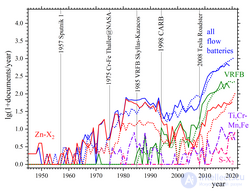
Number of patent families and non-patent publications on various types of flow battery chemistries by year.
The main advantages of VRFB over other types of batteries:
The main drawbacks of VRFB compared to other types of batteries:
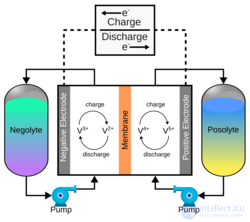
Diagram of a vanadium redox flow battery.
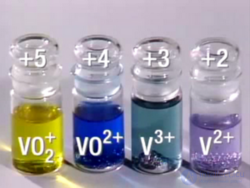
Solutions of vanadium sulfates in four different vanadium oxidation states.
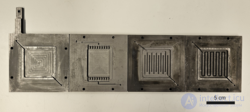
Vanadium flow batteries use various types of graphite channels to supply the liquid. From left to right: rectangular channels, rectangular channels with a flow distributor, interdigitated channels, and serpentine channels.
The electrodes in a VRB cell are made on the basis of carbon. Several types of carbon electrodes used in VRB cells have been reported, such as carbon felt, carbon paper, carbon cloth, and graphite felt. Carbon-containing materials have the advantages of low cost, low resistivity, and good stability. Among them, carbon and graphite felt are preferred because of their improved three-dimensional network structure and greater specific surface area, as well as good conductivity and chemical and electrochemical stability.
The pristine carbon-based electrode exhibits hydrophobicity and limited catalytic activity when interacting with vanadium compounds. Various approaches have been used to increase its catalytic efficiency and wettability, including thermal treatment, acid treatment, electrochemical modification, and the incorporation of catalysts. Carbon felt is typically obtained by pyrolysis of polyacrylonitrile (PAN) or viscose fibers at a temperature of approximately 1500 °C and 1400 °C, respectively. Graphite felt, on the other hand, undergoes pyrolysis at a higher temperature of about 2400 °C. For thermal activation of felt electrodes, the material is heated to 400 °C in an atmosphere of air or oxygen. This process significantly increases the surface area of the felt, raising it by a factor of 10. The activity toward vanadium compounds is explained by an increase in the number of oxygen-containing functional groups, such as the carbonyl group (C=O) and the carboxyl group (CO), after thermal treatment in air. Many other surface modifications have shown improved activity, for example graphene oxide and polyaniline . Currently there is no consensus regarding the specific functional groups and reaction mechanisms that determine the interaction of vanadium compounds at the electrode surface. It has been suggested that the V(II)/V(III) reaction proceeds via an inner-sphere mechanism, while the V(IV)/V(V) reaction proceeds via an outer-sphere mechanism.
Both electrolytes are based on vanadium . The electrolyte in the positive half-cells contains VO.+2and VO 2+ ions, while the electrolyte in the negative half-cells consists of V 3+ and V 2+ ions. Electrolytes can be prepared in several ways, including electrolytic dissolution of vanadium pentoxide (V 2 O 5 ) in sulfuric acid (H 2 SO 4 ). The solution, when used, is strongly acidic.
The membrane must allow protons to pass through while keeping electrons and other ions separate. This creates a charge separation and, consequently, a voltage. The most common membrane material is perfluorinated sulfonic acid (PFSA or Nafion ). However, vanadium ions can penetrate through the PFSA membrane, a phenomenon known as «crossover», which reduces the energy capacity of the battery. A 2021 study found that penetration is reduced by using hybrid sheets obtained by growing tungsten trioxide nanoparticles on the surface of single-layer graphene oxide sheets. These hybrid sheets are then embedded into a sandwich-structured PFSA membrane reinforced with polytetrafluoroethylene (Teflon). The nanoparticles also promote proton transport, providing a high coulombic efficiency and energy efficiency of over 98.1% and 88.9%, respectively.
Resistive losses, revealed by the polarization curve, can be attributed to three main regions: activation losses, ohmic losses, and mass-transfer losses . Activation losses arise from the slow kinetics of charge transfer between the electrode surface and the electrolyte. Ohmic losses are caused by the ohmic resistance of the electrolyte, electrode, membrane, and current collector. Ohmic losses can be reduced by improving the cell design, for example through a zero-gap cell design and a reduction in membrane thickness. Mass-transfer losses are caused by a shortage of active vanadium species transported to the electrode surface. A flow field design that promotes convective mass transfer is critical for reducing mass-transfer losses. Serpentine and interdigitated flow field designs have been obtained by machining the bipolar plate adjacent to the porous electrode. The felt electrode can also be cut to create an electrolyte flow channel. Both serpentine and interdigitated flow fields have been shown to improve mass transfer, which reduces mass-transfer polarization and, consequently, increases the limiting current density and peak power density. Flow distributors are sometimes placed in the cell to distribute the flow and reduce jetting. The flow field must also be designed in such a way as to ensure uniform distribution of the electrolyte to prevent stagnant zones in the cell and to reduce the pressure drop across the cell stack.
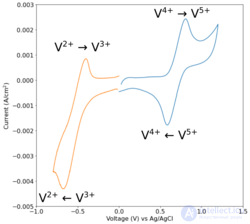
Cyclic voltammogram of a vanadium (IV) solution in a sulfuric acid solution
The reaction uses the half-reactions:
VO+2+ 2H + + e − → VO 2+ + H 2 O ( E° = +1.00 V )
V 3+ + e − → V 2+ ( E° = −0.26 V )
Other useful properties of vanadium flow batteries are their fast response to load changes and their overload capability. They can achieve response times of less than half a millisecond for a 100% load change and can tolerate overloads of up to 400% for 10 seconds. The response time is mainly limited by the electrical equipment. Unless the batteries are specifically designed for a colder or warmer climate, most sulfuric-acid-based vanadium batteries operate in a temperature range of 10 to 40 °C. Below this temperature range, the ion-saturated sulfuric acid crystallizes. The round-trip efficiency in practical applications is about 70–80%.
In the original VRFB design developed by Skyllas-Kazacos, sulfate was used as the sole anion in the VRFB solutions (added in the form of vanadium sulfate(s) and sulfuric acid), which limited the maximum vanadium ion concentration to 1.7 M. In the 1990s, Skyllas-Kazacos discovered the use of ammonium phosphate and other inorganic compounds as precipitation inhibitors to stabilize 2 M vanadium solutions over a temperature range of 5 to 45 °C, and in 1993 the University of New South Wales filed a patent application for the stabilizing agent. However, this discovery was largely overlooked, and around 2010 a group from the Pacific Northwest National Laboratory proposed a mixed sulfate-chloride electrolyte, which made it possible to use it in VRFB solutions with a vanadium concentration of 2.5 M over the full temperature range from −20 to +50 °C. Based on the standard equilibrium potential of the V 5+ /V 4+ couple, chloride oxidation is expected, and for this reason chloride solutions were avoided in earlier VRFB research. The surprising oxidative stability (although only at a state of charge below about 80%) of V 5+ solutions in the presence of chloride has been explained on the basis of activity coefficients. Many researchers attribute the increased stability of V(V) at elevated temperatures to the higher proton concentration in the mixed acid electrolyte, which shifts the equilibrium of thermal precipitation of V(V) away from V 2 O 5. Nevertheless, due to the high vapor pressure of HCl solutions and the possibility of chlorine formation during charging, such mixed electrolytes have not become widely used.
Another option — is the use of vanadium bromide salts. Since the redox potential of the Br₂ / 2Br⁻ couple is more negative than that of V⁵⁺ / V⁴⁺ , the positive electrode operates via the bromine process. However, due to volatility and corrosivity issues with Br₂, they have not become widely used (see the zinc-bromine battery for a similar problem). A vanadium / cerium flow battery has also been proposed.
Vanadium flow batteries (VRB) achieve a specific energy of about 20 W·h/kg (72 kJ/kg) of electrolyte. Precipitation inhibitors can increase the density to approximately 35 W·h/kg (126 kJ/kg), and higher density values can be achieved by controlling the electrolyte temperature. Specific energy is low compared to other types of rechargeable batteries (for example, lead-acid, 30–40 W·h/kg (108–144 kJ/kg); and lithium-ion, 80–200 W·h/kg (288–720 kJ/kg)).
The large potential capacity of VRFB may be best suited for smoothing the unstable power generation of utility-scale wind and solar power plants.
Reduced self-discharge makes them potentially suitable for applications requiring long-term energy storage with minimal maintenance — for example, in military equipment, such as the sensor components of the GATOR mine system.
They feature a fast response time, which is well suited for use in uninterruptible power supplies (UPS), where they can replace lead-acid batteries or diesel generators. Fast response time is also useful for frequency regulation. These capabilities make VRFB an effective, versatile solution for microgrids, frequency regulation, and load shifting.
Companies funding or developing vanadium redox batteries include Sumitomo Electric Industries , CellCube (Enerox) , UniEnergy Technologies , StorEn Technologies in Australia, Largo Energy and Ashlawn Energy in the USA; H2 in the city of Geryon, South Korea , Renewable Energy Dynamics Technology , Invinity Energy Systems in the UK, Schmalz , LIVA Power Management Systems in Europe; Prudent Energy in China; Australian Vanadium, CellCube and North Harbour Clean Energy in Australia; Yadlamalka Energy Trust and Invinity Energy Systems in Australia; EverFlow Energy JV SABIC SCHMID Group in Saudi Arabia and Bushveld Minerals in South Africa.

Comments