
Lecture 56 min.
The Grand Duchy of Lithuania was an East European state that existed from the mid-13th century until 1795 on the territory of present-day Belarus (entirely), Lithuania (except the Klaipėda Region), Ukraine (most of it, until 1569), Russia (the south-western lands, including Smolensk, Bryansk and Kursk), Poland (Podlachia, until 1569), Latvia (partly, after 1561), Estonia (partly, from 1561 to 1629) and Moldova (the left-bank part of Transnistria, until 1569). The extensive Rus lands that came under the rule of the Grand Duchy of Lithuania and made up the lion's share of its territory are called Lithuanian Rus.
From 1385 it was in a personal union with the Kingdom of Poland, and from 1569 in the Sejm-based Union of Lublin, as part of the federative Polish–Lithuanian Commonwealth. In the 15th and 16th centuries the Grand Duchy of Lithuania was a rival of the Grand Duchy of Moscow in the struggle for dominance over the East Slavic lands and in Eastern Europe as a whole. It ceased to exist after the Third Partition of the Polish–Lithuanian Commonwealth in 1795. By 1815 the entire territory of the former duchy had become part of the Russian Empire.
The name of the state and the title of its ruler (hospodar ) were not constant and changed with shifts in political borders and changes in the state structure. In the mid-13th and early 14th centuries the state was called Lithuania. Thus, Grand Prince Mindaugas was crowned as "King of Lithuania" . After the annexation to Lithuania of the Kyiv region and other lands of present-day Ukraine, the ruler was styled "king of the Lithuanians and of many Ruthenians" . After the inclusion of part of present-day Latvia, the Grand Duke of Lithuania Gediminas was styled "king of the Lithuanians and Ruthenians, lord and prince of Semigallia" . After the annexation of Samogitia (the central and western part of present-day Lithuania ) in the mid-15th century, the ruler used the title "Grand Duke… of all the Lithuanian land and of Samogitia and of many Ruthenian lands" . The Statute of 1529 states: "The written laws given to the realm of the Grand Duchy of Lithuania, Ruthenia and Samogitia and others by the most serene lord Sigismund, by the grace of God king of Poland, grand duke of Lithuania, Ruthenia, Prussia, Samogitia, Masovia and others" . Thus, in this period the full official name of the state in the Western Rus (Ruthenian) language was "the Grand Duchy of Lithuania, Ruthenia, Samogitia and other [lands]" .
After the conclusion of the Union of Lublin and the transfer of the lands of present-day Ukraine to Poland (1569), the state came to be called only the Grand Duchy of Lithuania, although the ruler continued to be styled grand duke of Lithuania, Ruthenia, Prussia, Samogitia, Masovia, and after the annexation of Livonia in 1561 also of Livonia .
In official documents the state was designated by the names "Grand Duchy of Lithuania", "hospodarstvo" (the ruler's domain) and "panstvo" (the realm) . The term "Rzeczpospolita" (Commonwealth) was used both to denote the Grand Duchy of Lithuania alone and as the name of the whole Polish–Lithuanian state .
In Latin the name was written as Magnus Ducatus Lituaniae, in Polish as Wielkie Księstwo Litewskie .
In the 14th and 15th centuries the concept of "Lithuanian Rus" arose as a counterpart to the concept of "Muscovite Rus" .
In Russian historiography, the term Lithuanian-Russian state was widely used to designate the state[10].
From the 6th century BC, Baltic (Latvian-Lithuanian) tribes inhabited the territories of present-day Lithuania, Belarus, and parts of Latvia, Poland and Russia. From the 8th century AD, in the course of the Slavic colonization of the East European Plain, the eastern part of the Balts took part in the ethnogenesis of the Krivichs, Radimichs and Vyatichs; in the basin of the Protva River some researchers subsequently identify the Baltic tribe of the Galindians (Goliad).
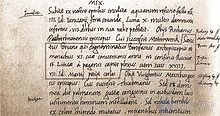
The name Litua, in the oblique-case form Lituae, first appears in the Quedlinburg Annals under the year 1009 in the description of the death of the missionary Bruno of Querfurt, who was killed "on the border of Rus and Lithuania". In the Russian chronicles the first dated mention of Lithuania belongs to 1040, when the campaign of Yaroslav the Wise took place and the construction of the Novogrudok fortress was begun. The "Tale of Bygone Years" names the Lithuanians, together with the Semigallians and Curonians, among the tributary tribes of Kievan Rus, while the territory of the Yotvingians was directly annexed to it in 983.
It is traditionally held that after the disintegration of Kievan Rus the Lithuanians, Samogitians, Semigallians and Curonians remained in tributary dependence on the Principality of Polotsk (which finally became independent in 1132), which in turn also underwent territorial fragmentation. As for another Rus principality bordering the Baltic territories — that of Gorodno (Grodno), situated in the upper Neman basin in immediate proximity to the lands inhabited by the Yotvingians — there are various theories of its origin: from the principalities of Turov, Polotsk or Volhynia. The northernmost of the Baltic tribes, the Latgalians, were dependent on the Novgorod Republic. In the early 13th century the Teutonic Order began to seize the lands of the Prussians, and the Livonian Brothers of the Sword those of the Semigallians, Curonians, Latgalians and the Finno-Ugric tribes of the Livs and Estonians. The latter was defeated at Saule by the Samogitians and Semigallians in 1236, and its remnants joined the Teutonic Order.
From the last quarter of the 12th century, many Rus principalities bordering Lithuania (Gorodno, Izyaslavl, Drutsk, Gorodets, Logoisk, Strezhev, Lukoml, Bryachislavl) disappear from the chroniclers' view. According to the "Tale of Igor's Campaign", Prince Izyaslav Vasilkovich fell in battle with the Lithuanians (before 1185). In 1190 Rurik Rostislavich organized a campaign against Lithuania in support of his wife's relatives and came to Pinsk, but because of the thawing of the snows the further campaign had to be cancelled. From 1198 the Polotsk land became a springboard for Lithuania's expansion to the north and north-east[11]. Lithuanian incursions begin directly into the Novgorod-Pskov (1183, 1200, 1210, 1214, 1217, 1224, 1225, 1229, 1234), Volhynian (1196, 1210), Smolensk (1204, 1225, 1239, 1248) and Chernigov (1220) lands, with which the Lithuania of the chronicles had no common borders. The First Novgorod Chronicle[12] under the year 1203 mentions a battle between the Olgovichi of Chernigov and Lithuania. In 1207 Vladimir Rurikovich of Smolensk marched against Lithuania[13].
There were also contacts between the Lithuanians and the Rus principalities. In the 1180s the Lithuanians gave military support to some princes of the Principality of Polotsk, while the chronicle sources record no military conflicts between Lithuania and the Polotsk land. The Lithuanians often sided with Polotsk in military confrontations with the crusaders. In 1214 crusaders of the Livonian Brothers of the Sword attempted to attack Gersik, a vassal of the Principality of Polotsk, but were defeated by the Lithuanians. In 1216 the Lithuanians were preparing to take part in the campaign of Prince Vladimir of Polotsk against the crusaders, but the campaign did not take place owing to the latter's death[14]. In 1235 the Lithuanian prince Mindaugas appears as an ally of Prince Izyaslav of Novogrudok. Apparently on the instructions of Daniel, Prince of Galicia-Volhynia, together they attacked Masovia[15].
Archaeological and linguistic data make it possible to speak of the existence, on the territory of the Neman region, which in the 13th century became the core of the formation of the Grand Duchy of Lithuania, of a broad zone of active peaceful Balto-Slavic contacts[16].
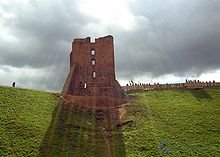
Evidence of the existence of early feudal associations is considered to be the treaty of 1219 between the Principality of Galicia-Volhynia and the princes of the Lithuanians, Dainova (Dyavoltva) and the Samogitians[17]. In the treaty, Mindaugas is mentioned among the five senior Lithuanian princes. In the 1230s he took a leading position among the Lithuanian princes[18].
The consolidation of the Grand Duchy of Lithuania took place against the backdrop of the events of the late 1230s and early 1240s: resistance to the crusaders of the Livonian Brothers of the Sword in Livonia and the Teutonic Order in Prussia, and the Mongol invasion of Rus'. The turbulent events of the time make it impossible to establish the details of the formation of the Grand Duchy of Lithuania with precision. According to one hypothesis, the creation of the duchy dates to the 1240s, when Mindaugas was invited to rule by the boyars of Novogrudok, which became the centre of Mindaugas's domains[19].
At the same time, the state's territory expanded to the north-west and north-east, a process that showed itself most clearly later, under the grand dukes Vaišvilkas and Traidenis. In 1248-1249 the Lithuanians carried out a largely unsuccessful campaign against the Principality of Vladimir-Suzdal, after which a struggle for power began between Mindaugas and his nephew Tautvilas, who was aided by the Romanovichi of Galicia-Volhynia (Daniel of Galicia was married to Tautvilas's sister).
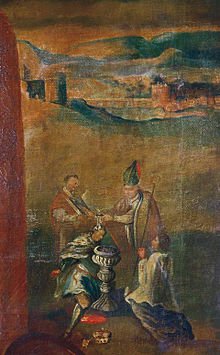
In order to improve the duchy's foreign-policy position, Mindaugas established relations with the pope and accepted Catholicism (1251). With the consent of Pope Innocent IV, Mindaugas was crowned King of Lithuania, and the state thus gained recognition as a full-fledged European kingdom. The coronation, which took place on 6 July 1253, was attended by invited guests including Andreas von Stirland, master of the Livonian Order, Albert II Suerbeer, Archbishop of Prussia, other notables, and Dominican and Franciscan monks. The ceremony was conducted by Heidenreich, Bishop of Chełmno (Pol.)in Russian; historians dispute where the coronation took place. According to some accounts, the coronation may have been held in Novogrudok, on the basis of which a number of historians conclude that Novogrudok was the capital of Mindaugas's state[20].
In 1254 Vaišvilkas, Mindaugas's son, concluded peace with Daniel of Galicia on Mindaugas's behalf and handed Novogrudok, together with all his other towns and those of Mindaugas, to Daniel of Galicia's son Roman. In 1258 Roman was killed as a result of a conspiracy between Vaišvilkas and Tautvilas. In the same year, Galician-Volhynian and Horde troops under Burundai jointly invaded Lithuania and devastated the environs of Novogrudok. Later in 1258 the people of Polotsk accepted Tautvilas, who was married to the daughter of the Polotsk prince Briacheslav, as their prince. Tautvilas maintained an alliance with Mindaugas and Vaišvilkas[21].
Mindaugas's son Vaišvilkas, having renounced the royal title, took monastic vows in an Orthodox monastery in Halych and then, in 1255-1258, went on pilgrimage to Mount Athos. Discontent was growing in the country at the activity of missionaries who were trying to organize a Catholic Dominican bishopric at Lyubcha near Novogrudok[22]. The presbyter Christian (Ger.)in Russian, appointed Bishop of Lithuania, complained to the pope that his residence was being attacked by pagans from among Mindaugas's subjects. According to papal bulls and the later reports of Jan Długosz, in 1255 Mindaugas launched a campaign against the Polish city of Lublin and burned it, and on 7 August 1255 Pope Alexander IV proclaimed a crusade against Lithuania in Poland, Bohemia and Austria. The pope subsequently proclaimed crusades against Lithuania in 1257, 1260 and 1261 as well.
No later than 1260 Mindaugas broke the peace with the Teutonic Order and supported the Prussian uprising against Order rule, which began in the autumn of 1260. According to German chronicles, Lithuanian troops took part in the defeat of the Order at Lake Durbe in Courland on 13 July 1260, where 150 knights of the Order were killed, including the master, the marshal and several commanders. Having renounced Christianity and the formal peace with the crusaders, Mindaugas carried out several campaigns in 1260-1263 that devastated the crusaders' lands in Livonia, Prussia and Poland. In January 1263 he burned the domain of the Archbishop of Gniezno in the Chełmno Land.
In 1263 Mindaugas was killed by conspirators, among whom various sources name the Polotsk prince Tautvilas, the Nalšia prince Daumantas, Prince Treniota, or the grand-ducal voivode Eustace Konstantinovich[23]. A struggle for the grand-ducal throne began in the state between the Polotsk prince Tautvilas and Mindaugas's nephew Treniota. The latter managed to kill Tautvilas and take the grand-ducal throne, but Treniota was soon overthrown by Mindaugas's son Vaišvilkas. In 1263 the Lithuanians managed to occupy Chernigov after the death of its local prince, but were soon driven out of it by Roman of Bryansk.
Around 1265 Vaišvilkas invited Orthodox priests and founded a monastery to spread Orthodoxy in Lithuania[24]. In 1267 he transferred the title and power to Shvarn, Mindaugas's son-in-law and the son of Prince Daniel of Galicia-Volhynia. A year later Shvarn died, after which Traidenis became grand duke. After the murder of Traidenis, Daumantas ruled. Between 1282 and 1291 the princes were Butigeidis and his brother Pukuveras Butvydas. This period, which lasted from the death of Traidenis (1282) to the death of Butvydas (1295), is very poorly documented in the sources, so information about it is often conjectural, with varying degrees of reliability.
After Shvarn's death, relations between Lithuania and the princes of Galicia-Volhynia worsened; in 1274-1275, in alliance with Khan Mengu-Timur of the Volga, and in 1277-1278, in alliance with Nogai, they invaded Lithuanian lands.
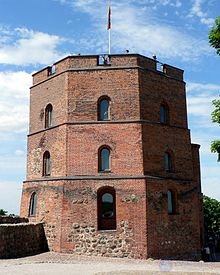
In 1295 Butvydas was succeeded by his son Vytenis (1295-1316), and after his death by his other son, Gediminas (reigned 1316-1341). They united the forces of the whole state under their authority, halted the advance of the crusaders, secured the West Rus' lands for Lithuania (many of which joined the Grand Duchy of Lithuania voluntarily[25][26]), and began expansion into the South Rus' lands, weakened by Mongol devastation. Under Vytenis, at the end of the 13th century, a Lithuanian Metropolis centred on Novogrudok was established, according to the lists of eparchies of the Patriarchate of Constantinople compiled under Andronikos II Palaiologos. At first the Lithuanian Metropolis included the bishoprics of Polotsk and Turov, and from the 14th century probably Kiev as well[27].
In 1316 Gediminas seized the Land of Brest, but then concluded peace with the Galician-Volhynian rulers Leo and Andrew Yuryevich (Lubartas Gediminaitis married Andrew Yuryevich's daughter). After the simultaneous death of the brothers in unclear circumstances (1323), Gediminas conducted a campaign against Volhynia, and then against Kiev. Some historians deny the historical reliability of the reports of Gediminas's subjugation of Kiev[28]. In both cases, opposition to Gediminas is known not only from the Rus' princes but also from the Tatars. Lubartas received domains in Volhynia, while in Kiev in the following years a Prince Fyodor is known, who, although acting in Gediminas's interests, ruled under conditions of continuing baskak rule. In 1333, for the first time in history, a non-Rurikid prince, Narimantas Gediminaitis, was invited to Novgorod as a service prince, receiving the suburbs and the Karelian Land as a kormlenie (over the period 1333-1471 Lithuanian princes of the Gediminid house were repeatedly invited to defend the Novgorod lands). After the local Galician dynasty came to an end, Lubartas became prince of Galicia-Volhynia (1340), but at that same time the war for the Galician-Volhynian inheritance between Lithuania and Poland began (lasting until 1392).
In 1317 Gediminas secured a reduction of the metropolis of the Grand Principality of Moscow: at his demand, under Patriarch John XIII Glykys (1315-1320), an Orthodox Metropolis of Lithuania was created with its capital at Novogorodok (Novogrudok, or Little Novgorod). That metropolis was apparently joined by those eparchies that depended on Lithuania, namely Turov and Polotsk, and then, probably, Kiev[27].
Under Gediminas, the founder of the ruling dynasty, the Grand Duchy of Lithuania showed considerable success in military affairs, grew significantly stronger economically and politically, and saw Orthodox and Catholic churches and cathedrals built across the country. Gediminas established dynastic ties with the leading monarchical houses of Eastern Europe: his daughters were married to the Polish king Casimir III, the prince of Galicia Yuri II Boleslaw, the prince of Tver Dmitry the Terrible Eyes, and the prince of Moscow Simeon the Proud. Gediminas kept the peace with the Principality of Moscow; his relations with Poland were tense, sometimes spilling over into military campaigns, and hostility with the German urban communities and the pope did not cease. It is also known that Gediminas used Golden Horde detachments against the crusaders.
Since the Grand Duchy of Lithuania had no fixed order of succession, in the five years after the death of Gediminas (1341-1345) the state faced the danger of disintegrating into independent lands. It was divided into 8 parts, administered by Gediminas's brother Vainius and by seven sons of Gediminas: Manvydas, Narimantas, Karijotas, Algirdas, Kęstutis, Lubartas and Jaunutis. The crusaders, who concluded an alliance with Poland in 1343 and were preparing a campaign against Lithuania, wanted to take advantage of this.
By an agreement between Algirdas and Kęstutis (1345), Jaunutis was expelled from Vilnius. The brothers concluded a treaty under which all of them were to obey Algirdas as grand duke. Kęstutis governed the north-western part of the duchy and waged the struggle against the Order. Algirdas's actions were concentrated in the eastern and south-eastern directions. Under Algirdas (reigned 1345-1377) the duchy effectively became the dominant power in the region. In the south Algirdas's domains expanded with the annexation of the Principality of Bryansk (1355). The state's position was strengthened especially after Algirdas defeated the Tatars at the Battle of Blue Waters in 1362 and added the land of Podolia to his domains. Following this, Algirdas removed Prince Fyodor, who ruled in Kiev as a vassal of the Golden Horde, and gave Kiev to his son Vladimir. At first this led to the cessation of tribute payments from these lands to the Horde, in which a struggle for power was under way at the time.
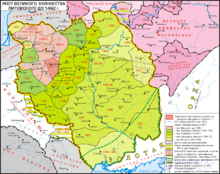
Under Algirdas the duchy's lands stretched from the Baltic to the Black Sea steppes, and its eastern border ran approximately along the present-day borders of the Smolensk and Moscow, Oryol and Lipetsk, and Kursk and Voronezh regions. During his reign the state included present-day Lithuania, the whole territory of present-day Belarus, the south-west of present-day Russia (including Smolensk, Bryansk and Kursk), and part of Ukraine. For all the inhabitants of West Rus', Lithuania became the natural centre of resistance to their traditional adversaries, the Golden Horde and the Teutonic Order. It should be noted that within the Grand Duchy of Lithuania there existed "politically separate territories" that enjoyed a degree of self-government (the lands of Polotsk, Vitebsk, Smolensk, Kiev, Volhynia and others) .
A special place in Algirdas's policy was occupied by the struggle against the Principality of Moscow, which sought dominance in North-East Rus', including by helping the Principality of Kashin gain independence from the Principality of Tver. In 1368 and 1370 Algirdas twice besieged Moscow without result, being forced to divert his attention to the struggle against the crusaders. In 1371 Mamai, who had achieved leadership in the Golden Horde, also came out on the side of the prince of Tver, and at about the same time the payment of tribute to the Horde was resumed from the South Rus' lands subject to Lithuania. In 1372 Algirdas concluded peace with Dmitry Donskoy, but in the last years of his reign Algirdas lost control of the eastern lands of the duchy, above all Bryansk and Smolensk, which inclined towards an alliance with Moscow, including against the Horde.
Algirdas waged a struggle with Poland for possession of Volhynia, which ended with a peace in 1377. The appanages of Brest, Vladimir and Lutsk went to Lithuania, and the lands of Chełm and Belz to Poland.
After the death of Algirdas (1377), Kęstutis remained the senior member of the dynasty, but in accordance with Algirdas's wishes he recognized the seniority of one of Algirdas's twelve sons, his nephew Jogaila. The latter was not recognized by his half-brothers: Andrew of Polotsk and Dmitry of Bryansk departed for Moscow and, together with Dmitry Bobrok, took part in the Battle of Kulikovo against Mamai (1380). Soon Kęstutis, learning of his nephew's dealings with the Order, deposed him in 1381 in order to establish his own sole rule. The following year Jogaila managed to seize Kęstutis and starved him to death in prison. During this struggle Jogaila ceded the land of Samogitia to the Order (1382). In 1384 Jogaila, Skirgaila and Korybut concluded a treaty with Dmitry of Moscow on a dynastic marriage between Jogaila and Dmitry's daughter and on the baptism of Lithuania according to the Orthodox rite. But in the same year Kęstutis's son Vytautas escaped from prison to the Germans and, together with them, began an offensive against Lithuania. Jogaila hastened to make peace with Vytautas, gave him Grodno and Trakai as an appanage, and promised the Order that he would accept Catholicism within four years.
In 1385 Grand Duke Jogaila concluded the Union of Krewo with the Kingdom of Poland: he accepted Catholicism and the new name Władysław, married Jadwiga, the heiress to the Polish throne, and became king of Poland while remaining grand duke of Lithuania. This strengthened the positions of both states in their confrontation with the Teutonic Order. In 1387 Władysław Jogaila officially baptized Lithuania.
Władysław Jogaila handed the grand-ducal throne to his brother Skirgaila, who recognized the supreme authority of the Polish king. The Catholic baptism of Lithuania brought increased Polish and Catholic influence. Lithuanian and Rus' boyars who accepted Catholicism were granted the privilege of owning land without restriction by the princes (noble status on the Polish model). Their estates were exempt from obligations, except for the building of towns by the whole land. Polish castellan courts were introduced for Catholics. These arrangements caused discontent among the Rus'-Lithuanian nobility, headed by Władysław Jogaila's cousin Vytautas. He waged a long struggle for the throne, winning over to his side the anti-Polish princes and boyars of the Grand Duchy of Lithuania and seeking allies both among the crusaders and in the grand prince of Moscow Vasily I Dmitrievich, to whom he gave his daughter Sophia in marriage in 1390. Metropolitan Cyprian gave considerable support to the policy of rapprochement between Lithuania and Moscow.
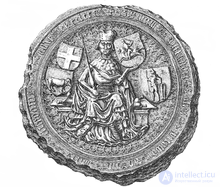
In 1392 the Ostrów Agreement was concluded between Jogaila and Vytautas, under which Vytautas became grand duke of Lithuania, while Jogaila kept for himself the title "supreme duke of Lithuania". Skirgaila was transferred to Kiev, where he soon died (possibly poisoned).
Vytautas, who seized Smolensk in 1395, soon sought complete independence and refused to pay tribute to Jogaila. Thanks to an alliance with the sons of Mansur of Mamai's Horde, Vytautas managed in the 1390s to annex peacefully to his duchy, in the south, huge territories of the Wild Fields. In 1399 Vytautas, who had supported the deposed Horde khan Tokhtamysh against Timur-Qutlugh, the protege of Tamerlane, suffered a heavy defeat from the Tatar mirza Edigu at the Battle of the Vorskla. As a result of the defeat Vytautas was forced to make peace with the Novgorodians, lost Smolensk (recaptured with the help of Polish troops after several campaigns in 1405), and began to seek rapprochement with Jogaila. The weakened Grand Duchy of Lithuania was forced in 1401 to conclude a new alliance with Poland (the so-called Union of Vilnius and Radom). By virtue of the act signed, on Vytautas's death his power was to pass to Jogaila, and on the latter's death the Poles undertook not to elect a king without Vytautas's consent.
In 1405 Vytautas began military operations against Pskov, which appealed to Moscow for help. However, Moscow declared war on the Grand Duchy of Lithuania only in 1406; no major fighting actually took place, and after several truces and the standoff on the Ugra, Vytautas and the grand prince of Moscow Vasily I concluded an "eternal peace", which for the first time established a common border between the two states.
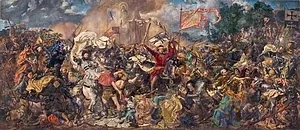
In the west the Grand Duchy of Lithuania waged a struggle against the Teutonic Order; the land of Samogitia, given up to the Germans, kept appealing to Lithuania with requests for liberation. At the Battle of Grunwald the united armies of the Kingdom of Poland and the Grand Duchy of Lithuania inflicted such a defeat on the Teutonic Order that the Order could never recover from it (1410). By the Peace of Thorn (1411) Jogaila and Vytautas received Samogitia for life; in 1422 the Teutonic Order finally renounced Samogitia.
In the 1410s the Horde forces led by Edigu thoroughly devastated the south of the Grand Duchy of Lithuania. In 1416 Kiev, the Pechersk Monastery and about ten surrounding towns were ravaged. In the following years Podolia was laid waste.
At the diet in Horodło the union of Lithuania with Poland was confirmed once more: diets were established in Lithuania, and the Lithuanian nobility was made equal in rights to the Polish. The consequence was a growth in the influence of the Poles and the Catholic clergy in Lithuania. Vytautas strove for a union of the churches, regarding the Uniate arrangement as a compromise that both the Orthodox and the Catholics could accept. But his negotiations on this matter and his support of the Hussites came to nothing. In his last years Vytautas contemplated separating Lithuania from Poland and planned to be crowned for this purpose, but the Poles intercepted the envoys bringing him the crown from the Emperor Sigismund.
Vytautas intervened in the affairs of the Grand Principality of Moscow when a dynastic quarrel began in 1427 between Vytautas's grandson Vasily the Blind and Vasily's uncle Yuri of Zvenigorod. Relying on the fact that the grand princess of Moscow, his daughter Sophia, together with her son, her people and her lands, had accepted his protection, Vytautas claimed dominion over all Rus'. Vytautas also intervened in the politics of European states and carried considerable weight in the eyes of European sovereigns. The Emperor of the Holy Roman Empire offered him a royal crown twice, but Vytautas refused and accepted only the emperor's third offer.
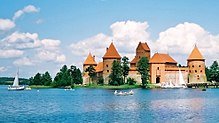
The coronation was scheduled for 1430 and was to take place in Vilnius, where numerous guests had gathered. The recognition of Vytautas as king and, accordingly, of the Grand Duchy of Lithuania as a kingdom did not suit the Polish magnates, who hoped for the incorporation of the Grand Duchy of Lithuania. Jogaila agreed to Vytautas's coronation, but the Polish magnates intercepted the royal crown on Polish territory. Vytautas was ill at the time; according to legend he could not bear the news of the loss of the crown and died in 1430 in his castle at Trakai, in Jogaila's arms.
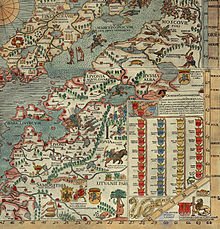
After the death of Vytautas, the princes and boyars of the Grand Duchy of Lithuania elected Švitrigaila, the younger brother of Jogaila, as grand duke at a diet; Jogaila recognized this election. This was done without consultation with the Polish king, magnates and lords, although such consultation had been provided for in the unions between the Grand Duchy of Lithuania and the Kingdom of Poland. The union between the Grand Duchy of Lithuania and Poland was thus broken, and moreover a military conflict between them soon began over Volhynia.
In 1432 a group of pro-Polish princes carried out a coup and placed Vytautas's brother Sigismund on the throne. This led to a feudal war between the supporters of Sigismund and Švitrigaila. In the course of the war Jogaila and Sigismund had to make a number of concessions in order to win over Švitrigaila's supporters. The outcome of the war was decided in 1435 at the Battle of Pabaiskas near Vilkomir (now Ukmergė), in which Švitrigaila's forces suffered very heavy losses.
Švitrigaila held out in the Rus' lands for several more years. Sigismund's rule did not last long: dissatisfied with his policy, suspicion and unfounded repressions, the Orthodox prince Czartoryski and the boyars formed a conspiracy against him, and he was killed in Trakai Castle (1440).
Some stood for Sigismund's son Michael, others for Švitrigaila, and still others for King Władysław. The latter, who had been elected king of Hungary at that time, sent his brother Casimir Jagiellon to Lithuania as viceroy, and Casimir was elected grand duke there. Some Rus' lands tried to take advantage of the instability of political power in the state to restore their independence (the Smolensk uprising of 1440-1442). The Poles' attempt to divide Lithuania between Władysław and Casimir provoked strong resistance in Lithuania. Following the advice of Gasztold, Casimir learned the Lithuanian language and grew accustomed to their customs. After Władysław's death the Poles elected Casimir king and demanded the union of Lithuania with Poland, but Lithuania resisted this. The question was raised at the diets (Lublin 1447, Parczew 1451, Sieradz 1452, Parczew and Piotrków 1453), but no agreement was reached.
In 1449 Casimir concluded a peace treaty with the grand prince of Moscow Vasily II, which divided the spheres of influence of the two states in Eastern Europe (in particular, the Novgorod Republic was recognized as lying in Moscow's sphere of influence), forbade each side from accepting the domestic political opponents of the other, and was observed until the end of the 15th century.
Under Casimir the Orthodox Metropolis of Kiev was established with its centre in Vilnius (1458), initially Uniate, and from 1470 under the jurisdiction of the ecumenical patriarch of Constantinople (while the Moscow metropolis retained its autocephaly). The Novgorodians' request to the metropolitan of Kiev to send them a new archbishop was followed by the seizure of the Novgorod land by the Principality of Moscow (1478). In 1480 the prince of Moscow Ivan III freed the lands under his rule from the Horde yoke, and in 1487 he assumed the title "Prince of Bulgaria", after which the Verkhovsky princes subject to Lithuania began to transfer into the service of the princes of Moscow together with their domains, which opened a series of wars known in Russian historiography as the "Muscovite-Lithuanian" wars. In particular, as a result of the war of 1500-1503 Lithuania lost about a third of its territory (the Chernigov-Seversk lands), and in 1514 the Smolensk lands.
Casimir expanded the international influence of the Jagiellonian dynasty: he subordinated Prussia to Poland and placed his son on the Bohemian and Hungarian thrones. In 1492-1526 the political system of the Jagiellons embraced Poland (with its vassals Prussia and the Principality of Moldavia), Lithuania, Bohemia and Hungary.
According to Casimir's will (he died in 1492), Poland passed to his son John Albert and Lithuania to Alexander. After the death of John Albert (1501), Alexander also became king of Poland. He sought to spread the Polish element in the Grand Duchy of Lithuania. Under him, in 1501, the political union of the Grand Duchy of Lithuania with the Kingdom of Poland was confirmed on the principles established already by Jogaila.
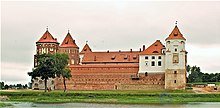
After Alexander, the youngest of the sons of Casimir, Sigismund I (1506-1548), was elected grand duke, and was later also elected king of Poland. His constant aim was an even closer rapprochement between Lithuania and Poland. He had to withstand the struggle with the claims of the szlachta, whose diets were constantly growing stronger. Sigismund's second wife Bona contributed much to the discord between the king, on the one hand, and the clergy and nobility on the other. The distribution of estates with exemption of the owners from obligations weighed heavily on the state treasury. Lands were at first distributed for temporary use, but gradually became hereditary. At the diet of 1535, on Sigismund's proposal, a resolution was passed to verify the szlachta's rights to land on the basis of the Crown Metrica. Sigismund resolved to carry out a general verification of the szlachta's rights and statutes, and then to restore certain taxes abolished by earlier kings, for example the ox-tax on cattle sold by the szlachta. This aroused strong discontent; when the "levée en masse" (pospolite ruszenie) against Moldavia assembled at Lviv in 1537, the szlachta did not want to join it and the campaign did not take place. This episode bears the ironic name of the "Chicken War". The Reformation penetrated Lithuania from Prussia, but at first spread rather weakly.
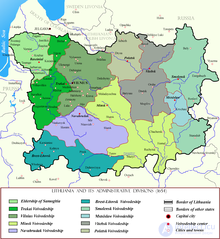
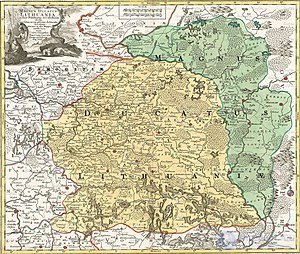
During the Livonian War, under Sigismund II Augustus (1522–1572), the Union of Lublin was concluded (1569). The union met with strong opposition from the Lithuanian elite, and only heavy pressure from the Kingdom of Poland forced Lithuania to agree. The Grand Duchy of Lithuania had to cede Podlachia, Volhynia and the Principality of Kiev to Poland. Livonia was declared a joint possession of both states. The Grand Duchy of Lithuania united with the Kingdom of Poland into a federal state, the Polish–Lithuanian Commonwealth. According to the act of the Union of Lublin (the original of which has not survived to this day), Lithuania and Poland were ruled jointly by an elected king, and affairs of state were decided in a common Sejm. However, the legal systems, currency, army and governments remained separate, and a border between the two states continued to exist, at which customs duties were levied. Three years later the Jagiellonian dynasty died out.
In the 16th–18th centuries the szlachta democracy prevailed in the Grand Duchy of Lithuania. In the second half of the 17th and early 18th centuries, after the devastating Russo-Polish War and Northern War of 1654–1667 and the Great Northern War of 1702–1709, the Commonwealth fell into decline.
In 1772, 1793 and 1795 three partitions of the territory of the Commonwealth took place among the Russian Empire, Prussia and the Austrian Empire. Under the St Petersburg Convention of 1795, most of the territory of the Grand Duchy of Lithuania was annexed to Russia, but the Białystok region, as well as Suvalkija (the territory between East Prussia and the Neman), went to Prussia. On 14 (25) December 1795 the Russian Empress Catherine II issued a manifesto "On the annexation to the Russian Empire of the whole part of the Grand Duchy of Lithuania which, after the cessation of the disturbances in Lithuania and Poland, had been occupied by troops"[29]. With this the actual existence of the Grand Duchy of Lithuania came to an end.
Subsequently, under the Treaty of Tilsit of 1807, Suvalkija became part of the Duchy of Warsaw, while the Białystok region went to Russia.
On 1 (13) July 1812, in Vilna, which had been occupied three days earlier during the Patriotic War, Emperor Napoleon I signed a decree on the restoration of the Grand Duchy of Lithuania. However, as early as 28 November (10 December) 1812 Russian troops returned to Vilna, thereby putting an end to the revived duchy.
After the Congress of Vienna (1815), when the Kingdom of Poland was created within the Russian Empire (including most of the abolished Duchy of Warsaw, among it Suvalkija), all the territories that had once formed the Grand Duchy of Lithuania became part of Russia.
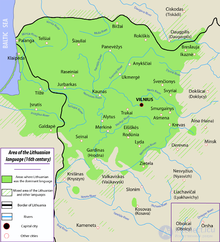
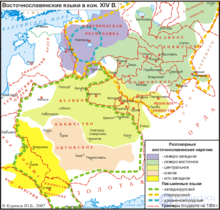
The Grand Duchy of Lithuania was a multiethnic state, owing to the ethnic heterogeneity of the lands that made it up. The ethnocultural basis of the duchy was formed by Slavs and Balts. The Slavic majority of the population consisted of the inhabitants of the former principalities of Rus, annexed by the Grand Dukes of Lithuania.
The Baltic population of the Grand Duchy of Lithuania (Samogitians, Aukštaitians, Dzūkians, part of the Yotvingians and Prussians) became the basis of the Lithuanian nation. The Slavic population of the duchy became the basis for the formation of two East Slavic peoples, the Belarusians and the Ukrainians.
The Grand Duchy of Lithuania was also inhabited by Poles (peasant colonists known as Mazurs, townspeople and, in part, the petty szlachta); Curonians, Latgalians, Selonians, Semigallians who had fled forcible Christianization in the 13th century, and Prussians (Bortai or Zukai, Skalvians, Lietuvininkai); Germans, who made up chiefly the merchant class and lived mostly in towns; Jews (Litvaks), Lithuanian Tatars, Karaites, and small groups of Scots (Schotten), Armenians, Italians, Hungarians and other peoples.
Official record-keeping was conducted predominantly in Ruthenian (Chancery Slavonic; in Belarusian historiography also known as Old Belarusian, in Ukrainian as Old Ukrainian), which arose from the interaction of the western dialects of the East Slavs with Old Church Slavonic[30]. The term "Old Belarusian language" was introduced into scholarly usage by the Russian Slavist philologist Yefim Karsky in 1893, on the basis of the closeness of the lexical structure of the Western Rus language to the popular Belarusian dialects of the 19th century. In the 14th–15th centuries the written Ruthenian language became the main language of the chancery of the Grand Duchy of Lithuania, retaining its dominant position until the mid-17th century[31], when it was displaced from official record-keeping by Polish, which in time also became the language of communication of the privileged estate (the szlachta). Official record-keeping was not conducted in Lithuanian proper.
It was the state language, which does not exclude the use of other languages in official record-keeping[32]. It is also noted that the state status of the Ruthenian language was enshrined in the Statutes of the Grand Duchy of Lithuania[33]. According to Lithuanian researchers, however, the written Ruthenian language cannot be called a state language, since it maintained a certain distance from the spoken languages. In this connection, Lithuanian historiography calls the written Ruthenian language the chancery language of the Grand Duchy of Lithuania[31].
According to Lithuanian scholars, on the basis of linguistic data, studies of lists of church registers, of educational institutions with indications of ethnic affiliation and language proficiency, of individual mentions in judicial sources testifying to the everyday linguistic situation, and of legal, economic and everyday terminology containing a large share of Lithuanianisms, the Lithuanian language in the Grand Duchy of Lithuania had a certain currency and was used as a language of communication in Samogitia and Aukštaitija, both by people of the lower estate and by the ruler's court and the most eminent boyars[31][34]. According to Belarusian researchers, the Lithuanian language was spread only among the lower estate of the population of ethnic Lithuania, although the inhabitants of these lands gradually switched to Slavic languages[35]. In the Rus lands of the Grand Duchy of Lithuania, East Slavic dialects were spoken, which formed the basis of the Belarusian and Ukrainian languages and were called "Ruthenian" or "the Ruthenian tongue"[31].
In the 18th century, literary monuments in the written Ruthenian language are represented mainly by interludes, short insertions into a text in another language. At the end of the 18th century the main documents began to be printed in Polish, the first parallel translations of individual documents into Lithuanian appeared, published for the inhabitants of the Grand Duchy of Lithuania, while the Ruthenian language was being displaced from official record-keeping. Thus the Constitution of 3 May 1791 was written in Polish and immediately translated only into Lithuanian (it became the first legal act in that language).
From 1791 translations of Sejm resolutions into Lithuanian also appear. Tadeusz Kościuszko's "Proclamations" of 1794 to the insurgent inhabitants of the Grand Duchy of Lithuania likewise address their fellow citizens in Lithuanian, among other languages[36].
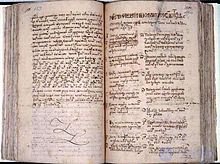
The legal structure of the Grand Duchy of Lithuania was built on the norms of Old Rus law ("We do not disturb the old, we do not introduce the new"), which in turn had been substantially influenced by the norms of Byzantine civil and criminal law. From the second half of the 14th century, as a result of the union with the Kingdom of Poland, Roman law was gradually adopted. The legal structure was set out in the Code of Laws (Sudebnik) of 1468 and then in three Statutes: those of 1529, 1566 and 1588.
The development of the social and legal structure of the Grand Duchy of Lithuania was connected with the development of feudal relations, the growth of towns and the formation of the szlachta estate (the boyars), and from the second half of the 16th century with the gradual enserfment of the peasants on the Polish model.
The culture of the Grand Duchy of Lithuania took shape on the territory of present-day Lithuania, Belarus, most of Ukraine, part of Poland and part of Russia, developed under the influence of interrelated socio-economic, estate-class and political factors, and drew on the rich Old Rus heritage and Western traditions. It had typical features common to East Slavic and European cultures.
When the Grand Duchy of Lithuania arose, the lands that entered it were at different levels of economic, political and cultural development. The main ethnic features of the material and spiritual culture of the Grand Duchy of Lithuania were determined in the 13th–16th centuries, when, as a result of a broad field of interaction among East Slavic, West Slavic and Baltic cultures, cross-cutting phenomena appeared. The territories of present-day Ukraine, Belarus and, in part, Russia made up 90% of the total area of the duchy, and in essence a single metaculture emerged in the Grand Duchy of Lithuania by the end of the 16th century. This was also promoted by historical traditions and cultural and linguistic closeness. The cultural life of the state was characterized by the presence of two tendencies: ethno-religious self-awareness oriented toward traditional cultural values, and a natural interaction of cultures that created a single cultural space.
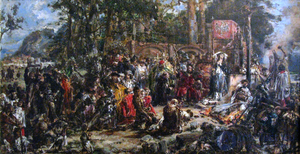
Before the Union of Krewo, there were two territories of unequal size in the Grand Duchy of Lithuania, differing in religion: the north-west of the state preserved traditional paganism, while the other part of the state had been converted to Orthodoxy as early as the Old Rus period. After the Union of Krewo the active spread of Catholicism began, enjoying the support of the central authorities. From the mid-16th century, under the influence of the Reformation, Protestant ideas spread in the Grand Duchy of Lithuania and were widely embraced among the magnates. In 1596 the Union of Brest was concluded, as a result of which part of the Orthodox recognized the authority of the Pope of Rome and took shape as a separate Catholic church that adheres to the Byzantine rite and is known as Uniatism. Among non-Christian religions in the Grand Duchy of Lithuania, the most widespread were Judaism and Islam, first recorded here in the 14th century.
In the 13th century literacy began to spread among townspeople, merchants and craftsmen. In the 14th and especially the 15th century schools were established on large estates. The teaching of children by itinerant self-taught teachers ("masters of literacy", "directors") expanded. The course of instruction was limited to elementary literacy.
As Catholics penetrated Lithuania, they also founded their own schools. One of the first was the college founded by Queen Jadwiga for 12 Lithuanians at the Prague Academy; later the Kraków Academy was established, where many Lithuanian boyars completed the course. However, Catholic schools too taught at first in Ruthenian. Thus in 1454 a school for the training of clergy was founded at Vilnius's Cathedral of St Stanislaus. Representatives of secular professions also studied at this school, but a considerable part of its graduates were intended for clerical service in churches. From its foundation until the early 17th century the sciences at this school were taught in Latin and Ruthenian. Teaching in church schools not only of Lithuania but also of Samogitia was conducted in Ruthenian right up to the end of the 17th century[37].
In the 16th century Calvinist schools arose in the towns and townlets of the Grand Duchy of Lithuania, and later schools of various Catholic orders: Jesuits, Basilians, Arians. In the 16th–17th centuries brotherhood schools played an important role in organizing education.
In the 1550s Calvinist congregations arose in Vilnius, Brest, Kėdainiai, Nesvizh, Biržai, Kletsk, Dubingiai. By the 1560s most of the magnates of the Grand Duchy of Lithuania had adopted Calvinism, and the number of congregations grew. Churches began to be built and schools established at the congregations.
In the second half of the 16th and early 17th centuries Calvinist schools existed in Šiluva, Vitebsk, Novogrudok, Orsha, Iwye, Smarhon, Zaslawye, Kaunas, Minsk, Kopyl, Plungė, Koidanov, Lyubcha, Iwyanets, Retavas and other places.
Particular attention in the schools was paid to religious upbringing, but a considerable place was also given to secular subjects: theology, various languages, rhetoric, history, mathematics, ancient poetry and church singing were studied.
Study lasted 6–10 years. Graduates of some schools acquired knowledge sufficient for admission to a university.
Arianism, as a current in Christianity, appeared at the beginning of the 4th century in the Roman Empire. In the 16th century the ideas of Arianism revived in the form of the teaching of the Socinians, and reached the Grand Duchy of Lithuania as well. The most significant Socinian congregations were in Novogrudok, Iwye and Nesvizh. Schools were opened at the congregations. Thus there were schools in Iwye, Kletsk, Lyubcha, Łosk and Nesvizh.
The schools had 3–5 classes. Besides theology, they taught the works of ancient philosophers, Greek, Latin, Polish and Belarusian, rhetoric, ethics, music, arithmetic and more. The children of not only Socinians but also of other Catholics and of the Orthodox studied there.
The best-known was the school in Iwye. In 1585–1593 its rector was Jan Licinius Namysłowski.
Educational institutions of the Catholic Piarist order appeared in the Grand Duchy of Lithuania in the 18th century. There were schools in Vilnius, Shchuchyn, Raseiniai, Voronovo, Dukštas, Mogilev, Ukmergė, Rossony, Postavy, Panevėžys, Vitebsk and Zelva. In 1726 a Piarist college was founded in Vilnius, which operated until 1842. In 1782–1831 the Polotsk Higher Piarist School operated.
They brought up children in a spirit of religiosity and devotion to the order. Instruction was considered free, but children from poor families performed work for the monastery.
In the 1740s, on the initiative of the Polish Enlightenment figure S. Konarski, a reform of Piarist schools was carried out: a course of theology was introduced, along with the study of the Polish language and literature, mathematics, music and drawing.
Orthodox brotherhoods were usually established at churches and monasteries. Brotherhood schools were opened in Brest (1591), Mogilev (1590–1592), Minsk (1612) and other towns of the Grand Duchy of Lithuania.
The school was headed by a rector; teachers were elected at meetings of the brotherhood. The schools were open to all estates and had 3–5 classes. They taught various languages, rhetoric, the works of ancient thinkers and music. Some knowledge of arithmetic, geography and astronomy was also given.
On 26 July 1400 the Polish king Jogaila revived the activity of the University of Kraków, which was of particular importance not only for Poland but also for the Grand Duchy of Lithuania: until either the University of Königsberg (1544) or the University of Vilnius (1579) was founded, the University of Kraków was the main higher school for Lithuanian youth. Jogaila supported Lithuanians studying at the university: in 1409 he ordered a house to be set aside to accommodate poor students, especially those who "had come from Lithuania and Rus".
The multilingual literature of the Grand Duchy of Lithuania developed in Ruthenian, Church Slavonic, Polish, Latin and Lithuanian.
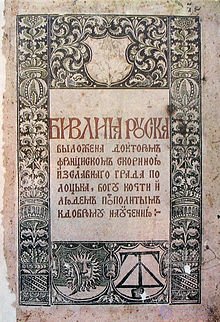
Book printing on the territory of the Grand Duchy of Lithuania was begun by Francysk Skaryna of Polotsk, a doctor of medicine. In 1517 he printed a Czech psalter in Prague, then 22 sacred books in translation into the Belarusian recension of Church Slavonic (or, according to another view, into the ecclesiastical style of Ruthenian), having first checked the translations against the Greek and Hebrew texts and the Vulgate. Having moved his activity to Vilnius, Skaryna printed the "Apostol" and the "Psalter" in 1526.
In Lithuania the well-known Russian first printers Ivan Fyodorov and Pyotr Mstislavets also continued their printing activity after fleeing from Moscow. They worked for Hetman Hryhory Khodkevych, who founded a printing house on his estate at Zabłudów. The first book printed at the Zabłudów press by Ivan Fyodorov and Pyotr Mstislavets was the "Teaching Gospel" (1568), a collection of homilies and instructions with commentary on the Gospel texts. In 1570 Ivan Fyodorov published the "Psalter with Book of Hours", which was also widely used for teaching literacy.
The first book in Lithuanian was compiled and published in Königsberg in 1547 by Martynas Mažvydas[38], "The Simple Words of Catechism". Besides the catechism, the book contained a verse preface in Lithuanian, eleven church hymns with musical notation, and the first Lithuanian primer. In Vilnius in the 16th–17th centuries there were the printing houses of the land and tribunal scribe Melchior Pietkiewicz and of the native of the city Jakub Markowicz. In 1598 Pietkiewicz published in his printing house the first Protestant book in Lithuanian in the Grand Duchy of Lithuania[39]. In 1600 Markowicz, with the support of Voivode Krzysztof Radziwiłł "Perkūnas", published the "Postilla lietuviška …"[40], the largest work in Lithuanian published in the Grand Duchy of Lithuania in the 16th century[41].
In 1629 Konstantinas Sirvydas[42], professor at the University of Vilnius, prepared the first Polish-Latin-Lithuanian "Dictionary of Three Languages". The first edition appeared in Vilnius around 1620, and the dictionary was then reprinted many times: a second, expanded edition in 1629; then 1631, 1642, 1677 and 1713. The dictionary was intended for students studying poetics and rhetoric and contained about 14,000 words. Until the mid-19th century it remained the only dictionary of the Lithuanian language printed in Lithuania (dictionaries of Lithuanian were published in Prussia). Sirvydas also published a collection of sermons (more precisely, outlines or brief summaries of sermons), "Punktai sakymų", in Lithuanian and Polish (first edition 1629, second 1644). He published commentaries on the Song of Songs and on the Epistle of the Apostle Paul to the Ephesians. In 1629 or 1630 Konstantinas Sirvydas prepared and published the first grammar of the Lithuanian language, "The Key to the Lithuanian Language", but this edition has not survived. In 1737, also at the University of Vilnius, a grammar of the Lithuanian language, "Grammar of the Principal Dialect of the Lithuanian Duchy", was published by an unknown author.
In the 17th century Kėdainiai became an important publishing centre of the Grand Duchy of Lithuania. Here, next to the Reformed school founded in 1625, a publishing house was opened in 1651 on the initiative of Janusz Radziwiłł.
In 1653 in Kėdainiai, the native of the city and burgomaster (1631–1666) Steponas Telega, with the help of Janusz Radziwiłł, published in Lithuanian, in a print run of 500 copies, a large work, "Knygą
продолжение следует...
Часть 1 The Grand Duchy of Lithuania, Ruthenia and Samogitia
Часть 2 See also - The Grand Duchy of Lithuania, Ruthenia and

Comments