
Lecture 56 min.
Это окончание невероятной информации про великое княжество литовское русское и житомирское.
...
nabožnystės krikščioniškos". The book has the first verse dedication in Lithuanian, to Janusz Radziwiłł, asking him "to graciously accept this work, to heed the Word of the Lord, to pray to God, to sing mercifully". This is the largest Calvinist publication in the Grand Duchy of Lithuania. Besides this work, the printing house published works by Samuel Minwid, Jan Bojanowski the Elder, Jan Bojanowski the Younger, Samuel Tomaszowski, Samuel Bogusław Chyliński and, separately from the first, Jan Bojanowski the Elder; a Bible in Lithuanian was being prepared, and a treatise by Adam Rasius on politics and law in trade was published.
Music
The musical art of the Grand Duchy of Lithuania developed within both folk and high culture. Initially church music had the greatest influence; in the 17th century secular music began to develop actively, which resulted in the creation of private orchestras and chapels. The first opera and ballet theatre of European standard appeared in Nesvizh in 1724. Plays for the theatre were written by the wife of Michał Radziwiłł, Franciszka Urszula. The well-known German composer Johann David Holland served as kapellmeister in the court chapel of Karol Stanisław Radziwiłł[be]. In the 18th century classical works by foreign and local authors were staged in the theatre.
Theatre
The origins of the theatrical art of the Grand Duchy of Lithuania lie in the folk theatre with its ritual songs and dances, in which elements of play-acting and theatrical transformation were present. Elements of theatricalized action are found in many calendar and family rituals. The first actors were the skomorokhs (minstrels), whose performances, rich in folk songs, dances, proverbs and sayings, jokes and tricks, became the highlight of any festival. Later, in the 17th–18th centuries, the art of the skomorokhs was transformed into fairground booths (balagany), and the art of puppet theatres into the vertep. Sometimes the skomorokhs performed with bears trained in special schools, the best known of which was the Smarhon Bear Academy. A school of rope jumpers existed in Semezhevo near Kopyl.
The folk puppet theatre, the batleika, became widely known. For batleika performances a peculiar stage was used, consisting of a wooden box in the form of a little house or church with horizontal partitions serving as separate tiers, or stages. The stage was decorated with cloth, paper and geometric figures made of thin sticks, and resembled a balcony on which the action took place. The box was closed with doors. The need for a multi-tiered box construction disappeared when batleika shows took on a secular character. The puppet characters were made of wood, coloured paper and cloth. The puppets were attached to a rod, with which the batleika operator moved them along slots in the tier-stage. A batleika with string marionettes is also known, as well as glove puppets. In time the originally religious repertoire of the batleika was supplemented with material from real life and folklore, with the canonical plot performed on the upper tier and the secular one on the lower tier. The greatest popularity was enjoyed by the secular repertoire with comic scenes, folk songs and dances.
In the 16th–18th centuries the so-called school theatre was widely represented in Orthodox academies and brotherhood schools and in Jesuit, Basilian, Piarist and Dominican colleges and schools, showing interludes and dramas on biblical and, later, also historical and everyday subjects. Performances were given in Latin, Polish, Lithuanian[43][44][45] and Ruthenian, and the sketches used the devices and plots of the batleika. The actors were pupils, who were trained in stagecraft by teachers of rhetoric. The school theatre had its own elaborate poetics with canonized means of stage movement, manner of performance, make-up and design of the stage space. The stage was lit by footlights and had a painted backdrop and three-dimensional scenery for stage effects. Performances took place especially often in Jesuit educational institutions, where the school theatre was given particular importance as a method of upbringing.
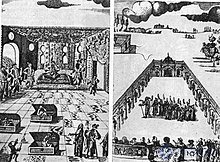
The 18th century saw the emergence of professional theatre in the Grand Duchy of Lithuania. From 1740 an amateur serf theatre of the Radziwiłł princes operated in Nesvizh, staging works by Urszula Radziwiłł, including plays by Molière that she translated and adapted. In 1753–1762 Prince Michał Radziwiłł "Rybeńko" gave the Nesvizh theatre a professional character; it also operated as a touring company. Opera and ballet enjoyed great popularity. Besides Nesvizh, well-known magnate theatres existed in Slutsk, Grodno, Minsk, Slonim, Shklow, Svislach, Ruzhany and Mogilev.
Architecture
Visual arts
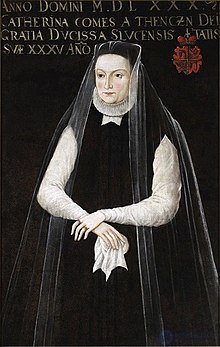
In the 14th–16th centuries painting, graphic art and sculpture developed in the Grand Duchy of Lithuania, and secular forms of art took shape. The visual art of the Renaissance in the state was strongly influenced by the rich traditions of Byzantine and Old Rus' cultures. By the middle of the 16th century the influence of the Italians was already felt, for example in the work of an unknown Mannerist master, the portrait of Katarzyna Teńczyńska-Słucka. The art of the Grand Duchy of Lithuania in this period is characterized by an interest in showing the inner world of the individual and his or her moral character. In painting there is a heightened interest in dramatic situations. The portrait genre developed especially actively. One of the most outstanding monuments of the genre of Sarmatian portraiture is the portrait of Jerzy Radziwiłł, painted in the second half of the 16th century.
Artists turned to sculpture and painted icons. Princely palaces, churches and Catholic churches were decorated with fresco paintings. Masters from the Grand Duchy of Lithuania executed paintings on the territory of other states, above all Poland. An example is the paintings in Lublin Castle, executed in the 15th century by Lithuanian painters under the direction of the Minsk master Andrei. In the creation of icons in the 14th–16th centuries, decorative and sculptural devices (carving and modelling), colouring of the background, various applied elements, and coating of the painted surface with a protective varnish of egg white or resin were used. A fine example is the icon of the turn of the 14th–15th centuries "Our Lady of Tenderness" from Malaryta.
In 1496–1501 the Lithuanian wood carver Ananiya created for Fyodor Yaroslavich, Prince of Pinsk, a unique carved icon, "Wisdom Hath Built Her House"[46].
Часть 1 The Grand Duchy of Lithuania, Ruthenia and Samogitia
Часть 2 See also - The Grand Duchy of Lithuania, Ruthenia and

Comments