
Lecture 45 min.
Colonialism is a system of domination by a group of states and countries (metropoles) over the rest of the world from the 16th to the 20th centuries.
Colonial policy is a policy of conquest and often exploitation, by military, political and economic methods, of peoples, countries and territories, mainly those with a population of a different nationality and, as a rule, economically less developed.
The German historian Jürgen Osterhammel defines colonialism as a complex process of the physical (and later also economic, political and cultural) seizure of a colony by an imperial centre and the retention of control over it . Colonialism differs from any other conquest of lands (for example, occupation and annexation) in the idea of a "civilizing mission". The conquerors want to instil in other peoples "civilization" and their own ideas about the organization of the world, statehood and way of life.
Colonization (from Latin colo, "to inhabit, to dwell, to settle") is the detaching of settlements or the founding of new settlements on foreign territory, or the settlement and development of one's own outlying lands (internal colonization) .
The stimuli of colonization (the colonization movement) in the world were overpopulation, religious and political persecution and the like, for example, the persecution of Christians under Decius, the Great Persecution, and the wars of religion in France.
Colonization is closely connected with the concept of migration, but it does not automatically imply that the colonizing community loses control over its former territory. In antiquity, colonization and the founding of colonies were a widespread practice among colonizing peoples such as the Phoenicians, Greeks and Romans. Beginning with the Age of Discovery, European colonization spread to various countries and continents. In time, the possession of colonies became so politically and economically important for the leading states that historiography speaks of an age of colonialism.
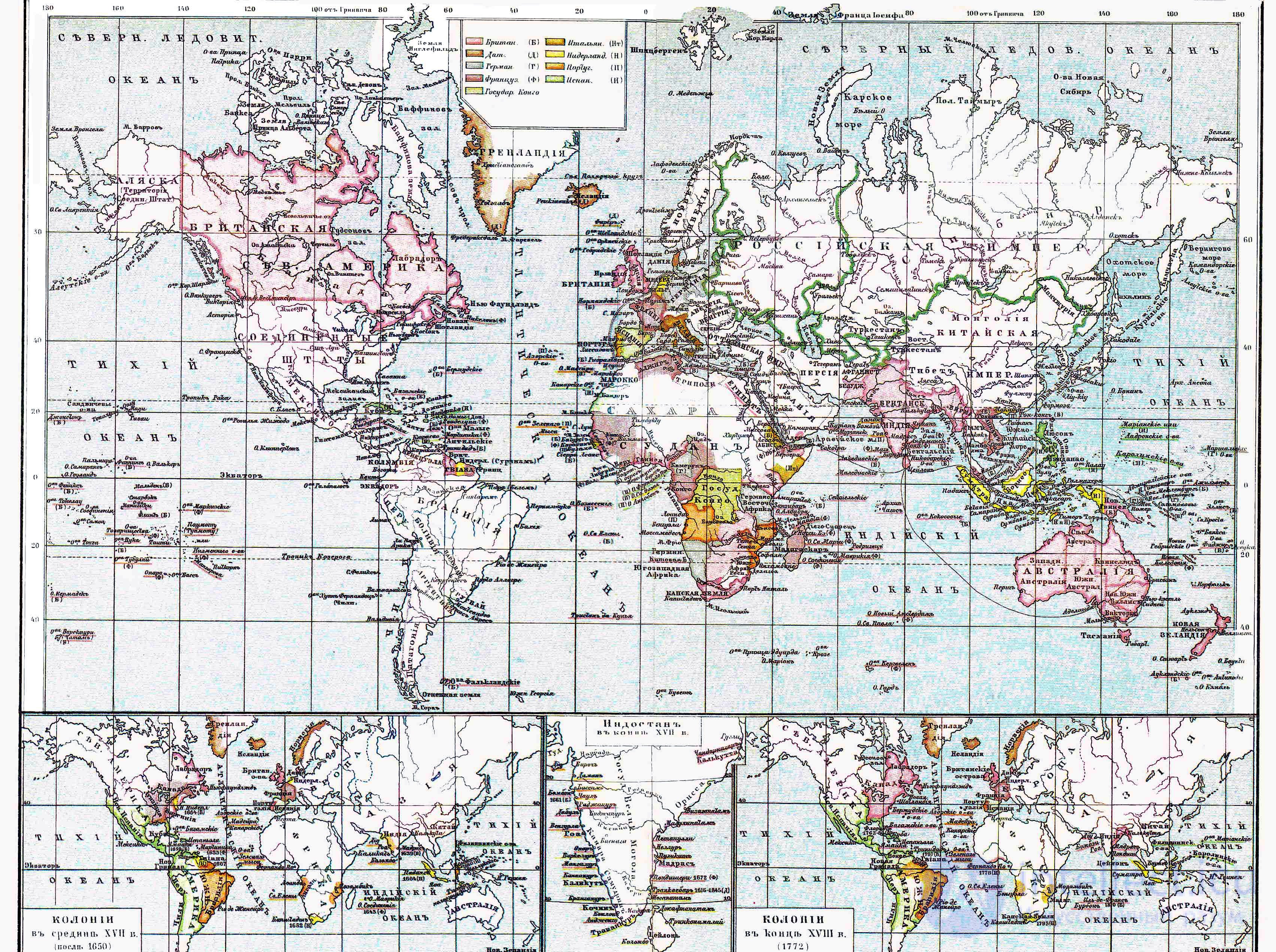
Colonial possessions of the European states, illustration from the Brockhaus and Efron Encyclopedic Dictionary, 1890-1907
The term internal colonization is also used. Sparsely populated states often invited foreign colonists for this purpose, granting them various kinds of privileges.
The chief stimuli of the colonization movement are: the lack of free land in a state or country, overpopulation caused by insufficiently intensive production or by the concentration of landed property in the hands of a few persons, political or religious persecution, the desire to find a more profitable investment for capital, and the like.
One of the cardinal questions of colonization policy is the question of the rational distribution of landed property in the colonized country (region), since the whole subsequent economic and political fate of the country and its people (peoples) depends to a large extent on one or another arrangement of land relations. Initially, all states that founded colonies adhered to a system of distributing lands to the first conquerors (conquistadors) and to government officials, thus creating a landed aristocracy; the Spaniards and Portuguese followed this course in founding colonies in America; the French, in colonizing Canada, formed a feudal system in the full sense, both secular and ecclesiastical; the English acted in exactly the same way in the early period of their colonizing activity. The harmful aspects of such a system were that the cultivation of the new lands had to remain, quite needlessly, extremely extensive for a very long time, and all those inconveniences and disorders that are generally associated with the concentration of vast tracts of land in a few private hands made themselves felt.
The alternative was either a system of selling lands or a system of distributing them as a reward for some culturally useful undertakings, such as, for example, building railways, digging canals and the like. The most striking manifestation of this policy was the passing in the USA and Canada of laws known as the homestead laws (see Homestead).
Decolonization is the process of the attainment of political independence by European colonies (dominions, protectorates and mandated territories) after the Second World War, chiefly in Asia and Africa.
Used in the neutral sense of the withdrawal of imperial powers, the term Entkolonisierung was used in Germany from 1930, especially by Moritz Julius Bonn [German]. After emigrating to Britain, he translated it into English as "decolonization". This scholar even predicted in his book The Crumbling of Empire (1939) that the world would soon witness the collapse not only of the British Empire but of all colonial empires.
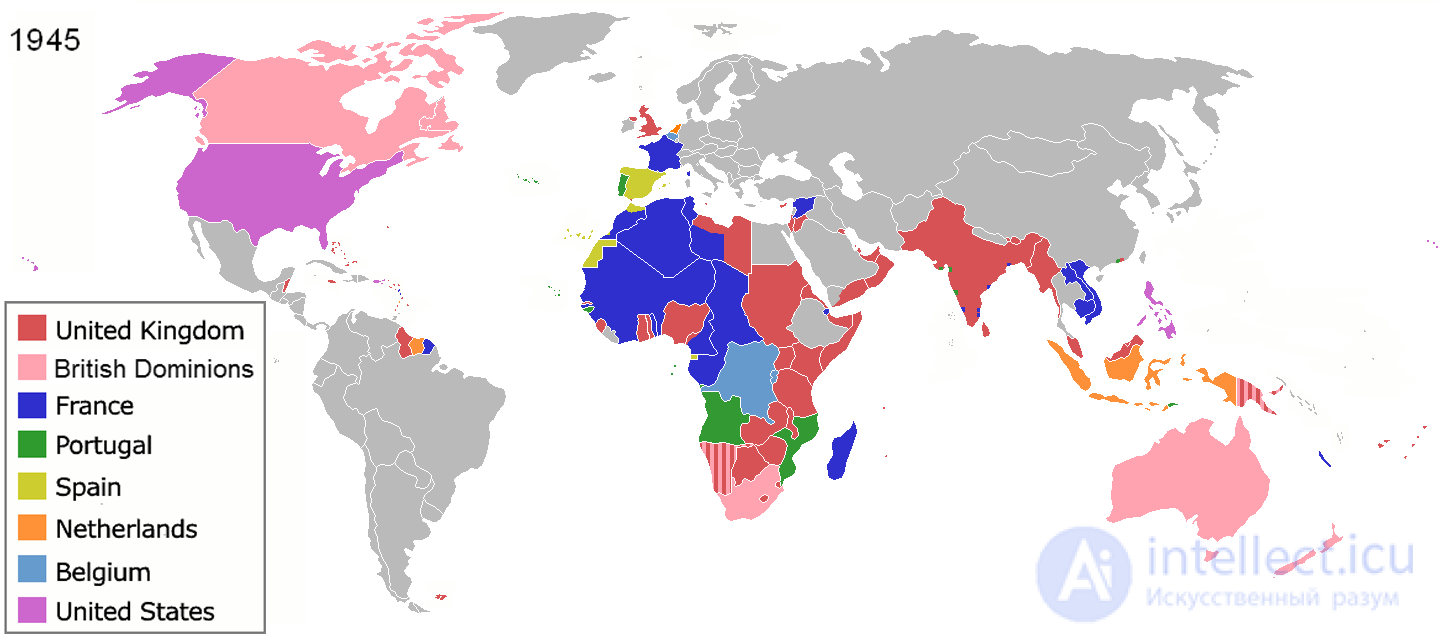
Colonial empires in Asia and Africa in 1945
The term decolonization was introduced into scholarly usage in the 1930s, but only after thirty years did it become popular among historians and political scientists.
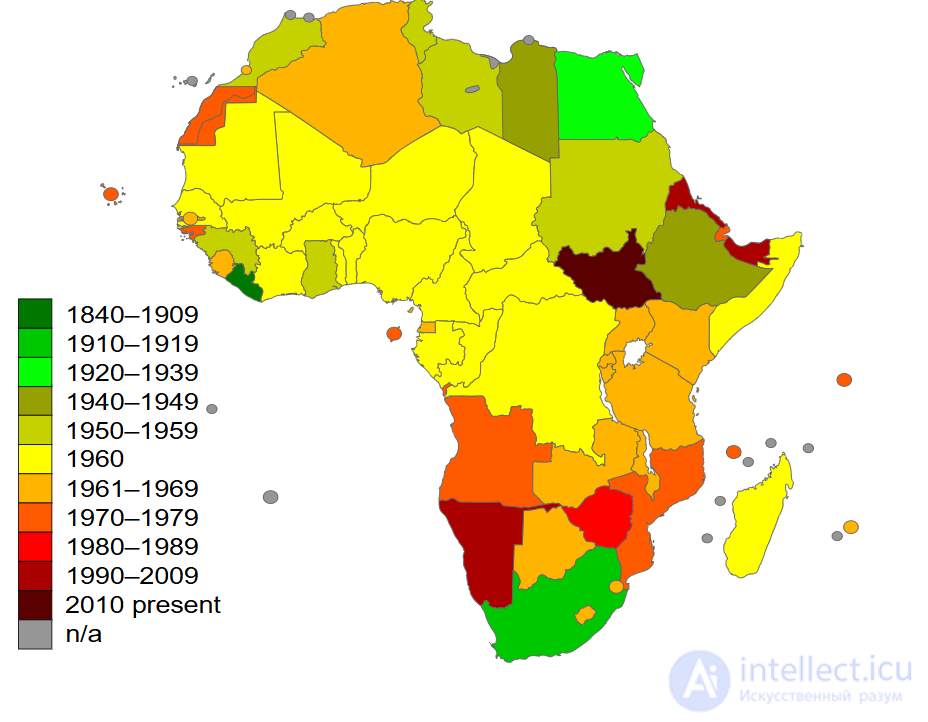
Dates of independence of African countries
By the middle of the 20th century the economic power of the European colonial powers had weakened, and they already found it hard to maintain troops, police and administration in their colonies. The colonies had long since ceased to bring the metropoles super-profits; the metropoles often spent more on keeping them under their rule than they received in return. Meanwhile, new elites were forming in the colonies: entrepreneurs, administrators and large landowners, who increasingly chafed under the rule of the colonizers. The contradictions between the democratic system of most metropoles and the autocratic system of governing their colonies also grew sharper, which led to political concessions to the national forces in the colonies.
The liberation movement, which began in the early 20th century and revived in the interwar period, gained greater strength during the Second World War, with the creation of the UN and the expansion of national liberation movements in the 1960s.
Before the Second World War some progress had appeared in this direction: the limited independence of Egypt, proclaimed by Great Britain in 1922, and the independence of Iraq, recognized in 1932. On the other hand, on 24 March 1934 the United States decided to grant independence to the Philippines (the Tydings-McDuffie Act), in accordance with the commitments assumed by President Wilson and the programme of the Democratic Party, which opposed "imperialism and colonial exploitation". By plebiscite the Filipino people agreed to wait for independence until 4 July 1946, content until then with internal autonomy.
The Second World War seriously weakened the colonial empires. The surrender of France to the enemy, and the Japanese seizure of a number of Asian colonies of Great Britain and France, as well as of the Dutch East Indies, dispelled among the colonial peoples the notion of the invincibility of the white man. Moreover, during the years of resistance to the Japanese occupation, fighting organizations arose in a number of colonies that gained experience in waging guerrilla warfare (the Hukbalahap in the Philippines, the Viet Minh in Vietnam, the Burma National Army in Burma). Finally, the Second World War definitively turned the USA and the USSR, which were hostile to colonialism, into superpowers.
The Atlantic Charter of 1941, which proclaimed the right of nations to choose their form of government and the restoration of the sovereign rights and self-government of those peoples who had been forcibly deprived of them, marked the beginning of the policy of decolonization. But Churchill made it clear that he had in mind only areas under German and Japanese occupation. France and Great Britain became permanent members of the UN Security Council, where they vetoed proposals to include the right to self-government in the UN Charter. In the course of the disintegration of the colonial system, the right to self-determination as a principle of international law gained recognition first in Article 1 of the UN Charter, which entered into force in 1945, and then in the Declaration on the Granting of Independence to Colonial Countries and Peoples (adopted by Resolution No. 1514 of the 15th UN General Assembly of 14 December 1960) and in subsequent international covenants and UN declarations.
As a new economic and military superpower, the United States regarded the European empires as an obstacle to opening borders to trade and investment. Nevertheless, it most often preferred to support its allies France and Great Britain in their colonies. The Soviet Union, for its part, wanted to stand out as a supporter of resistance to Western imperialism, but in the postwar period it was most concerned with securing control over Eastern Europe.
As early as 1943, during the Second World War, France granted independence to Syria and Lebanon. In 1945, at the end of the war, the leaders of the liberation movements of two other countries, Indonesia (Sukarno) and Vietnam (Ho Chi Minh), themselves proclaimed their independence after the defeat of Japan, which had occupied these countries, and the resulting political vacuum. The metropoles did not recognize this independence, and French troops and administration returned to Vietnam, and Dutch ones to Indonesia. Nevertheless, the colonial wars of France in Vietnam (1946-1954) and of the Netherlands in Indonesia (1947-1949) then ended in defeat for the metropoles.
Korea was liberated in 1945 as a result of Japan's defeat in the war. The USA relinquished the Philippines in 1946. Great Britain left India in 1947 and Palestine in 1948. In the same year, 1948, dominion status was granted to British Ceylon, while Burma immediately became a republic. In 1951 Libya gained independence. In 1953, in the midst of a protracted war in Vietnam, France decided to recognize the independence of Cambodia and Laos. Thus by the mid-1950s most of the Asian colonies of the European powers had gained independence.
Important milestones in the process, which consolidated the colonies' aspirations for liberation and confirmed the irreversibility of the process, were the Bandung Conference of 1955, the Cairo Conference of 1957 and the Accra Conference of 1958.
In 1946 the French Empire was renamed the French Union. The participation of deputies from the African colonies in the work of the Union's parliament gave them valuable political experience, which they later applied at home. In 1956 the executive authorities of the French colonies became responsible to their elected assemblies. In 1958 the French Union was transformed into the French Community, and the colonies were granted the right to leave it.
The second stage of decolonization began in 1956 with France's renunciation of its protectorate over Morocco and Tunisia, and Spain's of its protectorate over the Spanish zone of Morocco. In 1957 Ghana and Malaya (Malaysia) gained independence from Great Britain. In 1958 France granted independence to Guinea. The year 1960 went down in history as the Year of Africa: in that year 15 French and British African colonies gained independence at once, as well as the Belgian Congo and the Italian trust territory of Somalia.
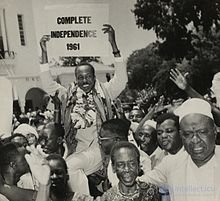
March 1961. Julius Nyerere with a placard demanding full independence for Tanganyika in 1961
In 1962 the Algerian War of Independence, which had continued since 1954, ended with France's recognition of Algeria's independence. In the same year Great Britain granted independence to Tanganyika and Uganda, and Belgium to Rwanda and Burundi. In 1964 the British colonies of Kenya, Nyasaland (Malawi) and Northern Rhodesia (Zambia) gained independence. The British Empire was able to transfer power to local elites in most cases peacefully (although there were the Mau Mau uprising of 1952-1956 in Kenya, the Chinese communist insurgency of 1948-1960 in Malaya, and the Aden crisis) and was transformed into the Commonwealth of Nations.
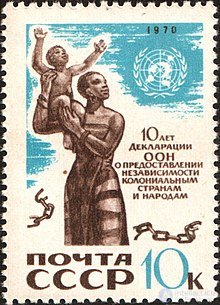
Soviet postage stamp of 1970
In 1974 Portugal, which since the 1960s had been waging war against insurgents in Angola, Guinea-Bissau and Mozambique, granted independence, after the "Carnation Revolution", to Portuguese Guinea (Guinea-Bissau), and in 1975 to Angola, Mozambique, Cape Verde, Sao Tome and Principe, and East Timor.
After the liberation of the Portuguese colonies in Africa, only such remnants of white colonization remained as the apartheid regime in South Africa, which lasted until 1990, and white minority rule in Southern Rhodesia (Great Britain did not recognize the independence proclaimed in 1965 by the Southern Rhodesian regime of I. Smith, but with the support of South Africa it was able to hold out until 1980, when, as a result of a guerrilla movement inside the country and pressure from world public opinion, the white minority yielded power to representatives of the black majority, who won the parliamentary elections of the new republic of Zimbabwe).
The process of decolonization was finally completed with the liberation of Namibia from South African rule in 1990, as well as with the transfer of Hong Kong by Great Britain to the PRC in 1997 and of Macau by Portugal to the PRC in 1999.
Very little remains of the vast colonial possessions of the past. Great Britain administers a dozen overseas possessions (some with internal autonomy); France administers 9 overseas departments and territories. The Netherlands administers the Netherlands Antilles. Spain holds Ceuta and Melilla on the coast of Morocco. The United States administers islands in Oceania (Guam, the Northern Mariana Islands, American Samoa), the US Virgin Islands and the "associated state" of Puerto Rico.
In 1945, when the UN was founded, about 750 million people lived in territories under colonial dependence, which was almost a third of the world's population. Today fewer than 2 million people live in the 17 non-self-governing territories.
While decolonization in the formal sense meant the transition to national sovereignty with its own political institutions, in the 1960s and 1970s many former colonies demanded a new international economic order. This was the result of formal and political independence that was not followed by corresponding economic independence. An important driving force was a broad alliance of states called the G-77, which in 1964 comprised 77 developing member states of the UN (the name has been kept, although today their number is 134). The programme included national control over natural resources, regulation of foreign companies, more predictable commodity prices, industrialization and protection of private business at the initial stage.
After the abolition of colonial rule, the borders of the colonial possessions became the borders of the new states without regard for their ethnic characteristics. This became one of the causes of recurrent interethnic conflicts. The formation of national statehood in Africa and Asia was accompanied by an almost universal establishment of authoritarian forms of political rule; personal and ethno-religious ties became the main methods of real political leadership, and corruption flourished.
The former metropoles did not renounce their influence over their former colonies. As early as the 1950s the term "neocolonialism" appeared, denoting the mechanisms by which one sovereign state is covertly subordinated to another, more developed one. Thus, in the 1960s France began pursuing in its former colonies a so-called "policy of cooperation" covering the military, financial and cultural spheres. France's foreign cultural policy, intended to promote its political and economic interests among postcolonial countries by means of "soft power", is called "Francophonie" .
Whereas in the past Europeans emigrated to the colonies, today a migration flow can be seen in the opposite direction . Decolonization is also invoked in demands that academic institutions give more room to non-Western perspectives and to the voices of the Global South and of indigenous minorities. Museums, too, are under strong pressure to return art and historical objects taken from the colonies[10][11].
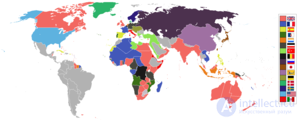
World empires and colonies in 1898, before the outbreak of the Spanish-American War, the Second Boer War and the Boxer Rebellion
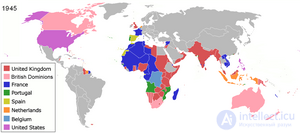
World empires and colonies in 1945
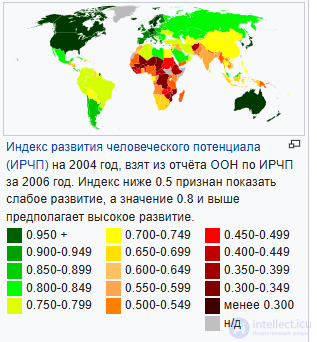
Human Development Index (HDI) for 2004, taken from the UN HDI report for 2006. An index below 0.5 is considered to indicate poor development, while a value of 0.8 and above suggests high development.
As long as imperialism exists, it will, by definition, seek to dominate other countries. That domination is what is today called neocolonialism.Che Guevara, from a speech on the Marxist revolution, 1965
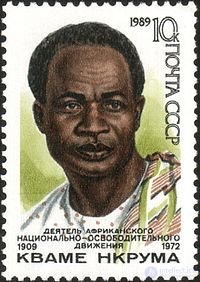
Kwame Nkrumah, the first president of the Republic of Ghana and one of the coiners of the term "neocolonialism", depicted on a Soviet stamp (1989).
The term "neocolonialism" first came into wide use, particularly in connection with Africa, after the process of decolonization, which consisted of the struggle of many national independence movements in the colonies after the Second World War. After independence, some national leaders and opposition groups began to argue that their countries were subjected to a new form of colonialism practised by the former colonial powers and other developed nations. Kwame Nkrumah, who in 1957 became head of the independent Republic of Ghana, was the first critic of what later received the classic definition of neocolonialism. This explanation is set out in one of the first books to use the term, "Neo-Colonialism, the Last Stage of Imperialism" (1965) . This work presents itself as a supplement to "Imperialism, the Highest Stage of Capitalism" (1916), in which Lenin argues that the imperialism of the 19th century is based on the needs of the capitalist system. Nkrumah says that "in place of colonialism, as the main instrument of imperialism, we have today neo-colonialism. Neo-colonialism, like colonialism, is an attempt to export the social conflicts of the capitalist countries". He goes on:
The result of neocolonialism is that foreign capital is used for the exploitation rather than the development of the less developed parts of the world. Investment under neocolonialism increases rather than decreases the gap between the rich and the poor countries of the world. The struggle against neocolonialism is not aimed at excluding the capital of the developed world from operating in less developed countries. It is aimed at resisting the financial power of the developed countries being used in such a way as to impoverish the less developed.
Original text (in English)The result of neo-colonialism is that foreign capital is used for the exploitation rather than for the development of the less developed parts of the world. Investment under neo-colonialism increases rather than decreases the gap between the rich and the poor countries of the world. The struggle against neo-colonialism is not aimed at excluding the capital of the developed world from operating in less developed countries. It is aimed at preventing the financial power of the developed countries being used in such a way as to impoverish the less developed.
The term "neocolonialism" came into wide use as a description of the foreign policy of the countries of the Organisation of African Unity (whose ideologist was K. Nkrumah), and also after the Bandung Conference (the Asian-African Conference, 1955), at which the concept of the Non-Aligned Movement was also introduced. A formal definition was given as a result of the All-African Peoples' Conference in 1960-1961, when the creation of a union of independent states under the aegis of the French Community was called neocolonialism.
During the Cold War, the USSR and the USA, the countries belonging to the Non-Aligned Movement, and OSPAAAL (the Organization of Solidarity with the Peoples of Asia, Africa and Latin America) defined neocolonialism as their first and main enemy. In addition, the elimination of neocolonialism was the main symbol of the struggle for independence for various guerrilla formations.
The term "paternalistic neocolonialism" is largely associated with the French and Portuguese policy of the civilizing mission (en:Civilizing mission). It was held that the domination of the central power, and its administration of and interference in the politics of the colony, should in the long term produce a positive effect. Movements of this kind were the basis of imperialism in the 19th century in French Algeria, the countries of French Black Africa and Indochina, as well as in Portuguese Angola, Mozambique and Timor.
This approach was used primarily as an ideological substitute for military intervention, in order to prevent protracted conflicts, which were disadvantageous to the colonial powers because they blocked the economic exploitation that was the basis of the relationship. In this way the Europeanization of the colonies, and the destruction and assimilation of indigenous cultures, was carried out.
Modern international organizations engaged in popularizing the shared cultural heritage and language of the former metropoles are sometimes accused of neocolonialism. And although the organizations themselves declare that they pursue a cultural and educational mission, what they essentially do is preserve the culture of the conquering countries on the territory of their former colonies. A shared culture is, as is well known, one of the very strong unifying factors. Some populists from African countries often try to play on a wounded sense of pride and dignity on behalf of their nation and accuse their former colonizers, for example France or Britain with the Commonwealth of Nations, of colonialism and neocolonialism, claiming that it is a new veiled form of British imperialism, which it is not
The history of colonialism was filled with inequality and exploitation, as the world's leading powers used the resources, labour and territorial advantages of their colonies for their own enrichment. In the 21st century, however, we are observing a phenomenon that can loosely be called
"recolonization" — a process in which former colonies, having gained independence, have developed an economic, technological and demographic potential so significant that they are beginning to dominate, or threaten to dominate, their former metropoles.
After gaining independence, many former colonies found themselves in a state of extreme poverty, with ruined infrastructure and economies oriented exclusively toward the export of raw materials. However, several key factors played a role in their recovery and consolidation:
China, which was the object of semi-colonial partition in the 19th century, has today become a global economic giant that is actively displacing the West from developing markets, including Africa and Latin America. Its economic influence allows it to build infrastructure, extend loans and obtain strategic resources, turning these regions into new zones of influence.
India, a former colony of Great Britain, today has one of the largest economies in the world. It exports not only goods and services but also culture, exerting considerable influence on the former metropole through its diaspora, investment and technology.
African countries, possessing enormous natural resources and a young population, are becoming the focus of attention of the major global players. Rather than remaining raw-material appendages, many of them are beginning to dictate their own terms in the market for rare-earth metals, oil and gas.
This term can be applied to situations in which former colonies begin to exert economic influence over their former masters.
The former colonial powers are confronting new problems:
It is possible that "recolonization" will become a mirror image of historical colonialism: countries once subjugated are now able to manipulate the economic, political and technological weaknesses of their former metropoles. Such processes could deepen inequality in a new direction, in which powerful developing countries will dictate terms to the world, including their former "masters".
In summary:
"Recolonization" is less a return to the old forms of colonial control than a new form of global influence, in which former colonies are becoming economic and political leaders. This process requires a rethinking of established notions of international relations and of survival strategies in the new global order.
Internal colonialism is the uneven impact of economic development on regions, also known as "uneven development", arising from the exploitation of minorities within society as a whole, which leads to political and economic inequality between regions within a state . It is considered analogous to the relationship between metropole and colony in colonialism proper . This phenomenon leads to a clear division between a dominant core and the periphery of an empire .
Robert Blauner is considered the developer of the theory of internal colonialism. The term was coined to emphasize the "blurred" boundaries between geographically close places that clearly differ in terms of culture . Other factors that separate the core from the periphery include language , religion , appearance , types and levels of technology , and sexual behaviour . [ 4 ] The cultural and integrative nature of internal colonialism is understood as a project of modernity and was explored by Robert Peckham in connection with the formation of a national modern Greek culture in the nineteenth century, when Greece gained independence from the Ottoman Empire .
The main difference between neocolonialism and internal colonialism lies in the source of exploitation. In the former, control is exercised from outside, and in the latter, from within the nation-state.
The first known use of the concept of internal colonialism was made by Marquard (1957) in reference to South Africa . However, the concept became popular after the publication of an article by González Casanova on Mexico ( 1965) . González Casanova was criticized by, and influenced, André Gunder Frank , who subsequently theorized internal colonialism as a form of "uneven development". Sergio Salvi , a poet, essayist and historian of minority languages, used the term "internal colonies" in a cultural sense in Le nazioni proibite: Guida a dieci colonie interne dell'Europa occidentale ("Forbidden Nations: A Guide to Ten Internal Colonies of Western Europe") (1973), among which he included Catalonia , Scotland , Brittany and Occitania . Other key works on the subject were published in the mid-1970s by Harold Wolpe and Michael Hechter .
A common theme among postcolonial writers has been the description of feelings such as schizophrenia , being torn between local traditions and global modernity.
Afghanistan is an example of internal colonialism affecting state-building, as Nazif Shahrani argues: "The continued centralization of state policy and the practices of internal colonialism, generally supported and encouraged by the old colonial powers... have had a cumulative negative impact on state-building efforts in Afghanistan". The international security specialist Dipali Mukhopadhyay considers that the presence of warlords on the Afghan periphery raises concerns for the development of the political economy, while a 2007 World Bank report highlights the weak institutional link between provincial administrations and a poorly defined relationship with the central government.
One exception to internal colonialism serving as the basis for the existence of "blurred boundaries" between centre and periphery is French Algeria. There were clear features separating the centre from the periphery. "The core was Christian, French-speaking, light-skinned and comparatively well-off". The other side was Muslim, spoke Arabic or Berber, and was significantly poorer. A grey zone of French Algeria was its numerous Jewish population, which belonged to neither the centre nor the periphery in terms of common cultural factors.
The Austro-Hungarian Empire displayed features of internal colonialism, in which certain regions and ethnic groups within the empire (for example Hungary and Transylvania) were systematically disadvantaged in comparison with the dominant German-speaking core.
In the mid-twentieth century the countries of Estonia, Latvia and Lithuania, annexed by the Soviet Union, had colonial relations with the rest of the Soviet Union similar to those that existed between the old tsarist empire and its remote territories. Although the countries were gradually Sovietized after a period of initial resistance, the newly created economic, cultural and social circumstances were colonial, since the rebuilding of the economy in the region served the interests of the colonizers, identities were shaped in relation to the growing Soviet presence, the experience of oppression became an increasingly important part of local culture, and the local historical and cultural heritage was reassessed and rewritten. When the Soviet Union collapsed and the Baltic states became independent again, they had to face problems similar to those of other postcolonial nations: polluted landscapes, a ruined economy, ethnic tension and the definition of a national narrative of the past, present and future.
Conway (2014) documents the internal colonialism of Central Canada in the western Canadian provinces, citing, among other things, problems with the National Energy Program , property tax and equalization payments in Canada .
Since the very beginning of Chinese administration in Tibet, the Chinese government has been accused by the TGIE , various Tibetan exiles and their supporters of committing both genocide and cultural genocide against the Tibetan people. Tibet, formerly a self-governing province of China, has been fully annexed by China since 1951, and the Tibetan Government in Exile (TGIE) claims that between 1951 and 1984 1.2 million Tibetans died as a result of the actions of the Chinese administration. Those who assert that the actions of the Chinese administration in Tibet amount to genocide and colonialism dispute the Chinese government's claim that Tibet has been regarded for centuries as an integral part of China , arguing that historical evidence clearly shows that Tibet was not regarded as part of China until recently. However, the nature of Chinese administration in the region has become the subject of fierce debate, with many opponents, such as the Hong Kong-based Tibet expert Barry Sautman , who disputes the idea that Chinese methods in Tibet can be characterized as genocidal or colonial, and argues that the political and legal equality of Tibetans under the current administration undermines the idea of colonialism in the region.
The transmigration programme ( Indonesian : transmigrasi , from Dutch : transmigratie ) was an initiative of the Dutch colonial government and was later continued by the Indonesian government to move landless people from the densely populated areas of Indonesia to less populated areas of the country. This involved the permanent relocation of people from the island of Java , and to a lesser extent from Bali and Madura , to less densely populated areas, including Kalimantan , Sumatra , Sulawesi , Maluku and Papua . At present the programme is coordinated by the Ministry of Transmigration .
The stated aim of the programme was to reduce poverty and overpopulation on Java, to provide opportunities for the hard-working poor, and to supply labour for more effective use of the natural resources of the remote islands. However, the programme caused controversy, since the indigenous population's fear of "Javanization" and "Islamization" strengthened separatist movements and communal violence . Those who arrived were mostly Madurese and Javanese , but also people from other localities, for example Hindu Balinese .
The Indonesian occupation of East Timor began in December 1975 and lasted until October 1999. After centuries of Portuguese colonial rule in East Timor , the Carnation Revolution of 1974 in Portugal led to the decolonization of the former colonies, creating instability in East Timor and leaving the country's future uncertain. After a brief civil war, the pro-independence FRETILIN movement declared victory in the capital, Dili , and on 28 November 1975 proclaimed the independence of East Timor .
In the Philippines, non-Manileños have often claimed that the country's affairs — political, economic and, most importantly, cultural, including linguistic — are imposed by the Manila centre on the rest of the country's periphery because of Tagalist nationalism. This was expressed in a Cebuano saying which reads: " Walay dahong mahulog sa atong nasod nga dili mananghid sa Malakanyang " , which translates as "Not a single leaf can fall in our country without the permission of Malacañang". Also ominously, some individuals call for political isolation, overthrow and outright murder of those who oppose the current relationship between the centre and the periphery.
Mindanao , with its advantageous location below the typhoon belt and its rich mineral resources, naturally attracted foreign capital to the region. This prompted the then president Ramon Magsaysay from the mid-1950s, and later President Ferdinand Marcos (1966–1986), to resettle people in Mindanao systematically. As a result, the share of indigenous peoples in Mindanao fell from a majority in 1913 to a minority by 1976. The best land in Mindanao was handed over to settlers and to owners of corporate agriculture, while most development investment and government services were offered to the Christian population. As a result, the Muslim population became backward and became one of the poorest in its own country. The resettlement programme was not entirely peaceful, since some settlers managed to obtain land from local Muslims through harassment and other violent acts that forced Muslims to leave their own lands.
Muslims were alienated by the Philippine government and felt threatened by Christian economic and political domination in their homeland. As a result, some Muslim groups resorted to extortion and violence in order to protect their land and avoid eviction. Such "integration" efforts led to the crystallization of the Moro identity, as Muslims' identification with the Philippine nation declined rapidly because of threats to the economic and social life of Muslims.
As a result of the resettlement, traditional Muslim leaders (also called datus ) were also excluded from electoral participation, since Christians, who made up a significant majority of voters, preferred Christian politicians to them. These local datus suffered losses in prestige, as they could no longer control Muslim lands. These politicians lost a considerable part of their original capacity to govern the Muslim population.
International aspects of the ethnic conflict in Sri Lanka, Prof. John P. Neelsen (University of Tübingen, Germany), 20th European Conference on Modern South Asian Studies, 8-11 July 2008: The shortcomings of international law with regard to internal colonialism and the right to self-determination make existing types of international intervention not only insufficient to promote a peaceful settlement of ethnic conflicts but also, as a rule, inflame them.
Power Sharing as a Structure of Peace: The Case of Sri Lanka, IICP Working Paper No. 2, 2005, Johan Galtung, Professor of Peace Studies: "External Colonialism: Democracy :: Internal Colonialism: Human Rights"
National Liberation Movements in a Global Context, Dr Geoff Sluka, Massey University, New Zealand. Proceedings of the conference "Tamils in New Zealand", July 1996, Wellington, New Zealand. A situation in which a state exploits and oppresses peoples and regions within its own borders, much as the European colonial powers exploited and oppressed overseas colonies, has been described as "internal colonialism". Sri Lanka is a striking example. Many third world peoples found that after gaining "independence" they had simply exchanged one set of oppressors (white) for another (brown and black). As a result, many third world states today, most of which are themselves the direct or indirect product of wars of national liberation, are fighting national liberation movements within their own borders.
Fourth World Colonialism, Indigenous Minorities and Tamil Separatism in Sri Lanka, Bryan Pfaffenberger (University of Virginia), Bulletin of Concerned Asian Scholars, vol. 16, 1984: Despite the withdrawal of colonial rule from third world countries, forms of oppression that could be called "colonial" persist in many of them: oppression carried out by third world nationalist governments whose regimes show no respect for the rights of indigenous minorities. For ethnic and regional minorities in many third world countries, the arrogance and injustice of these governments are no less than, and often exceed, those of the departed European colonial regime. The island state of Sri Lanka is a striking example. State investment, it seems, reaches Tamil lands only to a very small degree...
At the beginning of the 20th century the Siamese empire, which was a mandala empire , consisted of several vassal states, such as the principalities of the former Kingdom of Lanna in the north and the Sultanate of Patani in the south, under the tightening suzerainty of the Kingdom of Siam. It was transformed into a unitary modern nation-state by abolishing the vassal status of the vassal states, incorporating them as an integral part of Siam, and assimilating the vassals' cultures through a process of Thaification. For internal colonization in the Kingdom of Thailand, see the articles on Monthon and on Thaification . A link has been postulated between internal colonialism and ethnic rebellion in Thailand.
The internal colonization of the eastern provinces was planned during the rule of Mustafa Kemal Atatürk . Cemil Uybadın regarded the Report for Reform in the East as a guide to the internal colonization of the eastern provinces, through which the Kurdish population was to be Turkified . In a report submitted to the Republican People's Party (CHP) after the defeat of the Dersim rebellion , the Resettlement Law issued in 1934 was also described as an effective means of internal colonization of the eastern provinces.
The relationship between Appalachia and the rest of the United States, historically characterized by mineral extraction, destruction of the natural environment and exploitation of a class of miners who were at one time paid only in company scrip and controlled by private armies, has led to deeply entrenched poverty and health problems in the region. In 1963 the historian Harry M. Caudill described Central Appalachia as a "colonial appendage of the industrial East and Midwest".
Urban flight , sometimes called suburban colonization , is the movement of people from an urban area to the suburbs . The phenomenon is often studied in terms of its effect on the city, especially the weakening of political power and the decline in tax revenue resulting from depopulation .
As the outlying areas become more populous and influential under the principle of "one person, one vote" , they gain more votes in representative bodies, especially in metropolitan regions or large urban agglomerations such as Greater Toronto , Greater Montreal , Greater Paris or Greater London . As a result, votes from the suburbs begin to outweigh votes from the central districts of cities , just as a century earlier urbanization, or urban colonization, had weakened the influence of rural voters.
The decisions of these bodies accordingly begin to favor people living in the suburbs, providing more services oriented to cars and commuter transport , as well as more favorable property tax rates for single-family homes, since tenants in inner-city apartment buildings pay higher rates. In rapidly growing urban areas, services that promote urban sprawl may develop, such as large trunk sewers , expressways or shopping malls , while other services, such as youth recreation, disappear from city centers. This increases the outflow of population to the suburbs as the quality of life falls, but population growth may then force more people to move farther out from the city, which increases the political benefits (especially political donations from developers building new housing estates) of sprawl.
In the most extreme cases, when cities are unable to cover the costs of servicing extensive suburban areas and are under the political control of a larger jurisdiction , such as Manhattan in the state of New York , they may go bankrupt , as happened to New York City in the 1970s. This was predicted by urbanists, including Jane Jacobs , who fought Robert Moses and his plan to build a system of expressways across Manhattan , which was ultimately rejected. The city was able to recover only thanks to federal aid and municipal autonomy rights, including the right to levy its own income tax , which it still holds today.
Cities with underdeveloped inner-city infrastructure may suffer from disorder or major unrest, as happened in Los Angeles and Detroit in the 1960s to 1980s. Such incidents accelerate the flight of middle-class residents to the suburbs and sometimes to gated communities, where they are shielded from urban problems and consume a completely different set of services from those of inner-city residents, which, again, is very popular with politicians.
In some cases, particularly in Toronto and Montreal in the 1990s, a larger political unit forced smaller urban units to merge against the will of their residents, and this further strengthened the influence of the outer suburban regions, since they held the majority of seats on the new merged city council . Where a strong mayor system applies, a larger number of suburban residents will probably also control that office, and the need to campaign across a larger urban area generally excludes grassroots candidates or anti-poverty activist candidates not funded or supported by wealthier suburban voters or developers. Those who speak on behalf of the city may live on its outskirts. Mayors may be former mayors of former suburban cities, such as Mel Lastman , the former mayor of North York , who became mayor of Toronto after those cities (and three others) were amalgamated in 1998.
The political consequences of both mergers were serious. In Quebec, the Parti Québécois government was defeated by Jean Charest , who allowed Montreal to hold a referendum , which enabled it to politically demerge and restore the pre-merger identities of its cities. In Toronto no such relief came, but a "Province of Toronto" movement arose under the leadership of Jane Jacobs (who had moved to Toronto in the 1960s and again fought the intrusion of expressways into the city center, notably the Spadina Expressway and the widening of Front Street ), Lastman's opponent Tooker Gomberg in 2000, and the 2003 mayor (after Lastman), David Miller .
Joel Garreau, in his book Edge City, described the growth of cities on the outskirts of large urban agglomerations, which themselves became centers of population and power.
Dale Johnston, in the book Lost in the Suburbs, described the cultural and political rift that emerged in New Jersey and Ontario in the early 1990s, when suburban voters came to outnumber urban or rural voters and began to realize that they were paying taxes to provide urban areas with services that were not duplicated in their own community. Meanwhile, suburban communities exported problems to the cities, generally in the form of drug addicts , homelessness , smog , prostitution and other crimes serving suburban residents, as well as the need to accommodate large numbers of commuters and meet their needs for sewerage and parking . As inner-city residents and suburban voters became estranged, each felt that it was subsidizing the other, and accordingly the common solution, called the Common Sense Revolution in New Jersey and Ontario, redirected funds from urban needs to suburban sprawl, causing a decline in quality of life in both places as the population continued to disperse and city centers became ever more hostile to visitors from the suburbs.
Self-colonization is a process in which a society or culture voluntarily adopts the norms, values and patterns of behavior of an external (usually dominant) civilization, perceiving itself as a "colonized" object, even without external conquest.
Self-colonization is a cultural and ideological phenomenon in which a people or country perceives itself as "inferior" compared with an external (more often Western) civilization and begins to imitate it, abandoning its own traditions, language, thinking and values.
The term is actively used in the works of Alexander Etkind, especially in the book Internal Colonization, where he describes how Russia colonized its own territories and population, applying imperial methods of governance to them.
In Russian culture, self-colonization manifested itself in the desire to imitate the West, especially in the 18th and 19th centuries: from architecture and fashion to philosophy and language.
It is not simply borrowing but an inner conviction that what is "one's own" is worse and what is "foreign" is better.
| Type of colonization | Who colonizes | Who is subjugated | Examples |
|---|---|---|---|
| External colonization | An external power | The local population | British India |
| Internal colonization | The center of the empire | The periphery within | Siberia in the Russian Empire |
| Self-colonization | The subject itself | The subject itself | Russia, Ukraine, Latin America |
Language policy: abandoning one's native language in favor of a "prestigious" one (for example, English, Russian or French).
Education: orientation toward Western or Eastern standards, ignoring local traditions.
Cultural identity: perceiving one's own culture as "backward" or "underdeveloped".
Self-colonization can lead to the loss of cultural identity, internal conflicts and a sense of inferiority.
Some philosophers and writers (for example, Dostoevsky, Berdyaev) criticized this phenomenon as spiritual slavery.
продолжение следует...
Часть 1 Colonization, Recolonization, Decolonization, Neocolonialism and Internal Colonization

Comments