
Lecture 26 min.
Operation Unthinkable was the code name of two British plans (first offensive, then defensive) in which the Soviet Union was considered the adversary, drawn up by British staff officers in the spring and summer of 1945. Both plans were prepared on the instructions of Prime Minister Winston Churchill by the Joint Planning Staff of the War Cabinet in Britain, in the deepest secrecy, even from other staffs. The offensive plan was rejected by the British Chiefs of Staff Committee as militarily unfeasible. This British project was not coordinated with the United States in 1945. The British government categorically denied the existence of these plans until 1998 .
Operation Unthinkable was not carried out because the British military judged it militarily unfeasible: the Red Army had overwhelming superiority in Europe, the United States did not support the idea of a war against the USSR, and the political situation required preserving the anti-Hitler coalition and moving toward a peaceful settlement
At present, the documents relating to these plans are held in the National Archives of the United Kingdom .
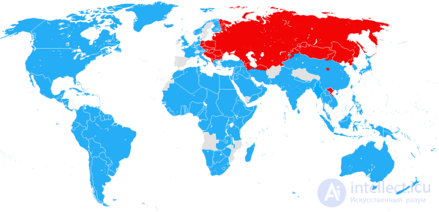
Territories controlled by the Western Allies of the anti-Hitler coalition (blue) and territories controlled by the USSR and its allies (red) in September 1945
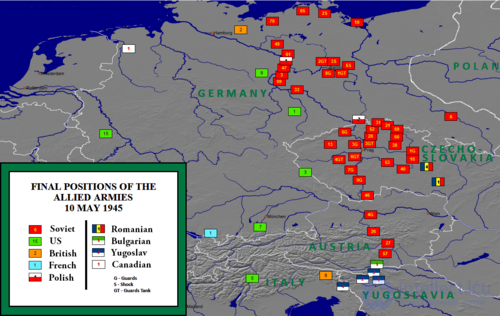
Position of the Western Allied forces on 10 May 1945
The immediate aim of the offensive plan was to "push" Soviet troops out of Poland by force; that of the defensive plan was to organize the defense of the British Isles in the event of a possible Soviet invasion of Western Europe after the withdrawal of American forces from there. In some sources the offensive plan is regarded as a plan for the Third World War ]. In his comments on the draft plan presented to him, Churchill noted that it was a "preliminary sketch of what I hope is still a purely hypothetical contingency" .
By April 1945 the Red Army fully controlled the territories of Poland, Hungary, Romania and Bulgaria, and parts of Czechoslovakia, Austria and Germany. Both the Soviet and the Anglo-American forces of the anti-Hitler coalition countries were advancing rapidly into the territory of the dying German Reich. On 13 April Soviet troops took the Austrian capital, Vienna, and on 16 April they began the operation to capture Berlin. On 25 April the historically important meeting of American and Soviet troops took place on the Elbe, near the town of Torgau.
In the Pacific, Japanese forces had been driven out of nearly all the territories they had previously seized, and the Japanese navy had been destroyed. Nevertheless, Japan's land forces still represented a powerful force, and the fight against them in China and on the Japanese islands themselves could, by the calculations of the American command, drag on until 1947 and demand heavy sacrifices . This made the United States and Britain vitally interested in the help of the Soviet Union, which at the Yalta Conference had undertaken to enter the war against Japan three months after the victory over Germany.
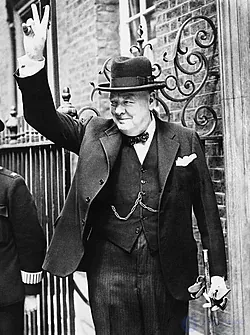
Winston Churchill, 5 June 1943
In his memoirs Churchill later formulated his view of the situation that had arisen in spring 1945 as follows: "The destruction of German military power brought with it a fundamental change in the relations between Communist Russia and the Western democracies. They had lost their common enemy, the war against whom had been almost the sole link binding their alliance together. From now on Russian imperialism and the Communist doctrine saw and set no limit to their advance and their drive toward final domination." From this, in Churchill's estimation, followed the following practical conclusions for Western strategy and policy:
- first, Soviet Russia had become a mortal danger to the free world;
- second, a new front against its rapid advance must be created immediately;
- third, this front in Europe must run as far east as possible;
- fourth, the chief and true objective of the Anglo-American armies was Berlin;
- fifth, the liberation of Czechoslovakia and the entry of American troops into Prague was of the utmost importance;
- sixth, Vienna, and in essence all of Austria, must be governed by the Western powers, at least on an equal basis with the Russian Soviets;
- seventh, it was necessary to curb Marshal Tito's aggressive claims with regard to Italy...
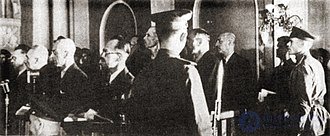
Arrested figures of the Polish government at the trial in Moscow, June 1945
The most painful issue in relations between the Western Allies and the USSR was the Polish question. The Anglo-Americans tried to prevent the establishment in Poland of the Communist government created by Stalin, defending the legitimacy of the London-based Polish government-in-exile, which continued the tradition of pre-war Polish statehood and had broad support and extensive structures within Poland itself (which remained underground both under the Third Reich and after the end of the war in Europe). Inside Poland an armed struggle was under way between supporters of the Communist ("Lublin") government, backed by the Soviet military administration, and supporters of the émigré "London" government, who were led by the commander of the Home Army, General Leopold Okulicki. The government-in-exile (Prime Minister Tomasz Arciszewski) never recognized the decisions of the "Big Three" on the "Curzon Line" (Churchill, Stalin and Roosevelt agreed that Poland's eastern borders would run approximately along the Curzon Line[10]) and therefore, in the view of the USSR, the United States and Britain, could not lay claim to power in the country [11]; the "liberum veto" of the Polish anti-Communists formed no part of the Big Three's plans[12]. The British and American governments, after numerous unsuccessful attempts to persuade the émigré government to accept the resolutions of the heads of the Big Three (the "Curzon Line", personnel compromises), finally decided to do without the émigré "London" government.[13] The British government, concerned about the negative effect of the Polish question on its relations with the USSR, continued to support those Polish politicians it considered the most sensible, who were no longer part of the Polish émigré government; Britain's relations with the Arciszewski government were in effect reduced merely to its recognition. The presence in the part of Poland occupied by the Red Army of an active Red Army numbering 2.5 to 3 million men, many dozens of its military commandant's offices, NKVD troops guarding the rear of the fronts and armies, security organs and units of the Polish Army made the activity of the entire anti-Communist underground in the rear of the Soviet forces extremely difficult. According to the agreements reached by the heads of the USSR, the United States and Britain in September 1944[14], the border of the Soviet zone of occupation of Germany was to run 150 km west of Berlin. All this foreshadowed Poland's passing into the Soviet sphere of influence.
In February at the Yalta Conference a compromise was reached between the powers, providing for the "reorganization" of the existing Communist government "on a broader democratic basis with the inclusion of democratic leaders from Poland itself and from Poles abroad"; Roosevelt expressed the opinion that in reality no Polish government had existed since 1939 . On 13 February 1945 the Polish government-in-exile published a statement which said: "The decisions of the Conference of the Three concerning Poland cannot be recognized by the Polish government and cannot be binding on the Polish nation"; the Allies ignored the veto of the Polish authorities in exile[16]. It became clear from the decisions of the conference that the core of the future Government of National Unity was to be the Provisional Government existing in Poland. It was assumed that the result would be the creation of a Polish Provisional Government of National Unity, which the Anglo-Americans promised to recognize and which was to hold free elections as soon as possible. The details of the "reorganization" and consultations with the Poles were entrusted to a special commission (consisting of the head of the People's Commissariat for Foreign Affairs, V. M. Molotov, and the British and American ambassadors in Moscow) . Nevertheless, it soon became clear that while the Anglo-Americans, in violation of the Yalta agreements, understood "reorganization" as the creation of what was in effect a new government from a union of the "London" and "Lublin" Poles (Ambassador Harriman even told Molotov at a meeting of the commission that possibly none of the members of the Provisional Government would find a place in the Polish Government of National Unity)[18], Stalin saw in it merely a decorative dilution of the previous government with a few non-Communist, pro-Western figures. He categorically objected to the Anglo-Americans, contrary to the agreements reached at the Yalta Conference on Poland, "placing an equals sign between individuals from Poland and from London and the Provisional Government of Poland", and proposed forming a government on the Yugoslav model (the Provisional Government of Democratic Federal Yugoslavia, in a 75% : 25% proportion), with the non-Communist members of the government required to be loyal to the USSR[19]. Even before the end of the war in Europe, on 21 April 1945, a Treaty of Friendship, Mutual Assistance and Postwar Cooperation between the Union of Soviet Socialist Republics and the Republic of Poland was concluded in Moscow for a term of 20 years; Stalin rejected the objections of the British prime minister[20] and the US president, and on 24 April Stalin emphasized: "You evidently do not agree that the Soviet Union has the right to seek to ensure that a government friendly to the Soviet Union exists in Poland, and that the Soviet Government cannot agree to the existence in Poland of a government hostile to it." The attempt to boycott the results of the Second World War failed[21]. The government-in-exile declared this agreement invalid, but in practice it remained in force until the expiry of the international treaty in 1965. Talk of creating a completely new government proved detached from reality. Churchill and the US president were unable to make Stalin hand over power in Poland to the anti-Communists, who opposed the state authority created by the Communists and the existing Polish-Soviet border. By June 1945 Stalin had established Poland's new borders de facto. Stalin understood perfectly well that the emergence of an anti-Soviet government in Poland would expose the communications linking the Soviet Union with the occupation forces in the Soviet zone of occupation of Germany and lead to an attempt to revise the Soviet-Polish border. Churchill was extremely alarmed by these trends, as well as by the reports reaching him of repressions against opponents of the Communist government: he saw in this a sign of Stalin's desire to establish a lasting Communist dictatorship in Poland .
As early as 13 March, Churchill stated in a letter to Roosevelt: "we are faced with the greatest failure and the complete breakdown of the decisions taken at Yalta, <…> we the British do not have sufficient strength to push this matter further, since we have exhausted our capabilities."
Political friction over the Polish question intensified in April, when, after Roosevelt's death, the new US President Truman took an extremely tough position on the issue.
At the same time, it became known in London that 16 senior figures of the London government's underground in Poland, headed by Okulicki, who had been summoned to Moscow in March supposedly for negotiations on forming a government, had been arrested (they were convicted in June at the so-called Trial of the Sixteen). The exposure of the anti-Soviet underground organization NIE and the revelation of the links between the anti-Soviet and anti-communist underground and London alarmed the British authorities; the arrest of the leaders effectively decapitated the military and political anti-communist underground. On 5 May, at the San Francisco Conference, the Anglo-American delegation made a sharp statement devoted to the arrest of this "group of eminent democratic leaders". The government-in-exile pondered how to persuade the Western Allies to start a new world war for the independence of the Second Polish Republic, within its pre-war borders in the East.
In a letter to Stalin of 29 April, Churchill emphasized: "The obligations we have undertaken with regard to a sovereign, free, independent Poland, having a government fully and properly representing all the democratic elements among the Poles, are for us a matter of duty and honour." He demanded equal representation for the London and Lublin Poles, firmly objecting to Stalin's plan of creating a government on the Yugoslav model.
Churchill regarded Poland as the key to Eastern Europe and believed that the Anglo-Americans must under no circumstances allow the establishment of communist domination there. In a letter to his Foreign Secretary Eden of 4 May, Churchill expressed the idea that the "Polish deadlock" could be resolved by refusing to withdraw American troops in Germany to the line dividing the occupation zones agreed at Yalta until the Polish question was settled. He expressed extreme concern about the proposed withdrawal of American troops (the withdrawal "would mean the spreading of Russian domination another 120 miles on a front of 300 to 400 miles" and would be "one of the most melancholy events in history"). "When all this is over and the territory is occupied by the Russians, Poland will be completely engulfed, buried deep inside Russian-occupied territories," Churchill believed, noting that in that case the whole of Eastern Europe would fall under Soviet influence and the question of Soviet control over Turkey and Constantinople would arise (in fact, the USSR had by then already begun to put forward territorial claims against Turkey). In Churchill's view, before the withdrawal of American troops from Europe, guarantees should be obtained regarding Poland's democratic future and the temporary nature of the Soviet occupation of Germany. "If these questions are not settled before the American armies withdraw from Europe and before the Western world has dismantled its war machines, one cannot count on a satisfactory resolution of the problems, and the prospects of averting a third world war will be very slim," he noted
In this situation, Churchill instructed the Joint Planning Staff of the War Cabinet to submit its views on a possible military campaign against the USSR, which received the code name "Operation Unthinkable".
The initial data (the conditions from which the planners were to proceed) were set as follows:
The plan was ready on 22 May. It assessed the situation, formulated the objectives of the operation, identified the forces to be committed, the axes of attack of the Western Allied troops and their probable results. The appendices to the plan contained information on the disposition of the Red Army (English documents usually use the term "Russian army") and of the Western Allies, as well as cartographic material. The time at which the Prime Minister commissioned the drafting of the plan is not indicated, but, given the complexity of its preparation and the nature and volume of the documents themselves, there is every reason to suppose that the Prime Minister's assignment was received by the planners in April 1945
The main general political objective of the operation was assumed to be imposing the will of the US and Britain on the Soviet Union with regard to Poland. However, the planners stressed, "although the 'will' of the two countries may be regarded as a matter directly concerning only Poland, it by no means follows that the degree of our involvement (in the conflict) will necessarily be limited". It was quite possible that the stated objective could not be achieved by a limited campaign, even if it were crowned by a quick victory in the operation on German territory, since the USSR would continue active resistance. In the latter case, one should be prepared for total war: "if they (the Russians) want total war, they will get it".
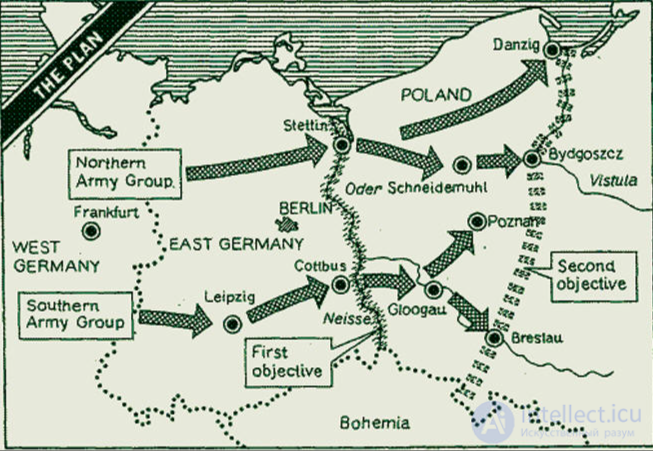
The plan for the land campaign envisaged two main thrusts in north-eastern Europe in the direction of Poland. The best area for the offensive was considered to be the territory north of the Zwickau – Chemnitz – Dresden – Görlitz line. It was assumed that the rest of the front would hold a defensive posture. The thrusts were to be: a northern one, along the Stettin – Schneidemühl – Bydgoszcz axis; and a southern one, along the Leipzig – Cottbus – Poznań and Breslau axis. In the second phase of the offensive operation, it was planned to employ more than eight thousand tanks. The main tank battles, it was assumed, would unfold east of the Oder–Neisse line, and the outcome of the campaign would depend on their result. Although the Allies were numerically inferior to the Soviet forces, they had hope of achieving success thanks to the factor of surprise and superiority in command and control and in aviation. In that case the Anglo-Americans would be able to reach the general Danzig – Breslau line. It was further noted that if the Red Army did not suffer a decisive defeat west of this line and was withdrawn, total war would be inevitable. This last option was regarded as extremely undesirable and risky. It would require the mobilization of all the Allies' forces and resources. It was noted that it was impossible to speak of a limit to the Allied advance into the depths of Russia at which further Russian resistance would become impossible. The planners could not even envisage the possibility of an Allied penetration as deep and as rapid as the Germans had achieved in 1941 without this leading to a final success.
The planners noted that only 47 Anglo-American divisions, including 14 armoured, could be employed in the offensive operations. By their estimates, they would be opposed by forces equivalent to 170 Allied divisions, of which 30 divisions were armoured. The British overestimated the strength of the Soviet ground forces in Europe. The planners assumed that their own troops would have to operate on the basis of the German transport network, almost completely destroyed during the Second World War, under the threat of Soviet agents recruited from local communist organizations or infiltrated into Western Europe.
The possibility was also considered of forming 10 to 12 German divisions for the operation, although they could not yet be ready by the time hostilities began. It was assumed that the majority of the population of Poland, and even Berling's army (that is, the army of the pro-Soviet government), would turn against the USSR.
Churchill sent the plan for consideration to Britain's highest staff body, the Joint Chiefs of Staff Committee. On 24 May, staff of the planning section held a meeting with the British Chiefs of Staff and gave them a copy of the document. On 31 May 1945, when the British Chiefs of Staff were discussing Operation Unthinkable with the Joint Chiefs of Staff Committee, Field Marshal Brooke, Chief of the Imperial General Staff, wrote in his diary: "We are more than ever convinced that this is an impossible task." On 8 June the conclusion of the Joint Chiefs of Staff Committee was drawn up. It noted that in Europe the Anglo-Americans had 103 divisions against Soviet forces equivalent to 264 Allied divisions, as well as 8,798 aircraft against the Soviet 11,742 (although with a twofold Anglo-American superiority in strategic aviation). The Anglo-Americans had unconditional superiority only at sea. As a result, the British command came to the following conclusions, discouraging for Churchill:
- in starting a war with the Russians, one must be prepared for a long and costly total war,
- the Russian numerical superiority on land makes the possibility of achieving a limited and rapid (military) success highly doubtful.
We therefore consider that, if war begins, achieving a quick, limited success will be beyond our capabilities and we will find ourselves drawn into a protracted war against superior forces. Moreover, the superiority of those forces could grow out of all proportion if American weariness and indifference increase and the magnet of the war in the Pacific draws them away to its side.
— from the conclusion of the Chiefs of Staff Committee sent to W. Churchill
The weakening of the British Empire did not worry American politicians; the US still sought the USSR's entry into the war against Japan, and after Harry Hopkins's trip to Moscow the Americans reached an agreement with Stalin. On 30 May 1945, Harry Hopkins, as special envoy of the US President, assured Stalin in the Kremlin that if the lists of people who were to take part in the coalition Polish government included people "known as agents of the present Polish government in London", they would be struck out[37]; Stalin promised him that the Polish government would include figures such as Mikołajczyk and Grabski. The Americans presented the British with a fait accompli: Hopkins refused Churchill's request to land in Frankfurt and report to the British Prime Minister on the progress of the Moscow talks. The US did not plan to start a Third World War over the failure of the geopolitical project of the Second Polish Republic and the Polish authorities in exile; on 8 June 1945 President Harry Truman approved the agreement reached in Moscow and persuaded Churchill to do the same, and Churchill was forced to back down.
In a reply memorandum to the Joint Chiefs of Staff Committee of 10 June, Churchill already expressed concern about the possibility of Soviet troops, thanks to their overwhelming numerical superiority, seizing the whole of Western Europe: he noted that in the event of the departure of part of the American troops from Europe, "the Russians will be able to advance to the North Sea and the Atlantic", and proposed to "work out a clear plan of how we could defend our Island". At the same time he noted: "Retaining the code name 'Unthinkable', the command assumes that this is merely a preliminary sketch of what I hope is still a purely hypothetical possibility."
The new plan, retaining the old code name "Unthinkable", was ready on 11 July. The planners rejected Churchill's idea of retaining bridgeheads on the Continent (in the event of a Soviet invasion of Europe) as being of no practical value. The defence of the British Isles was to be carried out, as in 1940, with the help of aviation and the fleet. It was pointed out, however, that the islands would be defenceless if the Russians used rockets, and the only possible response would be the use of strategic aviation (in which the Anglo-Americans had unconditional superiority). "Only in the event of the use of rockets and other new weapons which the Russians may acquire will a serious threat to the security of our country arise. An invasion or serious blows against our sea communications could be carried out only after lengthy preparation, which would take several years" – such were the conclusions of the plan.
According to Professor J. Erickson of the University of Edinburgh, Churchill's plan helps explain "why Marshal Zhukov unexpectedly decided in June 1945 to regroup his forces, received an order from Moscow to strengthen the defences and to study in detail the dispositions of the Western Allied troops. The reasons are now clear: evidently, Churchill's plan became known to Moscow in advance, and the Soviet General Staff took appropriate countermeasures." The plan of Operation Unthinkable was indeed passed to the USSR by the Cambridge Five[. The first information about Operation Unthinkable reached Moscow on 18 May 1945 with an unusual marking, "Super-lightning". The information came from Agent X, working in London, whose identity remains classified; he reported that on Churchill's orders a staff was drawing up a plan for a surprise attack by the British and Americans on Soviet troops. The report on Operation Unthinkable was presented to Stalin and Molotov by Lieutenant General I. I. Ilyichev. In the second and third ten-day periods of May and in June 1945, ever new reports on the progress of the drafting of Operation Unthinkable continued to arrive from the London residency of Soviet military intelligence; the plan became known to the USSR in advance, and the necessary measures were taken to prevent this global conflict.
Churchill, having been defeated in the elections in the summer of 1945, resigned. A Labour government headed by Clement Attlee came to power in Britain. Attlee was much more favourably disposed towards the USSR, but from the end of 1945 relations between Britain and the USSR entered a period of acute crisis because of the USSR's refusal to end its occupation of northern Iran (the Iran crisis) and the formal presentation in August 1946 of territorial claims against Turkey. In 1946 the Attlee government continued to develop plans for war with the USSR, involving the US and Canada. The conduct of the negotiations was entrusted to the head of the British military mission in Washington, Field Marshal H. Wilson, a participant in the Yalta and Potsdam conferences, who discussed British military projects with President H. Truman, General D. Eisenhower, then Supreme Allied Commander in Europe, and the Canadian Prime Minister M. King. In September a meeting took place on a yacht off the US coast between General D. Eisenhower and the British Field Marshal B. Montgomery. The parties ultimately came to the conclusion that if the Red Army launched an offensive in Europe, the Western Allies would be unable to stop it. Subsequent plans for war against the USSR were already being developed at the NATO level.
In June 2021 previously classified details of the operation were published. The English newspaper the Telegraph published in June 2021 a document from the National Archives on the plan of a military operation against the USSR that had been drawn up in 1945 on the orders of the British Prime Minister Winston Churchill. The popular British publication prefaced the article with the subheading: "Many believe that Britain's current relations with Russia are icy, but that is nothing compared with the war plan drawn up 76 years ago."

Comments