
Lecture 36 min.
Chronology (from the Greek χρόνος — time; λόγος — study):
Reckoning of years, also known as a calendar or era system, is a way of measuring and organizing time based on the cyclical recurrence of units of time such as days, months and years. Year reckoning is of great importance for organizing everyday life, planning events, and keeping historical and cultural records. Year reckoning (era reckoning) is a system for determining dates and long spans of time within general historical chronology, counting time from some conventionally chosen historical moment; it is a system for determining time by years from some agreed starting point.
time reckoning - the counting of time, the reckoning of years.
There are many different systems of year reckoning, and each has its own features and principles. One of the most widely used in the world is the Gregorian calendar, adopted in most countries. Here are some of the main aspects of year reckoning:
Year: The year is the basic unit of time in year reckoning. It is a period determined by the motion of the Earth around the Sun. In different systems of year reckoning, the year may be based on solar, lunar or other astronomical cycles.
Month: A month is a period of time consisting of a certain number of days, connected with the phases of the Moon or other astronomical cycles. In the Gregorian calendar, which is widely used, the year consists of 12 months of varying length.
Day: The day is the smallest unit of time in year reckoning. It is the period of the Earth's rotation about its axis. In most systems of year reckoning the year is divided into days, and the count begins from a specific starting day, known as the epoch.
Era and epoch: In some systems of year reckoning there are special periods called eras or epochs. These are long spans of time that have particular significance or historical importance. For example, the Gregorian calendar uses the era "Anno Domini" (AD) and the epoch "the Nativity of Christ" (year zero of the era).
Correction and the leap year: Because of astronomical irregularities, such as the length of the year, some systems of year reckoning include corrections to ensure the accuracy of timekeeping. In one such correction, a leap year is added in certain years to compensate for the fractional part that is not accounted for in ordinary years.
Year reckoning is an important aspect of the organization of time in various spheres of life, including civil life, business, science, history and culture. It helps people orient themselves in time, plan future events and preserve historical records for future generations.
Astronomical chronology studies the regularities of recurring celestial phenomena and establishes precise astronomical time; it is also one of the methods of historical chronology (see below).Astronomical chronology, or astronomical dating, is a technical method of dating events or artifacts that are connected with astronomical phenomena. Written records of historical events that include descriptions of astronomical phenomena have greatly helped in refining the chronology of the ancient Near East; works of art that depict the configuration of stars and planets, and buildings that are oriented toward the rising and setting of celestial bodies at a particular time — all this can be done with the help of astronomical calculations.
Geochronology — the division of geological time into conventional segments that have their own names (eras, periods, epochs and ages) and are arranged in a definite sequence. The scientific basis of geochronology is stratigraphy.
Historical (technical) chronology — a special historical discipline that studies the systems of year reckoning and the calendars of different peoples and states, and helps to establish the dates of historical events and the time of creation of historical sources. It is an auxiliary historical discipline that studies the systems of year reckoning and the calendars of different peoples and states and helps to establish the dates of historical events and the time of creation of historical sources.
Historical sources are the sources of our knowledge of the history of human civilization.
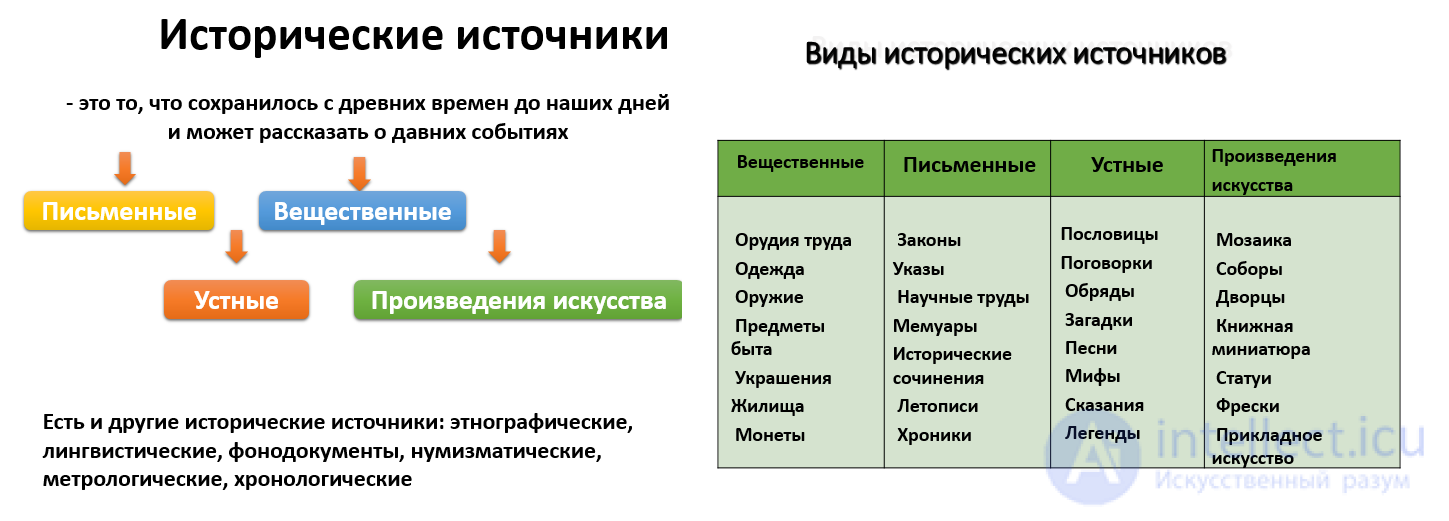
Fig. Historical sources and their types
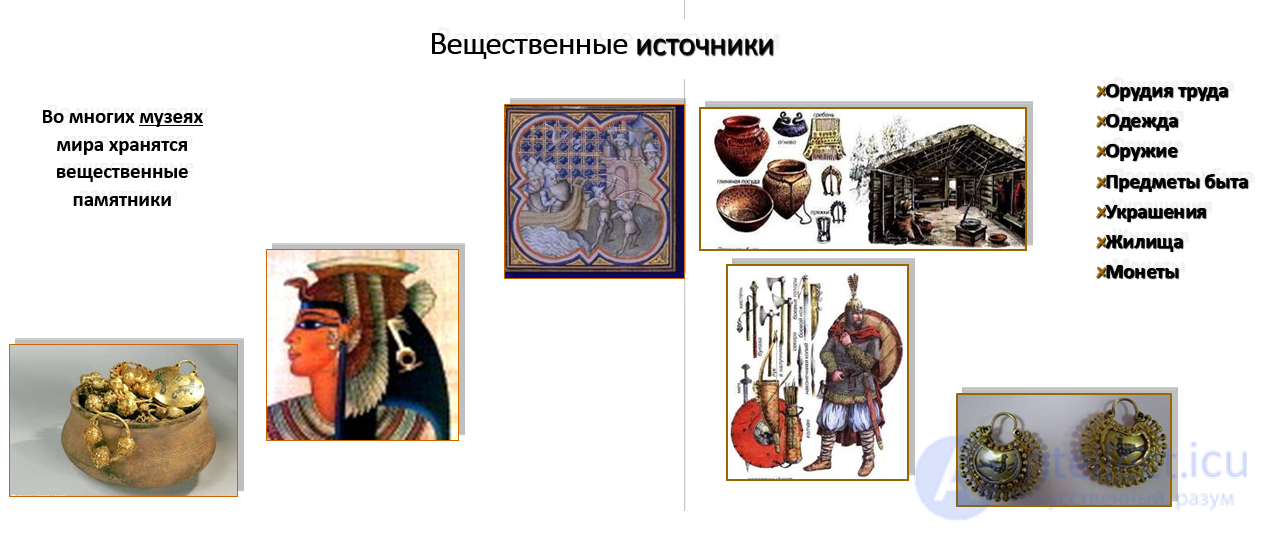
Fig. Material sources
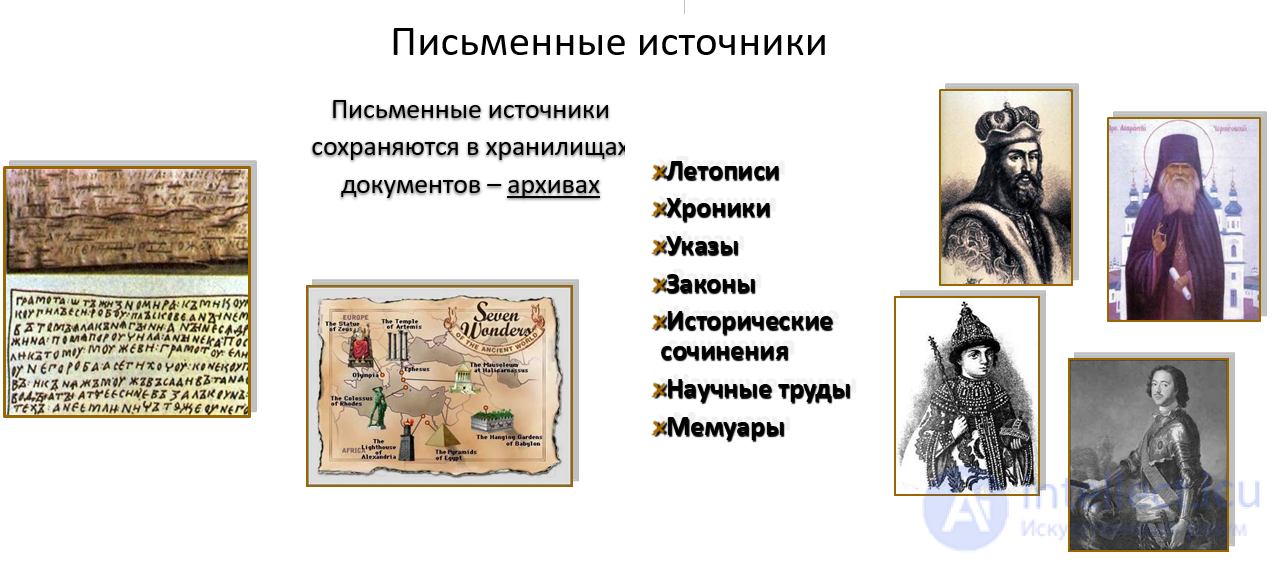
Fig. Written sources
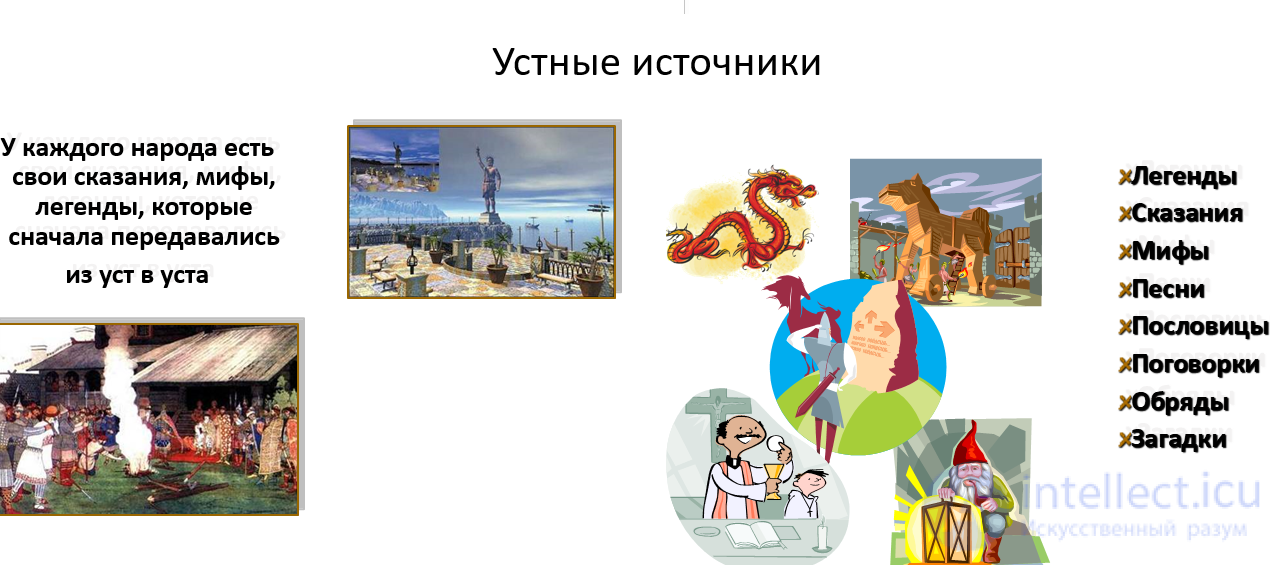
Fig. Oral sources
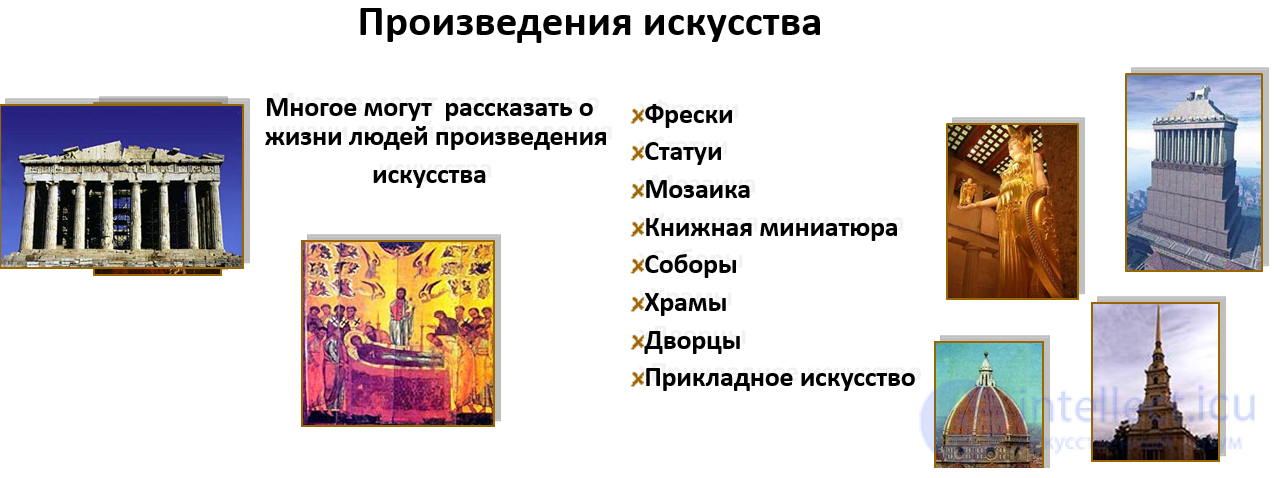
Fig. Works of art
The most natural measure of time is the rotation of the Earth about its axis. A complete rotation (through 360°) of the Earth is called a sidereal day, since in time it equals the interval between two successive culminations of any given star. Because of the Earth's revolution around the Sun, the true solar day, that is, the interval between two culminations of the Sun, is about 3 minutes 56 seconds longer than the sidereal day . This difference varies over the course of the year owing to the non-uniform motion of the Earth around the Sun in the plane of the ecliptic, so the true day cannot serve as a precise unit of time. Instead, the mean day is usually used, that is, the interval between the culminations of a fictitious luminary, the "mean Sun", moving uniformly along the ecliptic; its position on the celestial sphere coincides with that of the true Sun at certain epochs.
For longer intervals of time it is more convenient to use, instead of days, other units of time historically connected with observation of the apparent positions of the Moon and the Sun among the stars on the celestial sphere. The interval of time in which the Moon, after completing a full revolution around the Earth, is again opposite the same stars is called the sidereal month (27 days 7 hours 43 minutes). Owing to the movement of the Earth together with the Moon around the Sun, after a sidereal month the mutual arrangement of the three bodies will have changed somewhat, so the phase of the Moon seen from the Earth will be somewhat different, and the interval after which the Moon returns to its former phase, the so-called synodic month, is longer than the sidereal month (29 d. 12 h. 44 min.).
The interval of time after which, owing to the Earth's revolution around the Sun, the luminary returns to the same constellations, to "the same star", is called the sidereal year. By day the brightness of the Sun outshines the stars, and instead of the constellations against which the Sun is situated, one can compare the opposite constellations, which culminate at midnight at that time of year. The seasons are determined by the Sun's passage through the points of the equinoxes and solstices. Because of precession, the points of intersection of the planes of the equator and the ecliptic (the equinoxes) shift, as do the points of the Sun's greatest distance from the celestial equator (the solstices). The total duration of the four seasons is called the tropical year and is determined through the mean speed of the Sun's motion in longitude. The tropical year is often defined as the mean interval between two successive passages of the Sun through the vernal equinox, which is incorrect, since the points of the equinoxes and solstices shift relative to each other because of planetary perturbations . The tropical year is 20 minutes shorter than the sidereal year. The length of the sidereal year does not change; the length of the tropical year fluctuates depending on changes in the rate of precession; in our time the tropical year contains, in mean solar days and hours, 365 d. 5 h. 48 min. 46 s, and in sidereal days and hours 366d 5h 48m 46s. In the time of Hipparchus (2nd century BC) the tropical year was 12 seconds shorter .
Individual calendar years must necessarily contain a whole number of days; yet the lengths of the year and the day are incommensurable. The various systems of solar calendars arose as a result of the greater or lesser accuracy of the length of the year in days adopted in the calendar, and of the various methods of accounting for the accumulating fractions of a day, that is, of distributing the intercalary days. In turn, the lunar month is incommensurable with the solar year; in certain lunisolar calendars there were various methods of evening out the accumulating discrepancy by means of intercalary months. Later the month lost its character as a lunar revolution and became a conventional fraction of the solar year. The ancient astronomers, being unable to observe the culminations of stars, made do with the crude method of observing their rising and setting. The so-called heliacal rising of a star had particular importance. The length of periods built on heliacal risings requires a separate calculation each time, depending on the given star (that is, on its position relative to the celestial equator and the ecliptic), on the latitude of the place of observation on Earth, and on the amount of precession.
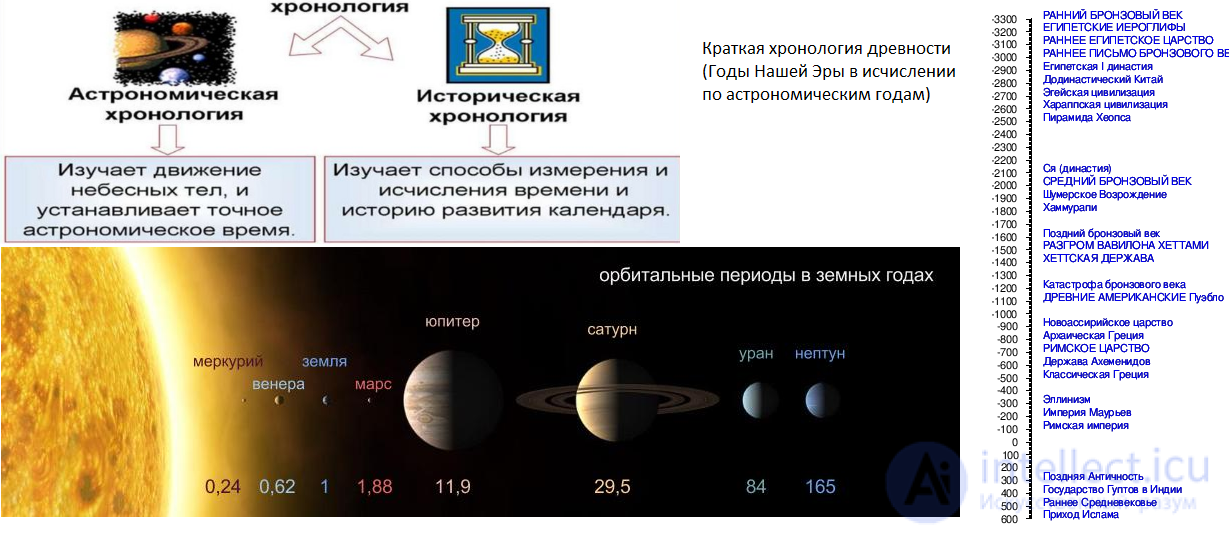
The first and most natural unit of time reckoning for ancient people was the day, divided into day and night. Later, through observation of the phases of the Moon, they began to distinguish the lunar month, which was counted alternately as 29 and 30 days. Then it was noticed that after about 12 lunar months the phenomena of nature recur. Thus the year was discovered. However, a year of 12 lunar months, or 354 days, does not correspond to the astronomical (solar) year, and the lunar calendar of 12 lunar months turned out to be a movable one (the Arabs still use a calendar of this type). To bring it into line with the astronomical year, an additional month was inserted as the error accumulated (about once every 3 years); among the Romans, for example, it was called "Mercedonius" and was inserted between 23 and 24 February. This kind of lunisolar calendar was used by most ancient peoples; in our time it is used by the Jews (see the Hebrew calendar).
The solar calendar was invented in Egypt (see the ancient Egyptian calendar). It consisted of 12 months of 30 days and 5 additional days. But since the true astronomical year exceeds 365 days, the Egyptian calendar also proved inaccurate. Later the Hellenistic kings of Egypt, basing themselves on the calculations of the Alexandrian astronomers, tried to introduce leap years, but the reform did not take root. In 26 BC Augustus reformed the Egyptian calendar on the model of the Julian calendar, establishing leap years and fixing the beginning of the year (1 Thoth) at 29 August; nevertheless, reckoning "in the old style" was widely practiced in Egypt until the very end of antiquity.
Where the Greeks (see the ancient Greek calendars) used a consistent system for inserting additional months, they used the system of octaeterides (eight-year cycles), with a month added in every 3rd, 5th and 8th year of the eight-year cycle. In the middle of the 5th century BC the Athenian mathematician and astronomer Meton discovered a 19-year period (the Metonic cycle), equal to 235 synodic revolutions of the Moon, after which the Moon and the Sun return to almost the same position relative to the Earth and the stars. He proposed this period to all the Greeks at the Olympic Games of 432 BC, proposing that 7 months be inserted during it. This proposal took hold slowly; for a long time the Greeks continued to use the cruder, but simpler and more familiar, system of octaeterides; but Meton's discovery is still used today in the Hebrew calendar and in calculating Easter, and the position of a year within the Metonic cycle has, since antiquity, been called the "golden number".
The Roman calendar was one of the least accurate. At first it had only 304 days and included only 10 months, beginning with the first month of spring (Martius) and ending with the onset of winter (December, the "tenth" month); in winter time was simply not counted. King Numa Pompilius is credited with introducing two winter months (Januarius and Februarius). The additional month, Mercedonius, was inserted by the pontiffs at their discretion, fairly arbitrarily and in accordance with various momentary interests. In 46 BC Julius Caesar carried out a reform of the calendar, based on the work of the Alexandrian astronomer Sosigenes, taking the Egyptian solar calendar as a basis. To correct the accumulated errors, he used his authority as Pontifex Maximus to insert, in the transitional year, in addition to Mercedonius, two extra months between November and December; and from 1 January 45 BC the Julian year of 365 days was established, with leap years every 4 years. The extra day was inserted between 23 and 24 February, as Mercedonius had been earlier; and since in the Roman system of reckoning 24 February was called "the sixth (sextus) day before the Kalends of March", the intercalary day was called "the twice-sixth (bis sextus) day before the Kalends of March" and the year accordingly annus bissextus — whence, through the Greek language, our word for "leap year" in Russian. In honor of Caesar the month Quintilis was renamed (to Julius).
After the assassination of Caesar the priests mistakenly began to declare every third year a leap year. When the error was discovered in 9 BC, the emperor Augustus had to omit leap years altogether for 16 years. Only from AD 8 did the Julian calendar begin to function normally. The month following Julius (Sextilis) was named after Augustus .
In the 4th to 6th centuries, uniform Easter tables, compiled on the basis of the Julian calendar, became established in most Christian countries; in this way the Julian calendar spread throughout the entire Christian world. In these tables 21 March was taken as the day of the vernal equinox.
However, as the error accumulated (1 day in 128 years), the discrepancy between the astronomical vernal equinox and the calendar one became ever more evident, and many in Catholic Europe considered that it could no longer be ignored. This was noted by the 13th-century Castilian king Alfonso X; in the following century the Byzantine scholar Nikephoros Gregoras even proposed a reform of the calendar. Such a reform was actually carried out by Pope Gregory XIII in 1582, relying on the project of the mathematician and physician Aloysius Lilius. The pope's decree of 24 February 1582 established that 5 October 1582 should be followed by 15 October, and that in future only those centennial years whose number of hundreds is divisible by 4 without remainder (1600, 2000, 2400) would be counted as leap years, while other centennial years would be counted as common years (1700, 1800, 1900, 2100). The result was the Gregorian calendar, astronomically more accurate than the Julian. Of the European countries, the Catholic ones switched to the New Style at once, the Protestant ones mostly in the 18th century: northern Germany, Denmark and Norway from 1700, England from 1752, Sweden from 1753; the Orthodox countries switched to the Gregorian calendar only in the early 20th century: Bulgaria in 1916, Russia from 1/14 February 1918, Serbia and Romania in 1919, Greece in 1923.
The need for a consistent counting of years arose with the emergence of written culture and stemmed above all from administrative needs. As a rule, documents were dated by the regnal year of the king; thus a list of kings with the years of their reigns provided a primitive chronological table. Such lists have come down from Mesopotamia and ancient Egypt, but they must be used with caution, since they often present as successive reigns that were in reality wholly or partly contemporaneous (for example, in times of unrest), and contain other similar "simplifications".
In city-states years were dated by the names of officials elected for a year, who were called, for example, "limmu" in Ashur and "eponymous archons" in Athens, and so on (the "eponymous year"). In Mesopotamia years were also often designated by important events, so that the list of years was something like a brief chronicle.
An acute need for chronological calculations arose with the emergence of historical scholarship, that is, around the 5th century BC. The simplest method of dating was the mutual relative dating of events: event A occurred X years before event B; event C happened Y years after event B; and the same events are mentioned by different authors. From this, by comparing the works of historians, it is relatively easy to calculate the mutual relationship of the events they mention. Thus, for example, the Greco-Persian Wars are the central event of Herodotus' "Histories", which also touches on earlier events, such as the formation of the Persian kingdom; Thucydides, describing the Peloponnesian War, mentions that between its beginning and Xerxes' departure from Hellas "about 50 years" had passed, and speaks briefly of the events of this "fifty years"; Xenophon directly continues Thucydides — that is, from a comparison of these three authors alone it is possible to compile a detailed chronological sequence of events covering about 200 years, from the middle of the 6th to the middle of the 4th century BC.
For events remote in time (such as the Trojan War), an approximate calculation "by generations" was applied on the basis of genealogical tables, taking 3 generations to a century. At the same time, attempts were made to compile a system of absolute chronology. The first chronological tables were compiled: the priesthoods of the priestesses of Hera at Argos (their author, Hellanicus of Lesbos, was apparently the first to take up chronological questions), the lists of the Spartan ephors and of the Athenian eponymous archons; in Herodotus one can find the regnal years of the Persian and other eastern kings. By comparing such lists it became possible to convert a date from one system to another (for example, to say under which Persian king an event occurred that took place under such-and-such an archon), and also to establish the chronological relationship of events to one another (that is, to determine their relative chronology) and to the moment at which the work was being written (that is, to determine absolute chronology). Since a single chronological system did not exist in Greece, a historian speaking of some important event was well advised to date it at once by several systems: the regnal year of the Persian king, the Spartan ephors, the Athenian eponymous archon. As an example, we cite a passage from Thucydides that contains both a relative and an absolute dating of the key moment of his "History" — the beginning of the Peloponnesian War (431 BC):
For fourteen years the thirty years' peace, concluded after the conquest of Euboea, continued to hold. In the fifteenth year, the forty-eighth year of the priestess-ship of Chrysis at Argos, when Aenesias was ephor at Sparta, and Pythodorus had four months of his archonship remaining at Athens, in the sixteenth month after the battle of Potidaea, at the beginning of spring, a detachment of armed Thebans (...) at the beginning of the night's sleep entered the Boeotian city of Plataea...
All the other dates in the text of Thucydides' "History" are in one way or another related to the date of the beginning of the war (in the passage quoted this can be seen in the example of the date of the end of the First Athenian-Spartan War and of the battle of Potidaea; later dates are given as "in such-and-such a year of the war"). Of the dating systems used by Thucydides, dating by the Athenian archons remained in use in historical scholarship for many centuries, and this allowed ancient chronologers to correlate Thucydides' data without difficulty with later chronological scales (by Olympiads, and through these with the Roman chronology by consuls and "from the founding of Rome", and through the latter this event is easily converted into the modern system of year reckoning, which is a direct continuation of the Roman). Finally, this date also lends itself to astronomical verification, since Thucydides places a solar eclipse in the summer of the same year, which, according to calculations (first carried out by Joseph Scaliger), took place on 3 August 431 BC.
In the 4th century BC the historian Timaeus of Tauromenium proposed introducing a single chronological system based on the pan-Hellenic lists of Olympic victors. Lists of this kind were kept from 776 BC. Thus all of Greek history was divided into 4-year intervals between the Olympic Games — "Olympiads", named after the victors, so that a date sounded like this: "in the 3rd year of the 79th Olympiad, when so-and-so was the winner in the footrace". This system of dating was adopted by historians (it was not used in official administrative practice) and was applied alongside dating by the Athenian archons. The first scientific chronology was compiled a hundred years after Timaeus by Eratosthenes, who in his work "Chronographiai" calculated a series of fixed dates (for example, the invasion of Xerxes and the beginning of the Peloponnesian War) and then, on the basis of these, calculated all the other events. The chronological fragment of Eratosthenes that has come down to us reads as follows (in considering it one must bear in mind that the year began in July):
The chronology of Eratosthenes is as follows: from the capture of Troy to the coming of the Heraclidae — 80 years; from the coming of the Heraclidae to the founding of Ionia — 60 years; from the founding of Ionia to the rule of Lycurgus — 159 years; from the beginning of his rule to the 1st year of the 1st Olympiad — 108 years; from there to the invasion of Xerxes — 297 years; from this invasion to the beginning of the Peloponnesian War — 48 years; from the beginning of this war to its end with the defeat of the Athenians — 27 years; from their defeat to the battle of Leuctra — 34 years; from this battle to the death of Philip — 35 years; from the death of Philip to the death of Alexander — 12 years .
At that same time in the Hellenistic East official datings of the type familiar to us, counted from a single date — the "epoch of an era" — came into use. The era was the accession to power of Seleucus Nicator, a general of Alexander the Great — 312 BC. However, the "Seleucid era" remained administrative until late antiquity and was not used by historians. Later it entered Aramaic and then Arabic historiography (under the incorrect name of the "era of Alexander") and was used by Syrian Christians until the 19th century. The Parthian Arsacids, for their part, introduced an era counted from their own accession (248 BC), which was also current in the East.
The Romans, who had long kept their own "fasti" — lists of consuls that also served as a brief official chronicle — fitted without difficulty into the Greek chronological system, so that, for example, in the work of the Greek author of the Roman era Diodorus Siculus (1st century BC) we find datings given all at once: by Olympiads, by Athenian archons and by Roman consuls. A contemporary of Diodorus was the Roman scholar Varro, who, on the basis of the consular fasti and the years of the Roman kings' reigns reported by legend, calculated the date of the founding of Rome (according to Varro, 753 BC) and introduced it into scholarly use as an era. This era "from the founding of Rome" was not used officially, but in historiography it survived until the 19th century (since it concerned events of Roman history).
Of great importance for chronology is the so-called "Ptolemy's Royal Canon" — a list of kings preserved in Theon's commentary on Ptolemy's astronomical work. It is a list of reigns, with precise astronomical dates, of the kings of Babylon (the Babylonian kings proper, as well as the Persian kings and Alexander the Great counted as Babylonian ones), the kings of Hellenistic Egypt and the Roman emperors. It was compiled by Alexandrian astronomers for the needs of their own calculations (in effect, for dating astronomical phenomena) from their own records and those of the Babylonian priests, and was later continued by copyists, who added to it the names of the Byzantine emperors (in some manuscripts it is carried down to the fall of Constantinople in 1453). It begins with the accession of the Babylonian king Nabonassar on 27 February 747 BC (the so-called "Nabonassar era"), in whose reign systematic astronomical observations were first kept, and it is based on the Egyptian wandering calendar (without leap years), which was then used by astronomers.
In the late Roman period, the era counted from the beginning of the reign of the emperor Diocletian — 284 — came into wide use in astronomical and astrological texts, and Easter tables were compiled in it (this era is still preserved by the Coptic-Ethiopian church under the name "era of the martyrs").
In 525, Pope John I commissioned the monk Dionysius Exiguus to compile a new Easter table. Dionysius used the tables of the Alexandrian church, which employed the Diocletian era, but, unwilling to count by the years of the reign of an "impious persecutor", he decided to "designate the years" from the "incarnation of Christ". In his table, the year 532 ab inscriptione ("from the incarnation") followed the year 247 of the Diocletian era. Having been approved by the papal see and come into general use, this Easter table also brought into circulation the era "from the Nativity of Christ", now universally accepted. In official acts, the era from the birth of Christ appears already in the capitulary of Carloman of 21 April 742. In papal acts it has been in use since John XIII (10th century). Meanwhile, an error was made at the start of the reckoning owing to a miscount of the number of Easters that had passed since the crucifixion of Christ . Because of this error, the year of Christ's birth falls not in 1 AD but lies in the interval from 12 to 4 BC.
Interest in questions of chronology reappeared in the Renaissance. The foundations of modern chronology are considered to have been laid by Joseph Scaliger (1540—1609); he introduced dating by the Julian period he had devised, beginning in 4713 BC, which made it possible to convert all existing dates into a single system; he was also the first to begin (or rather resume, since it had been applied sporadically even in antiquity) the astronomical verification of dates found in historical sources (for example, he was the first to give an astronomical date for the solar eclipse of 431 BC mentioned by Thucydides) . By cross-checking synchronous evidence and with the help of astronomical data, Scaliger and the Jesuit scholar Dionysius Petavius (1583—1652) calculated the principal dates, which in turn made it possible to recalculate all the dates of ancient history within a single system of chronology. In 1627 Petavius proposed a system of "backward" counting of dates "before the birth of Christ". This system, which won universal acceptance only by the end of the 18th century, greatly facilitated the study of chronology.
The polemic provoked by Scaliger's works stimulated the appearance of a large number of works on astronomical and technical chronology. The summarizing work in this field in the 18th century was the "Art of Verifying Dates" by the Benedictines d'Antine, Clémencet and Durand, whose last edition ran to 44 volumes. By the beginning of the 20th century scientific chronology had reached its peak. The work of the German astronomer and chronologist Christian Ludwig Ideler, the "Handbook of Mathematical and Technical Chronology", has not lost its importance to this day. Among modern specialists in chronology, particularly well known is the Russian-born American scholar E. Bickerman, author of "Chronology of the Ancient World" (London, 1969; Russian translation Moscow, 1975).
Roman chronology, of which our system of reckoning is, as noted, the direct continuation, is entirely reliable. It is characteristic, for example, that the date of Diocletian's accession (284) was established by three different scholars by three different methods. Scaliger proceeded from the Coptic-Ethiopian tradition, which equated the year 1582 with the year 1299 of the Diocletian era. Petavius proceeded from the fact that, according to the "Paschal Chronicle", Diocletian came to power in the consulship of Carinus (for the second time) and Numerian, which, according to the consular fasti, corresponds to the year 284. Ideler instead made use of the "Ptolemy's Canon" and an astronomical observation allowing a synchronous date to be derived: 81 years after the reign of Diocletian = 1112 years after the accession of Nabonassar; this equation again leads to 284.
Greek history can be synchronized with Roman, since many dates are known in both the Greek and the Roman systems of reckoning. Those eastern chronological data that have a direct or indirect link with Roman chronology are also reliable. Thus, the lists of Egyptian pharaohs by Manetho include the Persian kings and the Ptolemies, whose reign dates are known exactly — this makes it possible to calculate the reign dates of the preceding rulers as well. Here, however, difficulties arise because of the aforementioned peculiarities of eastern royal lists. Nevertheless, it is considered that, down to about 800 BC, Egyptian reigns are dated absolutely accurately, and back to the 16th century BC (that is, to the beginning of the New Kingdom) with a margin of a few decades. But the length of the transitional period between the Middle and New Kingdoms is not known precisely — as a result, the link with Roman chronology is lost. An important role in the chronology of the Middle Kingdom is played by a letter on the so-called "Kahun Papyrus", dating from the end of the 12th Dynasty; it reports that Sirius will rise on the 16th day of the 8th lunar month of year 7, during the reign of Senusret III. The date of this event is around 1800 BC, and this allows one to conclude (since the number of years of the pharaohs' reigns in the dynasty is known) that the 12th Dynasty ruled from approximately 2000 to 1800 BC. The length of the First Intermediate Period between the Old and Middle Kingdoms is likewise unknown, and therefore the chronology of the Old Kingdom is even more uncertain.
For historians of the Near East the footing is somewhat firmer. First of all, the Assyrian eponym list (limmu) has been preserved, between 911 and 648 BC, which is verified both by the "Ptolemy's Canon" and by the solar eclipse noted in it. For earlier centuries, of key importance is establishing the date of the beginning of the reign of King Hammurabi. It is based on an observation, described in a cuneiform document, of the heliacal rising (the first rising at morning dawn) of Venus, which occurred in year 6 of the reign of Ammisaduqa, one of the last kings of Hammurabi's dynasty (while it is known that year 1 of his reign is separated from year 1 of Hammurabi's reign by 146 years). The conditions of heliacal rising described in the document recur after several decades, so that as a result several variants of the date of year 1 of Hammurabi's reign appeared; on the basis of the totality of historical evidence, the most plausible of them is considered to be 1792 BC. To this date, accordingly, the datings of the preceding and following reigns are tied.
China always had a developed historiographical tradition with its own detailed chronology, based on reigns with their era names, as well as on 60-year cycles (see Chinese calendar); in India, questions of chronology and historiography were treated far more carelessly. Therefore the key date for synchronizing the ancient history of India with the European is given by the rock-carved edict of King Ashoka (3rd century BC) about the embassy he sent to Greece with the missionary aim of propagating Buddhism; it mentions five Hellenistic rulers (Antigonus Gonatas and others), the time of whose reigns is known exactly.
However, it must be borne in mind that "none of those who followed the Byzantine era believed that 5508 years had passed from the creation of the world to the incarnation. If it was necessary to state the year of Christ's birth, they put 5500. Paradoxically, 5508 was a number, but not a date"[14]. Thus, in the chronicles the year 5500 was taken as the date of Christ's birth (only occasionally 5505), but because of disruptions in the chronology of the reigns of the Roman emperors, subsequent events were dated in such a way that, when converting them to modern reckoning, the eras given above must be used.
The main problem of chronology is the synchronization of events. Through synchronization of an event it becomes possible to link it with the present time and to compare the event with other events. Among historians, a typical need is to synchronize the reigns of kings and leaders in order to connect the history of one country or region with that of another. For example, the Chronicon of Eusebius (AD 325) is one of the most important works of historical synchronism. The work consists of two sections. The first contains narrative chronicles of nine different kingdoms: Chaldean, Assyrian, Median, Lydian, Persian, Hebrew, Greek, Peloponnesian, Asian and Roman. The second part is a long table synchronizing the events of each of the nine kingdoms in parallel columns.
By comparing the parallel columns, the reader can determine which events were simultaneous or how many years separated two different events. To place all events on a single timeline, Eusebius used the Anno Mundi (AM) era, meaning that events are dated from the supposed beginning of the world, calculated from the Book of Genesis in the Hebrew Pentateuch. According to the calculations used by Eusebius, this occurred in 5199 BC. The Chronicon of Eusebius was widely used in the medieval world to establish the dates and times of historical events. Later chronographers, such as George Syncellus (died c. 811), analyzed and developed the Chronicon, comparing it with other chronologies. The last great chronographer was Joseph Justus Scaliger (1540–1609), who reconstructed the lost Chronicon and synchronized all of ancient history in his two major works, De emendatione temporum (1583) and Thesaurus temporum (1606). Most modern historical dating and the chronology of the ancient world ultimately derive from these two works. Scaliger invented the concept of the Julian day, which is still used as a standard single time scale by both historians and astronomers.
In addition to the literary methods of synchronism used by traditional chronographers such as Eusebius, Syncellus and Scaliger, events can be synchronized by archaeological or astronomical means. For example, the eclipse of Thales, described in the first book of Herodotus, can potentially be used to date the Lydian war, since the eclipse occurred in the midst of an important battle of that war. Similarly, various eclipses and other astronomical events described in ancient records can be used for the astronomical synchronization of historical events. Another method of synchronizing events is the use of archaeological finds, such as pottery, for sequence dating.


Comments