
Lecture 10 min.
Wavelet (from English wavelet, "small wave" or "ripple"; also called burst in Russian usage, more rarely wavelet with a variant spelling) is a mathematical function that makes it possible to analyze the various frequency components of data. The graph of the function looks like wave-like oscillations with an amplitude that decreases to zero far from the origin. However, this is only a particular definition: in the general case, signals are analyzed in the plane of wavelet coefficients (scale, time, level) (Scale-Time-Amplitude). Wavelet coefficients are determined by an integral transform of the signal. The resulting wavelet spectrograms differ fundamentally from ordinary Fourier spectra in that they give a precise link between the spectrum of various features of signals and time.
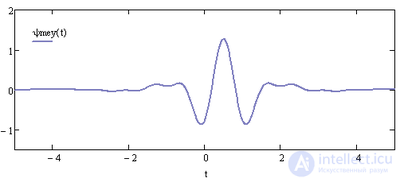
In the early development of the field, the term "wavelet" was used in Russian as a calque from English (volnochka). Later, the term "vsplesk" ("burst") proposed by K. I. Oskolkov was used . The English word "wavelet" means "small wave" or "waves following one another". Both translations fit the definition of wavelets. Wavelets are a family of functions that are localized in time and in frequency ("small"), and in which all the functions are obtained from a single one by shifts and dilations along the time axis (so that they "follow one another").
The development of wavelets is linked to several separate threads of reasoning that began with the work of Alfred Haar at the beginning of the 20th century. Important contributions to wavelet theory were made by Goupillaud, Grossmann and Morlet, who formulated what is now known as the continuous wavelet transform (CWT) (1982); Jan-Olov Strömberg, with early work on discrete wavelets (1983); Daubechies, who developed orthogonal wavelets with compact support (1988); Mallat, who proposed the multiresolution method (1989); Nathalie Delprat, who created the time-frequency interpretation of the CWT (1991); Newland, who developed the harmonic wavelet transform; and many others.
At the end of the 20th century, wavelet toolkits appeared in the computer mathematics systems Mathcad, MATLAB and Mathematica (see their description in the book by V. P. Dyakonov). Wavelets came into wide use in signal and image processing techniques, in particular for their compression and noise removal. Integrated circuits were created for wavelet processing of signals and images.
In December 2000, a new international image compression standard, JPEG 2000, appeared, in which compression is performed by decomposing the image over a basis of wavelets.
In 2002-2003, ICER appeared, an image compression format based on wavelet transforms, used for photographs obtained in deep space, in particular in the Mars Exploration Rover projects .
There are several approaches to defining a wavelet: through a scaling filter, a scaling function, or a wavelet function. Wavelets can be orthogonal, semi-orthogonal, or biorthogonal. Wavelet functions can be symmetric, asymmetric, or non-symmetric, with a compact domain of definition or without one, and can also have different degrees of smoothness.
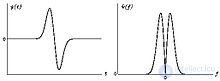
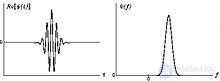
Examples of wavelets:
It is related to several other techniques.
All wavelet transforms can be regarded as a kind of time-frequency representation and therefore belong to the subject of harmonic analysis.
The discrete wavelet transform can be regarded as a kind of finite impulse response filter.
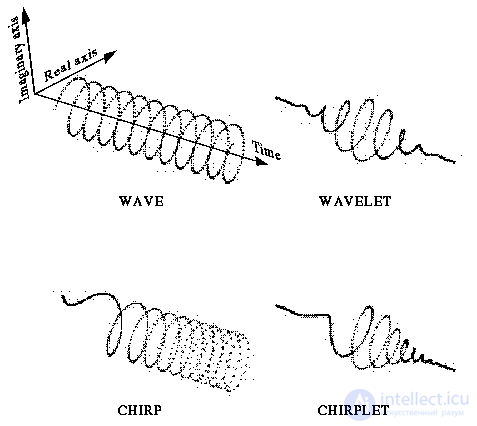
Comparison: wave and wavelet; chirp (linear frequency modulated signal) and chirplet
The wavelet transform is an integral transform that is the convolution of a wavelet function with a signal. The wavelet transform converts a signal from a time representation to a time-frequency one.
It is a way of transforming a function (or signal) into a form that either makes some quantities of the original signal more amenable to study or allows the original data set to be compressed. The wavelet transform of signals is a generalization of spectral analysis. The term wavelet means "small wave". Wavelets is the general name for mathematical functions of a particular shape that are localized in time and in frequency and in which all the functions are obtained from a single base function by modifying it (shifting, dilating).
A function (taken as a function of time) is considered in terms of oscillations localized in time and frequency.
Wavelets are used in signal processing, often replacing the ordinary Fourier transform in many areas of physics, including molecular dynamics, ab initio calculations, astrophysics, density matrix localization, seismic geophysics, optics, turbulence, quantum mechanics, image processing, analysis of blood pressure, pulse and ECG, DNA analysis, protein research, climate research, general signal processing, speech recognition, computer graphics, multifractal analysis and others.
Wavelet analysis is used to analyze non-stationary medical signals, including in electrogastroenterography.
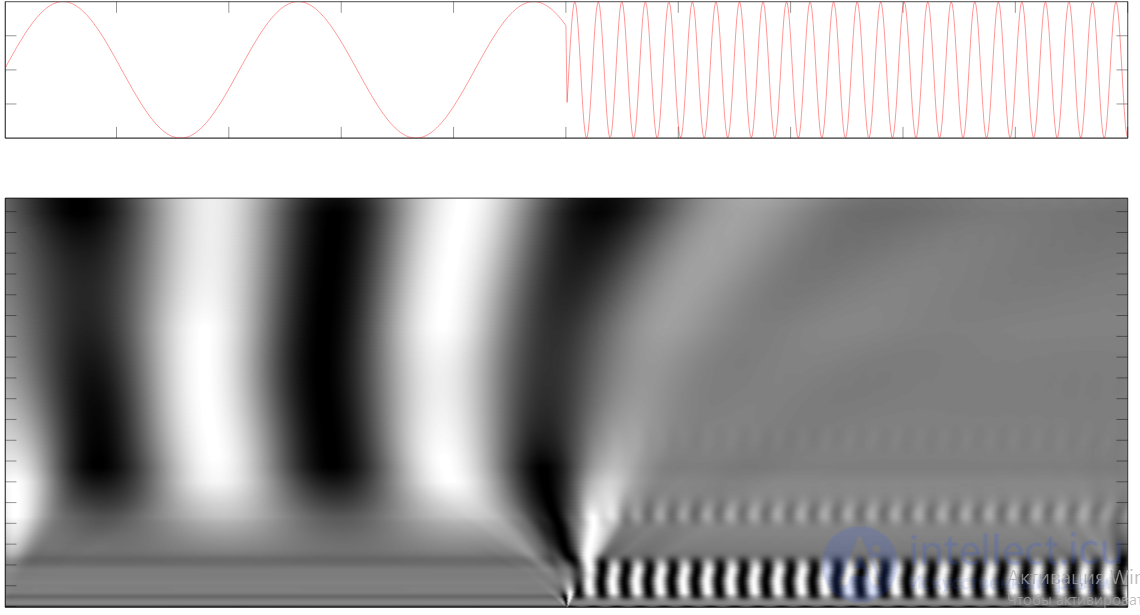
Wavelet transforms are usually divided into the discrete wavelet transform (DWT) and the continuous wavelet transform (CWT).
The wavelets that form the DWT can be regarded as a kind of finite impulse response filter.
Application: usually used for signal coding (engineering, computer science).
The wavelets that form the CWT obey the Heisenberg uncertainty principle , and accordingly the discrete wavelet basis can also be considered in the context of other forms of the uncertainty principle.
Application: for signal analysis (scientific research).
To carry out a wavelet transform, wavelet functions must satisfy the following criteria :
1. The wavelet  must have finite energy:
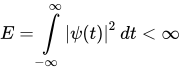
2. If  is the Fourier transform of the wavelet , that is,
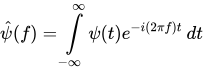
then the following condition must hold:
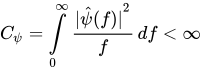
This condition is called the admissibility condition, and it implies that at the zero frequency component the wavelet must satisfy the condition  or, in other words, the wavelet must have a mean equal to zero.
3. An additional criterion is imposed on complex wavelets, namely that their Fourier transform must be real and must decay for negative frequencies.
4. Localization: the wavelet must be continuous, integrable, have compact support, and be localized both in time (in space) and in frequency. If the wavelet narrows in space, its mean frequency increases, and the spectrum of the wavelet shifts to the region of higher frequencies and broadens. This process must be linear: narrowing the wavelet by half must raise its mean frequency and the width of its spectrum also by a factor of two.
1. Linearity

2. Shift invariance

Shifting the signal in time by t0 results in a shift of the wavelet spectrum also by t0.
3. Scaling invariance

Dilation (compression) of the signal results in compression (dilation) of the wavelet spectrum of the signal.
4. Differentiation

It follows that it makes no difference whether one differentiates the function or the analyzing wavelet. If the analyzing wavelet is given by a formula, this can be very useful for signal analysis. This property is especially useful if the signal is given as a discrete series.
The wavelet transform of a continuous signal with respect to a wavelet function is defined as follows:
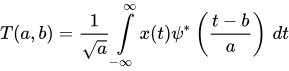
where  denotes the complex conjugate of
  , the parameter
  corresponds to a time shift and is called the position parameter, and the parameter
  sets the scaling and is called the dilation parameter.
 is the weight function.
We can define a normalized function as follows
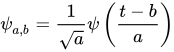
which means a time shift by b and time scaling by a. Then the wavelet transform formula becomes
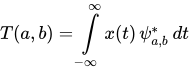
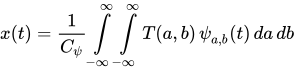
The original signal can be reconstructed by the inverse transform formula
In the discrete case, the scaling parameter a and the shift parameter b are represented by discrete values:

Then the analyzing wavelet has the following form:
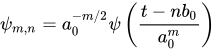
where m and n are integers.
In this case, for a continuous signal the discrete wavelet transform and its inverse are written by the following formulas:
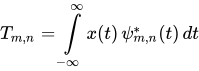
The quantities  are also known as wavelet coefficients.
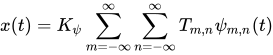
where  is the normalization constant.
The wavelet transform is widely used for signal analysis. In addition, it finds great use in the field of data compression. In the discrete wavelet transform, the most significant information in a signal is contained at high amplitudes, and the less useful information at low amplitudes. Data compression can be achieved by discarding the low amplitudes. The wavelet transform makes it possible to obtain a high compression ratio combined with good quality of the reconstructed signal. The wavelet transform was chosen for the JPEG2000 and ICER image compression standards. However, at low compression the wavelet transform is inferior in quality to the windowed Fourier transform, which underlies the JPEG standard.
The choice of a particular kind and type of wavelets depends largely on the signals being analyzed and the analysis tasks. Certain criteria have been developed for obtaining optimal transform algorithms, but they cannot yet be considered final, since they are internal to the transform algorithms themselves and, as a rule, do not take into account external criteria related to the signals and the goals of their transformation. It follows that in the practical use of wavelets, sufficient attention must be paid to verifying their workability and effectiveness for the goals set, in comparison with known methods of processing and analysis.
Advantages of the wavelet transform:
Disadvantages of the wavelet transform:

Comments