
Lecture
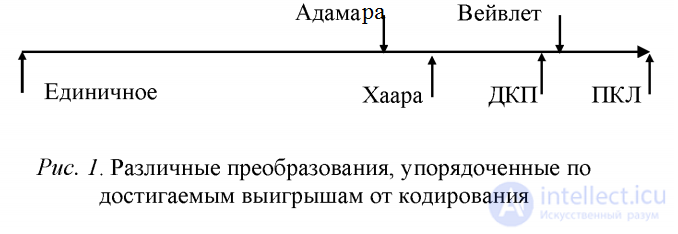
The Hadamard transform is based on a square Hadamard matrix, whose elements are equal to plus or minus one and whose rows and columns form orthogonal vectors. A normalized Hadamard matrix of order  satisfies the relation
  . Among the orthonormal Hadamard matrices, the smallest is the second-order matrix
 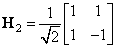 .
.
The wavelet transform is an integral transform that consists of the convolution of a wavelet function with a signal. The wavelet transform converts a signal from a time representation into a time-frequency one. It is a way of transforming a function (or signal) into a form that either makes certain quantities of the original signal easier to study or allows the original data set to be compressed. The wavelet transform of signals is a generalization of spectral analysis. The term "wavelet" means a "small wave". Wavelets is the general name for mathematical functions of a certain shape that are localized in both time and frequency and in which all the functions are obtained from a single base function by modifying it (shifting and stretching it).
The Haar wavelet is one of the first and simplest wavelets. It is based on an orthogonal system of functions proposed by the Hungarian mathematician Alfréd Haar in 1909. Haar wavelets are orthogonal and have compact support and good spatial localization, but they are not smooth. Later, Ingrid Daubechies developed the theory of orthogonal wavelets and proposed using functions computed iteratively, which came to be called Daubechies wavelets. Without loss of quality, it compresses the size of an image file that has long runs of identical brightness values. It preserves the main features of the image by lowering its resolution and substantially reducing the data when the detail matrices are discarded.
The discrete cosine transform (DCT) is one of the orthogonal transforms. It is a variant of the cosine transform for a vector of real numbers. It is used in lossy information compression algorithms, for example MPEG and JPEG. This transform is closely related to the discrete Fourier transform and is a homomorphism of its vector space. Mathematically, the transform can be carried out by multiplying a vector by a transform matrix. The inverse transform matrix is equal, up to a factor, to the transposed matrix. In mathematics, the matrices are chosen so that the transform is orthonormal and the constant factor equals one. In computer applications this is not always the case. Different periodic extensions of the signal lead to different types of DCT.
The Karhunen-Loève transform (KLT). The method of transforming continuous signals into a set of uncorrelated coefficients was developed by Karhunen and Loève. As stated in article [30], Hotelling [29] was the first to propose a method for transforming discrete signals into a set of uncorrelated coefficients. However, in most works on digital signal processing, both the discrete and the continuous transforms are called the Karhunen-Loève transform or the eigenvector expansion.
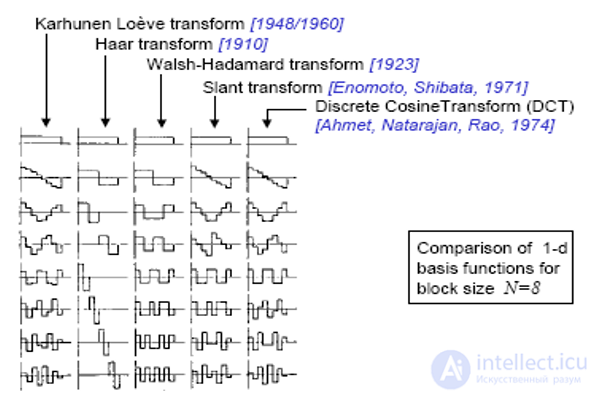
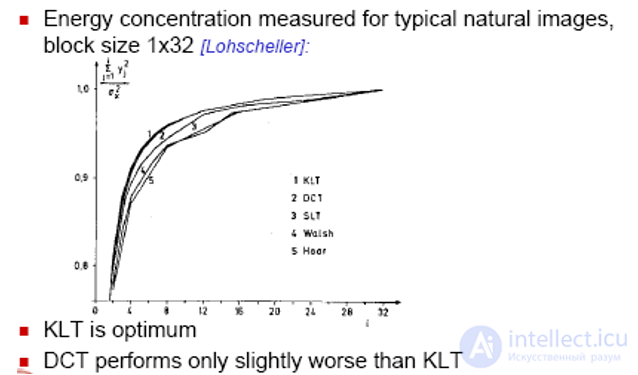
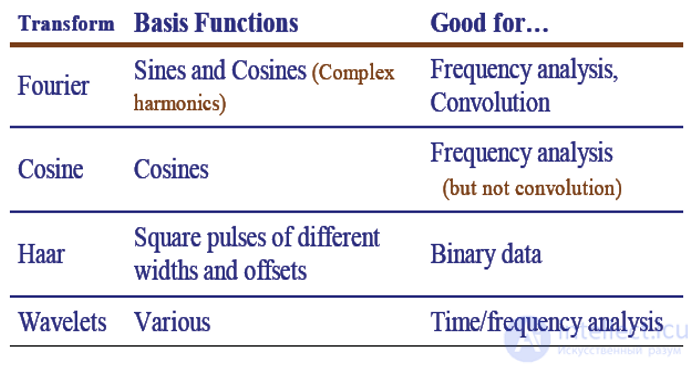
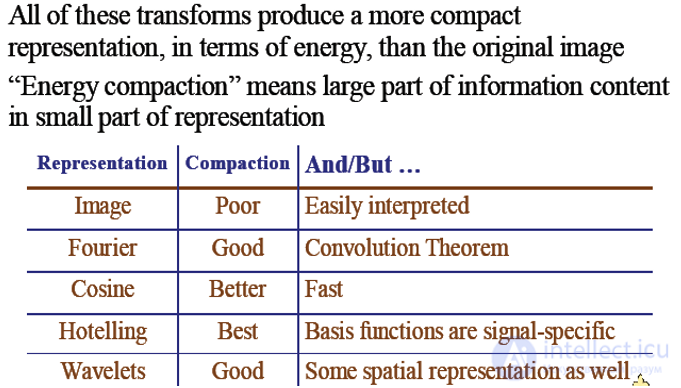
All these transforms give a more compact representation in terms of energy than the original image.
"Energy compaction" means that most of the information content is placed in a small part of the representation.
| Representation | Compaction | and / but ... |
| Image | Poor | Easy to interpret |
| Fourier | Good | Convolution theorem |
| Cosine | Better | Fast |
| Hotelling | Best | Basis functions depend on the signal |
| Wavelets | Good | Some spatial representation |

Comments