
Chirplet and Chirplet Transform

Lecture


In signal processing, the chirplet transform is the inner product of an input signal with a family of elementary mathematical functions called chirplets.

Analogy with other transforms

Like wavelets (see the continuous wavelet transform or the discrete wavelet transform), chirplets are derived from a single mother chirplet (analogous to the "mother" or "parent" wavelet in wavelet theory).

Chirplets and the chirplet transform

The term "chirplet transform" was proposed by Steve Mann ; it served as the title of the first published paper on the subject. The word "chirplet" itself was used by Steve Mann, Domingo Mihovilovic and Ronald Bracewell to describe the result of applying a weighting window to a linear frequency modulated (LFM) signal (a chirp). In Mann's words:

A wavelet is a piece of a wave, and a chirplet is, accordingly, a piece of a chirp. More precisely, a chirplet is the result of multiplying such a signal by a window, which provides the property of localization in time. In the setting of time-frequency space, small chirp pulses exist as rotated, shifted, deformed structures, moving away from the traditional parallelism along the time and frequency axes typical of waves (Fourier and the short-time Fourier transform, or wavelets).

Thus, the chirplet transform is a rotated, weighted or otherwise modified tiling representation of the time-frequency plane. If a wavelet on a time-frequency diagram looks like a horizontal "dash", then a chirplet is a slanted line (the angle of the slant depends on the rate of frequency shift). That is, this method extends the possibilities of analyzing spectrogram patterns and makes it possible to find more complex regularities in the non-stationary processes under study. Although chirps and their applications have long been known, the first published work on the "chirplet transform" described a particular representation of signals by means of families of functions related to one another by operators of frequency shift, time shift, scaling and so on. In that paper, the chirplet transform of a Gaussian was presented as an example, together with an example of detecting ice with a radar (an improvement in target recognition results when the described approach is applied). The term "chirplet" (but not "chirplet transform"!) was also used for a similar transform described by Mihovilovic and Bracewell later that same year.
Applications

Chirplet and Chirplet Transform
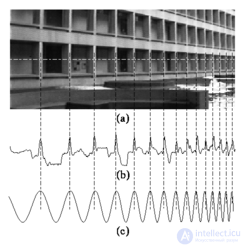
(a) In image processing, the period often changes linearly. (b) In this figure, repeating structures (dark areas in windows and light supports) are "squashed" (the frequency increases) when moving to the right. (c) The chirplet transform is more useful in this case than the Fourier or wavelet transforms.

The chirplet transform is widely used in:

  • radar
  • medicine
    • analysis of cardiograms;
    • analysis of EEG, for example Cui, et al..
  • signal processing
  • image processing
  • SETI@home uses chirps (LFM signals) to compensate for the Doppler effect.
  • Chirplet Time Domain Reflectometry (from National Instruments website)

Taxonomy of the chirplet transform

There are two main categories of chirplet transform:

  • fixed
  • adaptive

These categories can be further divided:

  • on the basis of the choice of chirp
  • on the basis of the choice of window

In both the fixed and the adaptive case, chirplets can be:

  • q-chirplets (quadratic chirplets), of the form exp(j 2π (a t² + b t + c)). In essence, a q-chirplet is a weighted chirp, hence its name (a quadratic change of phase means a linear change of frequency).
  • w-chirplets, or warblets (from the English warble, a trill). An "unweighted" warblet looks in the time-frequency plane like a sinusoid or a similar curve. An example of such a signal is an ambulance siren with periodically varying pitch. Thus, a warblet is a weighted signal with a periodic time-frequency image.
  • d-chirplets, or Doppler chirplets. This type imitates the Doppler frequency shift, such as, for example, the sound of the horn of a train passing by.
  • p-chirplets, in which the scale changes projectively. If the wavelet transform is based on wavelets of the form g(ax+b), then p-type chirplets are expressed as g((ax+b)/(cx+1)), where a is the scale, b is the shift, and c is the "chirp rate" (frequency slope).
  • In the analysis of oscillatory processes of a stepwise nature, where the width and amplitude of each successive step grow in geometric progression, a chirplet based on a function of the form x*sin(2*pi*log(x)/log(a)) may be useful, where the parameter a is the common ratio of the geometric progression. It is advisable to limit this infinitely growing function with a Gaussian window or a "step" by multiplying the expression by 1/(1+exp(-2*(1-x)/log(a))).

Windows used:

  • Gaussian
  • rectangular

See also

  • Time-frequency representation

Other time-frequency transforms:

  • Short-time Fourier transform
  • Continuous wavelet transform
  • fractional Fourier transform
  • [[b9592]]
  • [[b8481]]

See also

Comments

To leave a comment

If you have any suggestion, idea, thanks or comment, feel free to write. We really value feedback and are glad to hear your opinion.
To reply

Lectures and tutorial on "Digital image processing"

Terms: Digital image processing