
Lecture
Predictive brain theory is the idea that the brain does not simply passively “read off” the world through the sense organs, but constantly predicts what it is about to see, hear and feel, and then compares that prediction with the actual signals.
More simply:
The brain does not wait for data from the world.
It builds a hypothesis about the world in advance, and then tests it.
Predictive coding is a theory in neuroscience and the cognitive sciences according to which the brain constantly generates predictions of sensory signals and updates these predictions on the basis of actual data. This theory holds that perception is the result of the constant matching of the brain's predictions against real sensory data and the minimisation of prediction errors. Predictive coding is closely related to Bayesian approaches and Bayes' theorem.
The classical model of perception looks like this:
World → eyes/ears/skin → brain → understanding
But predictive brain theory says that it is more complicated than that:
The brain makes a prediction → receives sensory data → compares → corrects the model
For example, you see a silhouette in the dark and think: “that's a person”. You come closer and it turns out to be a coat rack. The brain first made a prediction, then received a prediction error and updated its model.
In neuroscience this is often called predictive coding or predictive processing: the brain maintains an internal model of the world and updates it when real sensory signals do not match expectations.
The idea of predictive coding has deep roots in the history of science. In 1860 the German physiologist Hermann von Helmholtz proposed the concept of “unconscious inference”, according to which perception is based on guesses and assumptions that the brain forms on the basis of incomplete sensory data.
In 1981 James McClelland and David Rumelhart developed a model of parallel information processing in which perception is determined by the interaction of bottom-up (sensory) and top-down (conceptual) processes.
In 1999 Rajesh Rao and Dana Ballard presented a computational model of predictive coding for the visual system that explains neuronal activity as the result of comparing predictions with sensory signals.
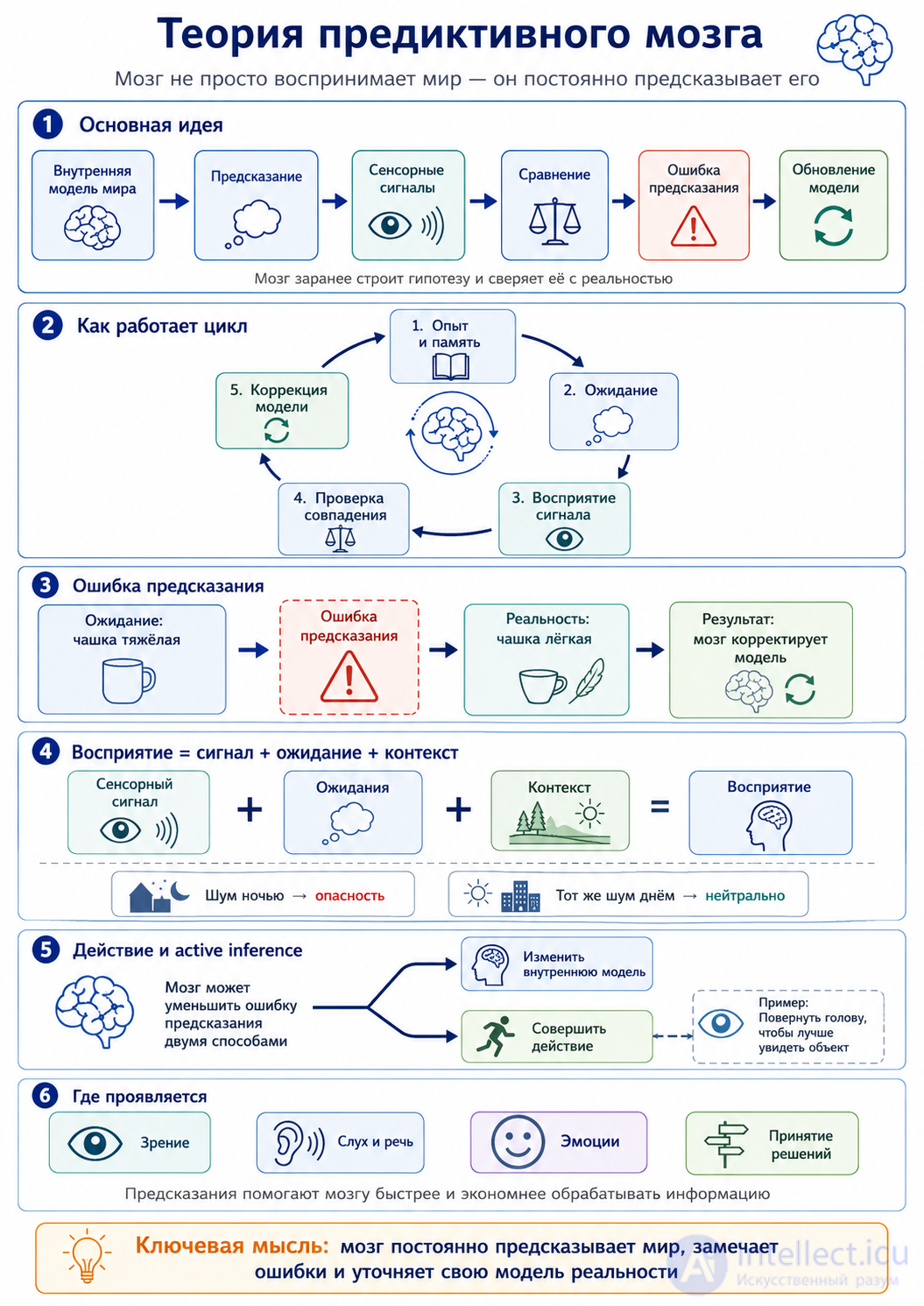
The key term is prediction error.
This is the difference between:
what the brain expected
and
what actually arrived from the sense organs
Example:
You expect a cup to be heavy, you lift it — and it is empty and light. Your hand jerks sharply upwards. This is because the brain predicted the weight in advance, but reality did not match.
Schematically:
The brain's expectation:
"the cup is heavy"
↓
Action:
the hand prepares for a large weight
↓

Reality:
the cup is light

↓

Prediction error:
"the weight turned out to be less"

↓

The brain updates its model:
"this cup is empty"
If the brain processed all the information “from scratch” every time, this would be far too slow and energy-consuming.
So it uses past experience:
Past experience
     ↓
Internal model of the world
     ↓
Prediction
     ↓
Comparison with reality
     ↓
Updating the model
This helps us quickly recognise faces, speech, objects, danger and other people's intentions.
For example, when you read a text with typos, you still understand the meaning, because the brain does not merely see the letters but predicts the words and phrases.
One important conclusion is that we do not see the world “like a camera”. We see the result of an interaction:
sensory data + expectations + memory + context
For example:
One and the same sound
in a forest at night → seems dangerous
in a park during the day → seems ordinary
The signal may be identical, but the predictive model is different.
When someone speaks in a noisy place, the brain often “fills in” the missing sounds.
You may not hear the phrase in full, but still understand it, because the brain predicts the likely continuation.
"Pass me the sa..., please"
In the kitchen the brain may predict:
"salt"
In the office:
"sample"
Context changes the prediction.
This theory applies not only to vision or hearing, but also to emotions.
An emotion can be understood as the brain's prediction about the state of the body and the situation.
For example:
Rapid heartbeat
+ a dark street
= fear

Rapid heartbeat
+ the gym
= physical exertion

Rapid heartbeat
+ a date
= excitement
The bodily signal is similar, but the brain explains it differently depending on the context.
The brain does not only predict what it will perceive. It can also act so as to make the prediction come true.
For example:
The brain predicts:
"I should see the cup more clearly"

↓

Action:
turns the head / shifts the gaze

↓

The sensory data become clearer
This is related to the idea of active inference. Within Karl Friston's free energy principle, an organism can reduce prediction error in two ways: by updating its expectations or by acting so that the world better matches those expectations.
You come home and expect to see the usual surroundings.
Prediction:
"the table is in place, the light is off, it is quiet"

↓

Reality:
the light is on, a sound can be heard

↓

Prediction error:
"something is wrong"

↓

Attention intensifies:
the brain begins to look for the cause
That is, attention is often engaged where a prediction is violated.
From the point of view of this theory, illusions may arise when the brain's prediction has too strong an influence on perception.
Roughly:
A weak sensory signal
+ a strong expectation
= the brain "sees" what is not there
For example, if a person is strongly expecting a call, it may seem to them that their phone has vibrated.
This does not mean that the theory fully explains all hallucinations, but it does provide a convenient model: perception depends on the balance between real signals and internal expectations.
Predictive brain theory resembles certain ideas in machine learning:
The model makes a prediction
↓
Compares it with the correct answer
↓
Computes the error
↓
Updates its parameters
But the brain does not work like an ordinary textbook neural network. It has a body, emotions, attention, motivation, memory, action and biological constraints.
The brain is less like a camera than like text autocomplete.
When you type:
the system may predict:
In the same way the brain constantly offers options:
And then it checks how well the prediction matched reality.
This theory is very influential, but it is not a conclusively proven “theory of the whole brain”.
There are debates:
Even the free energy principle associated with this field is discussed as a powerful but complex and contested attempt to unite perception, action and learning within a single mathematical framework.
Predictive coding assumes that the brain is structured hierarchically. Higher levels of the hierarchy form predictions about the sensory information arriving from lower levels. These predictions are compared with the actual sensory data arriving at the lower levels, and the discrepancies between prediction and actual data form prediction errors.
The prediction errors are then sent back to the higher levels in order to update and refine the predictions. This process allows the brain to continually adapt its internal models of the world so as to minimise prediction errors.
Most of the early work applying the predictive coding framework to neural mechanisms was devoted to the processing of sensory information, especially in the visual cortex. These theories propose that cortical architecture can be divided into hierarchically arranged levels corresponding to different cortical areas. Each level is thought to contain (at least) two types of neuron: “prediction neurons”, which seek to predict the bottom-up input signals for the current level, and “error neurons”, which signal the difference between the input signal and the prediction. These neurons are thought to be mainly deep and superficial pyramidal neurons, while interneurons perform various functions.
Within cortical areas there is evidence that different cortical layers may contribute to the integration of feedforward and feedback projections across hierarchies. These cortical layers are therefore assumed to play a central role in the computation of predictions and prediction errors, with the cortical column as the basic unit. The common view is that
However, there is still no consensus on how the brain most likely implements predictive coding. Some theories, for instance, suggest that the supragranular layers contain not only error neurons but prediction neurons as well. There is also still debate about the mechanisms by which error neurons might compute prediction error. Since prediction errors can be either negative or positive, while biological neurons can only exhibit positive activity, more complex error-coding schemes are required. To get around this problem, more recent theories suggest that error computation may take place in neuronal dendrites. The neural architecture and computations proposed in these dendritic theories are similar to wha
The relationship between predictive brain theory and intuition is very direct:
Intuition is a rapid prediction by the brain, based on past experience but without explicit logical analysis.
That is, the brain does not tell you step by step:
It immediately produces a feeling:
From the point of view of the predictive brain:
Experience and memory
↓
Internal model of the world
↓
Rapid prediction
↓
Bodily sensation / emotional signal
↓
Intuitive decision
For example, an experienced doctor may quickly notice that a patient looks “off”, even before a precise analysis of the symptoms. Their brain is comparing the current picture with thousands of past cases.
Or an experienced programmer looks at code and immediately senses:
"there is probably a bug here"
Although they cannot yet explain exactly where.
Intuition often looks like a “sixth sense”, but in this model it is rather the result of covert processing:
The brain noticed a pattern
↓
Did not bring it into consciousness in words
↓
But delivered a prediction through a sensation
That is, intuition is the brain's compressed inference.
Why intuition sometimes works well
It works well where a person has extensive experience:
In these cases the brain has already accumulated many models and quickly predicts how the situation will develop.
The problem is that the brain predicts not “the truth” but what is most probable given past experience.
If that experience was incomplete, traumatic, outdated or distorted, intuition can be deceptive.
Past negative experience
↓
Strong expectation of threat
↓
A neutral situation seems dangerous
For example:
A person once spoke badly in public
↓
The brain predicts: "public speaking = danger"
↓
Anxiety arises
↓
Even though there may be no real threat
Intuition may be a signal that the brain has noticed a mismatch:
Expectation:
"everything should be fine"

↓

Reality:
"there is a small oddity"

↓

Prediction error:
"something does not add up"

↓

Intuitive feeling:
"something is wrong"
For example, you read a message and feel that it is strange. Perhaps the brain has noticed an unusual tone, uncharacteristic words, the time it was sent, or details that consciousness has not yet articulated.
A short formula
Intuition = rapid prediction + past experience + weak conscious control
Or even more simply:
Intuition is when the brain has already made a prediction but has not yet explained to you why.
It is useful to listen to intuition, but not always to trust it blindly.
The best option:
Intuition gives a signal
↓
Logic checks the signal
↓
The decision becomes more reliable
That is, intuition is a good “radar” but a poor sole judge.
Predictive coding is closely related to Bayesian approaches to brain function. These approaches are based on Bayes' theorem, which allows the probability of a hypothesis to be updated on the basis of new data. Bayes' theorem is expressed as follows:
where:
 — the posterior probability of hypothesis after obtaining data ,
 — the probability of observing
  given that the hypothesis is true
  ,
, — the prior probability of hypothesis ,
 — the total probability of observing .
In the late 1990s Rajesh Rao and Dana Ballard embodied the idea of top-down and bottom-up information processing in a computational model of vision. Their paper demonstrated that there could be a generative model of the scene (top-down processing) that receives feedback via error signals. This leads to an updating of the prediction, which helps the brain to predict sensory input more accurately.
In 2004 Rick Grush proposed a model of neural perceptual processing according to which the brain constantly generates predictions on the basis of a generative model (which Grush called an "emulator") and compares this prediction with the actual sensory input. The difference, or "sensory residual", would then be used to update the model in order to obtain a more accurate estimate of the perceived domain. In Grush's view, "top-down" and "bottom-up" signals would be combined in such a way as to take account of the expected noise (also known as uncertainty) in the bottom-up signal, so that in situations where the sensory signal is known to be less reliable, the top-down prediction would carry greater weight, and vice versa.
Predictive coding was originally developed as a model of the sensory system, in which the brain solves the problem of modelling the distal causes of sensory input by means of Bayesian inference. The brain is assumed to maintain an active internal representation of distal causes that enables it to predict sensory signals. Comparing predictions with sensory signals yields a measure of the difference (for example, prediction error) which, when it significantly exceeds the expected statistical noise, leads to an updating of the internal model so as to predict better in future.
If the model accurately predicts sensory signals, activity at higher levels cancels out activity at lower levels, and the internal model remains unchanged. In this way predictive coding overturns the traditional view of perception as a bottom-up process, suggesting that perception is largely constrained by prior predictions.
Prediction errors can be used both to identify distal causes and to learn them through neural plasticity. This idea is also present in other theories of neural learning, such as sparse coding.
Predictive coding was originally developed as a model of the sensory system, where the brain solves the problem of modelling the distal causes of sensory input by means of a variant of Bayesian inference. It assumes that the brain maintains active internal representations of distal causes that enable it to predict sensory inputs. Comparison between predictions and sensory input yields a measure of the difference (for example, prediction error, free energy or surprise) which, if it is large enough to exceed the levels of expected statistical noise, will lead to an updating of the internal model in such a way that it better predicts sensory input in future.
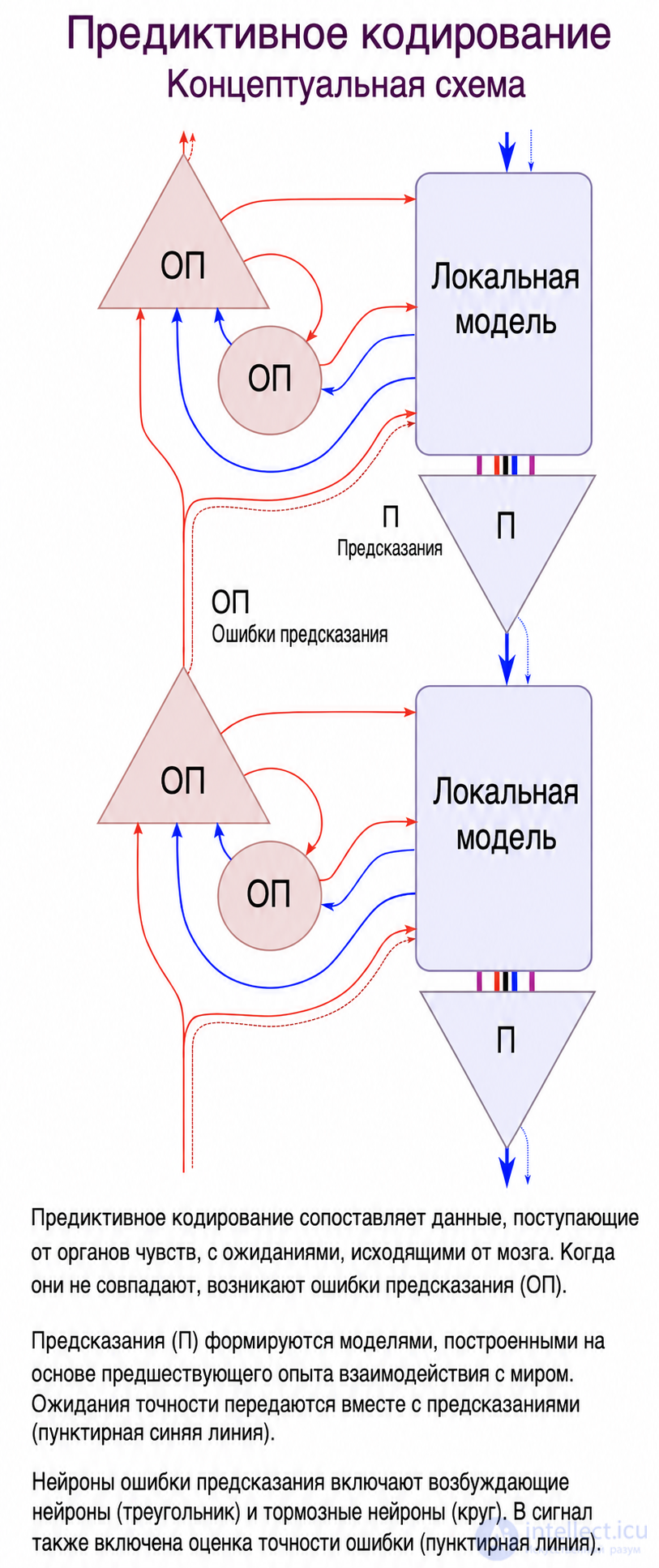
Conceptual schema of predictive coding with 2 levels.
If, on the other hand, the model accurately predicts the driving sensory signals, activity at higher levels cancels out activity at lower levels, and the internal model remains unchanged. In this way predictive coding overturns the traditional conception of perception as a largely bottom-up process, suggesting that it is to a considerable extent constrained by prior predictions, where signals from the external world shape perception only to the extent that they propagate up the cortical hierarchy in the form of prediction error.
Prediction errors can be used not only to infer distal causes, but also to learn about them through neural plasticity. The idea here is that the representations acquired by cortical neurons reflect statistical regularities in sensory data. This idea is also present in many other theories of neural learning, such as sparse coding, with the central difference being that in predictive coding it is not only the connections to sensory inputs (i.e., the receptive field) that are learned, but also the top-down predictive connections from higher-level representations. This makes predictive coding similar to certain other models of hierarchical learning, such as Helmholtz machines and deep belief networks, which, however, use different learning algorithms. Thus, the dual use of prediction errors for both inference and learning is one of the defining features of predictive coding.
The precision of incoming sensory input is its predictability given signal noise and other factors. Precision estimates are crucial for efficiently minimizing prediction error, since they allow sensory inputs and predictions to be weighted according to their reliability. For example, noise in the visual signal varies between dawn and dusk, so that sensory prediction errors are assigned greater conditional confidence in bright daylight than at nightfall. Similar approaches are used successfully in other algorithms that perform Bayesian inference, for instance in Bayesian filtering in the Kalman filter.
It has also been suggested that such weighting of prediction errors in proportion to their estimated precision is essentially attention, and that the process of attending may be neurobiologically implemented by ascending reticular activating systems (ARAS) optimizing the "gain" of prediction error units. However, it has also been argued that precision weighting can account only for "endogenous spatial attention" and not for other forms of attention.
The same principle of prediction error minimization has been used to explain behavior, in which motor actions are not commands but top-down proprioceptive predictions. In this active inference scheme, classical reflex arcs are coordinated so as to selectively sample sensory input in a way that better fulfills predictions, thereby minimizing proprioceptive prediction errors. Indeed, Adams et al. (2013) review evidence indicating that this view of hierarchical predictive coding in the motor system provides a principled and neurologically plausible framework for explaining the agranular organization of the motor cortex. This view suggests that "the perceptual and motor systems should not be regarded as separate but as a single active inference machine that tries to predict its sensory input across all domains: visual, auditory, somatosensory, interoceptive and, in the case of the motor system, proprioceptive."
The dual theory of automatic and conscious cognitive processes lays the foundation for understanding how the human mind works in psychology. Ideas related to dual theory go back to William James's 1890 work, which distinguished habitual processes based on automatic associations formed through experience from voluntary processes involving more effortful, conscious reasoning. This reflects more hierarchical and conscious reasoning, constituting a more volitional process. These initial conceptions of automatic and voluntary cognitive processes correspond to the modern dual theory developed by many psychologists.
Some researchers draw parallels between dual-process theories and predictive coding. On this view, automatic processing (often called "System 1") is compared to the initial processing of sensory information, whereas goal-directed processing ("System 2") is compared to the active maintenance of internal representations and the comparison of these representations with sensory input. In particular, as Jonathan Evans notes, System 2 of dual-process theory, which is characterized by a reflective process that allows a person to override the intuitive process (i.e., the initial perception of input), is closely related to the computation of prediction error (i.e., the discrepancy between the expected value and the actual outcome). Although the process of actively maintaining an internal representation, continuously monitoring the conflict between new experience and the internal representation, and shifting the posterior value (i.e., the updated belief after combining the prior belief and the actual evidence) is not singled out unambiguously in the dual-process model, the general mechanism requiring a more goal-directed and effortful cognitive process is described by System 2.
In cognitive psychology and philosophy, representation refers to the mental encoding of external stimuli. Specifically, it is defined as a hypothetical internal cognitive symbol representing external reality or its abstractions (for more on representation, see the section "Mental representation"). In philosophy, mental representation is regarded as a mediator between the real world and the observer (for details, see the section "Philosophy of mind"). In cognitive psychology, attempts have been made to test this concept using neuroimaging methods, the most common of which is functional magnetic resonance imaging (fMRI). This method involves examining a person's brain activity in response to external stimuli (for example, being shown a picture).
In computational neuroscience, models of active predictive coding typically include representations of visual stimuli as well as representations of goal-directed behavior. These representations interact in order to adapt to and acquire new concepts. Some work has attempted to link findings from neuroscience and cognitive psychology by studying how prediction errors change over time. Changes in prediction error have been interpreted as evidence that internal representations are continuously adjusted in response to new sensory input in order to better correspond to events in the external world.
The precision of sensory signals is determined by their predictability, based on signal noise and other factors. Estimating precision makes it possible to minimize prediction errors efficiently by weighting sensory signals and predictions according to their reliability. For example, the level of noise in a visual signal varies between dawn and dusk, so sensory errors in daylight are given greater weight than in darkness.
The principle of prediction error minimization also applies to behavior. In this active inference scheme, motor actions constitute top-down proprioceptive predictions. Actions are adjusted so that sensory information matches these predictions, minimizing proprioceptive prediction errors.
Predictive coding has been successfully applied to explain perceptual processes, especially in the visual system.
Predictive coding models are also used to explain interoception — the perception of the body's internal states.
The theory of predictive coding is being actively applied in machine learning and related fields to build more efficient models of representation learning.
The empirical evidence for predictive coding is most compelling for perceptual processing. As early as 1999, Rao and Ballard proposed a hierarchical model of visual information processing in which higher-order visual cortical areas send predictions downward, while feedforward connections convey the residual errors between the predictions and the actual lower-level activity. According to this model, each level in the model's hierarchical network (except the lowest level, which represents the image) attempts to predict the responses at the next lower level via feedback connections, and the error signal is used to simultaneously correct the estimate of the input signal at each level. Emberson et al. established top-down modulation in infants using a cross-modal audiovisual omission paradigm, determining that even the infant brain has expectations about future sensory input conveyed downstream from the visual cortex and is capable of expectation-based feedback. Functional near-infrared spectroscopy (fNIRS) data showed that the infant's occipital cortex responded to an unexpected visual omission (with no visual input) but not to an expected visual omission. These results show that in a hierarchically organized perceptual system, higher-order neurons send predictions to lower-order neurons, which in turn send back a prediction error signal.
There are several competing models of the role of predictive coding in interoception.
In 2013, Anil Seth proposed that our subjective emotional states, otherwise known as emotions, are generated by predictive models that are actively constructed on the basis of causal interoceptive inferences. Regarding how we attribute other people's internal states to causes, Sasha Ondobaka, James Kilner, and Karl Friston (2015) proposed that the free energy principle requires the brain to generate a continuous series of predictions with the goal of reducing the amount of prediction error manifested as "free energy." These errors are then used to model anticipatory information about what the state of the external world will be and to attribute causes to this state of the world, including understanding the causes of other people's behavior. This is particularly necessary because, in order to generate these attributions, our multimodal sensory systems require interoceptive predictions in order to self-organize. Ondobaka therefore argues that predictive coding is key to understanding other people's internal states.
In 2015, Lisa Feldman Barrett and W. Kyle Simmons proposed the Embodied Predictive Interoception Coding model — a framework that unites the principles of Bayesian active inference with the physiological architecture of corticocortical connections. Using this model, they proposed that agranular visceromotor cortices are responsible for generating predictions about interoception, thereby determining the experience of interoception.
In contrast to the inductive view that emotion categories are biologically distinct, Barrett later proposed the theory of constructed emotion, according to which a biological emotion category is constructed on the basis of a conceptual category — an accumulation of instances that share a common goal. In the predictive coding model, Barrett hypothesizes that, in interoception, our brain regulates our body by activating "embodied simulations" (full-fledged representations of sensory experience) in order to anticipate what our brain predicts for us sensorially in the external world, and how we will respond to it with action. These simulations are either retained if, based on our brain's predictions, they prepare us well for what actually happens in the external world, or they, and our predictions, are corrected to compensate for their error relative to what actually happens in the external world and how well we were prepared for it. Then, through trial and error, our system finds similarities in goals among certain successful anticipatory simulations and groups them into conceptual categories. Each time a new experience arises, our brain uses this history of trial and error to match the new experience to one of the categories of accumulated corrected simulations with which it has the greatest similarity. It then applies that category's corrected simulation to the new experience in the hope of preparing our body for the rest of the experience. If this fails, the prediction, the simulation, and possibly the boundaries of the conceptual category are revised in the hope of greater accuracy next time, and the process continues. Barrett hypothesizes that when the prediction error for a particular category of simulations for similar experiences is minimized, the result is a correction-based simulation that the body will reproduce for every similar experience, yielding a full-scale, correction-based representation of sensory experience — an emotion. In this sense, Barrett suggests that we construct our emotions, because the conceptual categorical structure that our brain uses to compare new experiences and select the appropriate predicted sensory simulation to activate is formed in the course of operation.
From a developmental perspective, predictive coding has been studied in connection with the biological maturation of the brain systems involved in sensation and cognition, highlighting how the brain's ability to generate and update predictions develops early in life. Evidence from neonatal research shows that prediction error mechanisms emerge very early: recordings of evoked potentials (patterns of brain activity observed in relation to specific events) show that even newborns distinguish expected from unexpected sounds, suggesting a very basic form of sensory prediction. As children grow, these predictive abilities become more complex as their brains mature and they gain experience (for more details, see the section "Neural development"). Studies of later stages of human development show that the development of the ability to direct and control attention and the process of inferential reasoning occur concurrently, as repeated interaction with the environment strengthens the brain's internal models of sensory regularities (for more on the complexity and specialization of neural connections at different developmental stages, see the section "Synaptic pruning"). This developmental trajectory is described as a shift from predominantly reactive processing of sensory information in infancy to proactive, model-based perception in childhood. As networks of connected brain regions mature, they support top-down modulation, in which prior knowledge shapes the way sensory information is processed, and precision weighting, which refers to how strongly prior expectations are taken into account relative to new sensory input (see the "Precision weighting" section on this Wikipedia page). Overall, this line of research is interpreted as suggesting that predictive coding may contribute to the development of efficient perception, attention, and learning in childhood, providing a computational framework for understanding how experience shapes the developing brain.
Research on predictive coding in a developmental context often involves the use of repetition suppression (a reduction in a particular pattern of brain activity observed with repeated exposure to the same stimuli), since it is generally regarded as a measure of the reduction of prediction error. In other words, a reduction in prediction error would indicate that the participant was updating their mental representation (i.e., expectation) to bring it closer to the presented stimuli. Studying the development of repetition suppression is therefore regarded as an indirect index of the development of predictive inference and mental representation. The application of predictive coding to human development is not without limitations. For example, most studies testing predictive coding with neural measures (e.g., event-related brain potentials) require responses from the participant, which is not possible with infants. In addition, developmental changes in brain anatomy and networks complicate the interpretation of prediction error, which calls for caution in interpreting the current literature.
It has been suggested that differences in predictive coding processes play a role in neurodevelopmental disorders such as autism spectrum disorder and attention deficit hyperactivity disorder (ADHD). Given the role of predictive coding in guiding the perception of the environment as well as further interaction with it, some authors have suggested that differences in attention and cognitive processes related to predictive coding may serve as potential biomarkers or biological correlates for understanding neurodevelopmental disorders.
In typical development, according to predictive coding theory, the perception and interpretation of perceived information depend on higher-order cognitive processes that minimize prediction error by continuously adjusting expectations in line with incoming sensory input. According to predictive coding theories, people with neurodevelopmental disorders such as autism spectrum disorder (ASD) and ADHD may show an imbalance in how much weight is given to prior expectations relative to incoming sensory data — a phenomenon sometimes referred to as precision weighting dysfunction. For example, research suggests that in autism prior beliefs may be underweighted, leading to an overreliance on moment-to-moment sensory input and difficulty filtering out irrelevant stimuli, which manifests as sensory hypersensitivity and a reduced ability to take context into account when processing a stimulus. It is proposed that in various disorders such differences result in less accurate internal representations, which may impair the brain's ability to form accurate predictions about social cues, rewards, and the environment. As a result, predictive coding abnormalities have been proposed as a possible cognitive model that could help link different symptom profiles in neurodevelopmental disorders to underlying differences in hierarchical information processing and learning.
An altered predictive coding system in mental disorders has attracted broad attention, likely in an attempt to explain how the symptoms of mental disorders arise. Below is a description of current research examining how problems with predictive coding may contribute to the development of various mental disorders.
Psychotic disorders. Psychotic disorders are characterized by symptoms of hallucinations (seeing, hearing, feeling, smelling, or tasting something that is not actually there) and delusions (a firmly held false belief that persists despite clear contradictory evidence). In applications of predictive coding, a mismatch between priors and prediction errors may account for these psychotic symptoms. There are three ways in which disrupted predictive coding may contribute to these symptoms: 1) overweighting of sensory prediction errors, 2) weakening of top-down priors, and 3) disrupted hierarchical connectivity between frontal and sensory regions. However, research capable of teasing apart the different factors affecting prediction error is limited.
In contrast to typical states, where perception depends on a balance between prior expectations (top-down predictions) and sensory data (bottom-up input) weighted by their precision or estimated reliability, some studies suggest that people with psychosis may have dysregulated precision weighting, resulting either in underweighted priors or in overweighted sensory prediction errors. According to this theory, internal noise may be misinterpreted as meaningful sensory data, which may contribute to hallucinations, while false associations may contribute to delusional beliefs that are resistant to updating. Neurophysiological data support this imbalance: people with schizophrenia show reduced mismatch negativity (MMN) and impaired prediction error signaling in frontotemporal brain circuits, indicating an inability to suppress or adequately update sensory predictions.
At higher cognitive levels, some researchers link predictive coding theories to the concept of aberrant salience, which refers to the attribution of excessive importance to stimuli that are ordinarily considered irrelevant. This mechanism is consistent with dopaminergic dysfunction, since dopamine is thought to encode the precision of prediction errors; hyperdopaminergic states amplify noisy error signals, fueling delusional inferences and unstable perception. Taken together, these findings have been interpreted as consistent with the idea that psychosis may involve disrupted hierarchical predictive coding, in which disturbances of both low-level sensory prediction and high-level belief formation interact to produce the characteristic symptoms.
Eating disorders. Research on eating disorders applies the concept of predictive coding. Within this approach, some theorists suggest that disordered eating behavior may arise in part from differences in interoception, the perception of internal bodily signals. Research on interoception in the field of eating disorders focuses on gastrointestinal interoception, defined as the process by which the nervous system detects and integrates signals originating from the gastrointestinal system. In particular, recent studies have begun to focus on the relationship between different aspects of gastrointestinal interoception profiles and different disturbances of eating behavior (e.g., binge eating, restrictive eating), which supports the usefulness of the predictive coding framework for further understanding the mechanisms underlying disordered eating.
With the growing popularity of representation learning, the theory is also being actively studied and applied in machine learning and related fields.
One of the greatest challenges in testing predictive coding lies in the imprecision of exactly how prediction error minimization works. In some studies an increase in the BOLD signal has been interpreted as an error signal, while in others it indicates changes in the input representation. An important question that needs to be resolved is what exactly the error signal represents and how it is computed at each level of information processing. Another challenge that has been raised is the computational tractability of predictive coding. According to Kwisthout and van Rooij, the subcomputations at each level of the predictive coding framework potentially conceal a computationally intractable problem, which amounts to "insurmountable obstacles" that computational modelers have yet to overcome.
Further research could focus on refining the neurophysiological mechanism and the computational model of predictive coding.
The predictive coding hypothesis attracts attention for its high explanatory power. It unites perception and motor control as parts of a single computational process. In both cases the brain minimizes prediction errors, but it does so in different ways. In perception the internal model is adjusted, whereas in motor control the actual environment is.
Experiments in the field of perception and motor control provide compelling evidence for the predictive coding hypothesis. For example, in a study published in the journal Neuroscience , subjects read the word "kick" on a screen and then heard a distorted recording of the word "pick" that sounded like a loud whisper. Many participants still heard "kick," and MRI scanning showed that the brain devoted the greatest attention to the initial sounds "k" and "p," which was associated with prediction error. If the brain were simply perceiving words, the largest signal should have been associated with "pick," since that word was presented both on the screen and in the audio.
Research continues to extend predictive coding theory beyond perception and movement. For example, Karl Friston argues that this hypothesis can explain higher cognitive processes, including attention and decision making. Recent computational work on the prefrontal cortex incorporates predictive coding into processes such as working memory and goal-directed behavior. A recent study also showed that overloading working memory can disrupt the synchronization of brain activity, which supports the importance of predictive coding in maintaining cognitive function.
Some scientists suggest that emotions and moods can be explained through predictive coding: emotions may be states that the brain generates in order to minimize the prediction error of internal signals such as body temperature, heart rate, or blood pressure. For example, if the brain recognizes arousal, it understands that all of these factors are beginning to increase, which may lead to a rise in blood pressure.
Much of the research in this area focuses on how predictive coding can explain neuropsychiatric and developmental disorders. As Karl Friston noted: "If the brain is an inference machine, an organ of statistics, then when it goes wrong, it will make the same kinds of mistakes a statistician would make: it will draw the wrong conclusions, paying too much or too little attention either to predictions or to prediction errors."
Autism, for example, may be linked to an inability to disregard prediction errors arising at the very lowest levels of sensory signal processing. This may lead to problems with the perception of sensations, a need for repetition and predictability, and sensitivity to certain illusions and effects. By contrast, in conditions involving hallucinations, such as schizophrenia, the brain may pay too much attention to its own predictions about what is happening and ignore sensory information that contradicts them. However, scientists caution that autism and schizophrenia are too complex to be explained by a single theory. Recent research published in *Nature* supports the view that predictive coding can also be used to explain the neurobiological basis of neuropsychiatric disorders such as schizophrenia.
In laboratory experiments conducted by Corlett, it was shown that new "beliefs" can be created in healthy subjects that lead them to "hallucinate" stimuli they had previously perceived. For example, in one experiment participants associated a tone with a visual pattern, and they continued to hear that tone even when no sound was present.
Scientists continue to investigate how these beliefs may influence perception, which provides new evidence that perception and cognition are not as sharply separated as was previously assumed. New beliefs can change how you perceive the world, but this evidence is not yet sufficiently compelling.
Electroencephalography (EEG) and event-related potential (ERP) studies are widely used to investigate predictive coding in humans. Within this framework, ERP components are often interpreted as neural markers of prediction error signals generated when sensory input differs from what was expected. For example, mismatch negativity (MMN), elicited by unexpected sounds, reflects the automatic detection of prediction violations and adapts with learning and attention. Performance-monitoring components such as error-related negativity (ERN/Ne) and error positivity have been linked to the discrepancy between the internal representation of the correct response and the actual response. Later components, such as the P300 and feedback-related negativity (FRN), have been linked to the updating of higher-order cognitive or reward models. The findings are interpreted as consistent with predictive coding models in which information processing is organized hierarchically, from early perceptual mismatches to more abstract belief adjustments.
Despite this evidence, establishing a unique link between ERP components and prediction errors remains a difficult task. ERPs represent the aggregate neural activity of overlapping sources, and their amplitude is influenced by numerous cognitive processes such as attention, stimulus novelty and salience, learning effects, and habituation to stimuli. For example, P300 amplitude often reflects general updating or arousal. EEG and ERP paradigms have provided important evidence for predictive processing, although alternative explanations remain. Nevertheless, careful experimental design and model-based analysis are needed to distinguish genuine prediction error signals from broader cognitive or perceptual influences.
One of the main challenges in testing predictive coding is the imprecision in our understanding of the process of prediction error minimization. It is important to determine what exactly the error signal represents and how it is computed at each level of information processing.
Future research may focus on identifying the neurophysiological mechanisms of predictive coding and building more accurate computational models.
Despite its broad popularity, predictive coding theory faces a number of criticisms. One of the main problems is that experimental results often support predictive processing but are not always uniquely explained by it. Some scientists argue that other theories can also account for these results.
As the neuroscientist Georg Keller of the Friedrich Miescher Institute for Biomedical Research in Switzerland notes:
"The theory is widely accepted in academic circles, but in systems neuroscience it is still somewhat unrecognized."
Georg Keller and his colleagues conducted a study published in the journal Neuron in which they observed the behavior of neurons in mice under unusual conditions. The researchers randomly reversed the directions of a virtual world while training the mice on a video game. As a result, they found that as the mice adapted to the changed rules, the signals in the brain changed slowly. If the neural signals were simple sensory representations, they would have adjusted to the new virtual environment immediately. This finding suggests that the neurons are involved in predicting visual flow on the basis of movement:
"It's about predicting visual flow given a particular movement," Andy Clark stated.
Studies conducted on macaques also provide evidence in favor of predictive coding. Neurons in lower stages of face processing encode details related to the orientation of the face, whereas neurons at higher levels represent abstract features such as identity. In an experiment in which the macaques' expectations about a sequence of faces were violated, prediction errors appeared at the lower levels of processing:
"It was interesting to find prediction errors and the specific content of predictions in this system," said the study's lead author, Caspar Schwiedrzik of the European Neuroscience Institute in Göttingen, Germany.
Critics argue, however, that these results confirm only that predictive coding is compatible with the observed data, but do not necessarily prove that it is the exclusive explanation. Alternative mechanisms of information processing may also account for some of these effects.
The researcher Lucia Melloni of the Max Planck Institute for Empirical Aesthetics in Frankfurt notes that her group is finding data in humans that can likewise be interpreted as prediction errors:
"We are beginning to see results compatible with a prediction error explanation in neural data."
Thus, while predictive coding remains one of the leading theories in the neuroscience of perception, it continues to require further experimental evidence and comparison with alternative approaches.
The predictive brain theory states:
The brain continuously builds a model of the world
↓
Predicts sensory signals
↓
Compares the prediction with reality
↓
Corrects the model or acts
↓
Predicts again
The main idea:
We do not merely perceive the world.
We are constantly guessing at the world — and correcting the guess based on errors.

Comments