
Lecture
Rumination is the focusing of attention on the symptoms of one's own mental disorder . Rumination is the intrusive, repetitive turning over in one's mind of negative thoughts, most often connected with the past, with mistakes or with distressing situations. In 1991 Nolen-Hoeksema proposed response styles theory , which is the most widely used conceptualized model of rumination. However, other theories offer different definitions of rumination. For example, in goal progress theory rumination is conceptualized not as a response to a mood state but as a "response to the failure to make satisfactory progress toward a goal". According to numerous studies, rumination is a mechanism that develops and maintains psychopathological conditions such as anxiety, depression and other negative mental disorders . There are several defined models of rumination, which are mainly interpreted through measurement instruments. There are many instruments for measuring ruminative thoughts. Treatments specifically targeting ruminative thinking patterns are still at early stages of development.
In psychology, rumination is studied within several branches:
Clinical psychology — regards rumination as a symptom or predictor of mental disorders such as depression, anxiety disorders, obsessive-compulsive disorder.
Cognitive psychology — studies rumination as a cognitive process associated with disturbances of attention, memory and thinking. Here the emphasis is on the mechanisms of looping and the repeated analysis of information.
Psychotherapy and psychopathology — investigates rumination as a factor in emotional dysregulation, especially in adolescents and students, and offers methods of working with it, including mindfulness, journaling and body-based practices.
Response styles theory (RST) originally defined rumination as passive and repetitive focusing on the symptoms of depression and on the possible causes and consequences of these symptoms. In support of this definition, rumination has been linked to the development, maintenance and exacerbation of both depressive symptoms, , and episodes of major depression . More recently, RST has broadened the definition of rumination beyond depression to include passive and repetitive focusing on the causes, consequences and symptoms of one's distress in general. This change was made because rumination has been linked to a variety of disorders, not only to depression.
RST also holds that positive distraction is a healthy alternative to rumination, in which attention is directed toward positive stimuli rather than toward the stressor. However, the literature shows that positive distraction may not be as effective a tool as was previously believed.
In particular, the S-REF model defines rumination as "repetitive thoughts generated by attempts to cope with self-discrepancy that are directed primarily at processing the content of self-relevant information rather than at immediate goal-directed action". Put more simply, when a person ruminates, they seek to answer questions such as:
However, in answering these questions, ruminators tend to focus on their emotions (i.e. on "self-referential information") rather than on problem solving (i.e. on "goal-directed action").
Metacognition is also an important part of the S-REF model and helps to explain the link between rumination and depression. In particular, those who hold "positive metacognitive beliefs" about rumination (that it helps to make sense of negative thoughts and emotions or to prevent them) may initially be motivated to engage in rumination with high persistence. However, people who engaged in positive rumination were more likely to use rumination as a coping mechanism when confronted with negative emotions. This leads the person to change their perception of rumination as unpleasant, uncontrollable and "socially damaging" in general. Rumination also tends to intensify as emotion regulation in the organism increases, thus beginning a downward spiral of depression. The person's "negative metacognitive" beliefs then contribute to the development and maintenance of depression.
Goal progress theory (GPT), sometimes called control theory, attempts to explain rumination as a function of progress toward a goal. In particular, GPT regards rumination as an instance of the Zeigarnik effect , which suggests that people are more likely to remember information from unfinished tasks than from completed ones. Proceeding from this understanding, GPT defines rumination as "the tendency toward persistent rumination about important higher-order goals that have not yet been achieved" or on which insufficient progress has been made.
GPT predicts that people for whom goal-related information is readily accessible are more prone to rumination . Various studies support this assumption. However, the rumination experienced in this case is more oriented toward problem solving than the rumination described by RST.
Extensive research on the effects of rumination, or the tendency toward self-reflection , shows that the negative form of rumination (associated with dysphoria ) prevents people from focusing on problem solving and leads to fixation on negative thoughts about past failures. Research data indicate that the negative consequences of rumination are due to cognitive biases, such as memory and attentional biases, which predispose ruminators to attend selectively to negative stimuli.
The organic causes of rumination are not fully understood. Studies have identified the activation of certain regions of the brain's default mode network as the neural substrates of rumination , but the number of neuroimaging studies of rumination is limited.
A tendency toward negative rumination is a stable constant over time and serves as a substantial risk factor for the development of clinical depression. Not only are those prone to rumination more susceptible to depression, but experimental studies have also shown that people who are induced to ruminate experience more strongly depressed mood. There is also evidence that rumination is associated with generalized anxiety, post-traumatic stress, binge drinking , eating disorders and self-harming behavior. Research shows that rumination is to some extent associated with a higher frequency of non-suicidal self-injury and is more closely associated with a history of non-suicidal self-injury.
It was initially believed that rumination predicts the duration of depressive symptoms. In other words, rumination about problems was considered a form of memory rehearsal that was thought in effect to prolong the period of depression. Current evidence indicates that although rumination contributes to the development of depression, it does not necessarily correlate with the duration of symptoms.
Research on the relationship between executive functions and rumination has produced mixed results. Some studies observed a negative correlation with two executive functions: set shifting and inhibition, but the magnitude of this association is unclear. Another study found only one relationship between rumination and a single executive function, namely the ability to discard past information from working memory . However, other studies found no relationship at all between rumination and working memory.
Theories of rumination differ in their predictions about the content of ruminative thoughts, based on their respective conceptualizations. Some models suggest that rumination focuses on negative emotional states and/or the circumstances surrounding that emotion (RST, sadness rumination, the five-factor model, negative cognitive style , models of social phobia ). In other models rumination focuses on discrepancies between current and desired status (goal progress, the conceptual-evaluative model of rumination). Finally, other models suggest that the most important factor is the negative themes of uncontrollability and harm in metacognitions. Some common thoughts characteristic of ruminative responses call one's own well-being into question and focus on the possible causes and consequences of one's depressive symptoms (Nolen-Hoeksema, 1991). For example, some intrusive thoughts include: "Why am I such a failure", "I'm in such a bad mood" or "I just don't feel like doing anything".
There are several types of rumination.
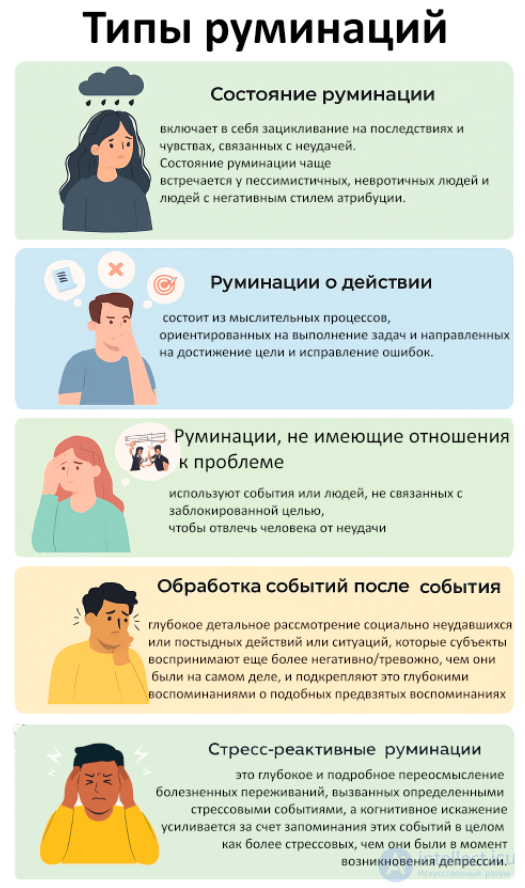
There are many instruments for measuring rumination. They include the following:
The tendency toward rumination can be assessed using the Ruminative Responses Scale of the Response Styles Questionnaire. In this measure people are asked to indicate how often they engage in 22 ruminative thoughts or behaviors when they feel sad or downcast.
The Rumination on Sadness Scale is a 13-item self-report instrument that uses a Likert scale to measure rumination on sadness.
The 31-item Repetitive Thinking Questionnaire (RTQ) measures levels of worry, rumination and post-traumatic processing with the aim of controlling for effects associated with a psychological diagnosis or disorder. It comprises two scales: repetitive negative thinking (RNT) and absence of repetitive thinking (ART). RNT is associated with anxiety, depression and other negative emotions, since it affects metacognitive beliefs, cognitive avoidance strategies and maladaptive thought control strategies. The ART scale reflects the absence of the negative emotions associated with the RNT scale, essentially measuring their opposites.
The Rumination-Reflection Scale comprises 24 items. Half of the questions target adaptive reflective thinking, and the other half self-rumination. This scale uses a Likert scale.
Recently researchers have begun to develop a validated measurement protocol that would best assess rumination dynamically, using the experience sampling methodology.
According to Susan Nolen-Hoeksema , women tend to ruminate when they are depressed, whereas men tend to distract themselves. This difference in response style has been proposed to explain the higher rates of depression in women compared with men. Research supports the theory that women are more prone to rumination than men, but the magnitude of this difference appears to be small. The assumption that men are more prone to distraction has not been consistently supported by research.
A meta-analysis has been conducted of sex differences in rumination in adults, as well as of the rumination subtypes "brooding" and "reflection" . Studies show that women are twice as likely as men to develop depressive symptoms or depression. Response styles theory (RST) suggests that this may to some extent be due to the higher frequency of rumination in women. Rumination can be conceived as continuous, passive, negative inner thinking. It is closely associated with the worsening of depression. Reflection is a more neutral than negative, more active form of self-observation. In the meta-analysis, women showed a statistically significant increase in the levels of both rumination and reflection, which supports RST. Interestingly, gender differences in reflection were much smaller than in rumination. The meta-analysis showed similar results across several studies.
Although rumination is generally unhealthy and associated with depression, ruminating and talking about one's feelings can be beneficial under the right conditions. According to Pennebaker, healthy self-disclosure can reduce stress and rumination when it leads to a deeper understanding of the source of one's problems. Thus, when people share their feelings with others in the context of supportive relationships, they are likely to experience growth. By contrast, when people continually ruminate and dwell on the same problem without making progress, they are likely to experience depression. Co-rumination (group rumination) is a process defined as "excessive discussion of personal problems within a dyadic relationship", a construct that is relatively understudied in both its negative and its positive trade-offs.
Some studies have begun to develop a type of cognitive behavioral therapy that focuses on rumination . Rumination-focused cognitive behavioral therapy (RFCBT) aims to teach patients to recognize when they are beginning to ruminate and ultimately to rethink their view of themselves. The theories underlying RFCBT as a treatment for rumination emphasize the fact that rumination is a destructive habit and is driven largely by the individual's abstract cognitive processing. The approach the therapist takes consists in discussion with the client in order to shift their thoughts toward a healthy thinking style. Instead of allowing clients to let negative repetitive thoughts take over their everyday life, therapists invite them to rework these into constructive thinking that is useful, process-focused and concrete. In practice this may look like the therapist encouraging the client to replace their abstract "why" ruminations with more concrete "how" questions, which can be more easily examined and answered. Support for these interventions comes from a number of studies showing that the implementation of both individual and group RFCBT correlates with a reduction in rumination in adolescents and young adults, both with and without major depression or anxiety disorders.
As mentioned in the introductory section, rumination is associated with other negative mental health conditions. Depression is one of the mental illnesses caused by genetic, environmental and mental factors that lead to ruminative thoughts. One study shows how a mindfulness-based intervention can reduce symptoms of rumination. The process of the mindfulness-based intervention includes: (1) an interest in acceptance, (2) defusion of thoughts and emotions, (3) the importance of being present in the current moment, (4) the self as context. These mechanisms make it possible not to suppress or avoid emotions but to meet them without judgment.
In particular, the process of mindfulness-based stress reduction (MBSR) correlates overall with a decrease in rumination symptoms both in patients with various mental disorders and in healthy patients. This process includes practices such as meditation, body scanning and other non-judgmental techniques, focused mainly on the breath and on passing thoughts. These practices can help people either to let go of intrusive thoughts or to reduce their focus on them by concentrating on things such as the breath.
Rumination is confused with other similar constructs that may overlap with it. Worry, negative automatic thoughts and avoidance are just a few of them.
Rumination appears to be closely related to worry. Some models regard rumination as a variety of worry (S-REF). Worry is defined as "a chain of thoughts and images, laden with negative affect and relatively uncontrollable; it represents an attempt at mental problem solving on an issue whose outcome is uncertain but contains the possibility of one or more negative outcomes".
Worry is often studied in the context of generalized anxiety disorder (GAD), whereas rumination is studied in the context of major depressive disorder . Owing to the high comorbidity of these two conditions, the relationship between worry and rumination has increasingly been investigated in recent years.
According to the Mental Health Foundation, rumination is considered one of the principal problems leading to anxiety and depression. A study conducted by psychologists at the University of Liverpool shows that dwelling on negative events that have occurred in a person's life is the most frequent predictor of depression and anxiety.
Measures of rumination and worry have also demonstrated a high correlation, exceeding the correlation between anxiety and depression symptoms (r=.66; Beck & Perkins, 2001). Rumination and worry overlap in their associations with anxiety and depression, although some studies indicate that rumination is specific to depression and worry to anxiety. Rumination has been found to predict changes in both depressive and anxiety symptoms, and it has been reported that people with major depression experience levels of worry similar to those of people with GAD. Overall, these studies show that rumination and worry are related not only to each other, but that each is also related to symptoms of both depression and anxiety.
Other studies have shown that the content of worry and rumination differs; worry thoughts are often focused on problem solving and are future-oriented, whereas ruminative thoughts concern themes of loss and are more focused on the past. Rumination, compared with worry, is also associated with less effort and less confidence in problem solving (Papageorgiou & Wells, 2004). It has also been suggested that rumination and worry serve different purposes, namely that rumination is associated with a greater belief in the personal significance of the situation and a greater need to understand it, whereas worry is associated with a desire to avoid distressing thoughts (Watkins 2004b). It has also been hypothesised that worry contains more imagery than rumination; however, evidence for this hypothesis is mixed.
Overall, these studies show that worry and rumination are interrelated constructs that both lead to depression and anxiety. Rumination and worry, like rumination and reflection, probably represent related types of repetitive negative thinking that are better viewed as subtypes of some larger construct, such as avoidant coping strategies.
Rumination has been compared with automatic negative thoughts, defined as repetitive thoughts containing themes of personal loss or failure. Nolen-Hoeksema (2004) argues that rumination (as defined in the RST) differs from negative automatic thoughts in that, whereas automatic negative thoughts are relatively brief appraisals of loss and depression in depression, rumination consists of longer chains of repetitive, recycling, negative and self-focused thoughts that may arise in response to initial negative thoughts. Nolen-Hoeksema also suggests that rumination may, in addition to analysing symptoms, causes and consequences, contain negative themes similar to those present in automatic thoughts. Similarly, Papageorgiou and Wells (2004) confirmed this conclusion when they found that rumination can predict depression even when negative cognitions are controlled for, suggesting that these constructs do not fully overlap and have different predictive value. Despite Nolen-Hoeksema's (2004) assertion that rumination and negative automatic thoughts are distinct phenomena, the Response Styles Questionnaire has been criticised for its conceptual overlap with negative automatic thoughts.
Avoidance may overlap with the habit of rumination, especially because rumination is itself an avoidant act. Simply because the act of actively avoiding certain thoughts is difficult to carry out without falling into rumination, the very practice of thought avoidance may reinforce rumination, even though the idea of avoiding thoughts and ruminating on them seems entirely opposite. There is evidence supporting this idea, with studies confirming the fact that unsuccessful attempts to suppress certain thoughts are significantly associated with strong tendencies towards rumination in some people
Research has shown that rumination is closely associated with various mental disorders. Disorders associated with frequent rumination include major depressive disorder, generalised anxiety disorder, social anxiety disorder and anorexia nervosa. People suffering from these disorders report higher levels of rumination compared with people without mental health problems. In addition, people with obsessive-compulsive disorder (OCD) experience rumination as an obsession, that is, people compulsively ruminate on thoughts and worries related to their obsessions.

Comments