
Lecture 11 min.
At first glance, the request "name any color and any single-digit number" seems perfectly simple. If the choice is truly random, one would expect the answers to be distributed fairly evenly: every color and every number should appear with roughly the same frequency. In real surveys, however, a curious pattern is sometimes observed: people disproportionately often name the color blue and the number seven. This became known as the "blue-seven" phenomenon (blue-seven phenomenon).
The "blue seven" is interesting not only as a psychological puzzle but also as a social phenomenon. It lets us examine how independent and random human choice really is, and what role culture, social norms, language, personal experience, and cognitive traits play in it.
At the same time, the existence of a universal "blue-seven" phenomenon remains debated. The results may depend on the country, the wording of the question, the makeup of the participants, and the conditions under which the study was conducted. It is therefore more accurate today to speak not of a proven universal law of human behavior but of an observed tendency that calls for cautious interpretation.
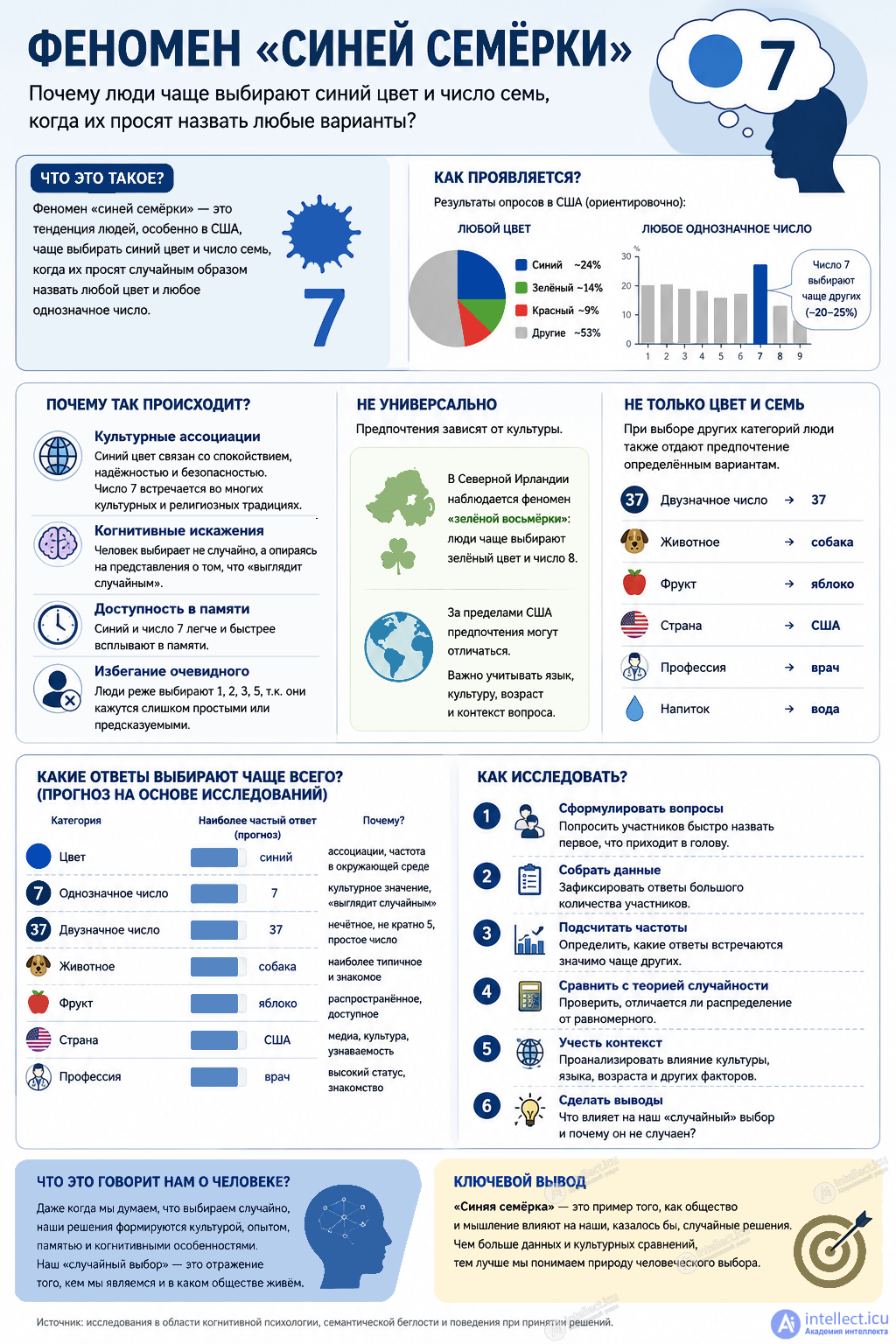
The classic version of the experiment is very simple. A person is asked to name any color without thinking for long, and then any single-digit number. Despite the wide range of possible answers, in some studies participants choose blue and seven relatively often.
This effect is especially often associated with American culture. However, that does not mean that most Americans will necessarily name "blue" and "seven." The results of different studies vary, and the very existence of a stable statistical advantage for these options is questioned.
This is where an important question arises: if a choice seems random, why might people favor some options over others?
One possible explanation has to do with the cultural and emotional meaning of colors.
In many societies, blue is associated with calm, stability, reliability, and safety. It is widely present in our surroundings, for example in images of the sky and water. In addition, blue holds a prominent place in advertising, design, clothing, and government and corporate symbols.
Thus, when a person is asked to name a color quickly, "blue" may turn out to be one of the most accessible options in memory. This does not necessarily mean a conscious preference. A person may perceive their answer as entirely random, even though it has already been shaped by accumulated cultural and life experience.
Still, explaining the popularity of blue solely by its positive associations would be too simple. Color preferences are shaped by many factors, including age, gender, culture, personal memories, and the context of the question.
With the number seven, the situation is even more interesting. It occupies a special place in many cultural and linguistic systems.
Seven is often perceived as a "special" or "magical" number. Various cultures have seven days of the week, seven colors of the rainbow, seven notes, and numerous religious and mythological images connected with this number. In popular culture, seven is also often used as a symbol of luck.
In addition, seven is a prime number and sits in a peculiar position between options that are too obvious, such as one, two, or five, and higher numbers. So for a person asked to name a "random" number from one to nine, seven may subjectively seem more random than the other options.
The result is a paradox: people may choose seven precisely because they consider it a random number.
The "blue-seven" phenomenon is especially interesting from the standpoint of studying cognitive biases.
The human brain is not a generator of perfectly random sequences. When people try to produce a random answer on their own, they rely on their own ideas of what a random choice should look like.
For example, a person may avoid obvious options, considering them "too predictable." They may skip one because it seems too simple, or five because it sits in the middle of the range. As a result, some options gain an advantage.
Thus, subjective randomness does not necessarily coincide with mathematical randomness.
This is fundamentally important. When a computer picks a number from one to nine at random, it does not "think" about which number looks random. A person, by contrast, has ideas about randomness, and those ideas themselves become a factor that influences the outcome.
Despite its psychological component, the phenomenon cannot be viewed solely as an individual quirk of thinking.
A person forms their ideas about colors, numbers, and symbols within a particular culture. The meanings that society attaches to various objects gradually become part of everyday experience.
Therefore, the same question asked of people from different countries can lead to different results.
A telling example is Northern Ireland, where a shift in preferences toward the color green and the number eight was described, the so-called "green-eight" phenomenon. If such differences are indeed reproducible, they show that even a choice that seems entirely individual can depend on the cultural environment.
Consequently, the choice of a color and a number may reflect not only a person's individual traits but also collective ideas, symbols, and cultural associations.
Studies and mass experiments show that when people try to choose a "random" number on their own, they disproportionately often choose 37, as well as other numbers containing 3 and 7. In a large Veritasium survey with roughly 200,000 participants, the most frequent answers included 7, 73, 77, and 37.
Why 37 seems "random":
But there is an important caveat: 37 cannot be considered the proven most popular two-digit number in all situations. The result depends heavily on the wording of the task and the range. For example, if you simply ask people to pick a number from 1 to 100, 37 often does turn up among the leaders, but in specific samples first place may be taken by another number.
There is some quite interesting research here too, although it is usually described not as a study of the "random animal" but as semantic fluency, in which people are asked to name as many animals as possible within a set time.
In one study on which animals are most often retrieved from memory, the top places were taken by the cat and the dog, followed by the lion, tiger, elephant, and others. The 10 most frequently named animals in the table were: cat, dog, lion, tiger, elephant, cow, horse, giraffe, bear, pig.
Another study with 20 participants also shows very high accessibility of the cat and the dog: out of 64 different animals named, the cat and the dog were among the most typical responses.
If a person is asked once and without preparation:
"Name any animal."
then the most reasonable hypothesis is a dog or a cat. But it cannot be claimed that there is a universal worldwide leader: the result will depend on language, country, age, culture, and the wording of the task.
Despite the fame of the expression "blue seven," it cannot be considered a universal law of human behavior.
First, research results do not always agree. Second, the wording of the task and the order of the questions can influence the answers. Third, the sample of participants may not be sufficiently representative. Finally, participants themselves may understand the word "random" differently.
If a person knows about the existence of the "blue-seven" phenomenon, this too can affect their answer.
In addition, results obtained in the United States cannot be automatically transferred to all of humanity. Cultural differences can significantly change associations with colors and numbers.
Researchers must therefore take the social and cultural context into account rather than look for a single universal cause.
Even if we set aside the debate about the statistical robustness of the "blue seven," the idea itself is of great value for social psychology.
It shows that people do not always act as randomly as they think. Our decisions are shaped by many factors, many of which remain unnoticed by the person themselves.
When someone says, "I just randomly picked seven," this may indeed be their subjective feeling. However, that choice could potentially have been influenced by language, culture, familiar symbols, previous experience, and ideas about what a "random" answer should be like.
Thus, the phenomenon lets us see an important feature of human behavior: individual choice is formed in a social space.
If I were to make a hypothesis for a small experiment based on the principle "name the first thing that comes to mind," I would predict the following answers. This is precisely a forecast, not a claim that these options will necessarily win.
| No. | Question | My forecast |
|---|---|---|
| 1 | Name any color | blue |
| 2 | Name a single-digit number | 7 |
| 3 | Name a two-digit number | 37 |
| 4 | Name any animal | dog |
| 5 | Name any fruit | apple |
| 6 | Name any country | USA |
| 7 | Name any drink | water |
| 8 | Name any profession | doctor |
| 9 | Name any mode of transport | car |
| 10 | Name any piece of furniture | table |
| 11 | Name any school subject | mathematics |
| 12 | Name any musical instrument | guitar |
| 13 | Name any month | January |
| 14 | Name any day of the week | Monday |
| 15 | Name any bird | pigeon |
| 16 | Name any insect | butterfly |
| 17 | Name any car brand | BMW |
| 18 | Name any flower | rose |
| 19 | Name any item of clothing | T-shirt |
| 20 | Name any sea | Black Sea |
I would single out the first five in particular:
blue → 7 → 37 → dog → apple
They make it possible to test different types of possible cognitive effects:
It will be especially interesting not to tell participants that the study is related to the "blue seven." Otherwise, they may begin, consciously or unconsciously, to choose exactly the expected options.
For a more serious experiment, I would word the instruction identically for everyone:
"Without thinking too long, name the first thing that comes to mind."
Then I would compare the actual results with a mathematically uniform distribution and see how strongly the leader stands out.
The "blue-seven" phenomenon is an interesting example of the intersection of psychology and sociology. The supposed tendency of people, especially in the US, to choose the color blue and the number seven when asked to name random options makes us reflect on the nature of human randomness.
There is as yet no unambiguous explanation for this phenomenon. Among the possible factors considered are cognitive traits, the symbolic meaning of colors and numbers, cultural associations, and people's ideas about randomness. At the same time, the very existence of a stable and universal effect remains disputed.
International comparison is especially important. If people in different cultures show different preferences, for example a "green eight" instead of a "blue seven," this suggests that even the simplest individual choice can be tied to the cultural environment.
Ultimately, the "blue seven" is interesting not so much as a puzzle about two specific options but as an example of a broader question: how free and random is human choice? Answering it requires taking into account both the psychology of the individual and the influence of the society in which they live.

Comments